

AI Agents for Pharma HCP Targeting: What to Automate and What to Keep Human

AI agents for HCP targeting are software agents that re-check a pharma field team's approved list of target healthcare professionals (HCPs) and its HCP segmentation every week, flag prescribers whose prescribing or payer access changed, and draft a call plan with a reason for each change. Unlike decile lists refreshed once a cycle, or next best action (NBA) scores that can't explain themselves, the agent shows its reasons, and a district manager approves the plan before reps see it.
Video summary: In this illustrative demo, the Field sales AI teammate reads all 142 territories each week and keeps the 13 that need attention. In one district, Rio Grande Valley, about 125 extra visits went to prescribers whose prescriptions stayed flat, while about 46 visits to growing prescribers never happened. The teammate names the rep to coach first, the district manager builds a coaching list with each HCP's figures and reason, and nothing reaches the rep until the manager sends it.
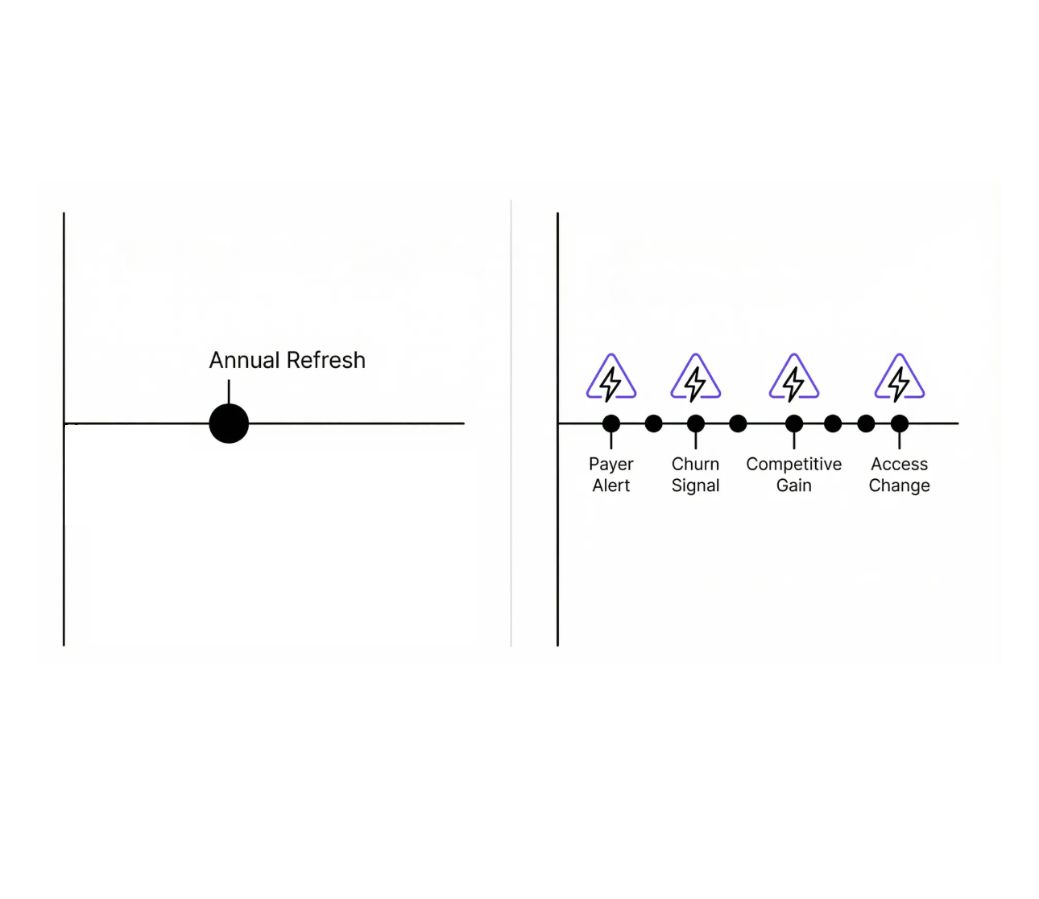
Pharma has spent years building tools that tell reps which doctor to see next, but those suggestions rarely say why a doctor made the list, and the target list underneath them is usually refreshed only once a cycle. That list hasn't noticed last month's payer change or the office that stopped seeing reps. So the field force keeps seeing enough HCPs, just not the right ones.
TL;DR
- Many target lists lean on past prescribing deciles and change once a cycle, while payer coverage and rep access change every month.
- Start the agent on read-only, weekly jobs: finding which prescribers changed, and deciding whether each territory's gap is about access or execution.
- Reconcile four things before the agent ranks anyone: HCP identity, territory alignment, the date of the payer coverage and each HCP's eligibility to be called.
- Use an approval grid: low-risk, rule-based flags run with little review, anything that reaches a rep needs the manager's OK, and changes to targets, call frequency or compliance stay with people.
- Judge the agent by whether the flagged HCPs got calls within two weeks, and don't claim the calls caused a lift in prescriptions.
Many agent projects stall before they help anyone. Gartner predicts that over 40% of agentic AI projects will be canceled by the end of 2027 because of escalating costs, unclear business value or inadequate risk controls (June 2025). In targeting, the failure often starts with the data, when an agent ranks prescribers on an old territory alignment or an out-of-date formulary and hands reps the wrong names with full confidence.
Why do pharma field teams stop trusting AI targeting after the first few cycles?
Field teams stop trusting AI targeting when the list goes stale and can't explain itself, and both problems start with data that doesn't join up.
- The list is a snapshot, but access keeps changing. Veeva Pulse data shows US HCP access fell from 60% to 45% between 2023 and 2024, and half of the HCPs who still see reps meet with three or fewer companies. In oncology, ZS reported in 2024 that only 32% of providers are fully accessible. When fewer doors open, every wrong name on the list wastes a call a rep can't get back.
- Reps can't see why an HCP is on the list, so they stop using it. A suggestion with no reason gets checked against the rep's memory, and one bad visit can be enough for a rep to stop opening the suggestions.
- The data underneath doesn't join up, so pilots stall before they scale. When HCP IDs aren't mastered across prescription, customer relationship management (CRM) and payer files, an agent double-counts some prescribers and misses others, and it does both without warning anyone. A pilot can hide this in one district, where an analyst fixes the joins by hand, but the errors surface as soon as it rolls out to the rest of the field.
A list that re-checks itself every week and shows its work fixes both, because a manager can see why each name is there before a rep ever sees it.
When is a static target list good enough?
A target list refreshed each cycle is good enough when it sits beside a working NBA program, when a small specialty team already knows each prescriber, or when a new launch has too little prescription history to rank on. An agent earns its place when the field force is large, payer access shifts mid-cycle and managers need to know why a territory slipped. If prescriber IDs, alignment and payer files still don't join, fix that first, because an agent will only rank the wrong people faster.
Which HCP targeting jobs should you start an AI agent on?
Start an AI agent on HCP targeting jobs that repeat every week and end in a finished output that a named person can review. The table lists five common jobs in the order we'd hand them over.
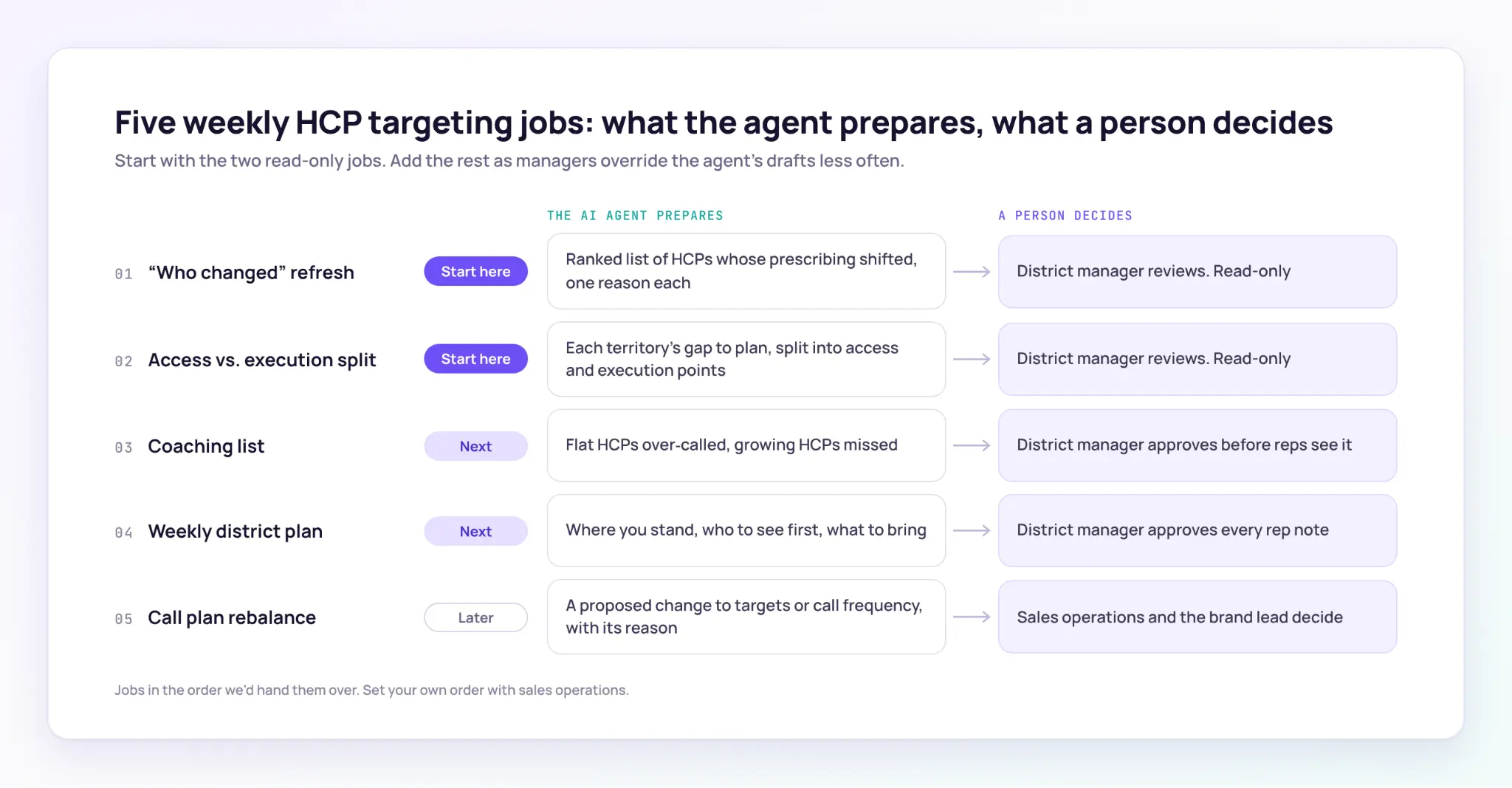
Start with jobs 1 and 2. They're read-only and easy to check, so a wrong answer costs a manager a few minutes rather than costing a rep a wasted visit. Jobs 3 and 4 come next, because they leave the manager's hands and need an OK. The video at the top shows job 3, the coaching list. Job 5 waits until the agent has a track record, because it changes how the whole field force spends its time.
Scoring sheet for your first HCP targeting agent
Score each candidate job from 0 to 2 on every row, and start with the highest total. A job that scores 0 on evidence readiness waits until the data is fixed, whatever its total, because an agent can't be more accurate than the data it joins.
A job that scores 9 or more out of 12 makes a good first job. That threshold is our own suggestion rather than an industry standard, so adjust it to your team's appetite for risk.
What should you keep human when AI agents do HCP targeting?
Keep people in charge of every decision that reaches a rep or changes a system of record, and let the agent do the reading and drafting. Reads and drafts can run without sign-off, because a mistake in a ranked list or a draft plan is cheap to catch before anyone acts on it.
Tellius AI teammates work the same way. Anything that would change a connected system, such as sending an email or posting a message, waits for your approval, and every question runs under the user's own Business Views and row-level policies. Administrators choose which roles can use AI teammates. In your own design, keep preparing an action, delivering it to its owner and executing an approved change in a system of record as three separate steps.
Who approves what? An approval grid for HCP targeting
Set human review by how much is at stake if the agent is wrong and by how rule-based the decision is. This grid adapts the one in our AI agents for procurement guide to field targeting and names who decides in each cell. Treat it as an example, and set your own levels with sales operations and compliance.
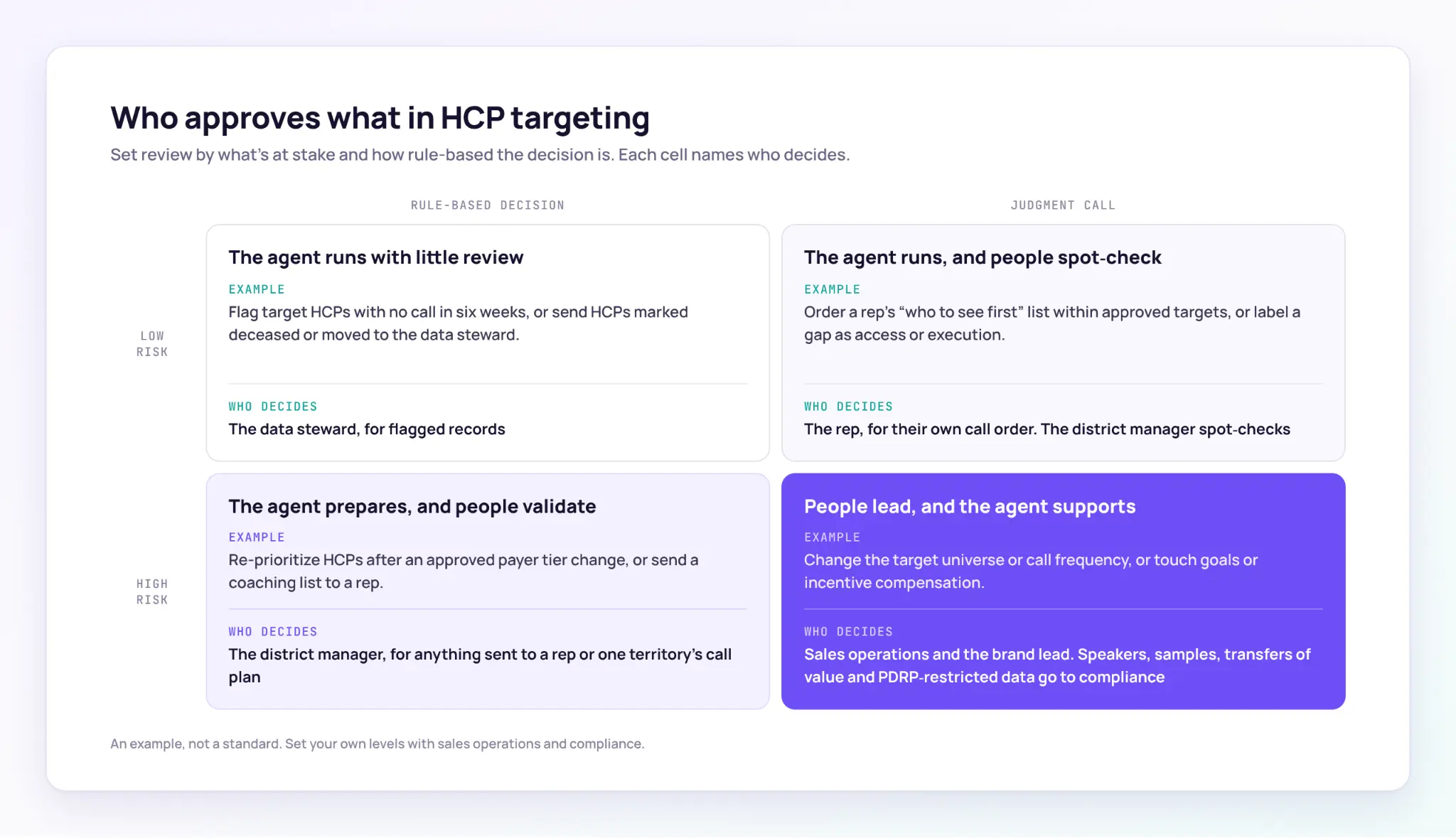
An agent earns more independence one step at a time. Track the override rate, which is how often managers change the agent's draft, and widen what the agent does alone only after that rate falls and stays low, because a district that stops reading the plan is hard to win back.
Compliance owns the riskiest cell because the rules behind it are strict and public. Since 2006, the American Medical Association (AMA) Physician Data Restriction Program (PDRP) has let physicians restrict pharmaceutical sales reps from accessing their prescribing data. An agent that shows reps prescriber-level numbers has to respect those opt-outs.
A list ranked by prescribing also shouldn't double as a speaker list. In a 2020 Special Fraud Alert, the Office of Inspector General of the US Department of Health and Human Services (HHS-OIG) described enforcement cases alleging that companies picked high-prescribing HCPs as speakers and rewarded them with lucrative speaker deals. The Code on Interactions with Health Care Professionals from the Pharmaceutical Research and Manufacturers of America (PhRMA) also says companies shouldn't select speakers based on past revenue or potential future revenue from their prescribing or ordering.
What should you reconcile before an AI agent ranks your HCPs?
Before an AI agent ranks a single HCP, confirm who each HCP is, which rep owns them this week, which payer coverage was in force and whether the HCP can be called at all. This work belongs in the context layer, the shared definitions and joins an agent works from, because every ranking depends on those joins.
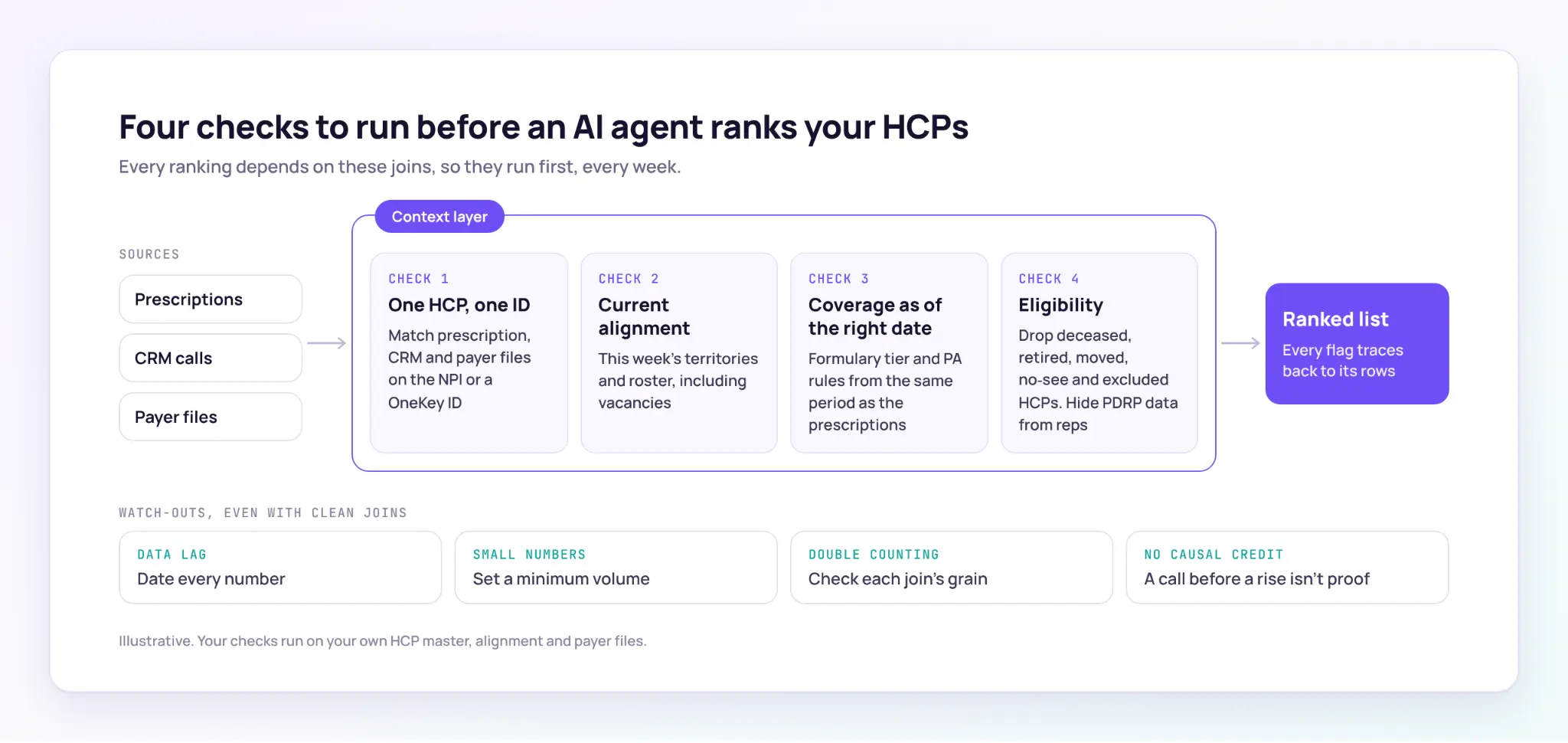
- One HCP, one ID. Match each prescriber across prescription data, the CRM and payer files using a shared identifier, such as the National Provider Identifier (NPI) or an IQVIA OneKey ID. Otherwise the same doctor appears twice, and their prescriptions and calls are counted twice.
- Current alignment. Use this week's territory alignment and roster, including realignments and vacant territories, so each HCP goes to the rep who actually covers them. A flag sent to the wrong rep teaches reps to ignore the list.
- Coverage as of the right date. Use the formulary tier and prior authorization (PA) rules in force during the same period as the prescription data. If the dates don't match, a drop caused by a payer change looks like a rep who stopped calling, and the manager coaches the wrong problem.
- Eligibility. Remove HCPs who have died, retired or moved, offices marked no-see and HCPs your compliance team has excluded. For physicians who opted out through the PDRP, hide their prescriber-level data from anything a rep sees.
Even with clean joins, a few traps can mislead a manager. Weekly prescription data arrives late, so every number the agent shows needs a date on it. Small numbers swing wildly for low-volume HCPs, so set a minimum volume before the agent flags anyone. Joining many calls to many prescriptions can inflate totals, so check each join at the right level of detail. And a call followed by a rise in NBRx doesn't prove the call caused it, so the agent should report what happened without claiming credit for it.
How does an AI agent build the weekly district plan?
An AI agent builds the weekly district plan by reading each territory against target, sizing the gap, splitting it into access and execution, checking the data, ranking the territories and drafting a plan for the manager to approve.
Tellius is a Decision AI platform for the enterprise, with industry-specific metrics and domain skills built in. Its Field sales AI teammate works for district managers, and its goal is every district on plan. It separates access gaps from execution gaps by district, drafts notes to reps for the manager's OK and sends each manager a plan for the week, running scheduled analyses to do that work. The skills and metrics come with the AI teammate, and the first job takes about two weeks to configure on your prescription, payer and CRM data and to prove against the last plan your team approved. The example below uses the illustrative demo data on tellius.com/ai-teammates, and the payer and territory names are fictional. For more on how Tellius supports field teams, see Tellius for field sales and HCP targeting.
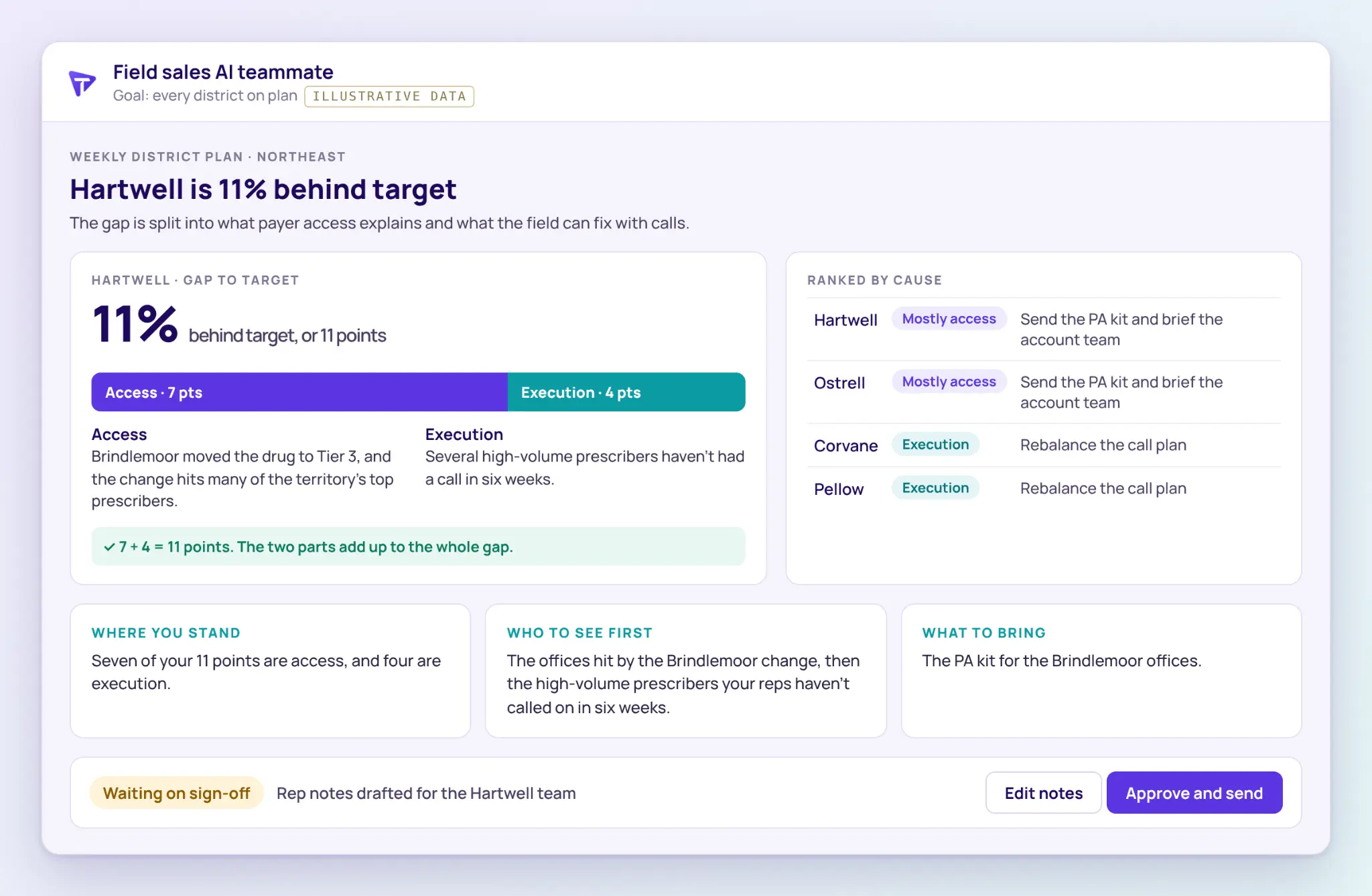
- Read the district against target. The agent compares each territory in the Northeast with its target and reports which gaps come from access and which come from execution.
- Size the gap. In the illustrative demo, the Hartwell territory is 11% behind target (11 points), which tells the manager how far behind it is but not why.
- Split the cause. Seven of those points are access, because a payer called Brindlemoor moved the drug to Tier 3, and that change hits many of the territory's top prescribers. The other four points are execution, because several high-volume prescribers haven't had a call in six weeks.
- Check before ranking. In your deployment, this is where the four checks from the previous section run. The split also follows rules your analytics team signed off, and the access and execution points must add up to the total gap (7 + 4 = 11).
- Rank the district. Hartwell and Ostrell are mostly access, so the plan is to send the PA kit and brief the account team. Corvane and Pellow are execution, so the plan is to rebalance their call plans.
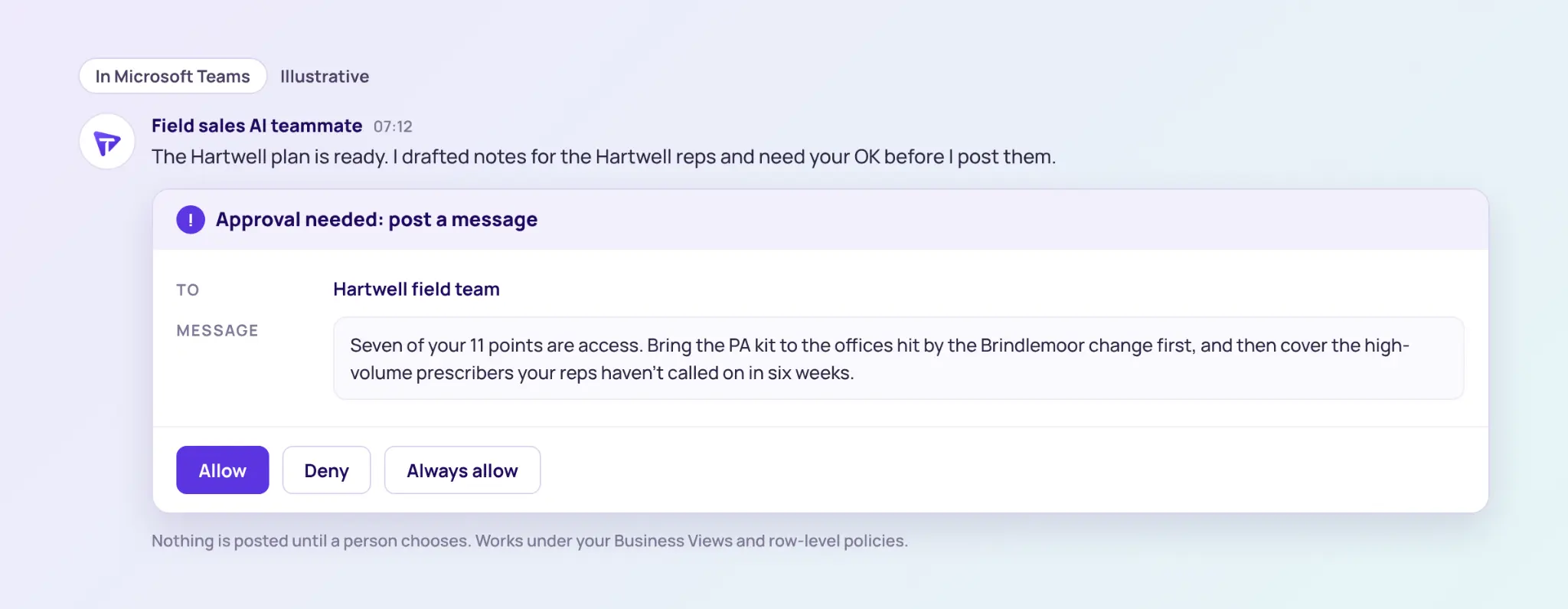
- Draft, wait and deliver. Each district manager gets a plan for their own territory, organized as where you stand, who to see first and what to bring. The plan arrives on the manager's phone before the weekly team call, and the rep notes the agent drafts show "Waiting on sign-off" until a manager approves them.
A line from the Hartwell plan might read: "Seven of your 11 points are access. Bring the PA kit to the offices hit by the Brindlemoor change first, and then cover the high-volume prescribers your reps haven't called on in six weeks."
The next week, the same plan runs again. The steps the AI teammate follows are locked when you approve them and replayed every run, so this week's numbers are worked out the same way as last week's. The new plan shows whether those prescribers got calls and whether the territory moved. If the manager corrected something last week, such as marking an office as no-see, the rule's owner approves that correction once and later runs use it, so nobody fixes the same thing twice.
How is the Field sales AI teammate different from CRM agents and NBA scores?
Field teams already use several kinds of AI, and each is built for a different part of the job. The Field sales AI teammate works alongside your NBA program, targeting refresh and CRM suggestions, giving the district manager a weekly, checkable read on the same approved targets.
What do field teams get from AI agents for HCP targeting?
AI agents for HCP targeting pay off in better-spent calls and in plans that managers can explain and check:
- For reps: a prescriber who changed last week shows up on this week's list with its reason, so a rep can check it in seconds instead of taking it on faith.
- For district managers: the access and execution split says what to do about a gap, so a manager doesn't push reps for more calls on offices where the real problem is payer coverage.
- For regional directors: every number in the plan traces back to its rows, so no one rebuilds it in a spreadsheet to answer where it came from.
Novo Nordisk's field leaders used to spend 10 days a quarter reconciling Excel exports, and with Tellius running the analysis on a schedule, the same answer now takes two days. Tellius runs at 8 of the top 10 pharma companies.
How do you pilot an AI agent on next week's call plan?
Pilot an AI agent on one district, start with the two read-only jobs and run them for four weeks next to your current target list. Running them side by side lets you compare the agent's flags with what your team would have done, without changing anything reps rely on.
Each week, check the override rate and the share of flagged HCPs who got a call within two weeks. Then ask reps whether the one-line reasons were clear and correct.
Widen the agent's scope only when overrides fall and reps say the reasons make sense. Then add the coaching list and the weekly district plan, and keep the call plan rebalance as a proposal until sales operations trusts the track record.
Bring one district's last four weeks of data, and we'll build the plan with you in a working session, so you can see how much of your target list still holds.
Get release updates delivered straight to your inbox.
No spam—we hate it as much as you do!


HCP targeting is how a pharma company decides which healthcare professionals (HCPs) its reps and channels should reach, and how often. Teams segment HCPs by prescribing volume, growth, payer access and whether they see reps, then set a target list and call frequency for each segment. Dynamic HCP targeting re-checks that list as new prescription and payer data arrives, instead of once a cycle.
AI agents for HCP targeting are software that re-checks a pharma field team's approved targets every week instead of once a cycle. They join prescription, payer and call data, explain why each HCP moved up or down and draft the call list for a manager to approve before anything reaches a rep.
Decile-based targeting ranks HCPs once a cycle by how much they prescribed in the past. Dynamic HCP targeting updates the ranking as new prescription, payer and engagement data arrives, so it can flag prescribers whose behavior is shifting while a call can still make a difference.
Next best action (NBA) tools suggest a rep's next call or message from a score. AI agents for HCP targeting work across the whole territory: they re-check approved targets every week, split a gap into access and execution and draft a plan, with a reason for each change, for a manager to approve.
The best AI agent for HCP targeting shows the reason for every flag, reconciles HCP identity, alignment, payer coverage and eligibility before it ranks anyone, and waits for a manager's approval before anything reaches a rep. Tellius's Field sales AI teammate is built for district managers on those terms: it splits each territory's gap into access and execution and sends each manager a plan for approval every week.
The rules that matter most for AI HCP targeting cover physician data opt-outs, speaker programs and public reporting of payments to HCPs. Physicians can opt out of sharing their prescribing data with reps through the American Medical Association's Physician Data Restriction Program (PDRP). HHS-OIG and the PhRMA Code both warn against choosing speakers based on prescribing. The federal Open Payments program also publishes payments and other transfers of value to HCPs.
AI agents won't replace pharma sales reps, because reps own the relationships and the conversations with HCPs. Agents take over rebuilding and checking the list every week, which gives reps and managers more time for the judgment calls that need a person.
Yes, AI agents for HCP targeting work with Veeva or Salesforce CRM, because they read call history alongside prescription and payer data. Tellius connects to Salesforce directly, and Veeva CRM call data typically reaches Tellius through your data warehouse, such as Snowflake. Tellius AI teammates deliver approved plans through Slack, Microsoft Teams and email, and any change to the CRM itself stays with the team that owns it.

Best HCP Engagement Platforms for Pharma in 2026: 12 Compared Across Orchestration, Activation, and Closed-Loop Measurement

Healthcare professional (HCP) engagement is becoming increasingly complex as pharma organizations navigate more channels, more data, and growing expectations for personalized experiences. This guide compares 12 leading HCP engagement platforms across the capabilities that matter most in 2026, including engagement orchestration, next-best-action decisioning, omnichannel activation, CRM integration, AI-powered personalization, and closed-loop measurement.
The Best HCP Targeting Platforms for Pharma: A Guide to AI-Powered Prescriber Intelligence
A practical overview of AI-powered HCP targeting platforms for pharma, explaining how prescriber intelligence is built (claims, CRM, specialty/payer signals), what capabilities matter (segmentation, next-best-action, governance, transparency), and how teams use these tools to prioritize accounts, tailor outreach, and measure lift—without relying on black-box scoring alone.