

AI Agents for Finance Teams: Which FP&A Jobs to Start With and What to Keep Human

An AI agent for finance is software that runs recurring finance jobs across ledger, plan and forecast data and hands back drafts for human approval, with every number traced to its source. AI agents in finance promise speed (the variance draft is ready when the books close), lower risk (the same traced steps every close, so fewer errors reach the board) and earlier action on margin (overruns surface while there's still a quarter to fix them).
But according to Gartner's June 2025 forecast, more than 40% of agentic AI projects are expected to be canceled by the end of 2027. Why? Missing context (the agent doesn't know how your business defines its numbers), which leads to wrong conclusions (real variances explained the wrong way) and rework (analysts rewrite the commentary every close). If your team has already tried an agent on the close, you've probably seen the subtle (and less subtle) ways it can miss nuances, for example by flagging opex from a Q2 acquisition your plan excludes as an overrun or reading an accrual your analyst reclassified to sales as a sales overspend.
This guide covers which FP&A jobs to start an agent on, scored against your own close, and what to keep human so your controller can sign off confidently on the work.
Why finance teams drop AI agents after the first few closes
Drafting a credible pack is possible with AI agents in an afternoon on a clean, pre-joined dataset during a demo. The trouble starts on a real close, which looks more like Excel exports from Oracle ERP/EPM stitched together with VLOOKUPs, cost centers that don't line up, and a plan version someone saved over. Common failure modes include:
- The data doesn't tie out. Finance leaders in Gartner's 2025 AI in Finance survey ranked data quality among their biggest obstacles, and a controller won't send commentary built on unreconciled exports.
- The agent doesn't know the business. Users in MIT NANDA's 2025 GenAI Divide report named tools that need too much manual context and don't learn from feedback as top barriers, so the same plan exclusions get corrected every close.
- The cost outruns the value. In S&P Global Market Intelligence's 2025 survey of more than 1,000 companies, 42% abandoned most of their AI initiatives, up from 17% a year earlier, with cost among the top obstacles. In-house builds add upkeep every time a reorg or reforecast changes the data.
Which FP&A jobs to start an AI agent on
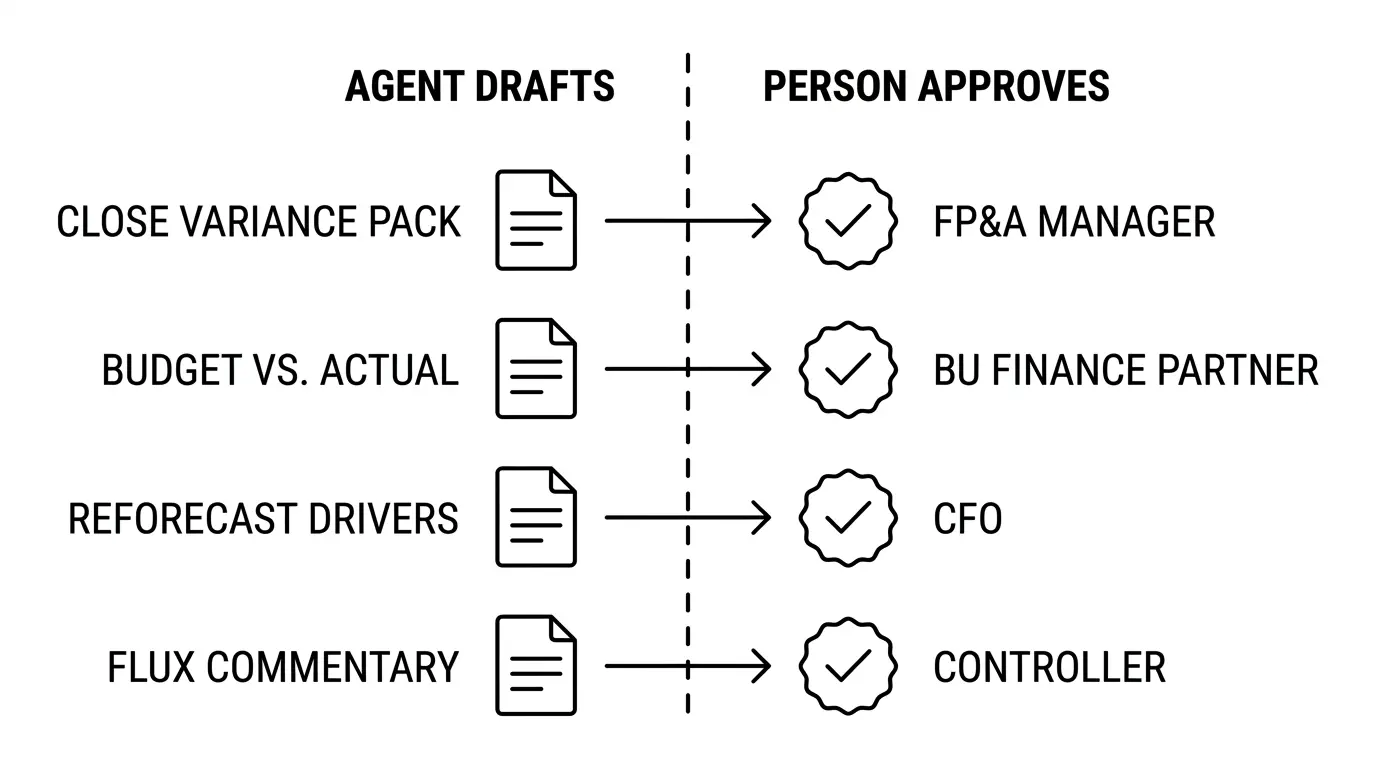
The best first jobs for an AI agent in finance are recurring ones that already end in a document someone reviews: the close variance pack, budget vs. actual by business unit, reforecast drivers and flux commentary. Here's how they compare on inputs, output, checks and sign-off.
The close variance pack is usually the best place to start, since its inputs are reconciled before anyone reads them and the FP&A manager already reviews it every month. Budget vs. actual comes next. Its review goes to budget owners outside finance, and a favorable year-to-date variance by itself says nothing about a full-year saving, so the timing-versus-permanent split has to be right before anyone touches the forecast. Our budget vs. actual guide walks through that check.
Reforecast drivers are a risky first job because its output is a proposed LE change, and a wrong driver that gets approved compounds through the rest of the year. Flux commentary compares period over period rather than against plan and usually sits with accounting, so it suits a second agent run by the controller's team.
Scoring sheet for your first finance AI agent
Score each candidate job from 0 to 2 on every row and start with the highest total. A job that scores 0 on evidence readiness waits until the data is fixed, whatever its total.
Fill the sheet in with the person who signs the output as well as whoever builds the agent, since the two tend to score evidence readiness differently.
What to keep human when AI agents do finance work
The parts to keep human are sign-off on anything that leaves finance, approval of any proposed LE change and an explicit yes before the agent writes to another system. Write that down job by job before the pilot, because it's the first thing your controller and auditors will ask about.
Reads and drafts can run without sign-off. Querying actuals and plan, decomposing the variance and writing first-pass commentary all stay inside the workspace, so a wrong draft costs the reviewer some time and nothing more. Anything that leaves finance, such as the BU review or the board pack, needs the person who signs it today, and so does a proposed LE change.
Be strictest about writes. Posting an adjustment or updating a plan table should need an explicit yes on that specific change. Governance reviews of agentic analytics focus on this category, so test it hardest in the pilot.
In Tellius, when the work ends in another system, Kaiya shows the exact write (operation, destination, rows, and identity) and runs it only after someone approves, as the connecting user. Snowflake supports reads and writes through MCP today. In chat and Apps that path is available now. Scheduled Missions can read connected systems but cannot write back yet in 6.4.
What to reconcile before an AI agent drafts the close pack
A controller signs commentary only when the numbers under it reconcile. Set up four checks before the pilot, and have the agent run them at the start of every close.
- Trial balance tie-out. Actuals by cost center and account sum to the trial balance for the period, and the total variance matches before any driver gets explained.
- Locked plan version. The comparison names one signed-off plan or LE version, so a resaved file can't move the baseline mid-close.
- Current mappings. Cost centers and accounts roll up to the current hierarchy, including any reorg since the plan was built.
- Exclusions and reclasses. Items the plan leaves out, such as opex from an acquisition, and entries an analyst reclassified are applied before the variance is ranked.
Four things break these checks most often. Late journal entries posted after the first run move the total. FX shifts when actuals and plan translate at different rates, so confirm both use the same one. Intercompany charges have to eliminate first, or one entity's overrun reads as another's saving. Accrual reversals land the month after the accrual, so an unpaired reversal reads as a favorable variance.
In Tellius, the plan version, mappings and exclusions sit in the governed context layer the agent reads from, and the tie-out runs as a fixed step in the Mission, so the checks run the same way every close, whoever builds the pack that month.
How an AI agent automates variance analysis for the monthly close
Tellius is an AI teammate for finance and FP&A teams, with FP&A domain context built in. It already knows how a variance investigation runs, from tying out the total to ranking drivers and splitting timing from permanent, and it learns your definitions from a governed context layer that holds your plan versions, mappings and exclusions.
Here's how it builds a monthly close pack once your team has configured the plan version, cost-center mapping, materiality threshold, with sign-off from your reviewers.
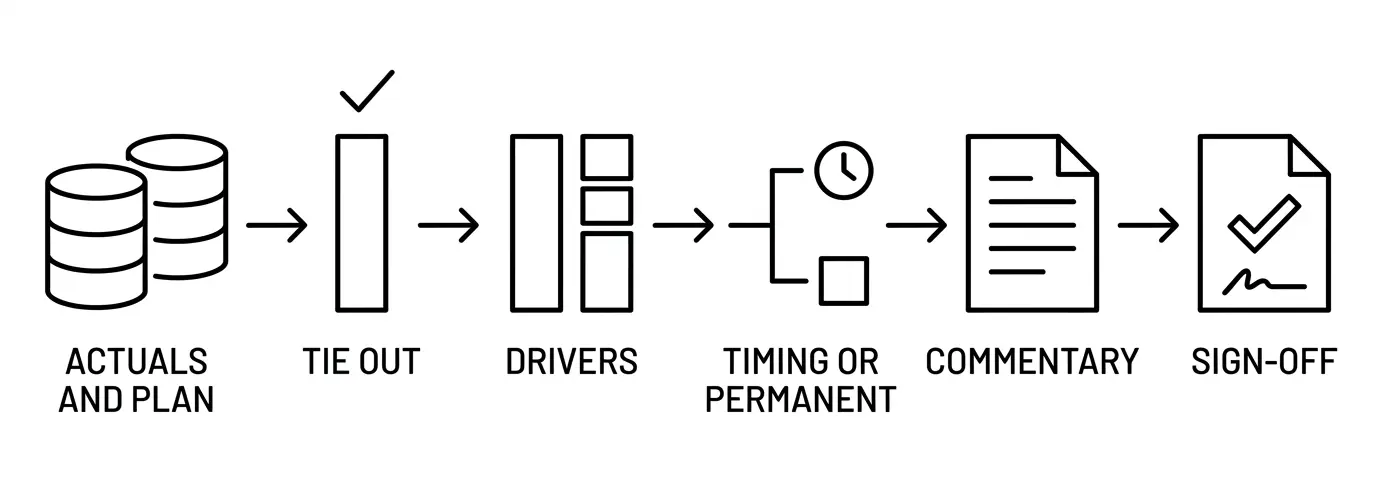
Say October opex lands at $43.6 million against a $42.0 million plan, $1.6 million (3.8%) over, and the agent works through it in this order.
- Pull actuals and the named plan version. October actuals by cost center and account go up against the plan version finance signed off.
- Tie out the total. The $1.6 million variance has to match the trial balance before any explanation gets written.
- Decompose the drivers and check they sum. In this case, engineering contractor spend accounts for $0.9 million, a marketing event for $0.6 million and FX on euro-denominated payroll for $0.1 million.
- Split timing from permanent. The $0.6 million event was planned for November and landed in October, so it reverses next month. The $0.9 million in contractor spend comes from a project pulled forward a quarter, which makes it permanent for the year.
- Draft commentary for every line over threshold, using your definitions and exclusions.
- Send it to the reviewer. The FP&A manager reads the pack and checks the trace on anything surprising before signing.
The draft line for the largest driver might read, "Engineering opex $0.9M over plan on contractor spend for the platform migration, pulled forward from Q1. Permanent for FY. Recommend raising Q4 LE by $0.9M. No offset identified."
For month-end variance, Kaiya investigates actuals against the plan in Deep Insights, then you can publish the same steps as a Mission so the pack (commentary plus PowerPoint or Excel) runs every close on the same SQL. Before you publish, Mission Preview traces figures to their queries. People still review what goes out. Because the queries stay fixed between closes, October's commentary can be read line for line against September's.
When the books close, the finished pack goes to the people who review it: ranked drivers, commentary on every line over threshold and the trace behind each figure, as a PowerPoint deck, PDF or Word document by email, Slack or Teams on the schedule you set. If late journal entries post after the first run, run the Mission again and the pack rebuilds on the same steps, so the version your controller signs matches the final ledger.
What finance teams get from an AI agent on the close
Speed, lower risk and earlier action on margin all come from the pack running the same way every close.
- Speed. The pack is ready when the books close, and it reruns each month without a rebuild. Because the pilot starts on a pack you already produce, the first result arrives at your next close. Outside finance, Novo Nordisk's field leaders spent 10 days a quarter reconciling Excel exports. With Tellius and a scheduled Mission, the same answer takes 2 days (customer story).
- Lower risk. Every figure traces to its query and the drivers sum to the total, so a wrong number gets caught in review before it reaches the board.
- Earlier action on margin. Each run reads current actuals, so a permanent overrun such as the $0.9 million in contractor spend reaches the LE in the month it shows up, with a quarter left to act on it.
How to pilot an AI agent on your next close
Agents that get dropped usually started too wide. Give yours one job your FP&A manager already signs, write down what stays human, and run it beside your current pack at the next close. If every number traces and the commentary holds up, your controller will trust it with a second job, which is further than a lot of teams ever get.
Get release updates delivered straight to your inbox.
No spam—we hate it as much as you do!


AI agents in finance are software that runs recurring finance jobs, such as the close variance pack, budget vs. actual reviews and flux commentary, across ledger, plan and forecast data. Each one works through the steps of a job, from pulling actuals to drafting commentary, and hands back a draft for a person to approve, with every figure traced to its source.
For FP&A variance work such as the monthly close pack, Tellius is the strongest fit, because Kaiya investigates the variance against your signed-off plan and Mission Preview traces each figure to its query before the recurring pack goes live. Building the plan itself is a different job, and a planning tool such as Anaplan or Workday Adaptive handles it. For the wider field, see our roundup of AI tools for finance teams.
AI agents in FP&A can pull actuals and plan, tie out the variance, decompose drivers, split timing from permanent and draft commentary for each line over threshold, then deliver the same pack every close. In Tellius, people still review what goes out, and nothing writes to another system without approval.
No. Agents take over the rebuilding work, such as pulling actuals and plan, tying out the total and drafting first-pass commentary. Analysts check the agent's timing-versus-permanent calls and decide what changes in the LE, so more of their close goes to reviewing the pack than assembling it.
Check that each figure traces to the query that produced it, that the drivers sum to the total variance, and that the comparison uses the signed-off plan version. In Tellius, Mission Preview traces figures to their queries before a pack is published, and the Mission runs the same SQL every close.
Tellius connects to the warehouses and databases where finance data already lands — for example Snowflake, Redshift, BigQuery, and databases such as Oracle via JDBC — and can also read connected apps through MCP (for example Salesforce). Planning tools like Anaplan or Workday Adaptive stay in place; you bring plan and actuals into governed Business Views or a Context Model rather than replacing the EPM.

14 Best AI Tools for Finance Teams in 2026 | Comparison Guide

AI is rapidly reshaping how finance teams plan, analyze, and report on business performance. This guide compares 14 of the best AI tools for finance teams in 2026, covering platforms for financial analysis, forecasting, reporting, and automated insights. It explains how modern AI tools help finance professionals move beyond spreadsheets and manual reporting by automating data integration, uncovering drivers behind financial performance, and generating faster forecasts and variance explanations. The article also provides a practical framework for evaluating finance AI tools—highlighting which platforms are best for FP&A, financial analysis, operational planning, and executive reporting in today’s AI-driven finance stack.