

What Is a Context Layer for AI Agents? The Definitive Guide for 2026
.webp)

"Context layer for AI agents" is one of those phrases everyone uses and few people define the same way. Half a dozen vendors have published architectures for it in the last six months, mostly shaped by whatever asset they already sell. The category is real but the public framing is still mushy. What follows is an attempt to sharpen it.
A context layer for AI agents is the architectural tier between enterprise data and AI agents that translates raw data into governed business meaning the agent can act on reliably. It combines five things: semantic definitions for metrics, entity resolution for entities across systems, governance for what an agent is allowed to do, lineage for how the agent reached an answer, and memory for what has been decided before. Without it, agents running on the best available models still produce confidently wrong answers when they touch enterprise data.
The gap is quantified. Only 7% of enterprises say their data is fully ready for AI (Cloudera/HBR, March 2026). DataHub's State of Context Management 2026 found 88% of organizations claim their context is operational while 61% delay AI initiatives because it isn't usable in practice. Those two numbers don't fit together, which is the whole problem.
Where the term came from
The phrase started circulating in late 2025, when Foundation Capital's Context Graphs: AI's Trillion-Dollar Opportunity by Jaya Gupta and Ashu Garg made the trillion-dollar case that the asset that matters isn't the data itself but the decision traces describing how an enterprise operates. Kirk Marple at Graphlit pushed back a day later, arguing that operational context — entities, ownership, temporal state — is the precondition without which decision traces are noise.
January brought a more concrete reference point. OpenAI published Inside OpenAI's In-House Data Agent, describing six explicit context layers running over 600 petabytes across 70,000 datasets serving 4,000-plus employees. A complex query that took 22 minutes baseline ran in 1 minute 22 seconds once the full context stack was in place, on the same underlying model.
Q1 2026 was the vendor wave. Snowflake's Agent Context Layer for Trustworthy Data Agents laid out the most rigorous architecture published so far and predicted that "agent context, not the model, will be the core product as the model gets commoditized." Databricks and Snowplow argued the real-time angle. Atlan published a fifteen-piece content cluster framing context as a metadata problem. SymphonyAI described it as a vertical AI domain knowledge graph. Each architecture took the shape of whatever the vendor already sold.
By March, a16z had picked up the category in Your Data Agents Need Context (Pranav Singhvi, Yoko Li), confirming what most practitioners had already worked out: agents fail in production because they can't read enterprise meaning, not because the models are weak. The piece named the convergence directly: "context OS, context engine, contextual data layer, ontology — the underlying concept is the same."
Underneath the different labels, the field has converged on what the layer is actually for, which is to solve four recurring problems: 1) definitions fragment across systems so that every team has its own version of "active customer"; 2) business logic lives as tribal knowledge that the senior analyst knows and the agent doesn't; 3) entity identity resolves differently in every database (CRM, billing, support each have their own customer ID); and 4) answers can't be traced back to their sources, so nobody can reconstruct how the agent got to a number.
The consensus architecture
Five components show up in most published architectures, sometimes under different labels.

Semantic layer. Shared definitions of what business metrics mean, so an agent and an analyst pulling the same metric get the same number. Revenue calculated the way the company has agreed to calculate it, not whichever variant different teams are running in their own spreadsheets. Net Revenue Retention with the cohort window finance signed off on. NBRx anchored to the prescription window that reflects actual territory behavior, not a platform default. This is the problem the BI semantic layer solved in the 2010s, now applied at agent speed and agent scale.
Entity resolution. A consistent answer to what entities are and how they map across systems, so an agent can tell that records in different systems describe the same thing. The customer in CRM is the same person paying in billing and writing tickets in support. The product in the catalog is the same SKU on the invoice. Easy to describe, expensive to actually do, and the most under-invested capability in most enterprises.
Policy enforcement. Rules for how specific intents get handled, so an agent doesn't get to improvise its way to a pricing answer. Pricing inquiries route to certified pricing tables. Win rate is disallowed because the underlying source isn't maintained. Forecast questions get the new model, not the deprecated one. The agent doesn't get to pick.
Lineage. A traceable record of how an answer was produced — which sources, which transformations, what freshness — so the answer is reproducible and auditable after the fact. In regulated industries, not optional.
Memory. A ledger of what was decided before and why — the 20% discount that overrode standard pricing policy with the approval chain intact, the pricing exception last quarter that became a precedent. Entries are written when decisions are made; the agent retrieves them when it needs to know what happened. Lookup is the full extent of what this component does. That's its job and its limit. It doesn't change how the agent structures the next investigation, rule out hypotheses that have already failed, or compound learned patterns into faster reasoning over time. Without it, every interaction starts from zero. With it alone, the institution can look up past decisions but still can't reason from experience. That capability belongs above this layer.
Where the consensus appears varies. Snowflake names roughly this set. Atlan calls them by different labels with overlapping content. OpenAI's six layers are this set plus a sixth (codebase enrichment) specific to their environment. Vendors with very different commercial interests are landing in roughly the same place because the job underneath is the same: take raw enterprise data — fragmented across warehouses, applications, and people's heads — and make it consistent, accountable, and safe enough that an autonomous agent can act on it without supervision. Each vendor is solving for that, from whatever angle they already sell into.
Where the consensus breaks down
Underneath the convergence, four debates are still open.
Who owns the context layer?
Foundation Capital argues vertical agent companies are best positioned to be the “system of action” because they sit directly in the execution path—where decisions are made and work gets done. Snowflake and Databricks point instead to the data platform, emphasizing data gravity and centralization. Atlan and DataHub make the case for the metadata catalog, framing governance as the durable advantage. Snowplow highlights the real-time behavioral stream, since customer state changes faster than batch systems can accommodate. SymphonyAI emphasizes the vertical AI platform, betting that domain knowledge is what ultimately differentiates outcomes.
Each of those answers is also a sales pitch, which is worth keeping in mind. For most enterprises, no single vendor produces all five components for the full estate. The context layer in a Fortune 500 ends up assembled across multiple owners, because every enterprise has a different combination of systems already in place. Which means the architectural thinking matters more than the vendor selection.
Context layer or semantic layer rebrand?
a16z called the context layer "a superset of the semantic layer." Atlan said the context layer operationalizes the semantic layer by adding governance. Iris.ai said any true context layer must be a superset of traditional semantic layers.
The distinction matters. A semantic layer solved one 2010s problem: every analyst should get the same revenue number when they query the same metric. A context layer adds four things on top of that — entity resolution across systems, policy enforcement, governance enforcement at the agent boundary, and memory of past decisions. If your semantic layer doesn't include those, you don't have a context layer. You have a semantic layer and a gap.
Is MCP sufficient?
The case for MCP is straightforward. It standardizes how agents request context from heterogeneous sources, removes a lot of bespoke integration work, and gives the emerging multi-agent stack a common protocol for context delivery. For teams building agentic pipelines across many tools, it solves a coordination problem that was previously solved with custom glue code.
The case against treating MCP as a context strategy is that it moves context, it doesn't produce context. A well-formed MCP request can retrieve a metric definition from a catalog that has no metric definitions in it. The protocol is only as useful as the governed content underneath it. Andres Garcia-Rodeja put a number on this at Gartner's 2026 Data and Analytics Summit: 60% of agentic analytics projects relying solely on MCP will fail by 2028 without a semantic layer underneath. MCP is necessary plumbing for a heterogeneous agent stack. It is not a substitute for building the governed context worth moving through it.
Centralized or decentralized?
Every vendor pitch assumes centralization. Most enterprise reality is decentralized: fragmented semantic models, scattered glossary terms, tribal knowledge in the heads of senior people who aren't always reachable on Slack.
For most enterprises, the practitioner question isn't whether to centralize. It's: what's the minimum context capability we need to start, and where does it have to live? Designing for a centralized end-state that's 12 to 18 months away while running on a decentralized reality today is the work in front of most teams. Federated context with strong contracts beats a perfect central catalog that's two years late.
What the context layer leaves out — the intelligence layer
Every published context-layer architecture stops at the same boundary. Snowflake's stack is semantic, identity, routing, lineage. Atlan is metadata-anchored governance. Databricks and Snowplow take the same components from a real-time angle. SymphonyAI applies them to vertical knowledge graphs. None of these claims to do reasoning. They make the data legible. The reasoning happens somewhere else.
That somewhere-else hasn't been named with the same clarity. Gartner came closest at its Data and Analytics Summit in March 2026, separating a Context layer (ontology, schema, metrics, policy as code) from an Intelligence layer above it (reasoning, models, agentic workflow). Rita Sallam called context "the brain for AI." The brain metaphor flatters the data layer. The data layer is not the cognition.
So why isn't the model itself the cognition? The intuitive position is that frontier models, given a clean context layer, will figure out the reasoning on their own. Better context does make a model's job easier: clean metrics, resolved entities, accessible decision history. A model reasoning over a real semantic layer beats the same model reasoning over a mess of spreadsheets.
Here's where the argument breaks.
- The failure modes are properties of generation, not gaps in context. Even with flawless context, transformer-based models don't execute deterministic operations reliably. Dimensional math doesn't always sum. Joins fan out. The same input produces different decompositions on different runs. Better context makes the wrong answer more fluently expressed, not more correct. Recent frontier models have gotten substantially better at sounding correct without getting commensurately better at being correct.
- Encoded method is not a context problem in disguise. Even with perfect schemas and ratified metrics, the model doesn't know an NBRx investigation starts with payer access, then competitor sample, then rep call frequency, against this institution's ratified P/V/M framework. That's procedural knowledge in senior people's heads. Put it in a system prompt or a RAG doc and you've started building the Intelligence tier. You haven't escaped it. You've relabeled it.
- We're seeing more scaffolding, not less. If smarter models removed the need for it, published agent architectures should be getting simpler. They're getting more elaborate. OpenAI's six layers from January 2026 include planning loops, runtime tools, and feedback ingestion. Anthropic frames context engineering as a discipline, not a workaround.
What the Intelligence layer actually contains: three capabilities on top of a deterministic substrate, with a feedback path running back through them, and governance crossing both tiers.

Reasoning is the deterministic execution of investigation logic: decomposing variance, ranking drivers, validating that components sum, running hypothesis chains against thresholds the business has agreed on. The component executes the logic; the model narrates it. In practice it's a distinct runtime, separate from the LLM and the context layer underneath, with debuggable failure modes of its own.
Encoded method is the library of how senior people investigate when the answer matters. When NBRx drops 12% in a pharma territory, the brand analyst tests payer access first, competitor sample activity second, rep call frequency third. Order, thresholds, and the choice of P/V/M as the decomposition framework all shape the answer. None of that lives in the warehouse. It lives in the heads of senior people, and an agent in production needs it encoded somewhere it can execute against.
Decision memory is how prior decisions actively shape current reasoning. Context-layer memory is a ledger — it stores entries and surfaces them on request; Intelligence-layer memory is the flywheel on top. An agent investigating Q2 variance doesn't just retrieve last quarter's similar case. It factors in that the rep-call-frequency hypothesis got ruled out three times for this region, and that the team ratified a refined P/V/M framework two months ago. Same data the Context tier holds. Different capability operating on it.
A note on vendor-hosted skills. Claude skills and OpenAI's skill-equivalents are encoded method externalized into the model vendor's runtime, which is itself evidence the category is real. The wrinkle: the planning loop that decides whether to invoke a skill lives with the vendor, not the enterprise. Determinism is weaker. Governance crosses an organizational boundary that's hard to audit end-to-end. Fine for a blog post. Not fine for an NBRx investigation that has to reproduce in a model risk management review six months later.
Governance crosses both layers. Context-layer governance handles what an agent is allowed to see; Intelligence-layer governance handles what an agent is allowed to investigate, decide, and ship. Different problems. Most enterprises treat the first as governance and the second as compliance theater.
A check against OpenAI's six published layers: four are Context-layer (business context, semantic models, query logic, codebase enrichment), one is substrate (runtime tools), and one is a write path (feedback). None is reasoning or encoded method as a named layer. The planning loop lives in OpenAI's inference orchestration, not in their named architecture. Even the most rigorous public agent stack does the Intelligence-layer work without labeling it.
The context layer makes data legible to agents. It doesn't make agents reliable in production. That work belongs to the layer above, and most published architectures leave it for the reader to figure out, not because the work is hidden but because they're honest about what they cover.
A practitioner checklist
If the context layer matters and the Intelligence tier above it matters more than most published architectures admit, what does that mean for an enterprise architect or AI platform lead deciding where to invest next quarter — what to build first, what to defer, and which architectural assumptions to challenge before locking them in? Five questions are worth working through. None of them have clean answers. Most enterprises are figuring them out in parallel with shipping their first agentic use cases, which is the honest state of the category — the goal is to be deliberate about the tradeoffs rather than to defer them.
1. What's in your context tier today, and what's missing? Most enterprises have a partial semantic layer and a hodgepodge of context floating across various systems and tools. Inventorying the five components honestly is the cheapest exercise in the whole stack, and the one that surfaces which pieces are real, which are aspirational, and which only exist in last year's architecture deck. Teams that skip the inventory tend to discover the gaps in production, which is the expensive version of the same exercise.
2. Where does reasoning happen, and how reproducible is it? This is the question most published architectures dodge. If an agent runs an investigation today, can a different analyst re-run the same investigation tomorrow and get the same answer with the same lineage? If the answer is no — or "probably, depending on which model version we're on" — you don't have an Intelligence layer yet. You have a model call wrapped in a prompt. Building toward reproducible reasoning is the highest-leverage work on this list because in regulated industries an auditor will treat non-reproducible reasoning as no reasoning at all, no matter how good the answers look in a demo.
3. Centralized or decentralized? Most vendor pitches assume centralization. Most enterprise reality is decentralized — fragmented semantic models, scattered glossary terms, knowledge in the heads of senior people who aren't always reachable on Slack. If true centralization is 12+ months out, design for decentralized operation in the meantime. Federated context with strong contracts beats a perfect central catalog that arrives two years late. Teams that plan for a centralization that doesn't materialize tend to end up with neither working architecture nor a workable interim.
4. What encoded methods does your domain require? Pharma commercial doesn't investigate the way CPG category management does, and neither investigates the way FP&A variance analysis does. The Intelligence layer above your context layer needs to know how your senior analysts actually think when the answer matters. Nobody has this fully figured out, and the realistic move isn't building a comprehensive method library on day one. It's picking the two or three investigation patterns your business runs most often, sitting with the senior people who run them today, and writing down the order, thresholds, and decomposition framework they use. Start narrow and let the library grow as agents take on more of the work.
5. How does governance cross both layers? Policy enforcement at the context layer handles what data the agent can see and how that data may be used. Policy enforcement at the Intelligence layer handles what the agent is allowed to investigate, decide, and ship. They're different problems with different audit trails, and the right question to ask isn't whether you have governance — most teams have something — but whether the enforcement happens at the agent boundary in real time or shows up later as after-the-fact dashboards and review meetings that look like governance but don't actually constrain what the agent does. That gap is where the next round of AI incidents will come from, and it's also what regulators are starting to ask about specifically.
The context layer is real, important, and worth investing in — and not enough on its own. A strong context layer alone gets you agents that are demonstrably better than the baseline but still can't be deployed in regulated workflows or trusted with high-stakes decisions. Context plus Intelligence built in parallel, with governance crossing both, gets you agents that pass audit, compound institutional knowledge over time, and actually take meaningful work off senior people's plates.

This piece was written by the team at Tellius, which is purpose-built for the Intelligence layer above the context layer. We work alongside centralized context platforms like Atlan, AtScale, and dbt's semantic layer where they exist, and bring our own context capability where they don't. If you're working on the architecture described above, we'd be glad to compare notes.
Get release updates delivered straight to your inbox.
No spam—we hate it as much as you do!


A context layer for AI agents is the architectural tier between enterprise data and AI agents that translates raw data into governed business meaning the agent can act on reliably. It combines five components: semantic definitions for metrics, entity resolution for entities across systems, governance for what an agent is allowed to do, lineage for how the agent reached an answer, and memory for what has been decided before. Without one, agents running on the best available models still produce confidently wrong answers when they touch enterprise data.
A semantic layer solves one problem: making sure every analyst gets the same revenue number when querying the same metric. A context layer adds four capabilities on top — entity resolution across systems, policy enforcement of agent requests, governance enforcement at the agent boundary, and memory of past decisions. A semantic layer is a component of a context layer, not a synonym for one. If your semantic layer doesn't include those four other capabilities, you have a semantic layer and a gap.
Yes. MCP standardizes how agents request context from different sources, but it moves context rather than producing it. A well-formed MCP request can retrieve a metric definition from a catalog that has no metric definitions in it. Gartner predicts 60% of agentic analytics projects relying solely on MCP will fail by 2028 without a semantic layer underneath. MCP is necessary plumbing, not a substitute for building the governed content worth moving through it.
Foundation Capital coined "context graph" to describe the asset of captured decision traces — the record of how an enterprise has decided things, encoded as data. A context layer is the broader architectural tier that includes the underlying components (semantic definitions, ontology, routing) that decision traces sit on top of. The graph is one component of the layer. The layer is the system around it.
Neither team owns it alone. The context layer crosses data engineering (semantic and identity work), platform engineering (routing and governance), and AI engineering (memory and how the agent consumes context). Most enterprises end up with shared ownership across two or three teams, with one accountable lead. Picking the lead matters more than picking the team — the work doesn't get done without someone whose job depends on it.
OpenAI's in-house data agent paper (January 2026) describes six layers: business context, semantic models, query logic, codebase enrichment, runtime tools, and feedback. The published outcome: a complex query that took 22 minutes baseline ran in 1 minute 22 seconds with the full stack in place, on the same underlying model. The architecture is the most rigorous public reference point for what a working context layer at scale actually contains.
Start with a real semantic layer and entity resolution for your top business domains. Add lineage early because retrofitting it later is painful and audit-blocking. Memory comes after you have actual agent activity worth remembering. Centralize on the components where consistency matters most (metrics, identity) and federate the rest. Governance is a discipline that crosses everything from the start, not a phase you bolt on at the end.
For narrow demos and isolated use cases, yes. For anything touching enterprise data with meaningful consequences, no. The published failure rate on agentic analytics projects without a real context layer is high enough that the question isn't whether you need one but how much of it you have to build before the work clears governance review.
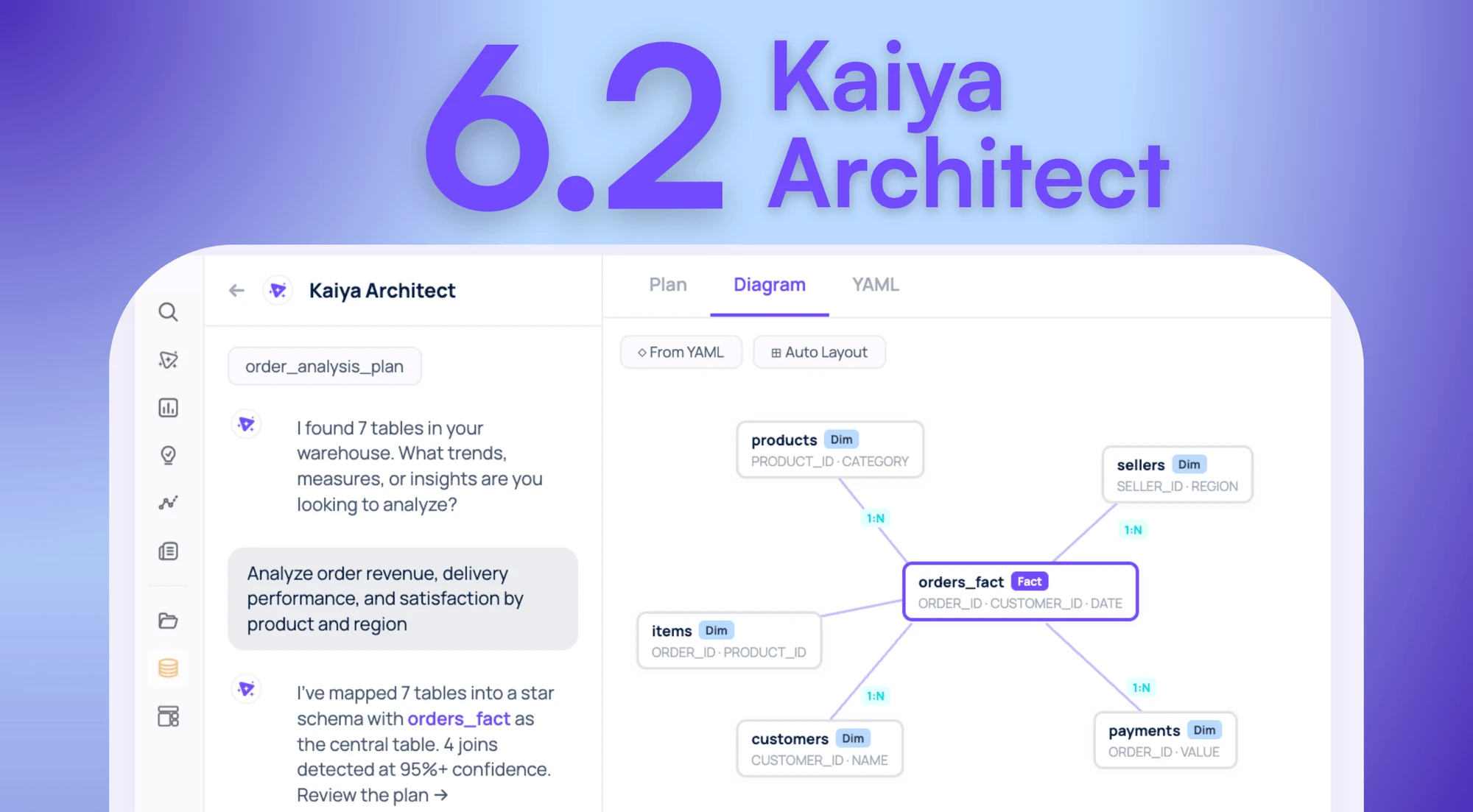
Your Data Is In The Warehouse. The Model That Makes It Useful Isn’t. Introducing Kaiya Architect.

Tellius introduces Kaiya Architect, an AI data modeling agent that builds governed semantic layers from raw warehouse data through a single conversation — eliminating the multi-week engineering bottleneck between business need and analysis.