

AI Agents for Procurement: The 2026 Field Guide to What's Real and Who Checks the Agent's Work

Agents now sit on both sides of the sourcing table. The open question is who checks the result.
AI agents for procurement are software systems that plan and carry out multi-step procurement work on their own. They triage purchase requests, run sourcing events, negotiate routine deals, check invoices against contracts and watch for supplier risk. They work inside your approval rules and hand high-stakes calls to a person.
In July 2026, on one sourcing platform, suppliers' bidding agents faced buyers' sourcing agents in 1,420 sourcing events. Keelvar, which runs the platform, says that was about 8% of its events that month, and that 90% of sourcing events on its platform were run by AI agents (vendor-reported).
Ask procurement teams in practitioner forums, though, and you hear a quieter story. For most of them, AI in their source-to-pay tools still mostly trims admin work: classifying spend, summarizing intake requests and pulling terms out of contracts.
Both stories are true, and most teams sit somewhere in the gap between them. This guide walks through that gap: what agents can really do today, how one is built, where they break and how to roll them out. It ends on the question the July numbers raise: when agents do more of the buying, who checks that the price paid was the price agreed?
Key takeaways
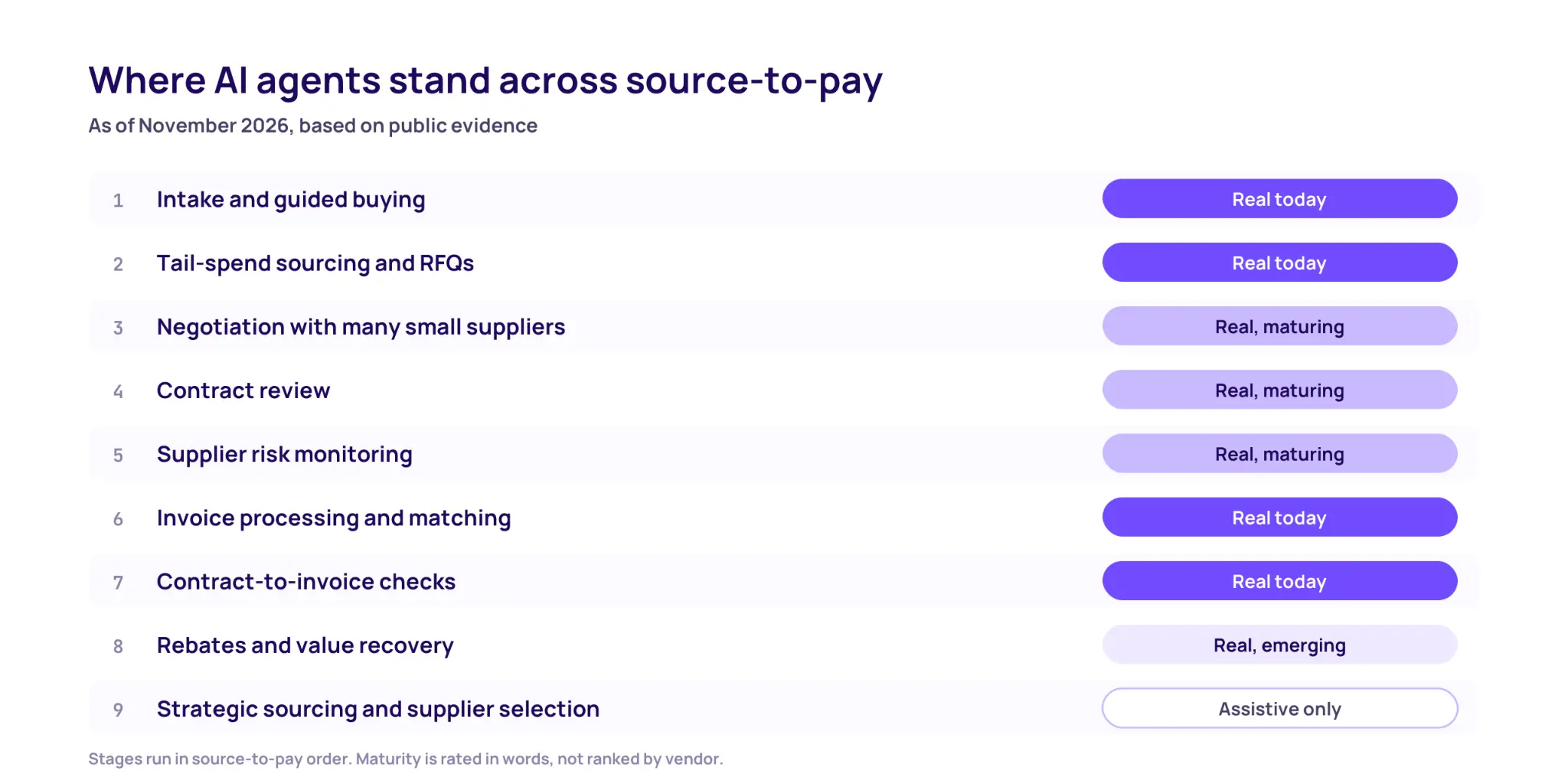
- Agents are real in procurement today, but in narrow places. Intake, tail-spend sourcing, invoice matching and contract-to-invoice checks have live examples. Fully autonomous strategic sourcing is still mostly a demo.
- Adoption is rising faster than scale. In The Hackett Group's 2026 study, 43% of organizations are actively pursuing AI deployment, but only 12% report large-scale implementation.
- Govern by money and risk. Let agents run low-value, rule-based work. Keep people on anything that commits real spend or touches strategic suppliers.
- Checking becomes the key control. As agents buy from agents, checking each invoice line, before and after payment, against the contract term that governs it matters more than how fast the deal was made.
Where AI agents stand in procurement (November 2026)
Why are procurement teams turning to AI agents in 2026?
The short answer is capacity: procurement work is growing faster than procurement teams, and two changes make agents the way to close that gap.
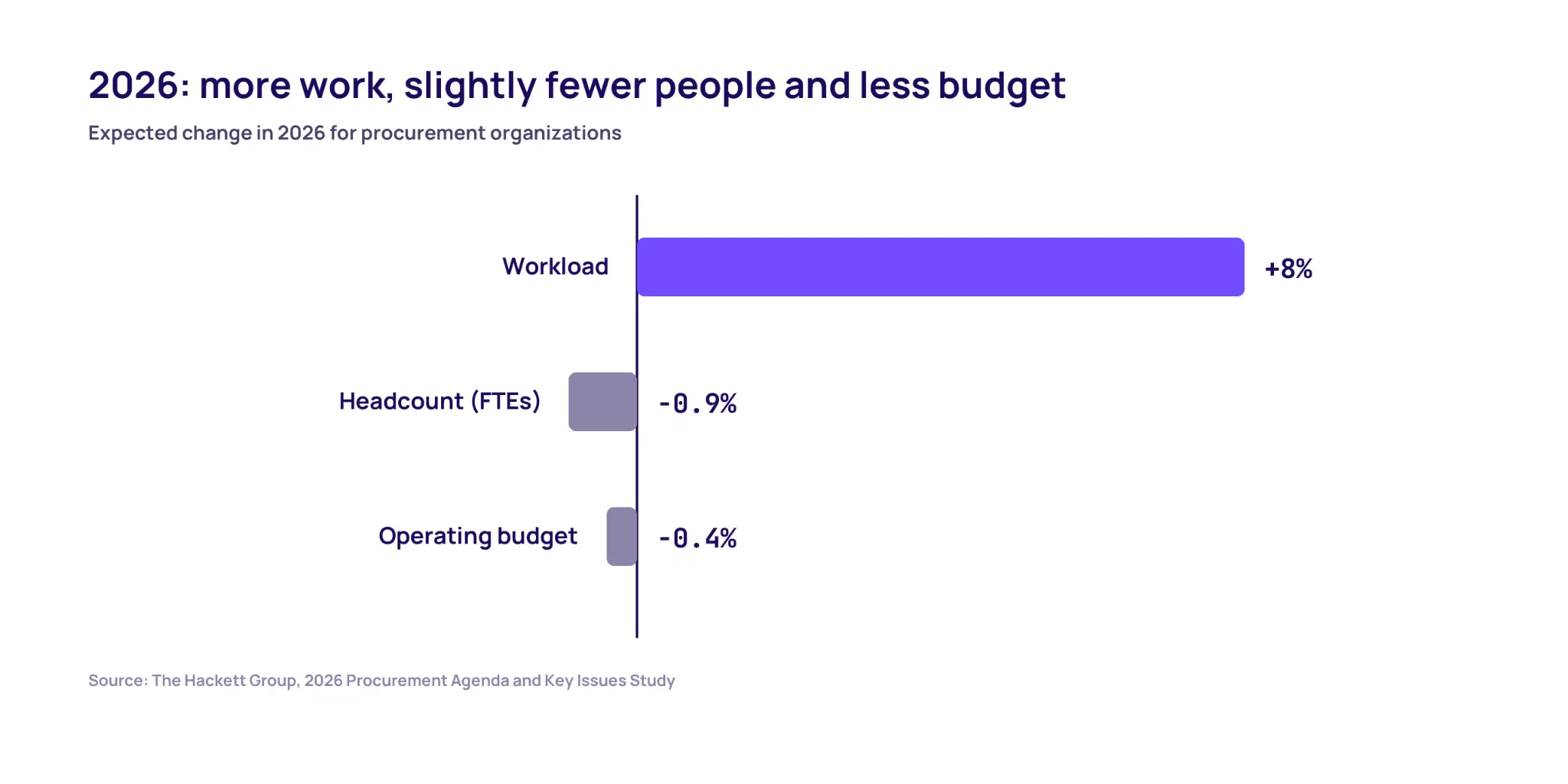
- The team can't grow with the work. The Hackett Group expects procurement workload to rise 8% in 2026 while headcount and operating budgets decline (Hackett Group, 2026), and McKinsey reports that spend managed per procurement FTE is 50% higher than five years ago.
- Older automation has hit its limit. Rules, RPA and three-way match already clear the clean cases. What's left is exception work that rules can't reason through, and that's where agents add capacity. McKinsey estimates agents could make procurement 25 to 40% more efficient (McKinsey, 2025).
- Agents now ship inside the suites. SAP, Coupa and Zip have all built AI into intake, the front door of source-to-pay, so teams can try an agent inside tools they already run instead of buying a new platform.
Interest is running ahead of readiness, though. Gartner finds that 67% of procurement organizations are discussing or planning agentic AI, yet 60% are dissatisfied with the ease of implementation and 40% worry about the rework it would bring (Gartner, via Zycus, 2026). Readiness starts with knowing what a real agent is.
What is an AI agent in procurement, and what isn't one?
An AI agent in procurement is software that starts from a trigger, plans the steps, uses your systems to act, and checks its own result. A copilot waits for you to ask. An agent acts for you, inside limits you set.
Much of what is sold as an "agent" is a chatbot or a script with a new label. Gartner calls this agent washing. It estimates that only about 130 of the thousands of vendors claiming agentic AI are the real thing, and it predicts that over 40% of agentic AI projects will be canceled by the end of 2027 (Gartner, 2025).
To tell a real agent from a relabeled chatbot, ask whether it starts on its own, plans its steps, acts within its permissions, reuses past rulings and logs every action.
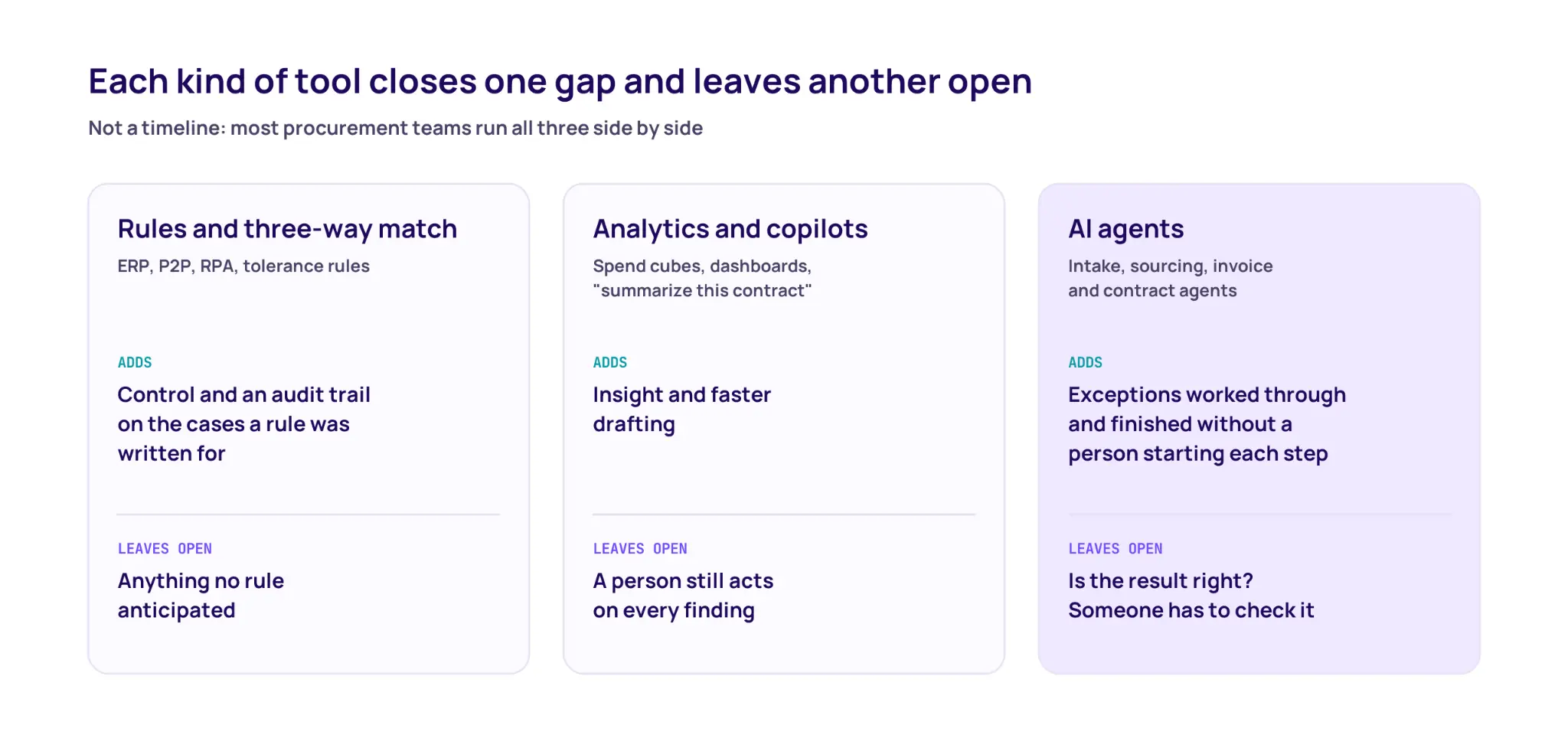
Each kind of tool closes one gap and leaves another open. Rules and three-way match add control, but a rule only catches what it was written for. Copilots add insight, but a person still has to act on every finding. Agents can work through exceptions and finish the job, which leaves one question open: who checks that the result is right? Most teams run all three side by side.
Where do AI agents work across source-to-pay today?
AI agents work today in the high-volume, rule-heavy parts of source-to-pay: intake, tail spend, invoices and contract-to-invoice checks. They are still assistive in strategic sourcing, where the context sits in people's heads. The table below is our read of public evidence as of November 2026. Vendors named in this section are examples of where activity is happening, not recommendations.
Can AI agents handle procurement intake?
Yes, intake is one of the most mature uses. With an agent, a request is classified (catalog item, contract item or new supplier), routed by budget and approval authority, and chased until someone decides. SAP has introduced a Joule agent in SAP Ariba Intake Management, Coupa's Intake & Orchestration gives employees one "AI Front Door" for requests, and Zip offers an Intake Superagent.
Can AI agents run sourcing events and negotiate?
Yes, for formulaic, high-volume categories and lower-value deals. In Walmart's pilot with Pactum, a negotiation agent reached agreement with 64% of the 100 tail-end suppliers invited, against a 20% target, at 1.5% average savings (Talking Logistics, 2023, citing HBR, 2022).
Buyers are moving carefully. Ahold Delhaize USA has begun piloting AI-supported supplier negotiations with Pactum. Sean Sieper, a director in its Indirect Center of Excellence, says: "Today, we maintain full oversight of each negotiation and interaction. Over time, as confidence builds and governance matures, the level of review can evolve appropriately" (CPOstrategy, 2026).
Can AI agents review contracts and monitor supplier risk?
Yes, both are maturing, and both depend on clean data. Agents redline against your playbook and send high-risk clauses to legal. Risk agents watch feeds and flag changes. apexanalytix, a supplier-data vendor, names poor data quality as the #1 barrier to AI adoption in procurement, warning that duplicated or outdated supplier records force AI systems to "infer, guess, and reconcile contradictions" (vendor-reported, apexanalytix, 2026).
Contract review is not where most of the money is lost, though. World Commerce & Contracting and Deloitte found that average contract value erosion is 8.6% (WorldCC and Deloitte, 2023). The report credits better post-award contract management for a small improvement from 9.2% in 2014. That is the stage where agreed terms have to show up in what you pay.
Can AI agents match invoices and stop overpayments?
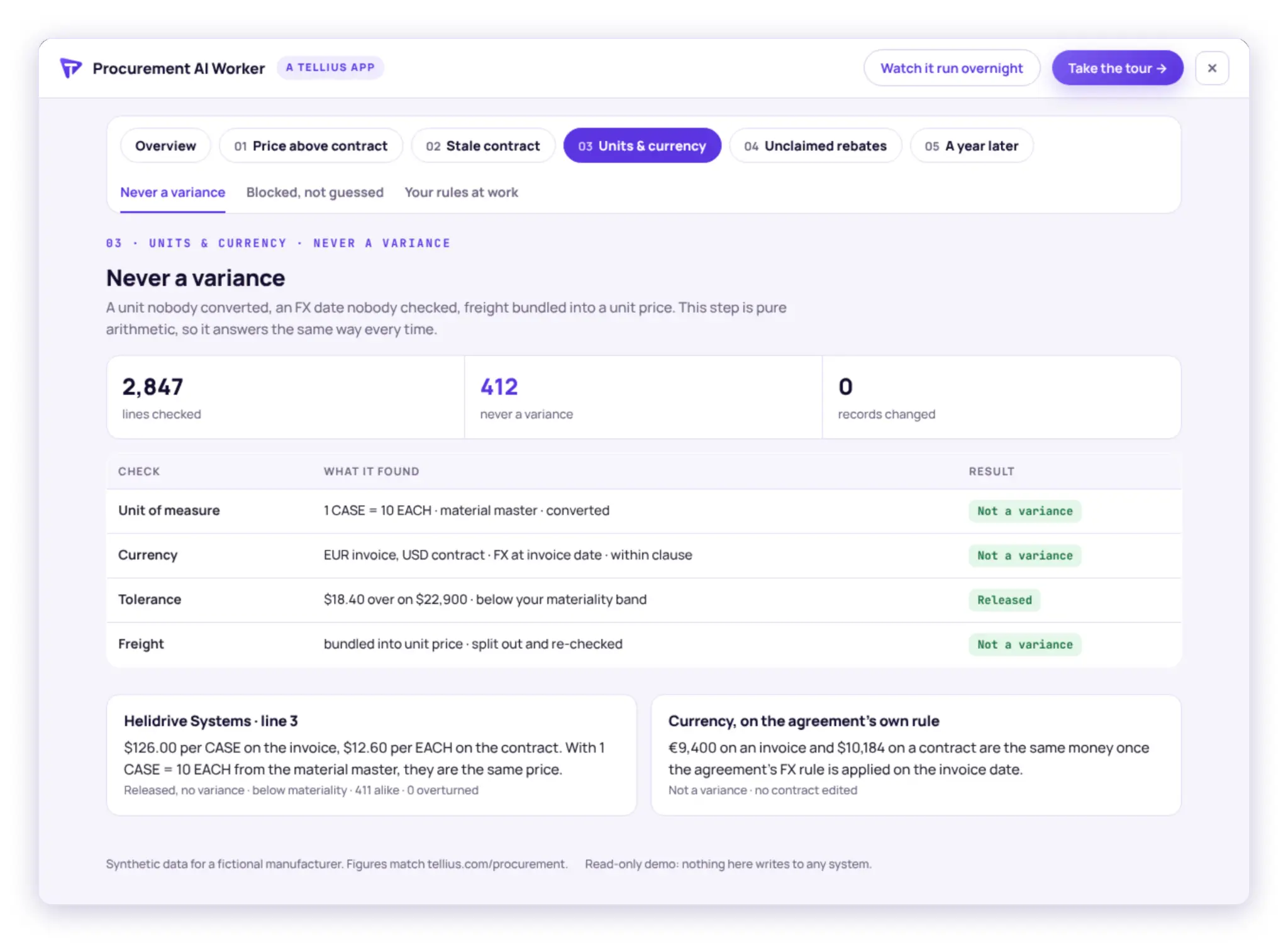
Yes, but matching is not the same as being right. Three-way match compares the invoice with the PO and the goods receipt. If the PO was raised at a stale price, the invoice matches the PO, the receipt confirms the quantity, and the overcharge is paid, so the check that matters also reads the contract. An agent can clear clean matches and surface exceptions. The harder job is knowing whether an exception is real. Take an invoice for 500 cases at $126 a case, against a contract price of $12.60 per unit. If one case holds ten units, $126 a case is exactly $12.60 a unit, so nothing is wrong. A careless agent sees a tenfold gap and either disputes a correct invoice or "corrects" a contract that was already right. A good agent converts units first, releases the line and logs why.
Can AI agents find spend leakage and recover rebates?
Yes for spend leakage, which is one of the clearest money cases for agents. Spend leakage is the gap between what a contract says and what you pay, such as overbilling, amendments that never reached the ERP and rebates nobody claimed. Rebate recovery is earlier-stage. McKinsey describes a global pharmaceutical company whose AI invoice-to-contract reconciliation tool, built as a proof of concept in four weeks, found more than $10 million in value leakage and led to supplier renegotiations (McKinsey, 2025).
Should AI agents choose strategic suppliers?
Not yet. Supplier selection and strategic negotiation depend on context that lives outside any system, such as relationships, risk appetite and a company's plans. Agents can prepare scenarios and shortlists. People should make the call.
A pattern runs through these stages. Agents work where the data is clean and the rules are written down, and they struggle where context lives in people's heads. To see why, it helps to look inside one.
How does a procurement AI agent actually work?
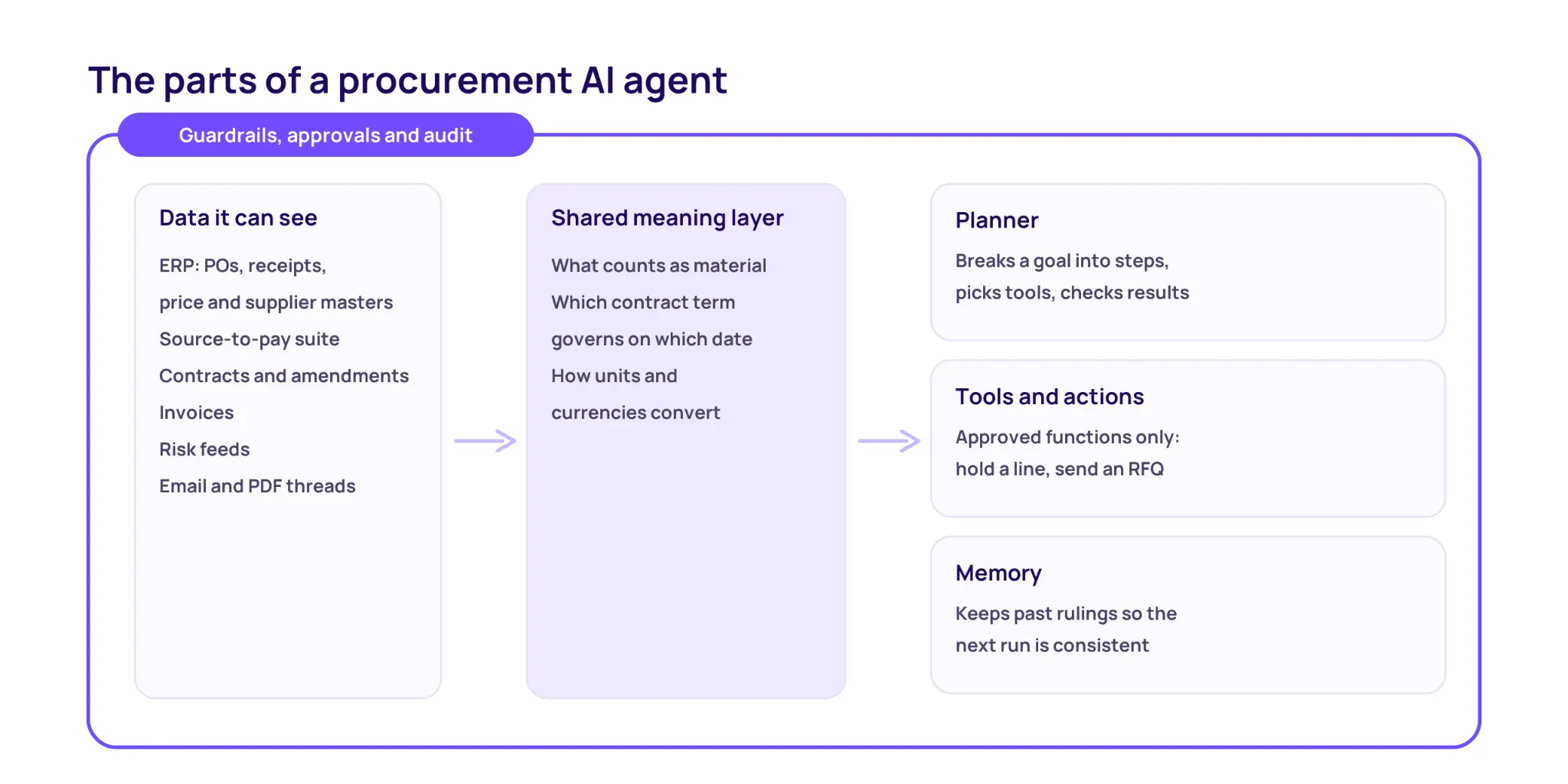
A procurement AI agent is a stack of parts inside a governance frame. If any part is weak, the agent's work can't be trusted.
What are the parts of a procurement AI agent?
- Data it can see. ERP records, the source-to-pay suite, contracts with their amendments, invoices and risk feeds. Procurement.news warns that "if an agent only sees one slice of that environment, it will produce shallow work."
- A shared meaning layer. The business rules every agent uses: what counts as material, which contract term governs on which date, and how units and currencies convert. Without it, two agents can disagree on what "price variance" means.
- A planner. It breaks a goal such as "find overbilling last quarter" into steps and checks results along the way.
- Tools and actions. The agent reads and writes through approved functions, such as holding an invoice line or drafting a debit note. The Model Context Protocol (MCP) has become a common way for agents to plug into systems. The safe default is read-only.
- Memory. The agent keeps past rulings, so the same line gets the same answer next time. That matters because a language model can answer the same question differently on each run, so settled cases should come from stored rulings and written rules, not a fresh guess.
- Guardrails, approvals and audit. Approval limits and a log of the data used, the decision made, who approved it and what changed. As Procurement.news puts it, "without auditability, agentic procurement becomes a control problem."
Who approves what? Designing human review by money and risk
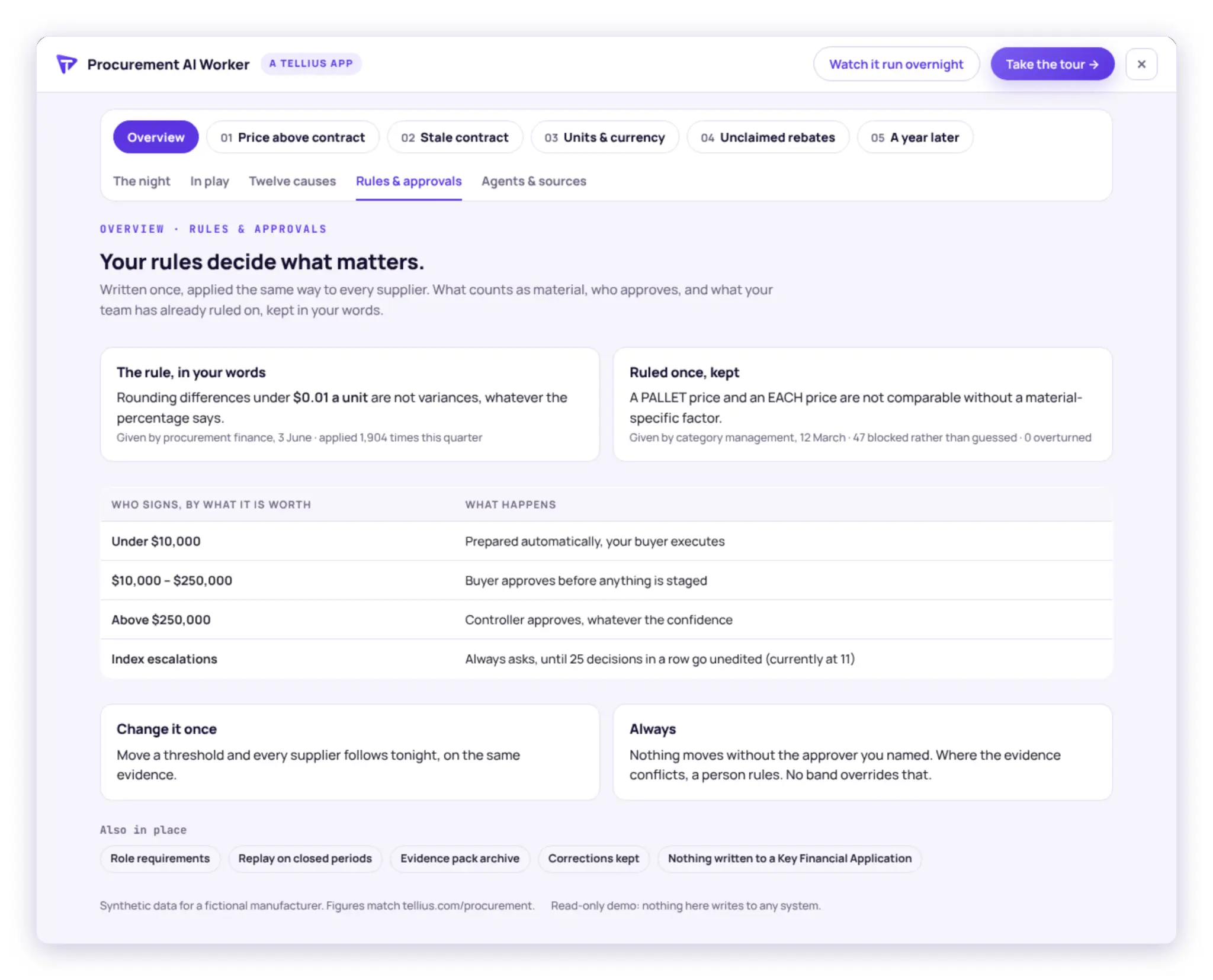
Set human review by two things: how much is at stake, and how rule-based the decision is. The more money and judgment involved, the closer a person should be.
A threshold ladder makes this concrete. Tellius's own procurement design is one example: fixes under $10,000 are prepared automatically for the buyer to carry out. Fixes from $10,000 to $250,000 need a buyer's approval. Anything larger needs the controller "whatever the confidence" (Tellius procurement page). Treat this as an example, not an industry standard. The point is that autonomy is earned and measured.
What changes when agents negotiate with agents?
When both sides use agents, the rules of the event matter more than any negotiator's skill. A fixed close time, for example, invites suppliers' agents to hold back and bid in the last second, which is why event rules such as auto-extensions or randomized close times matter more than ever (Keelvar Knowledge Hub). Speed on both sides also means more transactions to check afterward.
Where does verification fit?
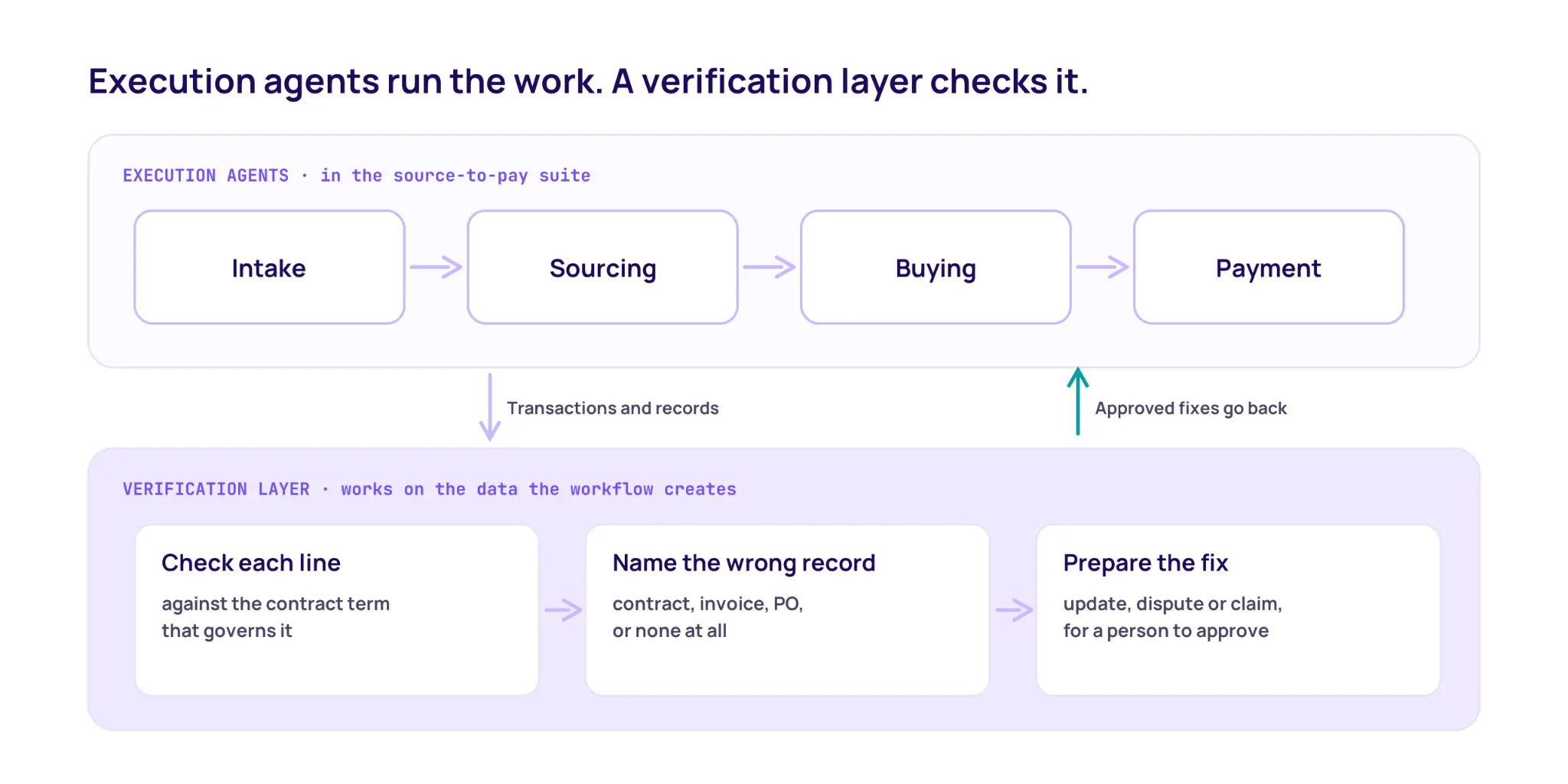
Execution agents run the workflow. Verification agents check the results. Agents in the source-to-pay suite run intake, sourcing, buying and payment. A separate layer works on the data those workflows create: it checks each line against the term that governs it, decides which record is wrong and prepares the fix. The two layers complement each other.
That is the design on paper. The people living with these tools describe something messier.
What are procurement practitioners saying about AI agents?
Practitioners are curious but wary. Four themes come up again and again in procurement forums and on LinkedIn:
- It's admin help, not autopilot. Teams don't see AI running whole sourcing processes or replacing buyers.
- Bad data means bad guesses. If historical data is messy, an agent's suggestions will be too.
- Keep people where money moves. The common advice is to start narrow: one category, clear policies, and human approval for anything that commits spend.
- Someone has to be accountable. When a buyer makes a call, that buyer answers for it. An agent answers to no one unless you decide in advance where people review its work.
Those worries map onto real failure modes, and each one has a practical fix.
What are the risks of AI agents in procurement, and how do good teams handle them?
The main risks are bad data, relabeled chatbots and agents that act wrongly at scale.
- Bad data leads to made-up answers. Fix: clean supplier and contract masters, shared business rules, and an agent that stops and asks instead of guessing when units or evidence don't line up.
- Agent washing means paying for a chatbot. Fix: use the questions above, and ask for a run on your own data.
- Wrong actions at scale. Fix: value thresholds, a replay on closed periods before go-live, and autonomy earned in steps, the path Ahold Delhaize describes.
- A "fix" that breaks a correct record. Fix: the agent must decide which record is wrong (the contract, the invoice, the PO, or none) before changing anything.
- Prompt injection and tool misuse. A supplier email or PDF can carry hidden instructions. The OWASP Top 10 for Agentic Applications for 2026 lists Agent Goal Hijack and Tool Misuse and Exploitation as its first two risks (OWASP, December 2025). Fix: treat supplier documents as untrusted, give agents the least access they need, and require approval for high-impact actions.
- Agent sprawl and shadow AI. Fix: one governance layer, a named owner for every agent, and a measure of success for each.
- Broken segregation of duties. An agent that can both change supplier records and release payments holds more power than any one employee is allowed. Fix: give each agent one role, keep supplier bank-detail changes with people, and log approvals apart from actions.
Knowing the risks is half the job. The other half is picking an agent and rolling it out so those risks stay small.
How do you evaluate and roll out AI agents in procurement?
Start with a checklist, then roll out in stages. Procurement.news suggests 12 questions to ask any vendor. They cover where the agent gets its data, which systems it can read from and write to, what requires human approval, how actions are logged and explained, how it handles conflicting data, how it knows when not to act and how ROI is measured.
Add two tests of your own. Does it give the same answer twice? The same invoice line should get the same ruling on every run. Can it say "nothing was wrong"? An agent that always finds a problem only creates more work.
Then roll out in stages:
- Foundation. Clean supplier and contract data, defined rules and thresholds, and audit logging.
- Read-only replay. Run the agent on last year's closed data and compare its findings with what your team found.
- Assistive. The agent prepares and people act.
- Bounded autonomy. The agent acts under value thresholds on rule-based work, and people approve the rest.
- Scaled. Several agents under one governance layer, each with an owner and a measure, with autonomy that widens as override rates fall.
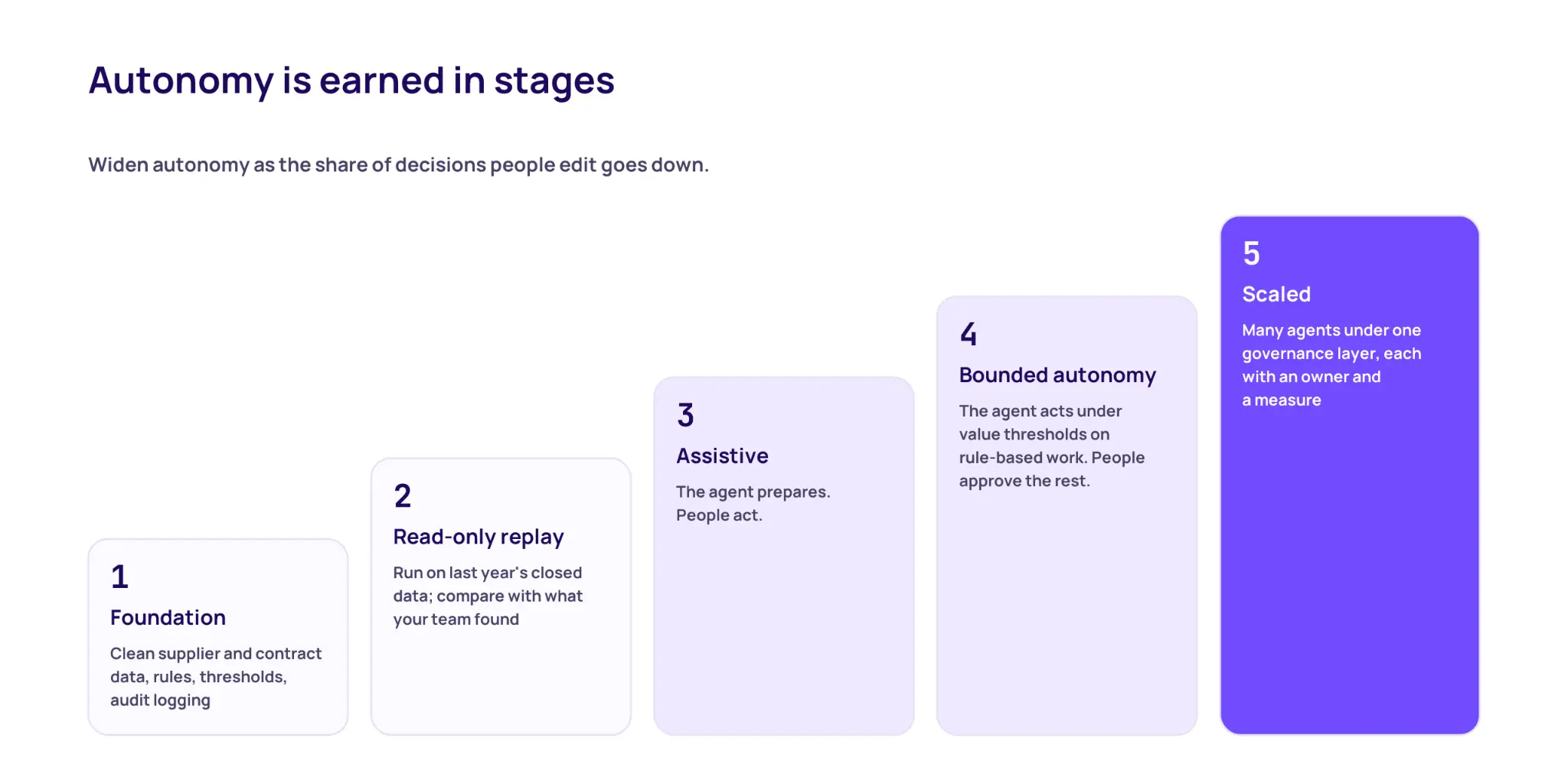
Each stage needs a way to tell whether the agent has earned more room.
How do you measure AI agents in procurement?
Measure agents by outcomes in time and money, plus how often people have to correct them.
Two of those metrics, leakage prevented before payment and the false-variance rate, come back to the question this guide started with: who checks the agent's work?
How does Tellius help procurement teams check the agent's work?
For procurement, Tellius provides Procurement AI teammates: Spend Leakage Control, which checks each invoice line against the contract term in force on the day you were invoiced, and Value Recovery, which finds money that was earned but never claimed. Tellius reads the source-to-pay suite you already run rather than replacing it, and nothing is written back without your team's approval: your team executes, and Tellius verifies.
Why add a separate layer when the suites have agents of their own? Because the system that does the work shouldn't be the only one grading it. Finance applies the same rule when it separates the person who raises a PO from the person who approves the payment.
- Unlike SAP's Joule agents or Coupa's AI agents, which are built to run the workflows of their own suites, Tellius sits outside any one suite and checks the results across SAP, Oracle, Coupa, Ariba and Ivalua at once. A company that runs more than one system gets one check across all of them.
- Unlike Keelvar or Pactum, which run the sourcing event or negotiation that sets the price, Tellius checks that the agreed price is the price billed, on every line, for the life of the contract.
- Unlike three-way match, which compares the invoice with the PO and the receipt, Tellius also reads the contract and the amendment in force on the invoice date, so a stale PO price is caught before payment.
- Unlike a recovery-audit firm, which typically reviews invoices after they are paid and takes a share of what it recovers, Tellius checks every night before payment and is priced by the supplier spend it manages.
Spend Leakage Control runs nightly and Value Recovery quarterly. With the Tellius platform behind them, they do seven jobs:
- Find the governing term. For each invoice line, they read the contract and the amendment in force on the invoice date, alongside the PO, the receipt and the price master.
- Clear what was never wrong. Unit, currency, date and tolerance are checked by arithmetic first. Gaps below your materiality band are released with the reason filed, and "nothing was wrong" is counted as an outcome.
- Tellius runs in your Snowflake or Databricks account or as a hosted service. Work starts read-only, with a replay of twelve months of history. Through MCP, Tellius's reasoning layer becomes a governed tool that Claude, an IDE or your own agent can call.
- Name the record that's wrong. Every held line resolves to exactly one of twelve causes, so the invoice, the contract, the PO or none of them is named before anyone changes anything.
- Prepare the fix and route it. The master update, debit note, dispute or claim packet is written and handed to the named person or supplier who can act on it.
- Recover what was earned. Value Recovery finds rebates, volume commitments and price protections that were earned but never claimed.
- Prove it to audit. Every change is approved or carried out by the person your value thresholds name. Tellius then reads the source again to prove the record changed, and each case keeps an evidence pack for internal audit.
- Answer the follow-up questions. Because the teammates run on the Tellius platform, buyers can ask Kaiya about the same governed data in plain English, see the drivers behind a change in spend, and schedule Missions that deliver briefs to Slack, Teams or email.
Tellius runs in your Snowflake or Databricks account or as a hosted service. Work starts read-only, with a replay of twelve months of history. Through MCP, Tellius's reasoning layer becomes a governed tool that Claude, an IDE or your own agent can call.
What's the bottom line on AI agents in procurement?
Go back to those 1,420 agent-to-agent sourcing events in July 2026. They show how fast the buying side is moving. AI agents in procurement are past the "can it work?" stage for intake, tail spend, invoices and contract-to-invoice checks, while strategic judgment still belongs to people. As more of the buying runs agent to agent, the advantage goes to teams that can prove each line was paid at the contract price.
AI agents in procurement: terms used in this guide
Get release updates delivered straight to your inbox.
No spam—we hate it as much as you do!


AI agents in procurement are software that plans and carries out multi-step procurement tasks on its own. They handle intake, RFQs, routine negotiation, invoice and contract checks, and risk monitoring, inside your approval rules. They hand high-stakes decisions, such as committing large spend or choosing strategic suppliers, to people.
An AI agent acts on its own from a trigger, while RPA follows fixed scripts and a chatbot waits for a prompt. RPA stops at exceptions it wasn't scripted for, and a chatbot only drafts text. An agent plans steps, takes real actions within its permissions and logs everything it does.
AI agents already handle intake routing, tail-spend RFQs, invoice coding and matching, and contract-to-invoice checks. Low-value negotiation, contract redlining and supplier risk alerts work but are still maturing. Strategic sourcing and supplier selection are still assistive: agents prepare options, and people decide.
People approve anything above limits the company sets, based on money and risk. One vendor's published pattern lets the agent prepare small, rule-based fixes for a buyer to carry out, requires a buyer's approval for mid-sized changes, and sends the largest to a controller. Every action should be logged with who approved it.
AI agents can be safe if they are read-only by default, act only under value thresholds, log every action and get human approval for anything that commits significant spend. Treat supplier emails and documents as untrusted, because they can carry prompt injection attacks, a top risk in OWASP's agentic security list.
AI agents will take over much repetitive, transactional work, and many practitioners expect some roles to shrink. McKinsey expects a hybrid workforce, where procurement professionals work with digital coworkers and spend more time on strategy.
Procurement AI agents need clean supplier master data, contracts with their amendments, POs, receipts, price masters, invoices and approval rules. apexanalytix, a supplier-data vendor, names poor data quality as the #1 barrier to AI adoption in procurement, so data cleanup is usually the first step.

Best AI Procurement Software in 2026: Spend Intelligence & Value Recovery Compared

This buyer's guide compares the leading AI procurement software platforms in 2026, evaluating how they help organizations transform procurement from a transactional function into a strategic driver of business value. The guide examines capabilities across spend intelligence, supplier performance analytics, contract and purchasing insights, sourcing optimization, risk monitoring, invoice and payment analysis, and value recovery. It also compares AI-native procurement platforms, source-to-pay suites, and analytics-first solutions, highlighting where each approach excels depending on an organization's procurement maturity and technology landscape.