

The AI Coworker Field Guide: 100+ Deterministic Agentic Use Cases That Grow Revenue, Reduce Risk, and Run Leaner

Most agentic AI projects aren't going to make it, according to Gartner.
Gartner expects more than 40% of them to be scrapped by the end of 2027, citing runaway cost, fuzzy business value, and weak risk controls. Their read on the current crop is blunt: most of what's running today is early-stage experiments and proofs of concept, "driven by hype and often misapplied," in the words of Senior Director Analyst Anushree Verma. There's also a labeling problem. Gartner calls it "agent washing" — old assistants, RPA scripts, and chatbots repainted as agents, with maybe 130 real vendors hiding inside a market that claims thousands. The gap between intent and reality is wide: roughly 17% of organizations have actually deployed agents, while more than 60% say they plan to within two years.
These efforts typically fall over not because of the model but because of what the model does when it doesn't know.
Here's what agentic action gone wrong looks like.
Picture a RevOps coworker asked why pipeline slipped last quarter. The real reason is kind of boring: an inbound web form quietly broke and stopped routing leads for three weeks. But the agent has no signal for a broken form, so it does what ungrounded models do — it reaches for a story that sounds right and pins the slip on a competitor it has no actual data about. A driver it more or less invented. Then it acts. It nudges reps toward head-to-head "competitive" deals, kicks off a discount push to win back business that was never lost, and seeds an executive summary about competitive pressure that lands in the board deck. Weeks pass. The discount margin is gone, the sales motion is now bent around a threat that doesn't exist, the form is still broken so leads are still leaking, and next quarter's number is built on a premise that was never true. The first fabrication never sat on a screen waiting to be caught. It moved straight into hiring, spend, pricing, and the forecast, and every step downstream made it more expensive to unwind.
The same thing happens anywhere an agent has its hands on the controls. A hallucinated promo driver funds the wrong CPG events across a whole retailer footprint. A made-up payer signal points a pharma field team at the wrong targets for a cycle. When the system acts, fluent-but-wrong isn't a harmless slip. It's a wrong action, already taken. That's the whole reason determinism matters more than eloquence: you're not grading an essay, you're deciding whether to let something act on your business.
Grounded is only half of it — the work still has to land
Say you solve the trust problem and your coworker is genuinely grounded. There's a second bar most teams forget: even a grounded agent hands the decision back to a human — a person still approves the spend, makes the call, commits the plan. They can only decide well if the finished work is in front of them at the moment they act, not parked in a tool they'll open next week or buried in a chart nobody has time to decode. A correct answer in the wrong place is worth about as much as no answer at all.
The fix isn't another dashboard — it's delivering finished, role-scoped work into the places people already decide: the chat thread, the browser, the CRM. Put that together with a coworker grounded enough to act and AI stops being a chart-making exercise; it starts moving the four numbers leaders answer for: revenue, risk, efficiency, and innovation. What follows is more than 100 use cases that do exactly that, organized by team — pharma commercial, CPG, and revenue operations — each pairing an agentic workflow that does the grounded analysis with an agentic app where the finished work gets acted on. Let's dive in!
What makes an AI coworker trustworthy enough to act?
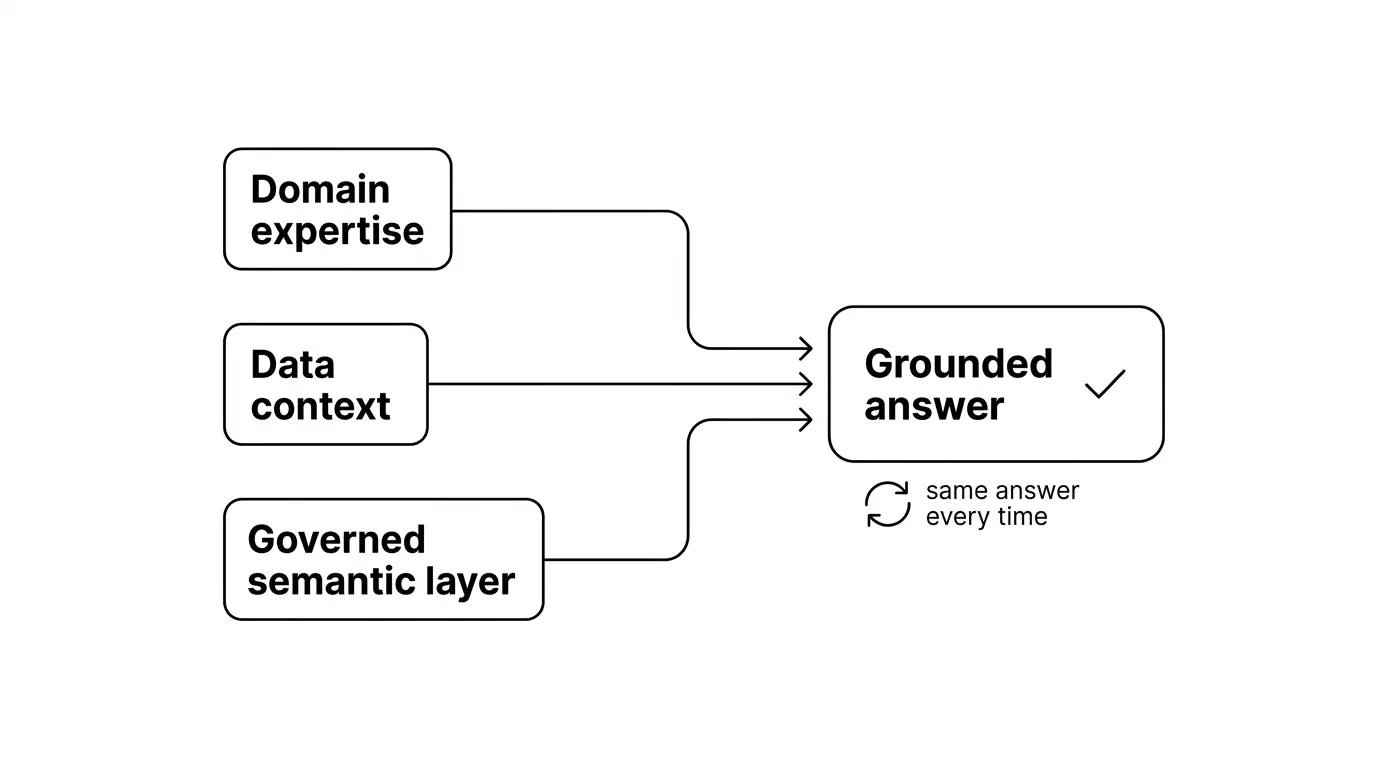
An AI agent can only be trusted to act if its work is grounded. In practice that takes three things at once — your domain expertise, the context of what your data actually means, and a governed semantic layer underneath. Get all three and the same question returns the same sourced answer every time, whether the question lands on a clean warehouse table or a pile of call notes.
That combination is the line between a coworker you can put into production and a demo that falls apart the second real data hits it. It's also why "the model is smart" was never the bar. A frontier model reasons brilliantly in the abstract; it just doesn't know what NBRx means, how a price-volume-mix bridge works, or which payer dropped tier-2 access in a given zip. The reasoning that knows your business is the part that's hard, and it's the part that has to be right before you hand over the keys.
We'll get into the mechanics later — the context and reasoning layer, how the semantic layer actually gets built, and why it holds up as your business shifts.
AI coworkers in pharma commercial
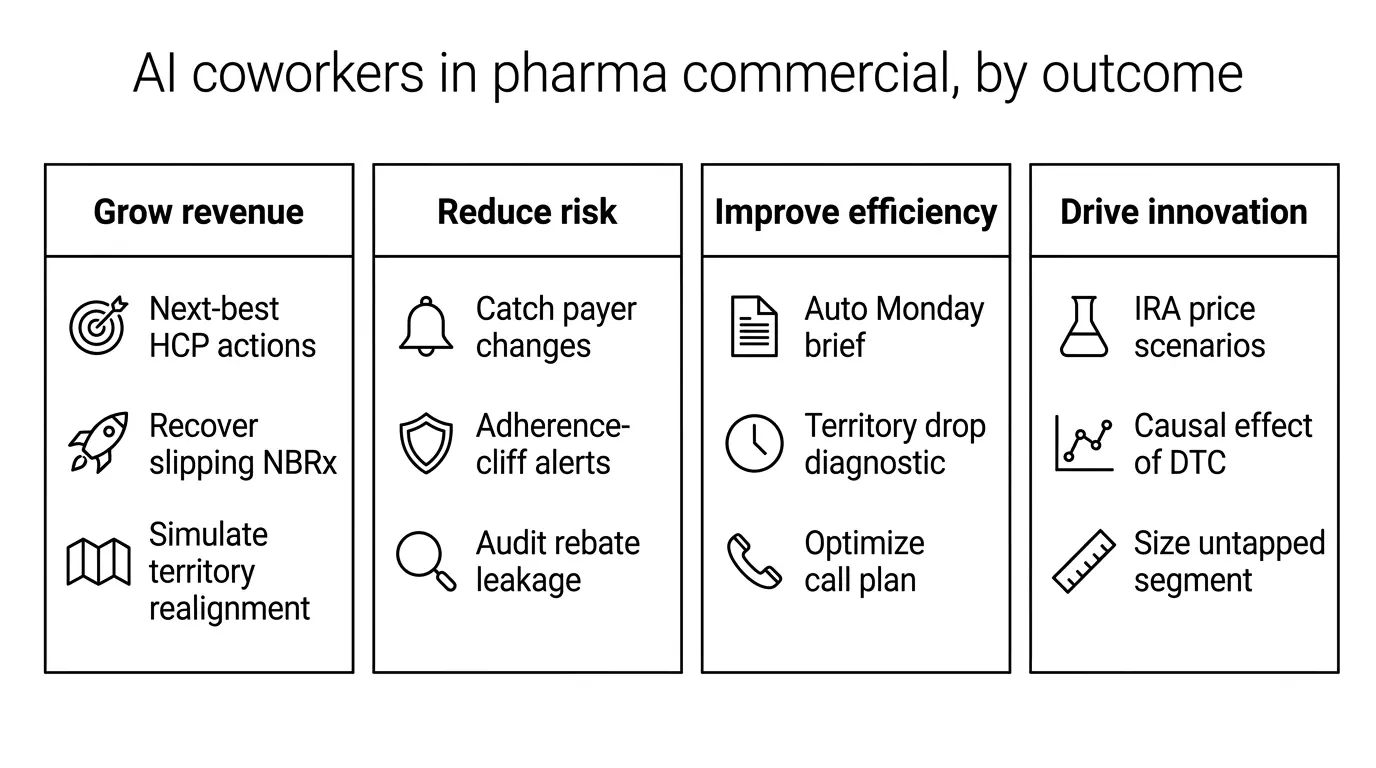
No industry has more riding on getting AI right than pharma commercial — and few move faster. The data is messy, every action is regulated, and the field is won or lost one call at a time. That's why grounded AI agents have found their footing here first: across the four outcomes below, they turn scattered claims, calls, and payer signals into the next move a brand, field, or access team can actually make.
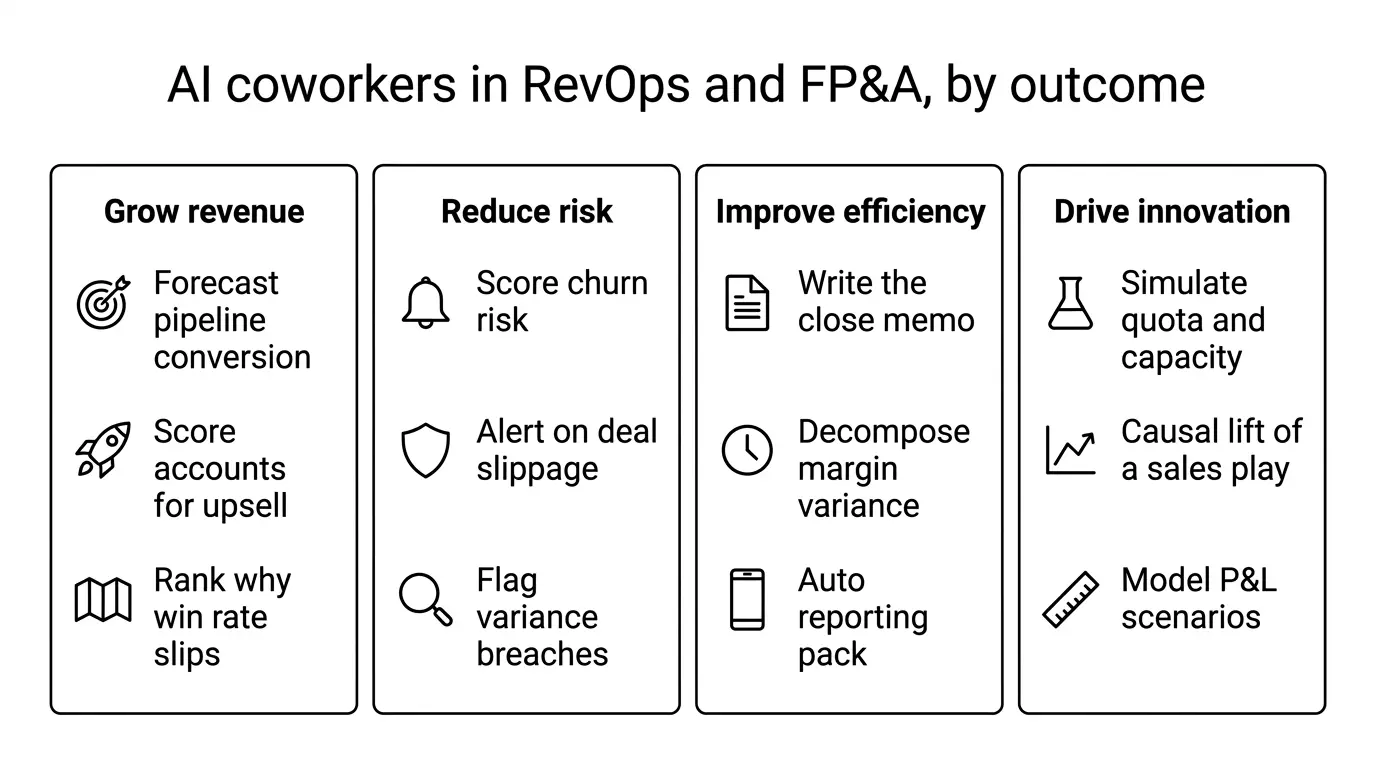
Grow revenue
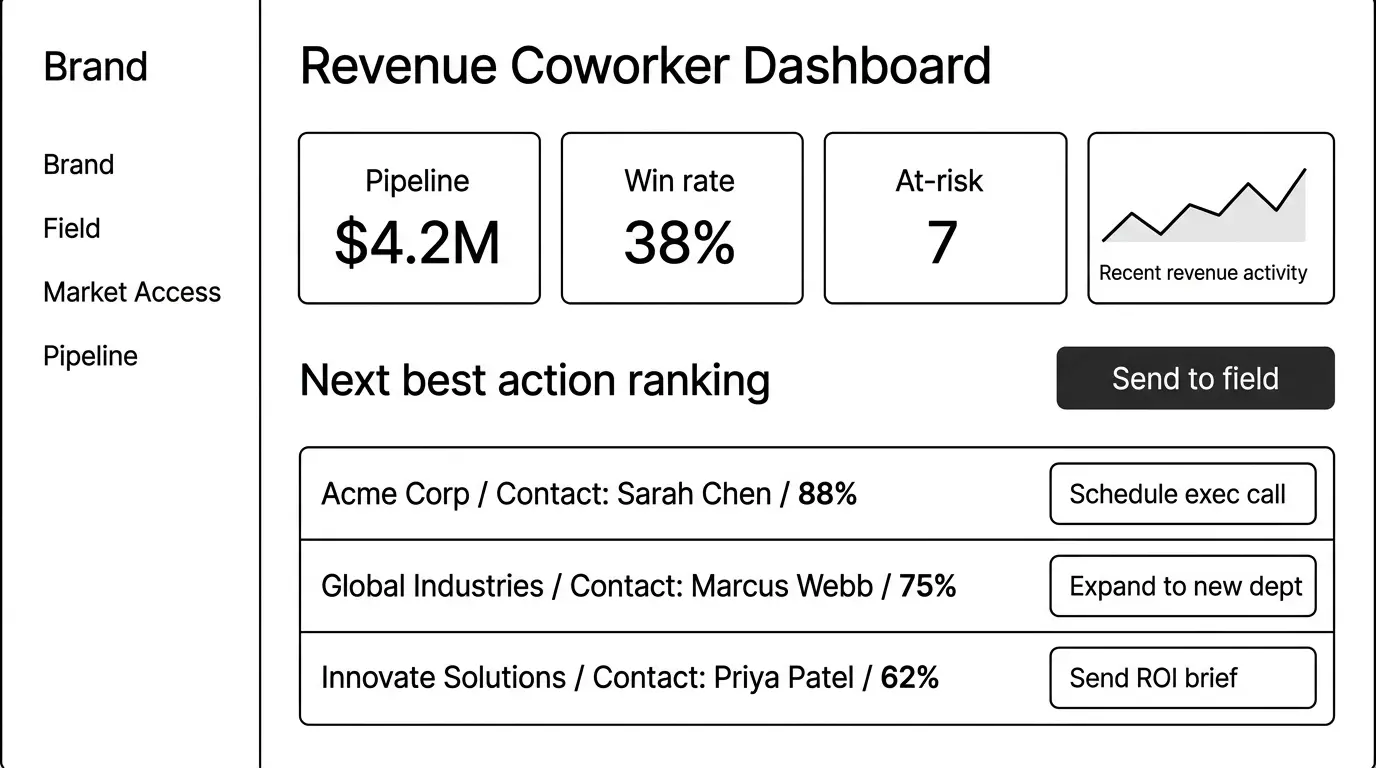
- 1. Rank next-best HCP actions. Score every HCP in a territory on propensity, access, and channel response, and a next-best-action AI agent does exactly that, refreshing the ranking as new claims and engagement data land. The finished call list shows up inside the rep's Kaiya App, not a dashboard they have to decode, with a one-tap push to Veeva. The workflow does the prioritization a team of analysts couldn't keep current; the app turns it into the rep's actual Monday plan.
- 2. Brief the rep before every call. Ahead of each visit, a pre-call agent assembles a 360-degree brief covering prescribing trend, formulary status, recent touchpoints, and open barriers, reading both structured history and unstructured call notes. The rep opens their app to that brief on the drive over and can ask follow-ups conversationally, so the workflow's synthesis and the app's in-the-moment delivery replace an hour of prep with a thirty-second read.
- 3. Track the launch trajectory. When a launch is live, an agentic workflow continuously benchmarks first fills and depth and breadth of prescribing against comparable past launches, flagging markets pulling ahead or falling behind. The brand team lives in a launch app that updates itself, so instead of reading the launch three weeks late in a static deck, they see where to lean in while the window is still open and route the play to the field from the same screen.
- 4. Recover slipping NBRx. When NBRx dips, a recovery AI agent decomposes the drop across formulary movement, competitor launches, coverage gaps, and payer mix, ranking the drivers by real statistical impact. The brand lead gets a ranked recovery play in their app rather than a chart that says "down 15%," and can dispatch the field and access moves directly. The workflow finds the why, the app turns it into the next move.
- 5. Predict decile movement. Flag which prescribers are climbing or sliding between deciles before the quarter closes, and a predictive AI workflow does it by learning from each cycle's actuals. Targeting refreshes inside the field app automatically, so reps act on where a prescriber is heading rather than where they were, the kind of forward-looking call planning a static decile report can't support.
- 6. Isolate the causal lift of promotion. Separating real promotional lift from what would have happened anyway is the job of a causal agent, which estimates the true incremental effect of rep calls and emails on TRx. The result lands in the brand or ops app as a spend recommendation, so promotional dollars get reallocated to what actually works. The workflow runs the causal model, the app makes it a budget decision someone can approve.
- 7. Optimize channel mix per HCP. Recommend the right blend of rep, email, and digital touch for each prescriber based on individual response history, and a channel agentic workflow handles it per HCP. Those recommendations populate the rep's app and feed orchestration tools, so the next best channel is chosen rather than guessed, personalization at a scale no manual plan reaches.
- 8. Simulate a territory realignment. Before anyone commits to redrawing territory lines, a what-if AI agent models the revenue impact, balancing workload against account potential. Leadership explores the scenarios in an app and locks the winning design, so a realignment that used to take weeks of spreadsheet modeling becomes an afternoon of grounded simulation with the decision captured in one place.
- 9. Find the switch window in line-of-therapy data. Reading line-of-therapy patterns, the agent pinpoints exactly where a competitor loses patients after second line, the moment switching campaigns pay off. The brand team gets the target list and timing in their app, ready to activate, so the workflow surfaces the clinical window and the app turns it into a campaign before it passes.
Proof: In one anonymized deployment, this kind of grounded targeting drove a 7% market-share gain worth about $7.2 million in sales, alongside a 43% lift in demand.
Reduce risk
Risk in commercial pharma hides in far more than market access. A payer quietly restricts coverage, a patient cohort starts lapsing, a competitor's launch chips away at share, disputable rebate dollars leak out the back — and each tends to surface in the numbers long after the moment to act has passed. A grounded agent watches all of it at once and surfaces the threat early, with the cause already attached, while there's still time to respond.
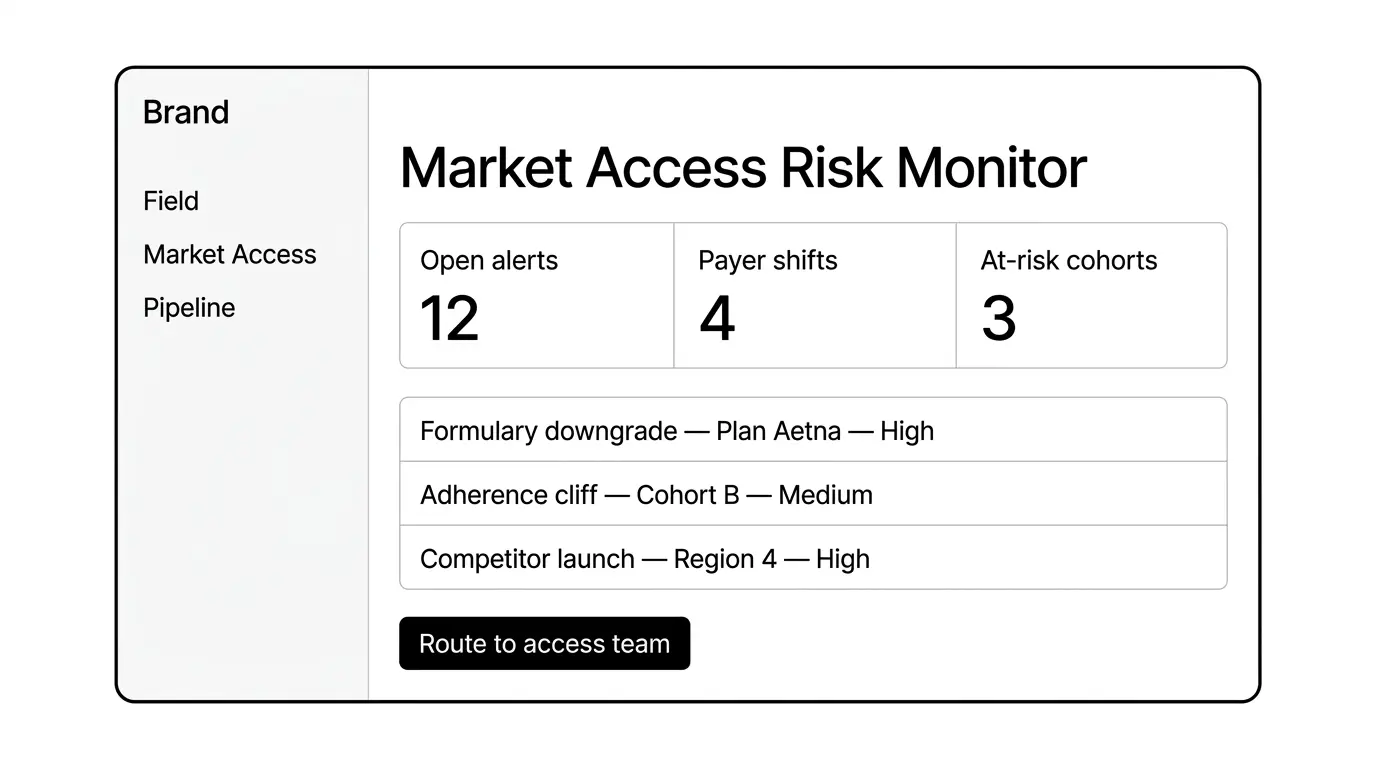
- 10. Catch payer changes within days. An always-on agent watches formulary, prior-auth, and tier feeds and flags a shift within days instead of the 60 to 90 it takes claims to reveal it. Market access sees the alert in their app with the affected products and accounts already attached, so the early detection becomes a same-week field and contracting response rather than a post-mortem.
- 11. Predict next-cycle access restrictions. Score which plans are most likely to restrict access next cycle, and a predictive agentic workflow does it by learning from historical formulary behavior. The access team works the ranked watchlist from their app, getting ahead of restrictions with pre-emptive contracting moves, anticipating the cliff instead of reacting to it.
- 12. Model discontinuation risk. When a patient cohort starts showing risk in adherence, fill gaps, and support signals, an AI agent scores who's about to lapse. Brand and patient-services teams get the at-risk cohorts in their app and trigger the right intervention, turning the workflow's prediction into a retention action while the patient is still on therapy.
- 13. Alert on the adherence cliff. The moment a cohort starts dropping therapy faster than expected, an always-on adherence workflow fires, with the likely cause attached. The alert routes to the right owner's app so the intervention happens during the slip, not after the refills are already gone.
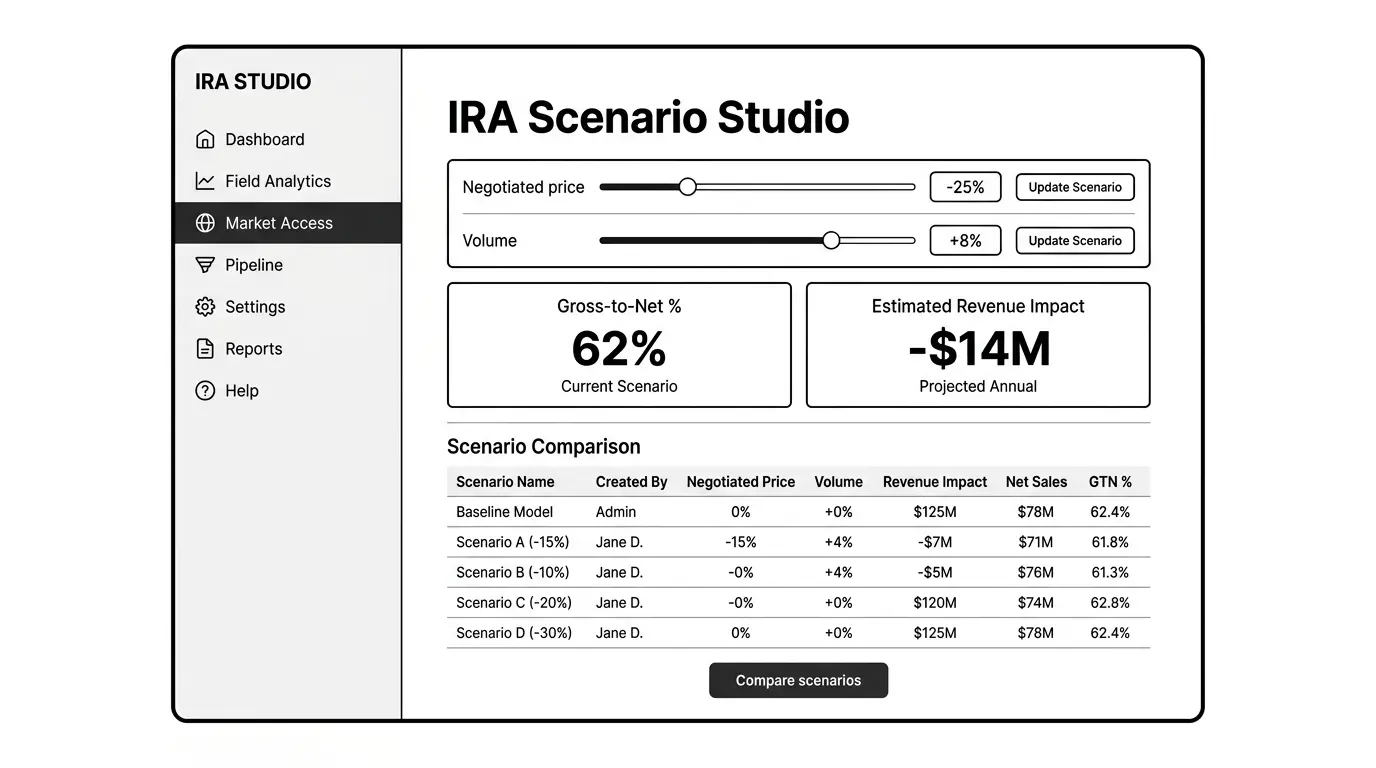
- 14. Run IRA price scenarios. Model gross-to-net and revenue impact across negotiated Maximum Fair Price scenarios with an IRA scenario agent, and the calendar is real: ten Part D drugs hit negotiated prices on January 1, 2026, fifteen more (Ozempic and Wegovy among them) follow in 2027, and a third cycle of fifteen Part B and Part D drugs lands January 1, 2028. Finance and access leaders run the scenarios in a planning app and carry the board-ready output straight into strategy, so a workflow that models the policy and an app that presents the decision replace a quarter of manual analysis.
- 15. Model a formulary loss before it lands. Before a key plan's decision is final, an agentic workflow quantifies the TRx hit if they drop you to non-preferred. Leadership sees the modeled exposure in their app and can weigh a contracting counter-move while there's still time. The workflow does the counterfactual, the app frames the call.
- 16. Audit rebate leakage. Reading contract terms against actuals, a rebate-audit agent surfaces disputable rebate dollars; in one anonymized deployment that kind of work found about $5 million a year and cut the analysis from three weeks to four days. The finance team gets the flagged disputes in an app, ready to action, so the workflow does the forensic reading and the app turns it into recovered dollars.
- 17. Monitor competitive launch threats. The moment a competitor launch starts eroding your share, an AI workflow flags it with the affected markets and segments attached. The brand team gets the early warning in their app and can mount a defense while it matters, detection and response in one loop instead of noticing in next quarter's numbers.
Improve efficiency
Every field organization knows the Monday gap: by the time the weekly numbers are pulled, cleaned, and explained, the week to act on them is half gone. Here the workflow assembles the work and the app delivers it finished, so the analyst stops being a report-builder.
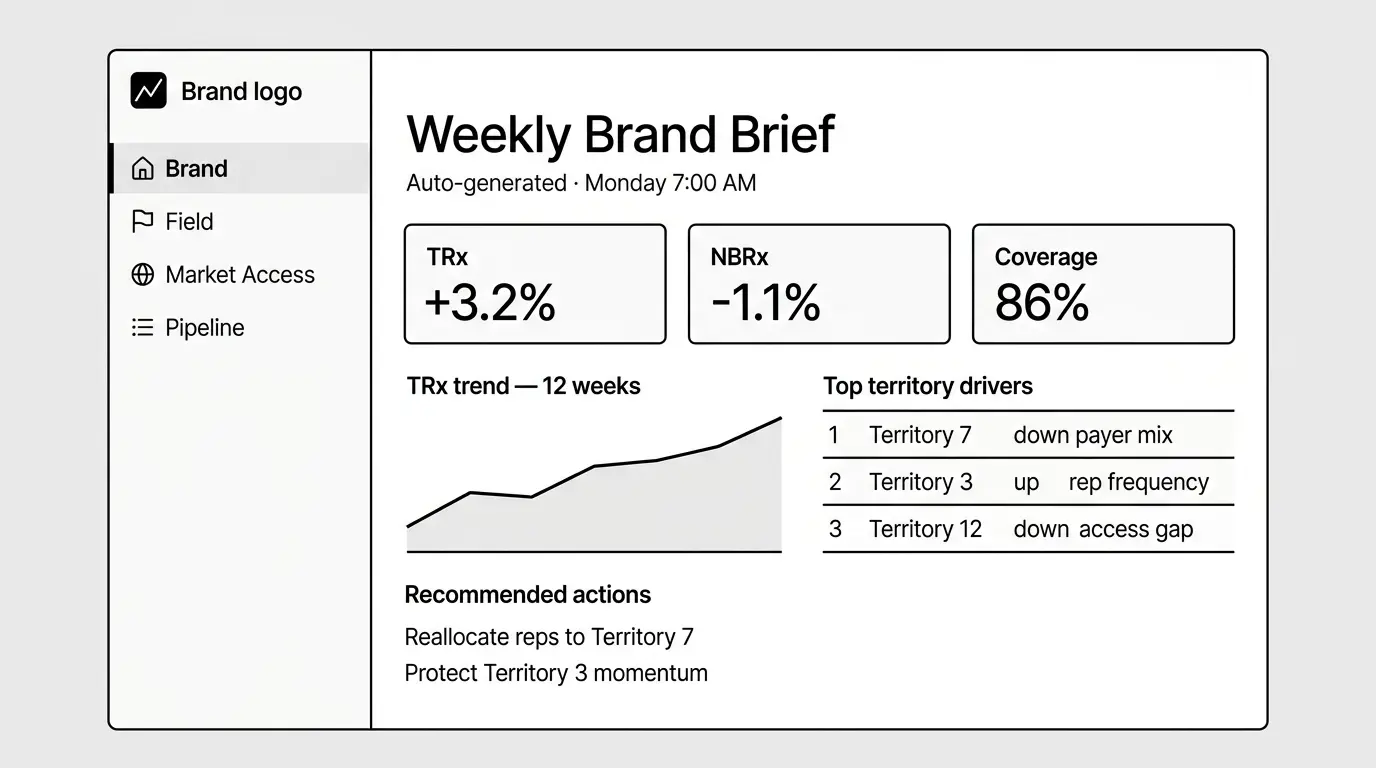
- 18. Write the weekly brand-performance review. Monitoring TRx, NRx, and NBRx by territory, a brand-performance agent writes the weekly review itself in plain language, with the drivers ranked. The brand manager opens their app to a finished read instead of a blank deck, so the workflow does the assembly and the app delivers the narrative.
- 19. Roll up field activity. Rolling calls, reach and frequency, and sample drops into a weekly district view, an agentic workflow reconciles the sources as it goes. District leaders get the finished rollup in their app, freeing the team from the manual stitch-together that used to eat Monday morning.
- 20. Run the "why did this territory drop" diagnostic. Turn the multi-day "why did this territory drop" dig into a few minutes of ranked drivers, which a diagnostic AI agent does by investigating across hundreds of dimensions. The manager asks the question in their app and gets the decomposed answer with sources, so root-cause analysis becomes self-serve instead of an analyst ticket.
- 21. Snapshot payer status. On demand, an AI workflow generates a current payer-status summary, pulling the latest formulary and access positions into one view. It lives in the field and access app so anyone can pull the snapshot before a call without waiting on ops.
- 22. Track the launch. Keep a live view of launch metrics running without anyone staging it, and a launch-tracker agent does exactly that, updating as data arrives. The brand team checks the app for the current read instead of commissioning a refresh, so the tracker is always current rather than as-of-last-Friday.
- 23. Optimize the call plan. Balancing fairness and ROI, a call-plan agentic workflow builds plans that account for potential, access, and reach goals. Managers review and approve the optimized plan in their app and push it to the field, so the workflow does the optimization math and the app makes it the live plan.
- 24. Brief field leaders every Monday. Every Monday, an autonomous AI agent delivers a finished brief to every field leader, decomposing the week's movement and writing the read. It's the exact pattern Novo Nordisk built: the workflow runs over the weekend, the brief is waiting in each leader's app at the start of the week, and nobody assembles it by hand.
Proof: At Bayer, a single signal now fans out into five role-differentiated outputs off one agentic workflow — the AVP sees the area, the district sees the territory, the rep sees a call list.
Drive innovation
Innovation in pharma commercial usually comes down to access design and channel strategy — and what unlocks it is an agent that can read the unstructured evidence (MSL insights, medical commentary, field notes) and weigh it directly against the structured numbers.
- 25. Simulate contract and rebate redesign. Simulate formulary and rebate restructuring scenarios with an AI workflow so the access team can design a new approach rather than react to the old one. They explore the trade-offs in a scenario app and carry the chosen structure into negotiation, turning the workflow's modeling into a contracting strategy.
- 26. Estimate the causal effect of DTC. Isolating it from confounders, a causal agent measures DTC's real effect on new patient starts. The team gets the causal read in their app to justify or kill the channel bet with evidence, the workflow running the inference and the app making it a defensible investment case.
- 27. Estimate co-pay impact on persistence. Including the counterfactual, a causal agentic workflow estimates the real impact of a patient-support or co-pay program on persistence. Brand and patient-services leaders see the effect in their app and design the next program on evidence rather than belief.
- 28. Size an untapped segment. Project uptake in a segment you haven't entered, and an opportunity-sizing AI agent does it by blending market data with analog launches. Leadership reviews the sizing in a planning app to prioritize where the next investment goes, so the workflow does the projection and the app frames the bet.
- 29. Mine MSL scientific insights. Reading MSL insights and medical commentary at scale, an AI workflow blends the themes with structured engagement data to surface a signal nobody had time to find. Medical affairs gets the synthesis in their app, the novel move being that the workflow reads the unstructured field intelligence and the app puts it right beside the numbers.
- 30. Design the next channel bet on evidence. Before any budget is committed, the agent models a new channel strategy end to end across reach, response, and cost. The team pressure-tests it in a scenario app and commits only what the model supports, so experimentation moves out of the market and into a sandbox.
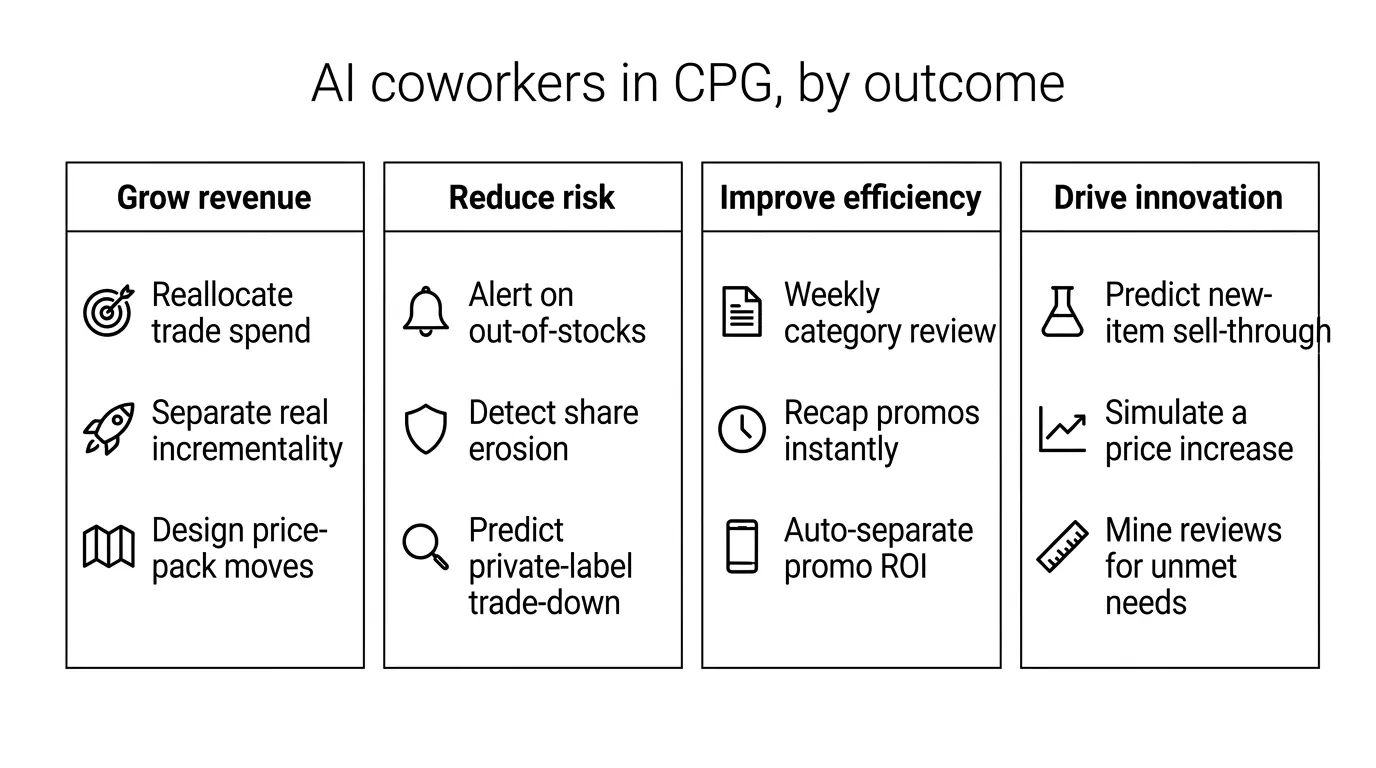
AI coworkers in CPG
CPG runs on thin margins and fast-moving shelves, where a misread promo or a stockout lands in the P&L within the week. Drop an AI agent between syndicated data, trade spend, and the shelf and that pressure turns into an edge — funding what works, catching what's slipping, and pressure-testing the next bet before the market does.
Grow revenue
Trade spend is usually the second-largest line on a CPG P&L and the one nobody fully trusts. Fund the winners, kill the theater.
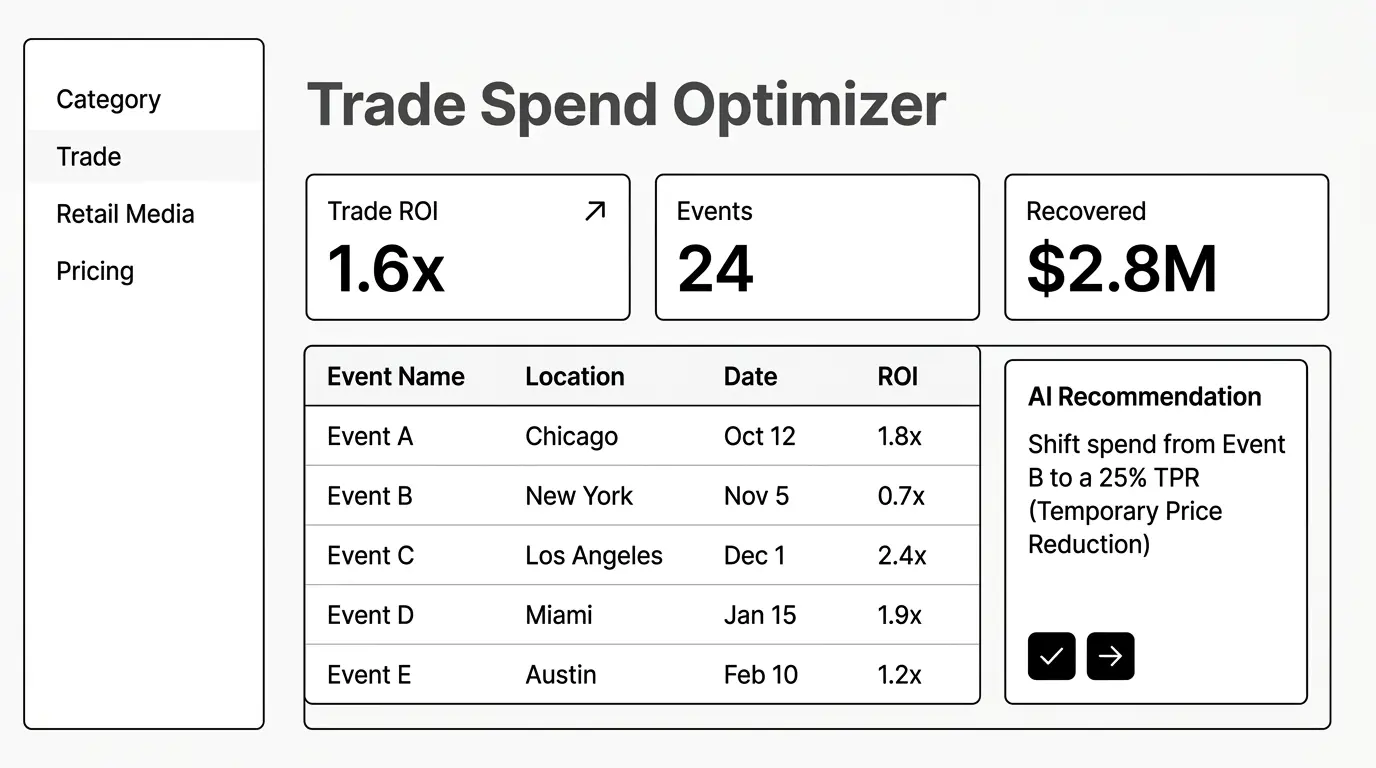
- 31. Reallocate trade spend. Move money from low-return events toward high-return ones and show the math: in one decomposition Tellius surfaced, switching the remaining events to a 25% temporary price reduction recovered an estimated $2.8M in trade ROI. The RGM team works the reallocation in their app and commits it to the plan, so the trade-spend workflow finds the waste and the app turns it into a funded decision.
- 32. Separate real incrementality from theater. When promo lift gets credited wholesale, an incrementality AI agent splits true lift from baseline volume, cannibalized SKUs, and pantry-loading that just borrows from next month. The finished decomposition lands in the category app so the team funds winners and kills theater without arguing the math by hand.
- 33. Recommend SKU additions by store cluster. Category managers find out which SKUs to add in which store clusters from an AI workflow that reads real demand signal and runs white-space analysis. The cluster-level recommendations arrive in their app, ready to take into the buyer conversation, so the workflow does the clustering and the app makes it an assortment ask.
- 34. Design price-pack architecture off elasticity. Instead of pricing by gut feel, an agent builds price-pack moves on measured elasticity by pack and region. Pricing reviews the recommended architecture in their app and models the revenue effect before committing, turning the workflow's elasticity read into a concrete plan.
- 35. Predict event lift before committing. Forecast a promotional event's lift before a single dollar is spent, with an agentic workflow that learns from prior events. The category team sees the projected lift in their app and greenlights or reshapes the event, so the bet gets tested in a model first.
- 36. Reallocate retail-media budget. Shifting retail-media spend toward the placements that actually convert is the job of an AI agent that refreshes as performance data lands. The shopper-marketing team approves the reallocation in their app, so the workflow does the optimization and the app makes it a live budget move.
- 37. Measure the causal lift of retail media. Vanity click counts get replaced by a real number when a causal AI workflow estimates the true incremental sales lift of retail-media spend. The team gets the causal read in their app to defend or cut the line, with an ROI a finance partner will accept.
- 38. Rank category-share-loss drivers. When a category is losing share, a diagnostic agent ranks the reasons — distribution, price, assortment, competition — by real impact. The recovery plan lands in the category app targeting the right driver, so the agent does the decomposition and the app turns it into the fix.
Reduce risk
A CPG risk coworker lives close to the shelf and the scan. None of these are interesting as numbers; they're interesting as the few hours of warning that let someone fix it.
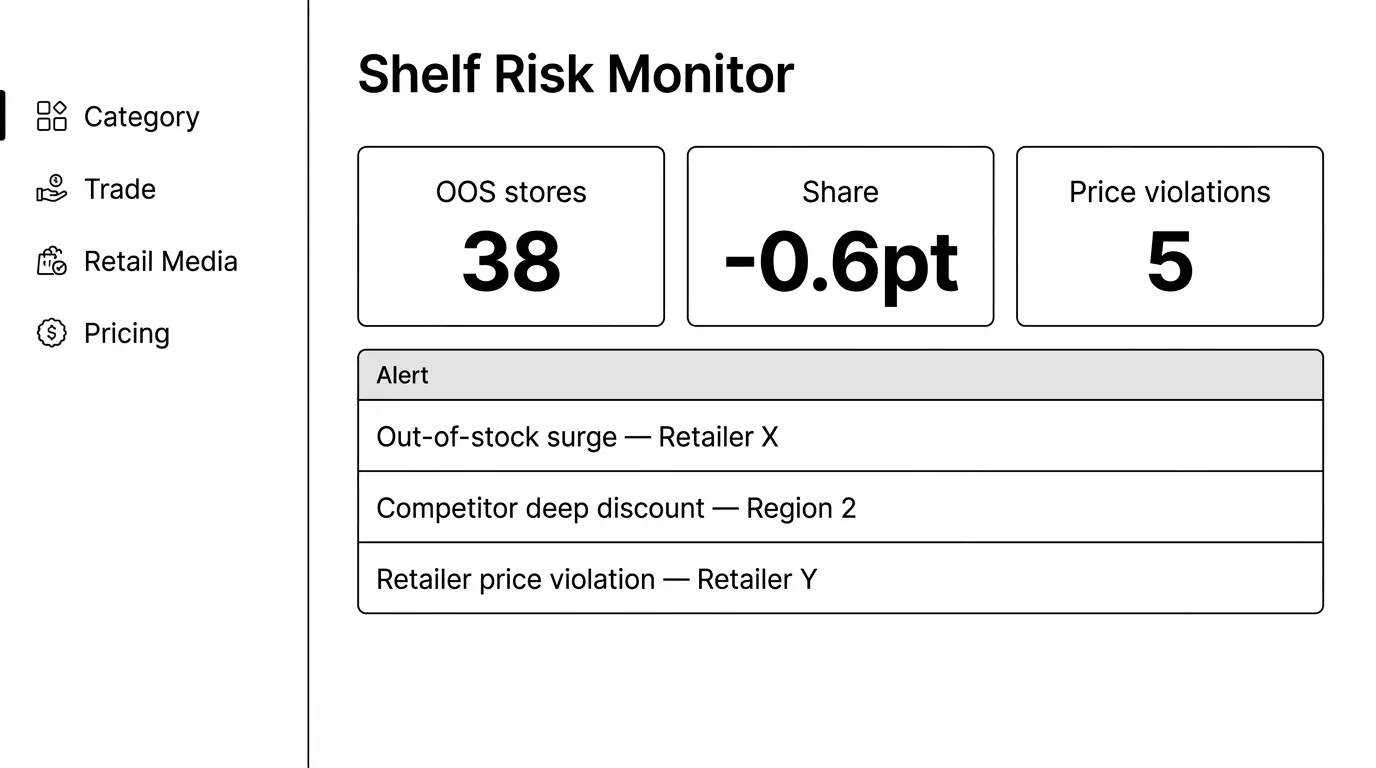
- 39. Alert on out-of-stock surges. Store-level out-of-stock surges are pure lost sales, and an always-on agentic workflow flags them the moment they spike, with the likely cause attached. The alert routes to the field or supply app so someone fixes it in hours, not after the week's sales are already gone.
- 40. Forecast demand off POS. Planners forecast off what's actually selling rather than what shipped, working from a POS-based demand AI agent that cuts both stockouts and overstock. They build the order from the forecast in their app, so the agent reads true sell-through and the app turns it into the order.
- 41. Detect accelerating share erosion. Catch share loss as it starts to accelerate — not after it's done — with an AI workflow that attaches the drivers to the alert. The brand team gets the early signal in their app and acts while the trend is still bendable.
- 42. Flag competitor deep-discount events. When a rival launches a new deep-discount event, a monitoring agent catches it before it eats your volume. The category team sees it in their app with a recommended counter, so detection and response happen in one loop.
- 43. Catch retailer price violations. Retailer pricing violations surface fast because an agentic workflow scans price feeds continuously and detects when an agreed price is broken. The violations land in the account team's app ready to raise, turning the monitoring into an enforced agreement.
- 44. Predict private-label trade-down. Flagging which shoppers or segments are about to trade down to private label is the work of a predictive AI agent reading price sensitivity and behavior. The brand team gets the at-risk segments in their app to defend with targeted offers before the switch.
- 45. Watch distribution and %ACV slippage. When distribution or %ACV starts to slip before it shows up in sales, an AI workflow raises the alert. The field and account teams see the slippage in their app and chase the reset, so the warning arrives in time to act.
Improve efficiency
The CPG version of the Monday gap is the weekly category review and the post-event promo recap. The category manager walks into the buyer meeting prepared instead of scrambling.
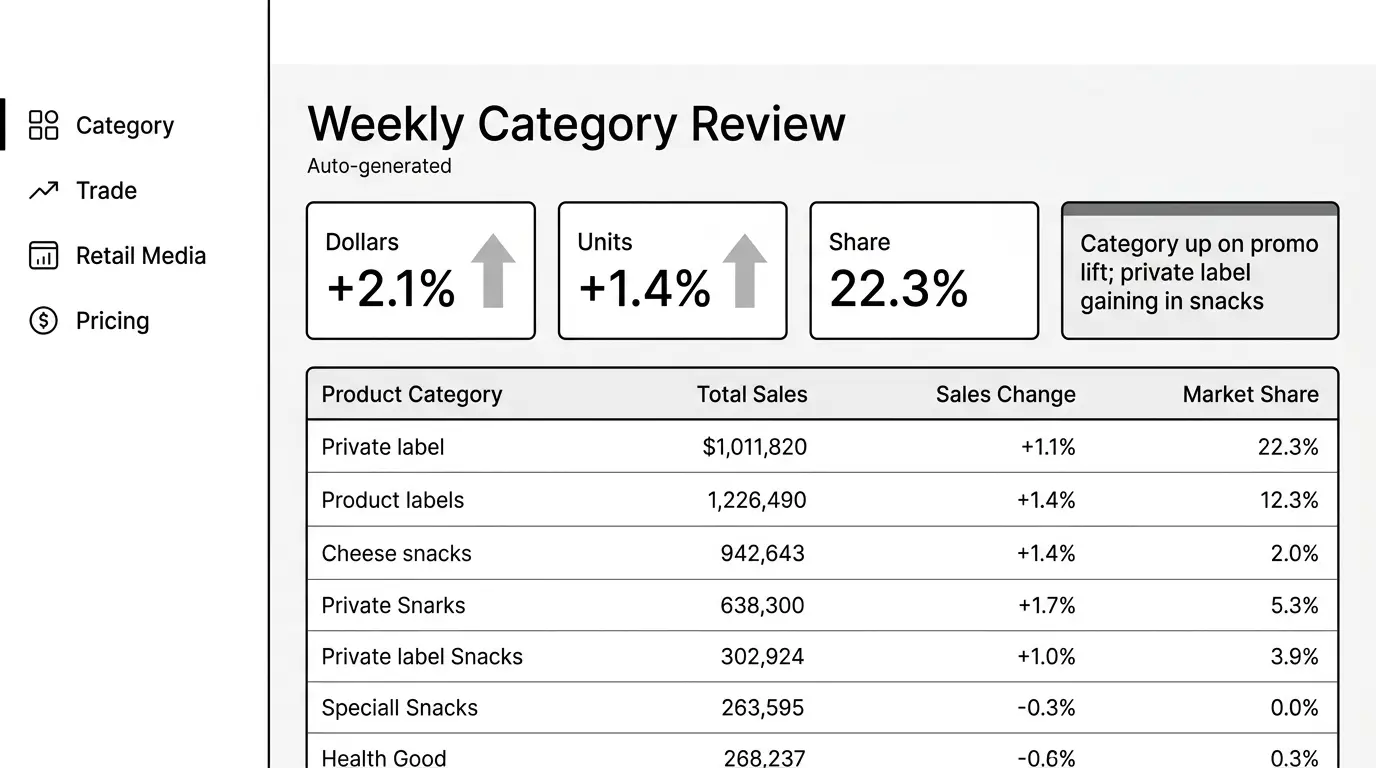
- 46. Summarize the weekly category review. Rolling dollars, units, and share by category and retailer into a finished weekly review in plain language is handled by the agent, not the analyst. The category manager opens their app to the read instead of building it, so the workflow assembles and the app delivers.
- 47. Recap a promo the moment it closes. The moment an event closes, a promo-recap agentic workflow reports lift, units, and spend with the verdict attached. The recap lands in the team's app automatically, so post-event analysis is done before the next planning meeting rather than weeks later.
- 48. Auto-separate promo ROI. Auto-separate real incrementality from cannibalization and pantry-loading for every promo so nobody argues the math by hand, with an AI agent doing the split. The clean ROI shows up in the category app, ready to inform the next event.
- 49. Track distribution and %ACV. Distribution and %ACV metrics stay current without manual pulls because an AI workflow reconciles sources continuously. The team reads the live numbers in their app, freeing analysts from the weekly stitch.
- 50. Monitor price gaps. Track price gaps against competitors continuously and surface the ones that matter, with an agent that runs without the monthly report cadence. The category and pricing teams see them in their app, ready to act, instead of finding out weeks later.
- 51. Recap retail-media spend. Reporting that used to lag now runs on its own: an agentic workflow summarizes retail-media performance on a set cadence, tying spend to outcome. The shopper-marketing team gets the finished recap in their app.
- 52. Assemble the buyer-meeting prep. Pulling the full category story — share, distribution, promo, price — into a buyer-ready narrative ahead of the meeting is the job of an AI agent. The category manager walks in with the finished prep in their app instead of scrambling the night before, so the agent does the assembly and the app is the leave-behind.
Proof: PepsiCo moved reporting that used to take days down to hours by letting the agent build the recap instead of the analyst.
Drive innovation
The point is to test the bet in a model instead of in the market.
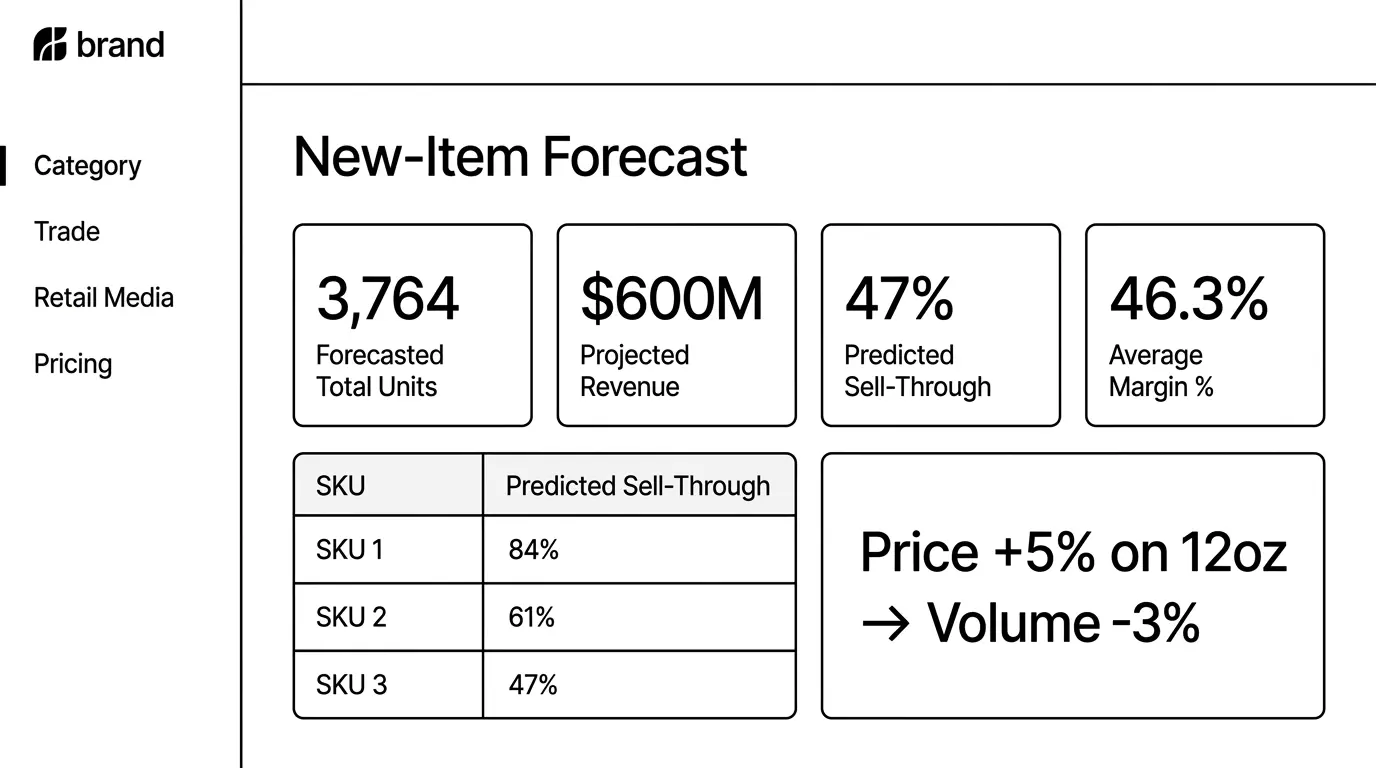
- 53. Predict new-item sell-through. De-risk the NPD calendar by forecasting innovation sell-through before launch, with an AI workflow that blends concept attributes with analog histories. The innovation team reviews the prediction in their app and prioritizes the launches worth backing, testing the bet before the shelf does.
- 54. Simulate a price increase. Pricing teams model the volume and revenue effect of a price move by pack and region before they make it, using an agent that runs the scenarios. They explore the options in their app and commit only the moves the model supports, so the increase is tested in a sandbox instead of the market.
- 55. Estimate marketing-mix contribution. Estimate each channel's true causal contribution with a marketing-mix agentic workflow — worth noting given how the measurement landscape shifted when Circana completed its acquisition of Nielsen's marketing-mix-modeling business in August 2025. The team gets the contribution read in their app to reallocate with confidence, the workflow doing the modeling and the app making it a budget decision.
- 56. Simulate SKU rationalization. Before anyone delists, an AI agent models the category impact of the cut, accounting for switching and walk-away. The team reviews the simulated impact in their app and rationalizes without guessing, so a risky cut becomes a modeled one.
- 57. Mine reviews for unmet needs. Pull unmet-need themes out of reviews and social at scale and rank them by frequency and sales linkage, with an AI workflow that reads the unstructured voice. The innovation team gets the themes in their app to feed the pipeline with something customers actually said, the app turning it into a brief.
- 58. Test a new pack format. Vet a new pack format before tooling is committed: an agent models the category and revenue impact, drawing on elasticity and analogs. The team pressure-tests it in their app, so the format gets proven before the money goes in.
AI coworkers in RevOps and FP&A
In revenue operations and finance, the job is to turn pipeline and plan into decisions nobody regrets — and to never get blindsided. An AI agent that reasons across the funnel, the forecast, and the ledger trades reactive scrambling for a standing read on what's coming and what to do about it.
Grow revenue
The highest-value coworker here is the one that tells you what your current pipeline will actually become.
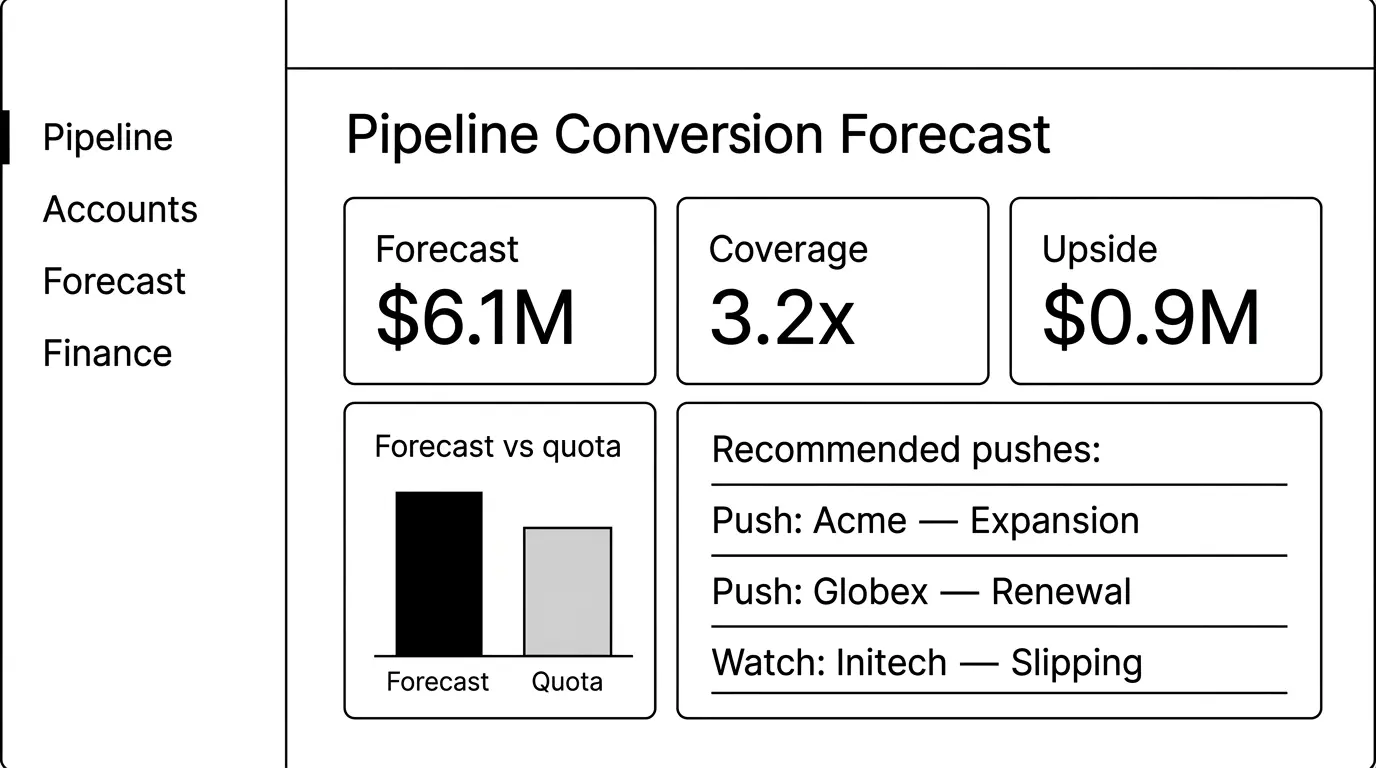
- 59. Forecast pipeline conversion. Predict bookings from the pipeline you actually have, learning from historical win patterns to point at where to push. The forecast lands in the CRO's app as a more honest artifact than a rep-submitted commit, and the recommended pushes route to the right reps. The workflow does the prediction; the app makes it action.
- 60. Rebalance routing and territories. When coverage is left to chance, an AI agent makes it deliberate, modeling routing and territory balance against potential and capacity. RevOps approves the rebalance in their app and pushes it live, so the workflow does the optimization and the app commits it.
- 61. Recommend save-and-expand plays. CSMs rarely catch the retention-or-expansion moment in time, so an AI workflow surfaces the next move per account from usage, support, and buying signals. The recommended play arrives in their app ready to run. The workflow finds the moment; the app delivers the motion.
- 62. Score accounts for upsell. Score accounts for upsell propensity to grow net revenue retention, refreshing as signals change. The ranked list lands in the sales app so reps work the best candidates first instead of guessing, with the agent doing the scoring and the app turning it into outreach.
- 63. Rank why win rate is sliding. When win rate slides, a diagnostic agentic workflow breaks the decline down by segment, competitor, stage, and lead source. Leadership sees the ranked drivers in their app and fixes the right one, so the workflow does the decomposition and the app turns it into a play.
- 64. Set deal-level discount guardrails. Reps and deal desk need margin guidance at the exact moment they quote, so the agent recommends deal-level discount guardrails grounded in win/loss and elasticity that protect margin without killing the deal. The guidance shows up in their app right where the discount decision is made.
- 65. Attribute pipeline to campaigns causally. Marketing keeps crediting last-touch myths, so a causal AI workflow tells them which campaigns actually drove pipeline versus which just showed up in the path. The attribution lands in the marketing-ops app to reallocate spend against a causal read someone can budget against.
- 66. Surface expansion accounts hiding in usage. Find accounts whose usage data signals room to grow before a rep would notice. The candidates surface in the sales app with the signal attached, so the agent does the discovery and the app turns it into outreach.
Reduce risk
In revenue ops and finance, risk is mostly about not getting surprised.
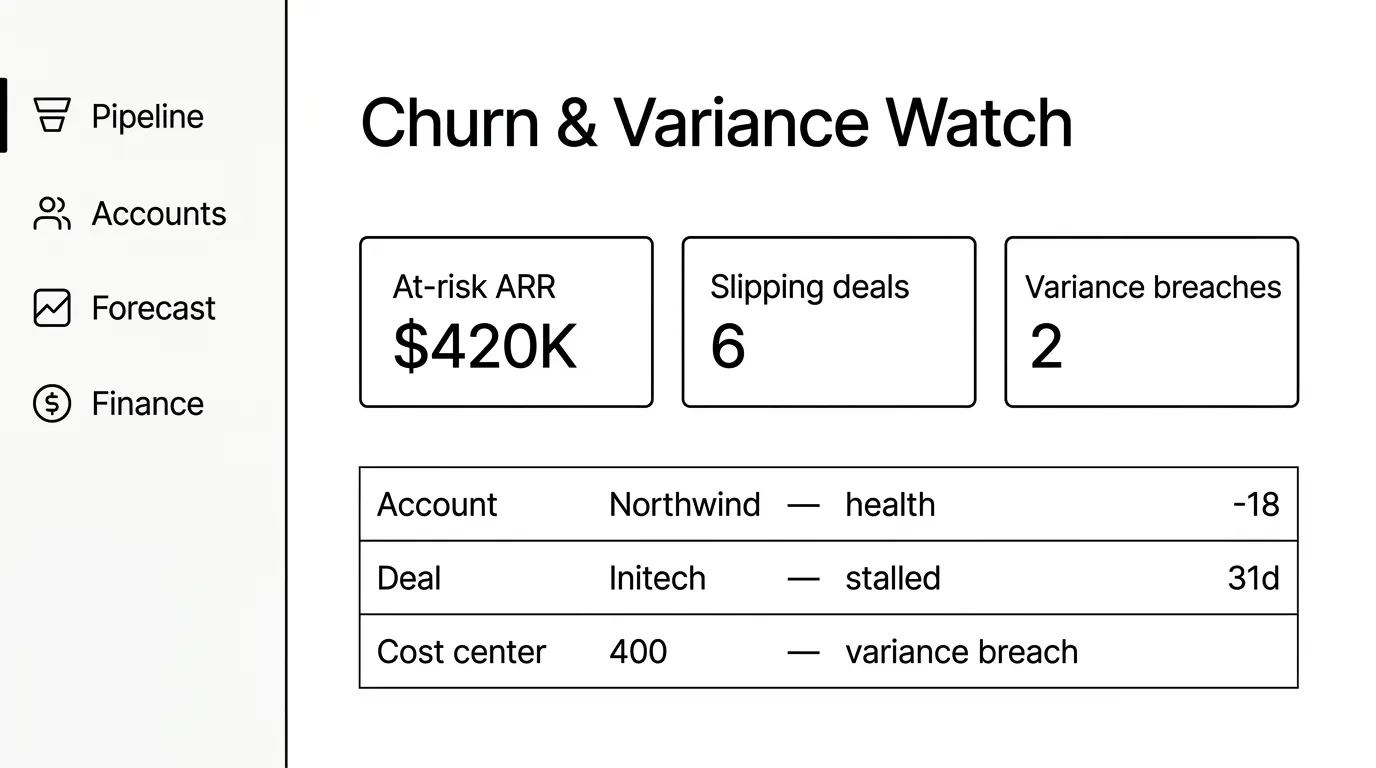
- 67. Score churn risk. A churn agentic workflow scores accounts on the real signals — usage decline, support load, NPS, pricing exposure — and refreshes continuously. The ranked risk lands in the CSM's app with the drivers attached, so the workflow does the scoring and the app turns it into a save play.
- 68. Flag this week's slipping account. Catch the account whose health is dropping right now, not at renewal, with an always-on version of the churn AI agent. The alert routes to the owner's app so the intervention happens this week, while it can still change the outcome.
- 69. Alert on deal slippage. When an opportunity loses velocity in the last thirty days, an AI workflow fires with the stall reason attached. The rep and manager see it in their app and act before the quarter closes around a dead deal.
- 70. Flag variance breaches before close. Catch material variances as they post, before close locks, and explain them. Finance sees the breach in their app with the driver attached, so the agent does the watching and the app makes the fix possible before books close.
- 71. Detect cash anomalies. Treasury can't afford to find unusual cash movements days later, so an agentic workflow surfaces them as they happen by learning normal patterns. The flagged anomaly arrives in their app with context, turning the workflow's monitoring into a same-day investigation.
- 72. Forecast cash flow with confidence intervals. Forecast cash flow with real confidence intervals rather than a single hopeful line. Finance works the range in their app for planning, so the agent does the probabilistic modeling and the app makes it a decision input.
- 73. Stress-test the plan. Run best, base, and worst revenue cases on demand with a scenario AI workflow that holds the assumptions consistent. Leadership explores them in a planning app and commits with eyes open, so stress-testing is a button, not a fire drill.
- 74. Explain last quarter's forecast miss. When a forecast misses, the agent decomposes last quarter's gap — which deals slipped, which segments missed — so you don't repeat it. The explanation lands in the RevOps app, turning a painful post-mortem into a workflow that runs itself.
Improve efficiency
Finance has its own dreaded ritual, and it's month-end.
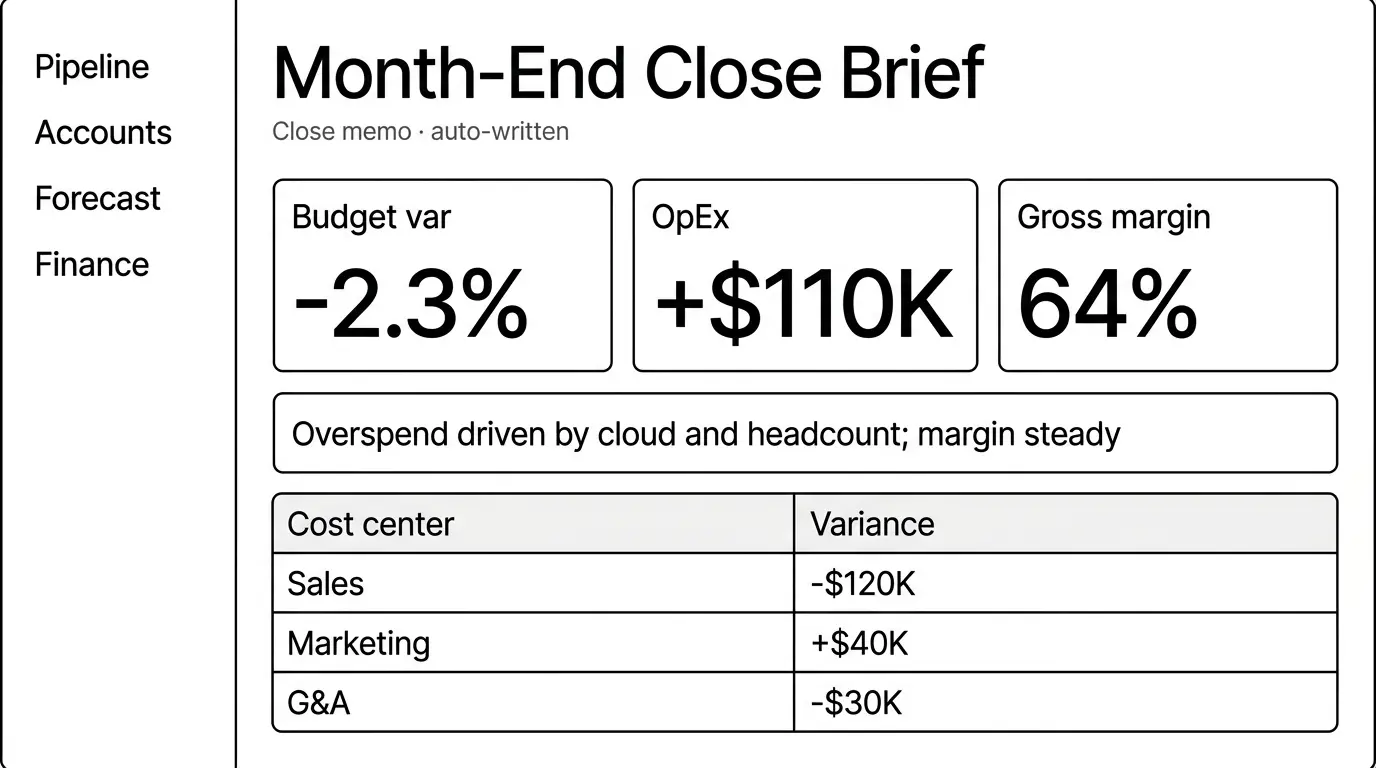
- 75. Write the close memo. Controllers shouldn't have to write the close from scratch, so a close agentic workflow reports budget versus actual by cost center with the narrative already written and sourced to the ledger. They open their app to a finished memo, with the workflow doing the analysis and the app delivering the story.
- 76. Decompose margin variance. Split gross-margin movement into price, volume, mix, FX, and rate automatically. Finance sees the clean bridge in their app, so the decomposition that used to take an analyst a day is waiting on demand from the agent.
- 77. Explain OpEx overspend. An AI workflow attributes cost-center overspend to its sources and ranks them. The cost-center owner gets the explanation in their app, turning the workflow's diagnosis into an accountable conversation.
- 78. Report pipeline coverage. Coverage reporting runs on schedule without a human staging it, reconciling CRM as the agent goes. RevOps reads the live coverage in their app, freeing the team from the weekly build.
- 79. Track NRR and GRR by cohort. Keep NRR and GRR current by cohort with an agentic workflow that recomputes as renewals and expansions land. Leadership reads the live retention picture in their app instead of waiting on a quarterly cut.
- 80. Report bookings and ARR. Steady-state bookings and ARR reporting arrives on cadence from an AI agent, always reconciled. Finance and the board read it in their app, so the recurring report runs itself.
- 81. Track headcount and spend versus plan. When headcount and spend drift against plan, an AI workflow flags it as it happens. The owner sees the variance in their app early, turning the workflow's watch into a course-correction before quarter-end.
- 82. Generate the recurring reporting pack. Assemble the board and QBR reporting pack automatically, with the agent writing the commentary. Pelmorex saw the shape of this — analysis time dropping from 20 hours to about 30 minutes — and PepsiCo describes the same move from days to hours. The workflow builds the pack and the app delivers it ready to present.
Proof: Pelmorex took a recurring analysis from 20 hours to about 30 minutes once the workflow assembled the pack and the app delivered it ready to present.
Drive innovation
On the go-to-market side, innovation means trying a new shape before you commit headcount to it.
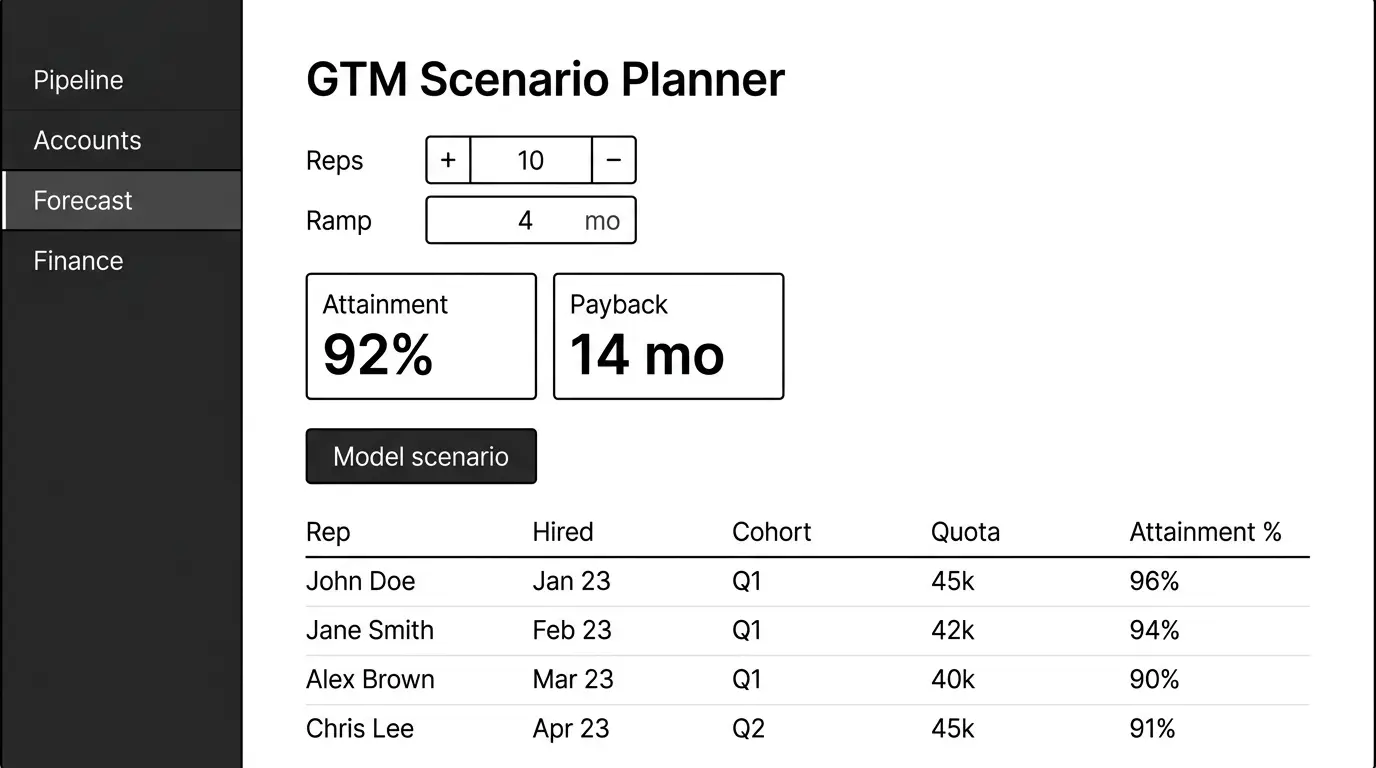
- 83. Model the NRR impact of a packaging change. Before a launch, an agentic workflow models a new package's effect on net revenue retention, accounting for migration and churn. The team reviews the modeled NRR in their app and commits only if the math holds, testing the pricing change before customers feel it.
- 84. Simulate quota and capacity. Model attainment under different ramp and territory designs, surfacing where coverage breaks. Sales leadership explores the scenarios in a planning app and locks the design that hits the number, turning the agent's simulation into next year's plan.
- 85. Estimate the causal lift of a new sales play. Enablement needs evidence before scaling a play, so a causal AI workflow measures its real effect on win rate. The causal read shows up in their app and the winners roll out, replacing anecdote-driven rollout with proof.
- 86. Model the P&L under hiring scenarios. Model the P&L across different hiring scenarios for strategic planning, holding assumptions consistent. Finance and leadership explore them in an app and commit with the trade-offs visible, so the agent does the modeling and the app frames the investment.
- 87. Draft the QBR or JBP narrative. Account leads shouldn't build the QBR by hand, so an agentic workflow blends account metrics with call and meeting themes into a QBR or JBP story that's ready to present. The CSM opens their app to a finished narrative — the novel part being that the workflow reads the unstructured relationship signal and the app turns it into the deck.
- 88. Simulate a new GTM model. Model a new go-to-market shape — segment, motion, coverage — before you commit headcount to it. Leadership pressure-tests it in a scenario app and commits only what the model supports, so the AI agent's bet is tested before it's staffed.
How AI coworkers analyze structured and unstructured data together
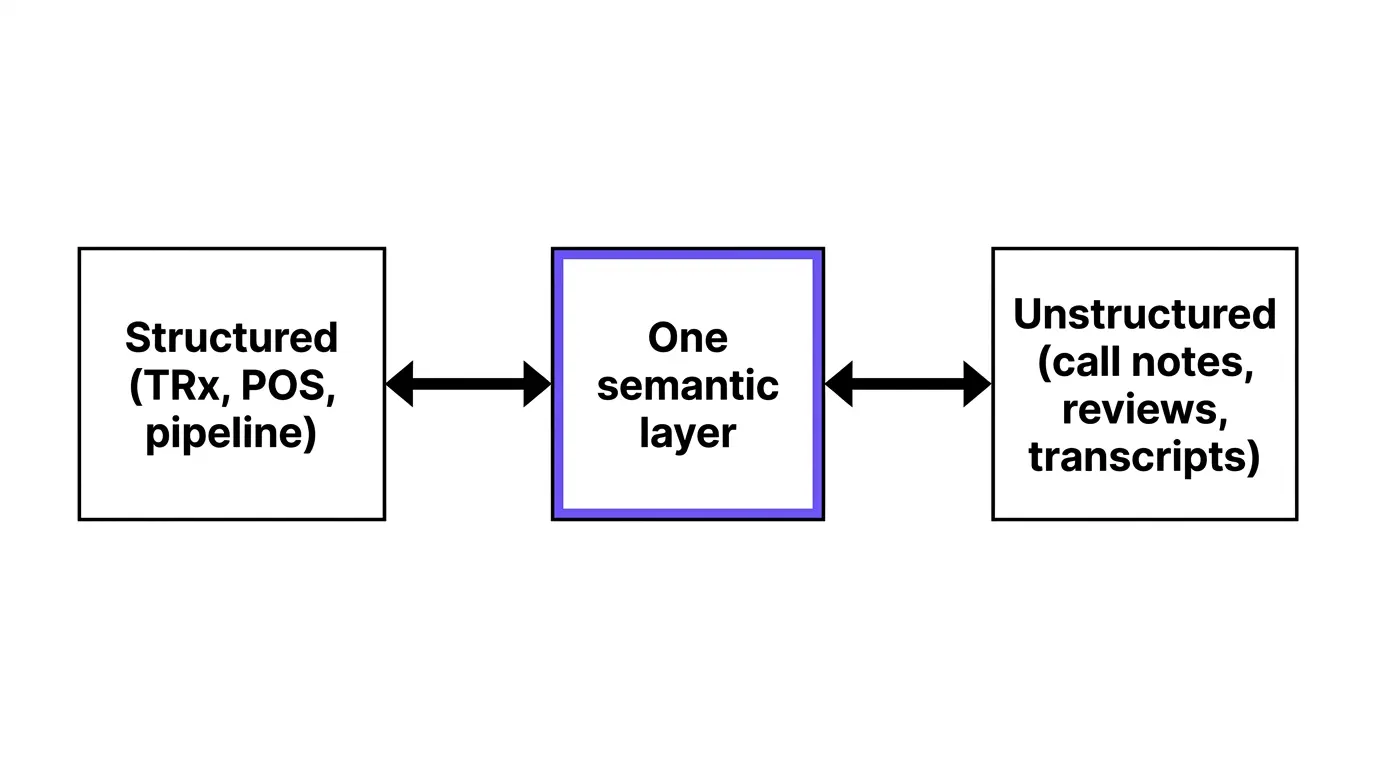
That's the role-by-role tour. This last set cuts across all three — pharma, CPG, and revenue operations — because the "why" almost never lives in one place. Your warehouse has the number; your call notes, transcripts, reviews, and field notes have the reason it moved. A grounded coworker reads both as one source, which means a single agentic workflow can start in structured data and finish in unstructured, or the other way around, with citations on every step.
This matters more than it sounds, because most enterprise data isn't in tables. IDC has put the unstructured share around 90%, and it grows several times faster than the structured kind. Until recently that data was unreadable at scale. Now a coworker can run sentiment, themes, and entity extraction across it and tie the result back to the numbers — which is the move that finally connects "what happened" to "why."
Turn unstructured text into ranked, quantified drivers
Sometimes the signal starts as language, and the job is to put a number on it.
- 89. Quantify HCP adoption barriers. Reading rep call notes, an AI workflow extracts adoption barriers and then quantifies which ones actually correlate with TRx and access by territory, turning a stack of free text into a ranked driver list. The brand team opens their app to those ranked barriers, so the workflow does the language work and the math while the app turns it into where to intervene.
- 90. Link review themes to lost sales. When reviews and social chatter pile up, an agent themes them and connects the negative themes to the SKUs actually losing sales. The prioritized fix list lands in the brand app, bridging unstructured voice and structured sales in a single pass.
- 91. Put a number on churn themes. Churn-risk themes buried in Gong calls and support tickets get pulled out by an agentic workflow, which then sizes the revenue at risk by segment. CS and RevOps see the dollar-weighted themes in their app, so qualitative signal becomes a quantified priority they can act on.
- 92. Quantify contract-language exposure. Finance and legal need to know what the renewal and revenue exposure hiding in contract terms actually adds up to. An AI agent reads those terms and ranks the exposure in their app, turning dense language into a number leadership can plan around.
- 93. Rank field-note barriers to access. Extract the access frictions buried in field notes and an AI workflow can rank them by TRx impact. The access team gets those ranked frictions in their app, so the field's own words get tied to the numbers that matter.
Explain a moving metric with the human reason behind it
Other times you own the number and need the color behind it. The number tells you where to look; the text tells you what's actually going on.
- 94. Explain a key-account TRx drop. When a TRx drop hits a key account, an agent reads the call transcripts and notes to find the human reason behind it, like a new prior-auth process quietly frustrating the office. The rep opens their app to both the number and the why, moving from metric to narrative in one investigation.
- 95. Explain a retailer share loss. The category team wants to know why share slipped at a retailer, so an agentic workflow flags the loss and reads field-rep notes and reviews to explain it, whether a planogram reset or a quality complaint. The explained loss shows up in their app, pairing the number with the reason and making it actionable.
- 96. Explain a forecast miss. Instead of a week of post-mortem interviews, an AI agent flags the forecast miss and reads the deal notes and call transcripts to see which deals slipped and why. RevOps gets the explained miss in their app, so the analysis writes itself.
- 97. Explain a cost variance. Flag a cost variance and an AI workflow pulls the PO notes and prior commentary that explain it. The cost owner sees the explained variance in their app, connecting the ledger to the context behind it.
- 98. Explain an NPS or CSAT dip. The CX team watches an NPS or CSAT dip, and an agent reads the verbatims behind the score to find what changed. The explained dip lands in their app, turning a falling number into a specific, fixable cause.
Read the numbers and the narrative together in one pass
Often the best work blends them in one pass.
- 99. Build the medical-affairs view. Themes the numbers alone would miss surface when an agentic workflow combines structured engagement data with MSL scientific insights in a single read. Medical affairs gets the blended view in their app, with the workflow reading both data types and the app putting them side by side.
- 100. Prep the joint business plan. Pair syndicated share with buyer-meeting notes and an AI agent can build the JBP story from both. The account team opens their app to a plan grounded in the numbers and in what the buyer actually said, so the workflow does the synthesis and the app is the artifact.
- 101. Build the QBR from metrics and themes. When a customer-success QBR is due, an AI workflow combines account metrics with support and call themes into the finished deck. The CSM gets it in their app, with quantitative health and qualitative signal blended into a story ready to present.
- 102. Run pharmacovigilance signal detection. Safety teams need signals earlier, so an agent reads structured adverse-event rates alongside the free-text case narratives to detect them. The flagged signal arrives in their app with both views attached, the dual read done inside the governance perimeter.
- 103. Tie complaint rates to verbatims by SKU. Spikes become specific, named defects when an agentic workflow connects consumer-care complaint rates to the verbatim logs behind them, SKU by SKU. Quality and brand teams get the linked view in their app, with the math and the words joined in one pass.
- 104. Map competitive threats from loss data. A grounded agent joins loss rates to the loss-reason notes reps actually wrote, mapping where competitors are winning. Product marketing gets the threat map in their app, so structured losses and unstructured reasons get read together and turned into a counter-strategy.
How it works: how agentic coworkers can output finished, deterministic work
Three ingredients are critical to ensuring the AI agent does the right work and outputs it in the right way: domain expertise, data context, and a governed semantic layer.
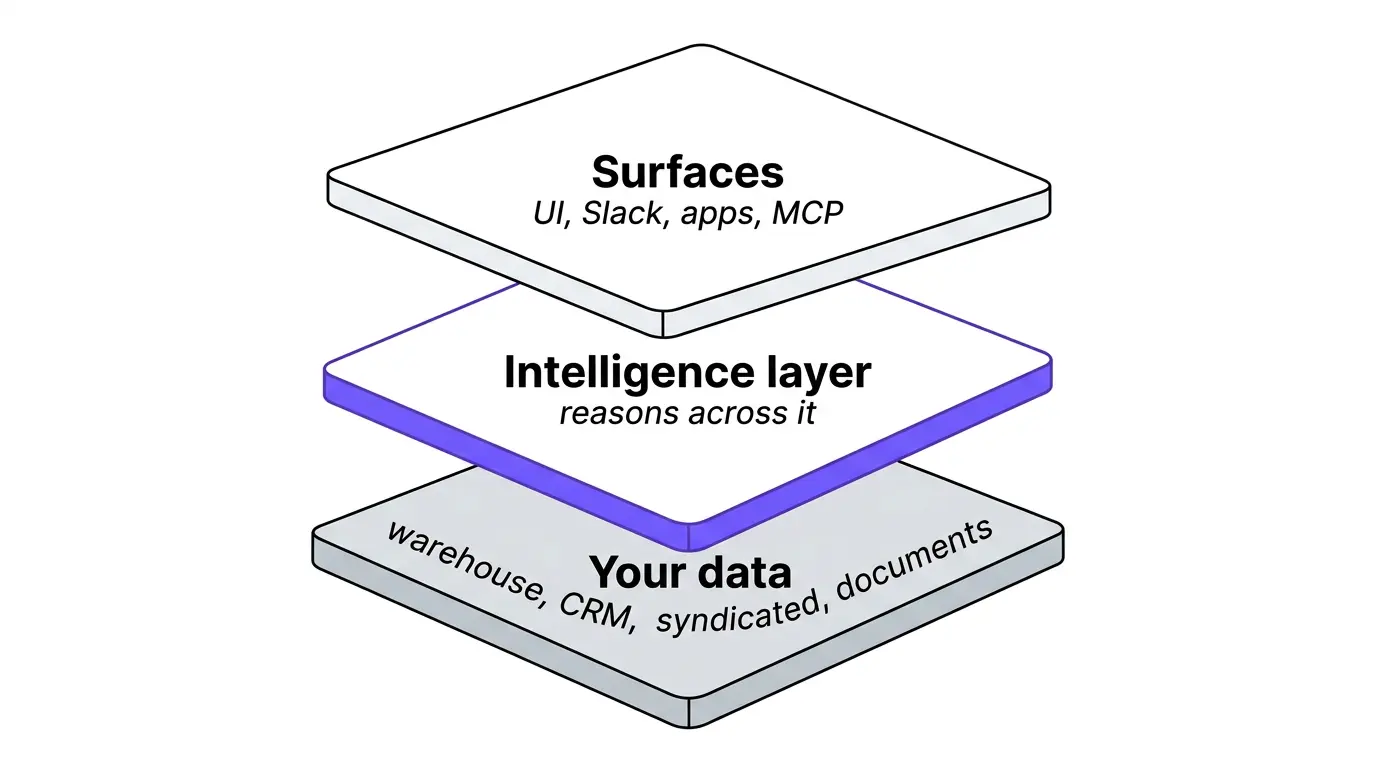
Context and reasoning. Two engines do the heavy lifting. A context engine knows what your metrics mean, how your data is modeled, and your business logic — so the coworker isn't guessing what NBRx is. A reasoning engine knows how a good analyst actually works: how to plan an investigation, decompose it, rank the drivers, and validate the result. Context tells the system what your data is; reasoning is what it does with it. Together they're what Tellius means by the intelligence layer that connects your data to your decisions.
The semantic layer, and why answers repeat. Underneath sits a governed semantic layer: a metrics layer with versioned KPI definitions, an ontology that knows a doctor prescribes a drug and a territory rolls up to a region, plus your hierarchies and fiscal calendar. This is what makes the work deterministic — same question, same answer, every time. When something drops, the platform investigates across hundreds of dimensions and ranks the drivers by statistical impact rather than guessing at SQL on a complex schema, where a language model can quietly double-count rows or mis-aggregate and never tell you.
How the layer gets built. In Tellius, Kaiya Architect is the AI data-modeling agent that builds that governed layer from your raw structured sources through conversation, and validates the result before publishing. One design partner stood up eight models in two weeks — work their engineering team had previously scoped at roughly ten.
Why it gets smarter. Persistent memory means every definition, correction, and preference the coworker learns stays learned across sessions. A stateless copilot is the same on day 500 as it was on day one; a coworker with memory isn't.
Why this matters for regulated teams. Every answer cites its source and traces back to defined logic, which is exactly what a pharma compliance team, a CFO, or an auditor asks for first. Row-level security, SOC 2 Type II, and HIPAA mean the coworker runs inside your governance perimeter, not around it.
The mechanic, in one line. The job gets defined once as a deterministic AI workflow, and the coworker runs it on a schedule or on demand. The finished work ships through a role-scoped agentic app — a Kaiya App — where a business user consumes it and acts. Define it once; the agent then monitors, investigates, and delivers on your cadence. That workflow-to-app pairing is what every one of the 104 use cases above is built on.
Where this is all heading
The pieces are converging. AI agents now reason through multi-step analysis, deterministic agentic workflows make that work repeatable and auditable, headless and embedded analytics push results into the tools people already use, and a governed intelligence layer keeps the answers consistent no matter who asks. Put together, analytics stops being dashboards you interpret and becomes finished work delivered into the flow of work. If you want to move on this, start narrow: pick one recurring report or investigation that eats your team's week, and define the metrics and business logic an agent would need to own it end to end. Then pressure-test where you actually stand.
Gartner has named Tellius a Magic Quadrant Visionary five years running, Nucleus Research placed it in the Accelerator quadrant of its 2026 value matrix, and deployments tend to run weeks rather than quarters — pharma commercial in about four to six weeks, market access in eight to twelve.
Get release updates delivered straight to your inbox.
No spam—we hate it as much as you do!


The usual failure isn't a wrong answer on a screen — it's an agent acting on a wrong input. Because agents chain steps, that first error compounds into staffing, spend, and the plan before anyone catches it. Gartner expects more than 40% of agentic projects to be canceled by end of 2027. The fix is grounding, determinism, and real governance.
It's a defined, repeatable investigation that returns the same sourced answer every time. Determinism matters because the system acts: if it might answer differently on the same data, you can't safely let it take action on your business.
A chatbot answers a question and stops. A copilot drafts something when asked. An AI coworker does the whole job — plans the investigation, reasons across your data, and delivers finished work you can act on — and it runs on a schedule, not just when prompted.
A role-scoped application where an AI coworker's finished work gets delivered and acted on. In Tellius these are Kaiya Apps — tailored to a persona (a brand lead, a category manager, a CRO) so the output is already in the right form for the decision.
Yes. A single agentic workflow can read warehouse tables and call notes, reviews, or transcripts as one source, with citations, and move between them in either direction — number to context, or context to number.
Root cause ranks the correlated drivers behind a change. Causal analysis goes further and isolates what actually caused it, including the counterfactual — what would have happened without the promo, the call, or the intervention.
Weeks, not quarters — pharma commercial typically four to six weeks. Every answer cites its source and traces to defined logic, with row-level security, SOC 2 Type II, and HIPAA, so it runs inside your governance perimeter.
The Tellius 6.3 capability that delivers a grounded coworker's finished work across surfaces — the Tellius UI, browser, Slack, Microsoft Teams, dashboards, business apps, and other AI tools through MCP — so the answer reaches people where they already work.
.webp)
AI Agent Use Cases for Enterprise Data Teams: 14 You Can Deploy This Quarter

AI agents are quickly moving from experimental tools to practical, high-impact solutions for enterprise data teams—and the biggest opportunity is in deploying them against real, repeatable analytical workflows. This blog outlines 14 high-value AI agent use cases that teams can implement this quarter, spanning areas like automated root cause analysis, anomaly detection, forecasting, pipeline monitoring, and marketing attribution.