

Tellius is a 5X Visionary in the Gartner MQ for Analytics & BI Platforms

Gartner has named Tellius a Visionary in the Gartner® Magic Quadrant™ for Analytics and Business Intelligence Platforms — for the fifth consecutive year! 🎉 What an honor!
It’s exciting to see the market arriving where we’ve been building for the last 9 years around conversational, autonomous, agentic analytics. In this post we'll unpack why we believe we were named Visionary again a fifth time, what it means for you, and where we see AI & analytics heading next.
What's the Magic Quadrant (MQ)? Who Cares?
The Magic Quadrant is the foremost enterprise software evaluation produced by Gartner, the most influential analyst firm in tech, and it represents the crème de la crème of software vendors judged across a wide range of capability and market metrics.
Hundreds of vendors are assessed each year. Only about 20 land a spot on the 2x2 matrix. That's roughly a 2% rate — tougher than getting into Harvard.
And making it once is one thing. Holding a spot for five straight years in the fast-moving “Visionary” quadrant is the harder feat. Sustaining recognition through a market that keeps rewriting its own rules — this year Gartner re-drew much of the map around agentic AI — is the real signal. It means this isn't a tool chasing a trend. I
In a moment when everyone is “agent-washing” their offerings — with every demo looking the same, and every landing page proming autonomous, conversational, do-it-all AI — a trusted third-party voice like Gartner is how buyers cut through the noise, letting them pressure-test the claims, talk to customers, and score what's real against what's marketing.
Why We Believe We're So Visionary
Everyone has been racing to put AI on top of their enterprise data. And most teams hit the same wall: the model doesn't know what your data actually means. It doesn't know your definitions, your hierarchies, or which source to trust when two of them disagree. So it guesses. And in the enterprise, a confident guess is worse than no answer at all, because guesses scale into wrong decisions, lost trust, and higher risk.
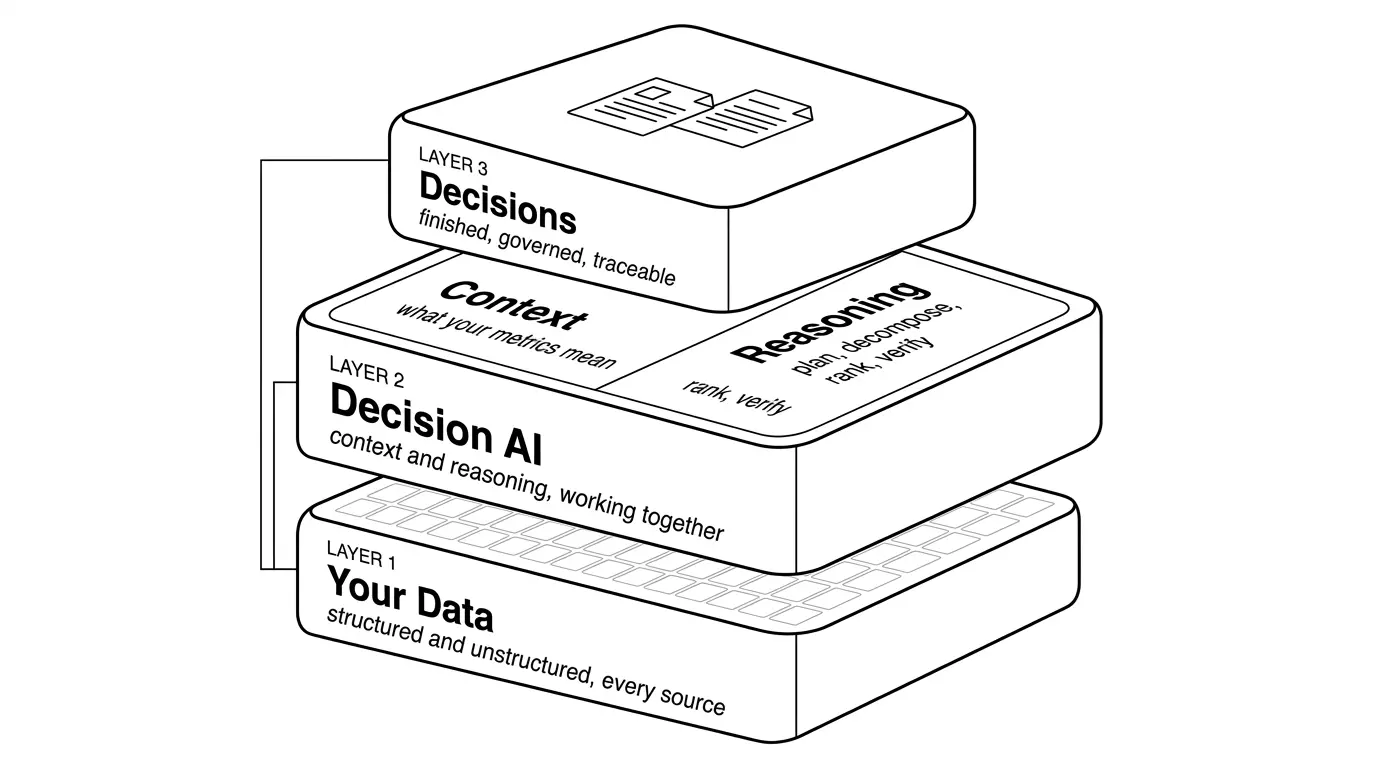
We've spent years solving for AI that actually knows your business, and we think that's a big reason Gartner keeps awarding us Visionary, five years running. Tellius is Decision AI for the enterprise — the intelligence layer connecting your data to your decisions.
If Context is King, Reasoning is Queen
Most "agentic analytics" today consists of an LLM wired up to few data sources performing text to SQL queries. This part is becoming table stakes — and plenty of companies are building it now with tools like Snowflake or dbt. Then there’s the context layer: what your metrics mean, how your data is modeled, the relationships and business logic underneath it all.
The piece everyone forgets is the reasoning layer that works the way your best analyst actually works: planning the analysis, decomposing the drivers, ranking what matters, checking/reflecting on its own work, and recommending next steps. Context without reasoning is just a well-organized pile of data. Reasoning on top is what turns it into an insight you can act on, and it's the part you can't fake by pointing a model at a warehouse.
Gartner credited Tellius for autonomous workflow orchestration — breaking a complex business objective into a multi-step plan and running it across both structured databases and unstructured documents — and for automated semantic modeling. In our world those aren't two separate features. They're context and reasoning working together.
Since trust is everything in the enterprise, the math is deterministic. The language model handles the language; a separate engine handles the numbers. So 1+1 always equals 2, the same question gives you the same answer every time, and every result traces back to the exact query that produced it. No quiet hallucinations.
AI coworkers that actually know your business
When context and reasoning come together, you get something closer to a coworker who already knows the business.
It knows what promo lift means to you — or gross-to-net, or pipeline coverage, or whatever the language of your team is. It reasons across your structured and unstructured data as if they were one source, because the "why" almost never lives in a single place. Your warehouse has the number; your call notes, contracts, and scorecards have the reason it moved.
And the expertise that used to live in one analyst's head — your vocabulary, your formatting, what "good analysis" even looks like on your team — gets taught once and applied automatically, in every conversation, for everyone. The knowledge stops walking out the door when your best analyst takes PTO.
It’s like an Iron Man suit for your analysts and business teams with humans staying in command, reviewing, and deciding, while the AI does the scalable legwork: pulling data, decomposing variance, drafting the brief, and watching the numbers around the clock.
It runs on its own, and it ships finished work
Rather than one-off queries, the highest performing enterprise teams set objectives and AI goes to work — around the clock, watching for variance, slippage, inflection points, and investigating the moment something slides sideways. AI agents allow us to run missions toward the outcomes you care about while you sleep.
And rather than handing back charts to decode, we ships finished work: a board-ready brief, a deck, a Slack summary, an Excel model, formatted in your template and delivered to the right person before they even ask. Two weeks of analyst work, waiting in the inbox every Monday morning.
Where AI & Analytics Are Headed
We think analytics is about to disappear. Not go away — disappear into the work.
For decades, analytics has been a destination. You stop what you're doing, go to the tool, build the answer, and bring it back. The future is the opposite: intelligence that's always running, always in context, and actually DOES the work. The question stops being "did we analyze this?" and becomes "of course we ran the numbers." That's where all of this is heading, and it's the world we've been building toward.
Models are getting better for everyone, every quarter — they’re not where the real edge. Better models lifts all boats. The real advantage that compounds is the layer that learns your business: your vocabulary, your definitions, the patterns that turned out to matter last quarter, the decisions you actually made. That knowledge doesn't reset between sessions. It accumulates.
This is the difference between a tool and a coworker. A stateless copilot at month eighteen is identical to the one you turned on day one. Tellius at month eighteen knows eighteen months of your business — what moved, why, and what you did about it. The longer your team uses it, the sharper it gets, and that edge lives nowhere else.
We made the AI-first bet back in 2017, before it was anywhere near trendy. While others are now bolting GenAI onto systems that were never designed for it, we built the hard parts — the semantic understanding, the deterministic reasoning, the memory that compounds — into the foundation years ago. And we haven't stopped: we're shipping new agentic capabilities constantly, pushing on context, memory, and reach so the platform keeps getting further ahead of where the market is now arriving. As the model layer commoditizes, the value moves up to the reasoning-and-context layer we've spent the better part of a decade on — and keep extending. Gartner reshaping its evaluation around agentic AI isn't a surprise to us. It's the road we've been on.
The future of analytics is agentic, contextual, and everywhre. We've been building toward it the whole time. With Tellius, you're not catching up to the curve. You're ahead of it.
Gartner, Magic Quadrant for Analytics and Business Intelligence Platforms, Anirudh Ganeshan, Christopher Long, Edgar Macari, [29 June 2026].
GARTNER is a registered trademark and service mark, and MAGIC QUADRANT is a registered trademark, of Gartner, Inc. and/or its affiliates in the U.S. and internationally and are used herein with permission. All rights reserved.
Gartner does not endorse any vendor, product or service depicted in its research publications, and does not advise technology users to select only those vendors with the highest ratings or other designation. Gartner research publications consist of the opinions of Gartner's research organization and should not be construed as statements of fact. Gartner disclaims all warranties, expressed or implied, with respect to this research, including any warranties of merchantability or fitness for a particular purpose.
Get release updates delivered straight to your inbox.
No spam—we hate it as much as you do!

.webp)
Kaiya Everywhere: Intelligence That Knows Your Business, Now Wherever You Work

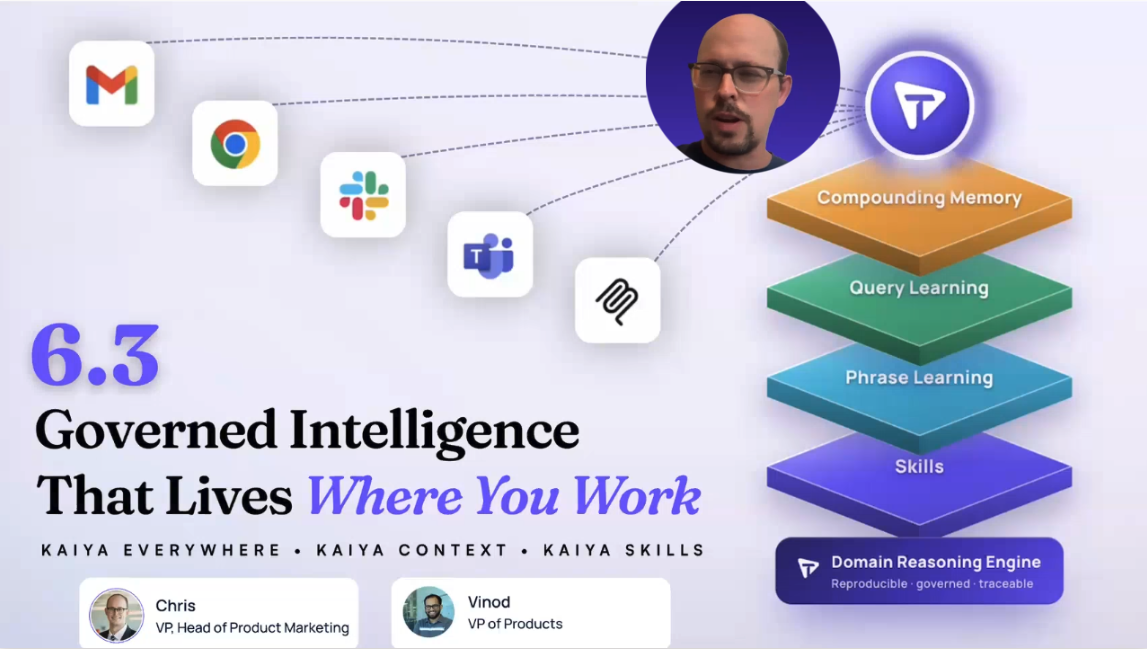
Tellius 6.3 marks a major step toward making enterprise AI available wherever work happens. With Kaiya Everywhere, users can access trusted AI-powered analytics directly from Slack, Microsoft Teams, dashboards, browsers, enterprise applications, and AI tools through MCP integrations. The release also introduces powerful new capabilities for domain reasoning, enabling organizations to combine business context, semantic definitions, institutional knowledge, and analytical best practices into every AI interaction. New Kaiya Skills make it easier to customize how AI performs analysis, generates insights, creates visualizations, and executes workflows, while enhancements to memory, phrase learning, and query learning help AI become more accurate over time. Tellius 6.3 also streamlines onboarding, allowing teams to connect data, build business views, and start generating trusted answers in minutes. Together, these innovations help enterprises move beyond generic AI assistants to AI that understands their business, reasons with context, and delivers actionable insights wherever decisions are made.