

AI Agent Use Cases for Enterprise Data Teams: 14 You Can Deploy This Quarter
.webp)

TL;DR
- AI agents that ship in production share three traits: they automate high-frequency repetitive analysis, they answer "why did the number move," and they start from a productized template — not a blank page.
- The fastest payback use cases vary by function: variance analysis (FP&A), TRx anomaly investigation (pharma commercial), trade promo ROI (CPG), and pipeline health (revenue operations).
- Pre-built agents deploy in 4–6 weeks. Custom builds take months to over a year for a single use case.
- What makes them work: three layers — a context layer, agentic reasoning, and pre-encoded domain logic. Skip any one and the agent stalls.
- Tellius ships these 14 (and more) as Kaiya Missions — pre-built AI agents with the workflow, semantic layer, and domain logic already encoded.
Most AI Agent Projects Don't Make It to Production
According to S&P Global Market Intelligence's 2025 Voice of the Enterprise survey of 1,006 enterprises, 42% of companies abandoned most of their AI initiatives in 2025 — up from 17% in 2024. Gartner predicts more than 40% of agentic AI projects will be canceled by 2027, citing escalating costs, unclear business value, and inadequate risk controls.
The teams shipping AI agents to production aren't smarter or better-funded. They picked use cases somebody else had already productized — and below are 14 of them, organized by function. Real workflows, measurable outcomes, deployable in 4 to 6 weeks against your existing data.
What Makes an AI Agent Actually Work
.png)
Every AI agent that fails to ship fails for the same reason: one of three foundational layers is missing. Every agent that ships has all three.
1. A Context Layer That Knows Your Business
A generic LLM can write SQL. It cannot know that "revenue" in your business excludes intercompany transactions, or that "active customer" means something different in your renewal motion than in your billing system. A context layer — what Tellius calls the semantic layer — encodes business definitions, hierarchies, table joins, and governance rules so the agent reasons against your real semantics, not its guesses.
2. Agentic Reasoning, Not Just Question-Answering
Earlier AI products answered questions. Production-grade agents run multi-step investigations. An agent detects that revenue fell in a region, decomposes the variance across segment, product line, and channel, queries each one, identifies which factor explains most of the drop, and writes the narrative. That is six tool calls and a structured output — not a chat exchange.
3. Pre-Encoded Domain Logic for the Workflow
This is the layer most custom builds underestimate. A pharma TRx anomaly investigation isn't a generic anomaly check — it's a specific decomposition across payer access, competitor activity, field force coverage, and HCP switching patterns. Variance analysis isn't a generic delta calculation — it's a structured walk down the GL hierarchy with materiality thresholds. Productized domain logic means the workflow is encoded once and reused, not rebuilt for every team.
The pattern: Context layer + agentic reasoning + productized domain logic. Skip any one and the agent stalls. The 14 use cases below are evidence of the pattern in production.
How to Pick Your First Three Use Cases
Three filters narrow the field fast.

1. Highest-frequency repetitive analysis your team currently does by hand. Variance analysis at month-end. Territory deep-dives every Tuesday. Trade promo post-mortems after every campaign. Anything that runs on the same schedule every cycle is a strong candidate — the agent learns the work once and runs it automatically.
2. The biggest "why did the number move?" question your function gets asked. The questions a team can't answer in the meeting are the ones that hurt — they cost a week of follow-up and arrive after the moment they mattered. An agent turns those into seconds-long answers.
3. Work that's been quietly dropped. Forecast accuracy review by segment. Account-level churn signal monitoring. Field activity productivity scoring. Work that didn't stop being valuable, just stopped being possible. Agents reclaim that surface area.
Deployment Readiness Checklist
Before scoping a use case, run it through this:
- [ ] Is there a defined data warehouse the agent can read from (Snowflake, Databricks, BigQuery, Redshift)?
- [ ] Is the workflow you're targeting documented somewhere — even informally as a runbook or a recurring deck template?
- [ ] Is there a named business owner who will review agent output weekly?
- [ ] Can you name the specific decision the agent's output should change?
- [ ] Do you have one quarter of patience for ROI — not one week, not one year?
Five yeses and you're ready. Two or more no's and you're scoping a data project, not an agent project — fix that first.
14 AI Agent Use Cases You Can Deploy This Quarter

For FP&A and Finance Teams
.png)
1. Variance Analysis Agent. Monitors budget vs. actuals across the P&L. When a line item misses by a material amount, the agent decomposes the variance by entity, account, customer, and product, identifies the primary driver, and writes a CFO-ready narrative with supporting numbers. Work that took a senior FP&A analyst three to five days during close week happens in seconds — same level of detail, same structure your team already uses. Deep dive into AI-Powered Variance Analysis for FP&A. See it in Tellius: FP&A Intelligence
2. Close Anomaly Detection Agent. Flags unusual journal entries, account movements, and balance shifts during the close. The agent learns what normal looks like for each account at each point in the period, then surfaces outliers — a misposted accrual, a duplicate vendor invoice, a margin calculation that broke when someone updated a mapping. Issues caught before audit, not after. Related: 14 Best AI Tools for Finance Teams in 2026
3. Forecast Accuracy Agent. Explains why forecasts missed when they miss. Decomposes variance by segment, product line, geography, and channel, then identifies recurring patterns: the rep who consistently sandbags, the region that always front-loads, the product line where the planning model has stale assumptions. Replaces the monthly "what happened?" email thread with structured analysis of the actual inputs that were wrong.
4. Cash Flow Anomaly Agent. Surfaces unusual AR/AP patterns and working-capital shifts before they show up in next month's forecast. A customer paying 15 days slower than usual. A category of vendor invoices clustering at month-end. A DSO trend about to break covenant. The agent watches daily and alerts when a pattern deviates enough to matter — when there's still time to act.
For Pharma Commercial Teams
.png)
5. TRx Anomaly Investigation Agent. Detects when prescription volume drops in a territory and runs the standard decomposition — payer access, competitor activity, field force coverage, HCP-level switching patterns. If formulary access changed, it surfaces the affected plan. If a competitor's rep frequency spiked, it surfaces that. Runs daily, on every territory, with structured root cause output — not a list of charts to interpret. Brand teams running this manually catch territory anomalies in week five at best. The agent catches them in week one. Deep dive: Agentic Analytics for Pharma
6. Payer Access Monitoring Agent. Watches formulary status across plans and flags changes the day they hit. A typical mid-size brand sees $5–15M in revenue exposed annually to undetected access changes. Catching them at week one instead of week six is the difference between a contained issue and a quarter-end fire drill. Deep dive: Market Access Analytics for Pharma
7. Field Force Performance Agent. Identifies underperforming territories with root cause attribution — separating territory-potential issues from rep-execution issues from market-access issues. A territory at 80% of quota looks identical to any other 80% territory in the CRM. The agent shows that one is a coverage problem, one is a payer problem, one is a rep who needs coaching. That distinction turns a quarterly performance conversation from a status update into something a manager can act on. Deep dive: 11 Best AI Platforms for Pharma Commercial Analytics
8. Brand Performance QBR Agent. Drafts the quarterly business review automatically. Pulls TRx, NBRx, share, payer mix, field activity, and HCP-level performance, then writes the narrative with charts, callouts, and the standard "what happened, why, what we're doing about it" structure brand teams already use. QBR prep typically consumes 14 days of combined analyst and brand manager time. The agent compresses that to roughly 2 days of review and revision. See Pharma commercial analytics in Tellius — TRx, payer, field, and QBR agents in production at top-20 pharma brands.
For CPG and Consumer Goods Teams
.png)
9. Trade Promotion ROI Agent. Explains which promotions drove incremental volume vs. cannibalized base sales vs. pulled forward future demand. Decomposes lift across baseline, promotion, and competitive effects using POS data, integrating retailer-specific signals where available. CPG teams running consistent, systematic promo ROI analysis typically capture 10%+ in trade ROI improvement. Deep dive: Trade Promotion Analytics for CPG
10. Retailer Performance Agent. Flags retailer-level anomalies before category reviews. The standard approach pulls a retailer scorecard once a month — meaning drift that started in week two doesn't surface until week five, right before the category captain meeting. The agent watches velocity, distribution, share of shelf, and pricing across retailers continuously, surfacing drift early enough to act on. Deep dive: Retailer AI Analytics for CPG
11. Assortment & SKU Rationalization Agent. Surfaces low-velocity SKUs and identifies replacement candidates with quantified upside. Connects POS, margin, supply chain cost, and category share data, then ranks SKUs by both performance and strategic role — distinguishing the slow-moving SKU that holds shelf space from the slow-moving SKU that's dead weight. Deep dive: Agentic SKU Rationalization in CPG
For Revenue Operations and Sales Teams
.png)
12. Pipeline Health Agent. Flags slipping deals with reasons attached. Watches stage velocity, engagement signals, multi-thread coverage, and historical close patterns to identify deals that look healthy in the CRM but won't close. Pipeline reviews catch the obviously broken deals; the agent surfaces the quietly broken ones — the stalled deal with no executive sponsor, the deal whose champion changed roles, the deal in "verbal commit" for six weeks. That second category is where most forecast misses come from. Deep dive: Best Revenue Intelligence Platforms in 2026
13. Deal Coaching Agent (MEDDIC). Scores active deals against MEDDIC criteria and recommends specific next actions. Champion identified? Economic buyer engaged? Decision criteria documented? The agent reads call summaries, email threads, and CRM notes, then grades each deal across the framework and tells the rep what's missing — continuously, after every meaningful touch, not as a forecast-review compliance exercise.
14. Churn Risk Agent. Detects account-health degradation and surfaces save plays. Product usage drop, support ticket pattern shift, key contact departure, executive sponsor turnover. The agent connects signals across systems and flags accounts where leading indicators have moved — getting the team there 60 to 90 days earlier than renewal-conversation discovery, when there's still something to save. Deep dive: AI Analytics for Customer Retention
Build, Buy a Platform, or Buy Productized Agents?
Three paths to put an enterprise AI agent into production. The deployment math separates them sharply.
Build from scratch. Months to over a year per use case, depending on domain logic complexity, plus ongoing maintenance as data sources change. A single custom-built FP&A variance agent requires defining what "material variance" means in your GL hierarchy, building validation logic, constructing the semantic layer, and clearing finance compliance review before a stakeholder sees output. Teams that started in 2024 are mostly still on use case number one.
Buy a horizontal AI platform (Snowflake Cortex Agents, Databricks Genie). Gives you orchestration, evaluation, and governance scaffolding — but not the domain logic. You still define the variance decomposition methodology for FP&A, the payer access investigation workflow for pharma, the trade promo lift model for CPG. The platform compresses engineering time. It doesn't touch domain time, which is usually the larger constraint.
Buy productized agents. Kaiya Missions ship with domain logic already encoded — TRx decomposition for pharma, variance analysis for FP&A, trade promo lift for CPG, MEDDIC scoring for sales. They run on Tellius's semantic layer, which auto-maps business definitions to existing data sources (Snowflake, Databricks, IQVIA, Veeva, Salesforce, NetSuite). Deployment is configuration, not engineering. Typical time from kickoff to first agent in production: 4 to 6 weeks.
The cost of delay is rarely modeled, but it's the largest number on the page. A variance agent shipping in 4 weeks instead of 12 months recovers nearly a full year of analyst capacity. Across a portfolio of 14 use cases, the difference between productized and custom is the difference between this fiscal year and 2028.
Get Your First Agent Into Production This Quarter
Pre-built and custom aren't either-or. Deploy a Kaiya Mission for variance analysis in six weeks — showing the CFO ROI from the first close cycle — while your engineering team separately scopes a custom agent for a use case nobody has productized yet. The first pays for the second. Running a production agent in your environment also teaches you more about agent governance, data integration, and adoption than any proof-of-concept will.
The enterprises moving fastest on AI agents share one trait: they don't wait for a perfect architecture before shipping. They ship something real in Q1, learn from it, and layer complexity in over subsequent quarters. The teams still in planning by Q4 are still in planning.
Get release updates delivered straight to your inbox.
No spam—we hate it as much as you do!


An AI agent in enterprise analytics is software that monitors business data continuously, investigates anomalies on its own, and delivers explanations and recommendations without being asked. Copilots respond to prompts; agents act without being asked. Traditional RPA runs deterministic workflows that break when data structures change; agents run reasoning workflows and adapt because they reason against business semantics. A copilot can answer "why did revenue miss in EMEA?" if you ask it. An agent detects the miss, runs the investigation, and posts the narrative to the FP&A channel before the question gets asked.
Variance analysis (FP&A), TRx anomaly investigation (pharma commercial), trade promotion ROI (CPG), and pipeline health (revenue operations) deliver value fastest because they replace high-frequency repetitive work with measurable outcomes. Variance analysis returns time to FP&A within the first month-end close. TRx anomaly investigation flags revenue-protecting issues within the first week of monitoring. The shared property is short feedback loops — you know within weeks whether the agent is doing the work correctly.
Three layers. First, a context layer (semantic layer) that encodes business definitions, table relationships, and governance rules so the agent reasons against your real semantics rather than guessing. Second, agentic reasoning capability that runs multi-step investigations and decomposes root causes. Third, pre-encoded domain logic for the specific workflow — variance decomposition, payer access investigation, trade promo lift methodology. Without the context layer, agents hallucinate. Without domain logic, deployment turns into a 12-month project.
Pre-built agents on platforms like Tellius deploy in 4 to 6 weeks against existing data infrastructure. Custom-built agents take months to over a year for a single use case, depending on domain logic complexity. The difference is where the domain logic lives — pre-built agents have variance decomposition, payer access investigation, or trade promo lift methodology already encoded; custom builds require the team to define and validate that logic from scratch before anything reaches a business stakeholder.
Yes. Modern agentic platforms connect to existing data warehouses (Snowflake, Databricks, BigQuery, Redshift), CRM systems (Salesforce, Veeva), ERP (SAP, NetSuite, Oracle), and industry-specific sources (IQVIA, Symphony, Veeva Compass, Nielsen, Circana) without data migration. The agent reads data where it lives, applies the context layer, and runs investigations against your existing infrastructure. If a vendor requires you to move data into their proprietary warehouse, that's a different product category.
Agent decisions are governed through observable inputs, traceable steps, and reviewable outputs. Production-grade agentic platforms log every query the agent runs, every data source it touches, and every reasoning step it takes — so a finance controller or compliance officer can audit the chain from question to conclusion. Security inherits from the underlying warehouse: row-level security, role-based access, encryption at rest and in transit. For pharma and financial services, look for SOC 2 Type II, HIPAA support, and the ability to deploy in your own VPC.
Pre-built AI agents have domain logic encoded; frameworks give you scaffolding to build that logic yourself. A pre-built variance analysis agent already knows how to decompose budget variance across entity, account, customer, and product. A framework like Snowflake Cortex Agents or Databricks Genie gives you orchestration and governance primitives — the variance decomposition is something your team builds. The choice is between buying the work and buying the platform to do the work.
Kaiya Missions are pre-built AI agents inside the Tellius platform, each purpose-built for a specific enterprise workflow: variance analysis, TRx anomaly investigation, trade promo ROI, deal coaching, and the rest of the use cases on this list. The difference from generic agents is the encoded domain logic. A generic agent can run SQL and write narratives. A Kaiya Mission knows how a pharma brand team decomposes TRx variance, which payer access signals matter, and how to phrase output for a brand manager. That domain encoding compresses deployment from months to 6 weeks.
Cortex Agents and Genie are agent platforms — they give you the building blocks. Tellius is an agentic intelligence platform that ships pre-built agents on top of those building blocks. The trade-off is engineering control versus deployment speed. Cortex and Genie make sense when you have a dedicated AI engineering team, a long roadmap, and use cases unique enough that nobody has productized them. Tellius makes sense when you want production agents in 4 to 6 weeks for use cases that map to FP&A, pharma, CPG, or revenue operations workflows. Many enterprises run both. For a deeper look: [Best AI Data Analysis Agents in 2026](https://www.tellius.com/resources/blog/best-revenue-intelligence-platforms-in-2026-clari-gong-tellius-7-more-compared/).
Total cost depends on how much of the stack you build versus buy. Custom builds run into six figures per use case in engineering time over months, plus ongoing maintenance. Pre-built agent platforms price by deployment scope and data volume; the typical mid-market starting point is in the low six figures annually for an initial set of use cases, with payback in 6 to 9 months from analyst capacity recovered or revenue protected. The harder cost to model is the cost of waiting — a year of variance analysis still being done by hand is rarely on the procurement spreadsheet, but it should be.
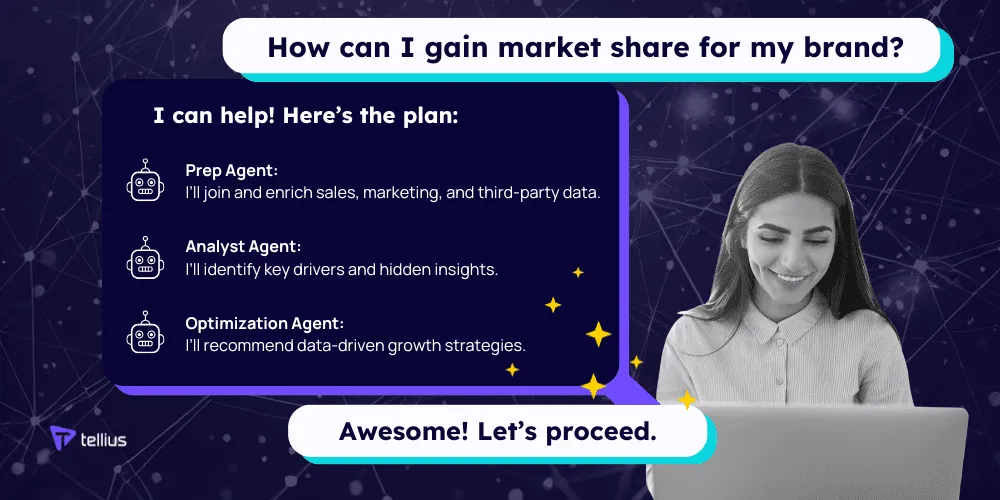
AI Agents: Transforming Data Analytics Through Agentic AI

AI agents aren’t just hype—they’re the engine behind the next generation of self-service analytics. This post breaks down how agentic AI enables multi-step, contextual analysis workflows that automate the grunt work of business intelligence. Learn what makes agentic systems different, what to look for in a true AI-native platform, and how Tellius is pioneering this transformation.
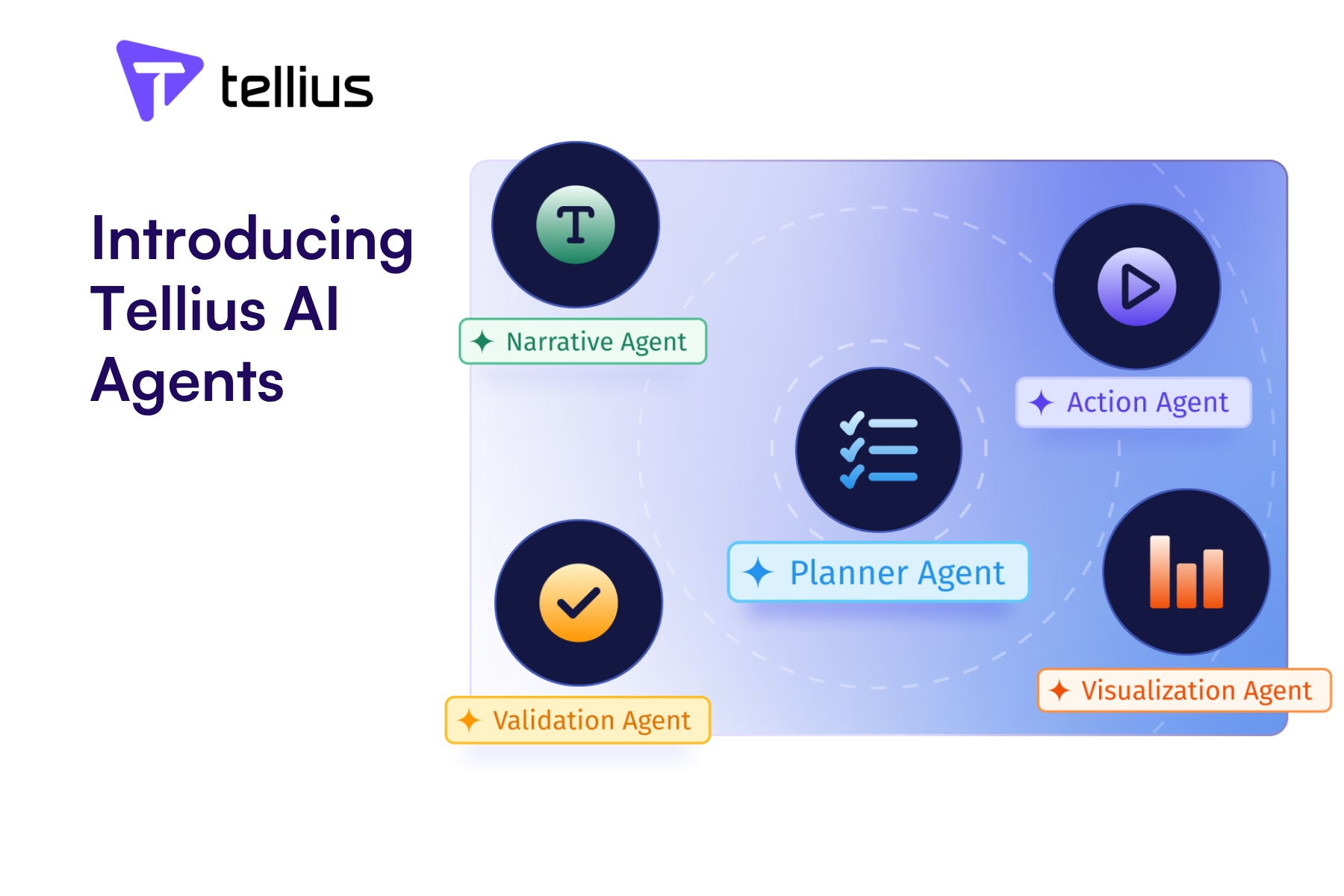
Introducing Tellius AI Agents
Tellius AI Agents and AgentComposer transform business analytics by automating complex multi-step analysis through specialized autonomous agents. Unlike generic chatbots or RPA tools, these agents leverage your enterprise data and business context to deliver deep insights across sales, marketing, finance, and manufacturing—turning questions into actions in minutes instead of days. With no-code agentic workflows, organizations can achieve 100X productivity gains and continuous, data-driven decision making.