

Best Conversational Analytics Software for Pharma Commercial Teams (2026): 13 Platforms Compared

Conversational analytics for pharma commercial teams is software that lets brand, field, market access and commercial data and analytics teams ask questions of their commercial data in plain language and get back the answer, the reason behind it and, on some platforms, finished work such as a district coaching brief or a regional review deck. It runs on the data commercial teams already license: NBRx and TRx from weekly prescription feeds, payer and formulary status, specialty pharmacy and hub data, CRM call activity and territory alignments. Here, conversational analytics means asking questions of business data, not analyzing recorded calls or speech.
This guide covers the conversational and agentic layer: the software a brand lead or district manager talks to. For the wider commercial analytics stack, including next-best-action, media measurement and statistical tools, see the best AI platforms for pharma commercial analytics.
Which conversational analytics platform should a pharma commercial team choose?
The right choice depends on where your data lives, which systems your field already works in, and how much of the recurring analysis you want software to finish rather than answer. Every platform here answers plain-language questions. They differ on whether they explain why a metric moved across Rx, payer and CRM sources, whether pharma definitions come with the product or have to be built, and whether anything arrives finished on a schedule.
Tellius publishes this guide and is one of the platforms in it. In our assessment, Tellius is the strongest fit when the goal is finished recurring work: it explains why NBRx, TRx or access moved across sources, traces each figure to its query and source, and runs scheduled Missions that deliver the brief or deck, with any write to another system waiting for a person's approval. Its customers include 8 of the top 10 pharma companies (company figure). The matrix below shows where that assessment comes from, using the same evidence standard for every vendor, including Tellius.
How do conversational analytics platforms for pharma compare?
Most platforms now answer questions natively. The differences show up in four places: explaining why across sources, pharma definitions, scheduled finished output, and controlled writes to other systems.
The matrix rates what each product does for a pharma commercial team, based on public documentation, release notes and press releases available on October 8, 2026. It doesn't score or rank vendors, because a weighted total would imply more precision than public evidence supports.
- Native: documented and available in the named product without a custom build.
- Configurable: ships with the product but is set up per deployment, by the customer or the vendor.
- Custom build: possible, but the customer's team builds it with the platform's tools.
- Not documented: no public documentation found. That doesn't mean the capability is absent; ask the vendor.
Disclosure: Tellius researched and published this comparison and rates its own product. We applied the same evidence rule to every row: a capability is Native only where public documentation shows it, and Tellius's pharma definitions are rated Configurable because they're set up during deployment rather than switched on out of the box. Vendors who see an error can send a correction with a public source, and we'll update the page. Sources for each rating are listed at the end.
The ratings describe capability, not effort or cost. Deployment requirements usually decide the shortlist, so they get their own table.
Is your BI good enough for pharma commercial analytics?
For watching known metrics, usually yes. For explaining why they moved and turning that into the weekly brief or review deck, most BI hands the work back to people.
A well-built NBRx dashboard shows a brand team where the trend went this week, and a field scorecard shows which territories missed plan. The trouble starts with the follow-up question. For many commercial analytics teams, a weekly Rx file lands, an analyst exports it, joins it in Excel to the payer coverage file and the latest territory alignment, and checks it against last week. Then a debate starts over which NRx number is right, because brand measures against one plan version and the field against another. By Wednesday someone has built slides, and by the time the regional director sees them, the meeting that needed them has passed.
A chat box on the dashboard speeds up the first query but leaves most of that week in place.
- Sources don't line up. A commercial question usually spans weekly prescriptions, monthly claims, payer formulary files, CRM call activity, specialty pharmacy and hub feeds, and a territory hierarchy that changed last quarter. Matching HCP IDs and time windows across them is manual work, repeated every cycle.
- Context never made it into the data. How the brand defines a new-to-brand patient, which plan version the field is measured against and which source wins when two disagree live in a few people's heads and in last year's consulting deck. A chat tool pointed at raw tables doesn't have that knowledge, so an expert has to check its answers.
- The last mile stays manual. With the right number and explanation in hand, someone still writes the coaching brief, builds the review deck and updates the launch tracker.
Most commercial organizations cover these gaps with analysts who know the data and a consulting firm on a recurring statement of work for the deeper analysis. That recurring spend, more than the BI license, is the right benchmark for a conversational analytics platform.
What separates chat, investigation and AI workers?
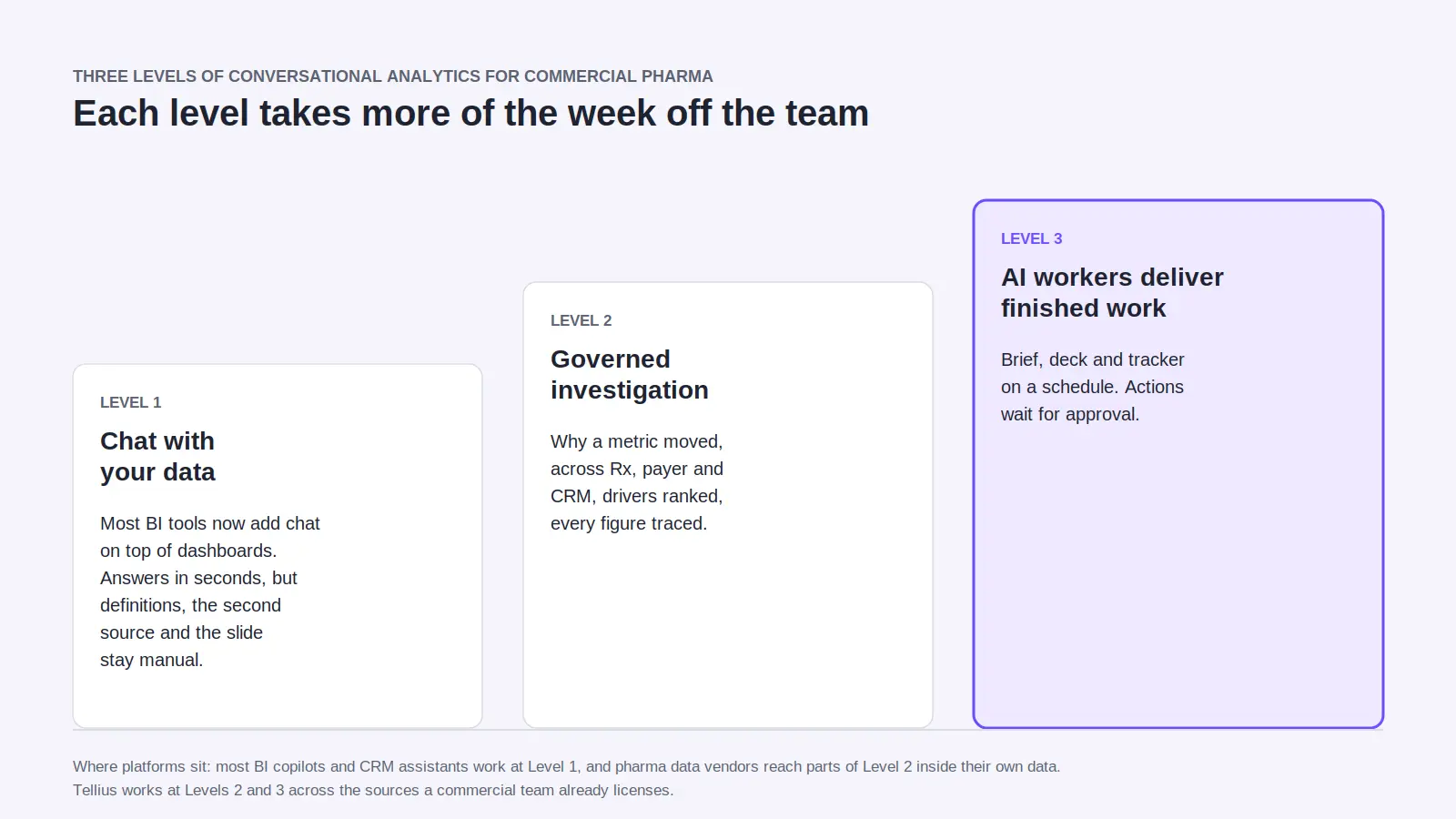
Conversational analytics runs from chat that answers questions, through governed investigation that explains why, to AI workers that hand back recurring work finished.
Level 1: Chat with your data. A user types a question and gets back a number, a chart or a short summary. Power BI Copilot, Tableau Next's Concierge, Looker's Conversational Analytics and the CRM assistants from Veeva and Salesforce mostly work here. It beats filing a ticket, but a person still confirms which NBRx definition the answer used, chases the cause into a second source and builds the slide.
Level 2: Governed investigation in pharma context. The platform works out why a metric moved across Rx, payer, CRM and territory data together, applies the team's definitions and data-lag rules, ranks the drivers and shows the query behind each figure. Databricks Agent mode, Snowflake CoWork's Deep Research and ThoughtSpot Spotter 3 investigate in depth on data their customers have modeled. IQVIA and Komodo Health go deep inside their own data.
Level 3: AI workers that deliver finished work. An AI worker is a persistent role for one commercial function, such as field effectiveness, that coordinates several specialized agents on a schedule and hands back the finished artifact. Anything that writes to another system waits for a person to approve it.
Several platforms now schedule output: Snowflake CoWork emails Automations, Databricks Genie sends scheduled results as PDF, and ThoughtSpot schedules Liveboards. So a schedule alone doesn't make a workflow finished. What matters is whether the scheduled run applies your pharma definitions, checks its own work, produces the artifact a district manager actually reads and holds any write for approval. The next section walks through one example.
What does a governed investigation look like from question to follow-through?
Here's one illustrative Monday on Tellius, not a customer case, running from governed definitions through approval to the next cycle.
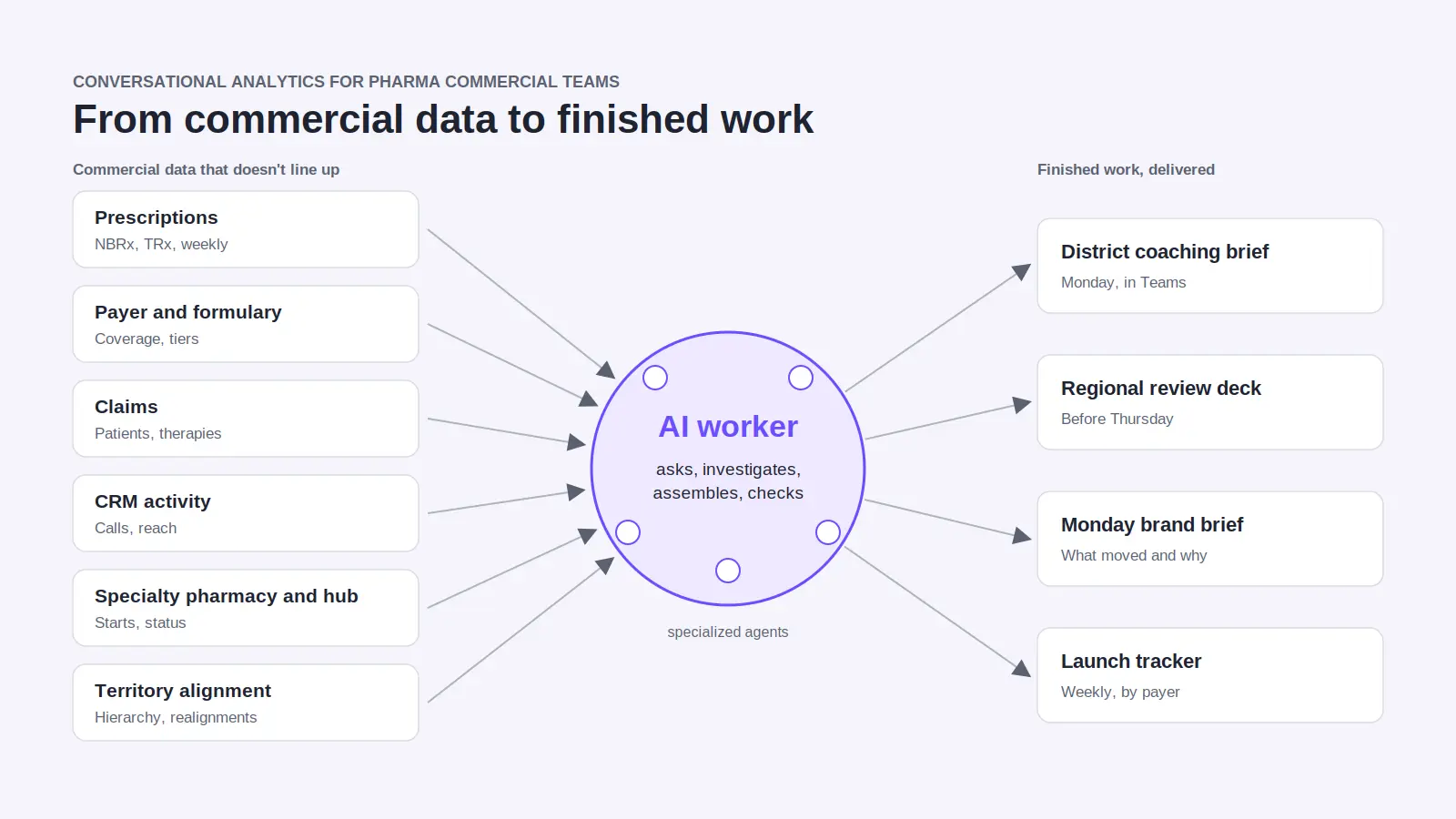
- The context is set first. During deployment, the brand's governed Business View fixes the new-to-brand rule for NBRx, the current alignment version and complete-week comparisons, and Kaiya Architect checks the joins for double counting before anyone sees a number.
- The Mission investigates. At 6 a.m. Monday, the Brand Performance Mission finds Southeast NBRx down 8% against plan and ranks the drivers by payer, territory and prescriber segment. A regional plan's move to a non-preferred tier accounts for most of the drop, concentrated in two territories.
- The result is checked. HCP IDs are matched across Rx and CRM data, the incomplete week is excluded, driver contributions reconcile to the total, and every figure cites its query and source.
- A person approves what leaves the team. The brand lead gets the brief and a PowerPoint deck in email or Teams, with a draft pull-through list for the two territories. Writing that list to another system runs only after she approves it, under her identity.
- The next cycle carries the correction. She flags a closed-door long-term care pharmacy that shouldn't count toward NBRx. Once she confirms, the correction is saved, and when the definition is updated, every Mission that reads it uses the new rule. Next Monday's rerun shows whether the two territories recovered.
Conversational analytics platforms for pharma, profiled
Tellius is profiled first because Tellius publishes this guide. The rest are grouped by type, not ranked: pharma data and services vendors, data platforms, horizontal analytics tools and CRM vendors.
Tellius
Tellius is an analytics platform for pharma commercial teams built around AI workers: each one owns a recurring commercial question, coordinates specialized agents, and delivers the finished brief or deck on a schedule. Kaiya, the built-in assistant, answers questions in plain language and helps people get set up on every surface.
Native:
- Driver analysis that breaks an NBRx or TRx change down by payer, channel, territory and prescriber segment and ranks contributors.
- Missions that rerun the same parameterized query on a schedule, with citations on reported figures and versioned history.
- Apps built from a plain-language description on a governed Business View.
- Delivery to email, Slack and Teams, PowerPoint and PDF export on a company template, and MCP both as a server other agents call and a client that reaches other systems.
- An approval step before any write, which then runs as the approving user.
Configured during deployment: the governed definitions for NBRx, TRx, payer status and alignments, and each AI worker's Missions and schedules. Kaiya Architect drafts the model and runs validation checks, but your team agrees the definitions.
Where Tellius falls short: Tellius doesn't sell data, so teams need their own IQVIA, Symphony or claims contracts, and the first workflow waits until those feeds and the definitions are in place. Live queries cover Snowflake, BigQuery and Redshift; other sources are loaded into Tellius. CRM writes depend on what the CRM's connector exposes. It's also a smaller name in pharma commercial circles than IQVIA, Veeva or Salesforce, so it's less likely to be on the approved-vendor list already.
Pricing: A platform fee plus add-ons by workflow or therapeutic area rather than per seat. Quotes on request.
Consider if you want the brief, the review deck and the launch tracker produced on a schedule from data you already license, with every figure traceable. More on Tellius conversational analytics.
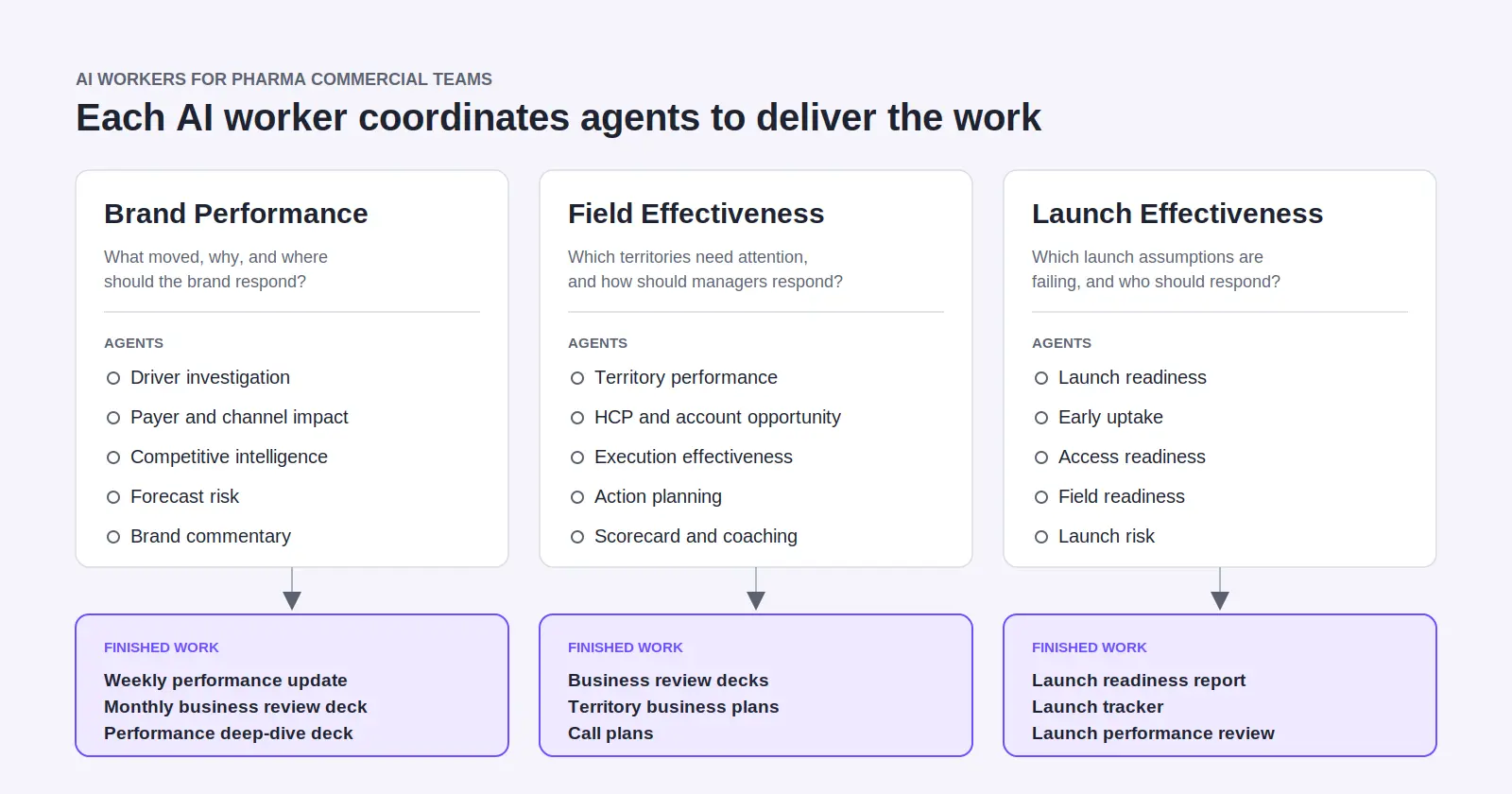
The three AI workers below are a typical setup for a commercial organization. Each worker's agents, schedules and deliverables are configured with the customer rather than switched on out of the box.
IQVIA (WhizAI)
WhizAI, now an IQVIA business, is conversational analytics built on what IQVIA calls an intent-ready NLP engine and a domain-tuned language model. IQVIA has also announced AI agents built with NVIDIA for tasks such as market assessment and HCP engagement.
Where it stands out: IQVIA's prescription and claims data sit at the center of most US commercial analytics, and teams already buying it get conversational access close to the source, with life sciences terminology built in. WhizAI has also queried Snowflake since a 2021 partnership.
What to verify: Public documentation doesn't describe how WhizAI ranks drivers across sources, traces figures, schedules finished deliverables or writes to other systems. Ask how Symphony, payer and CRM data connect, and which recurring outputs arrive as software versus through an IQVIA services engagement.
Pricing: Enterprise contracts, typically alongside data and services.
Consider if your team runs mostly on IQVIA data and wants conversational access to it from the vendor that supplies it.
Komodo Health (Marmot and MapAI)
Komodo Health launched Marmot in August 2025 on its Healthcare Map of de-identified patient journeys. MapAI is the assistant inside its MapLab applications.
Where it stands out: Patient-level questions, such as where treated patients cluster or how they move between therapies, run on the claims data the platform is built on, and Komodo says each insight ships with auditable code checked by a review agent.
Where it falls short: It works best on Komodo's own data. Territory performance, call activity and coaching briefs aren't its focus, and combining it with CRM and alignment data isn't publicly documented. The Healthcare Map is sold on Snowflake Marketplace, which helps teams join it with their own data elsewhere.
Pricing: Enterprise contracts tied to data licensing.
Consider if patient journey and market sizing questions dominate your agenda.
ZS ZAIDYN Commercial
ZAIDYN Commercial from ZS includes three agents: Assist explains what changed and why, Augment monitors signals across planning, engagement and incentives, and Act turns approved strategies into field actions. It integrates with Veeva, and in September 2026 ZS positioned it alongside Salesforce Life Sciences Cloud.
Where it stands out: Alignment, call planning and incentive compensation are part of the product's model, reflecting a consulting practice that has worked on commercial operations for years.
Where it falls short: ZAIDYN is usually sold with ZS services, so recurring analysis often continues as consulting work. Public detail on conversational use by a brand lead or district manager is thin.
Pricing: Platform fees, typically alongside services.
Consider if you already rely on ZS for commercial operations and want a platform from the same partner.
Axtria InsightsMAx.ai
Axtria launched InsightsMAx.ai in April 2025 with a library of pre-built life sciences agents, apps and APIs, and says it supports MCP and agent orchestration.
Where it stands out: Agents start from named commercial use cases rather than a blank model, and it connects to Axtria's data management products.
Where it falls short: Deployments tend to be services-assisted, so recurring analysis often stays Axtria project work. Public documentation of traceability and scheduled output is limited. A side-by-side of Tellius and Axtria covers the differences.
Pricing: Platform fees, typically alongside services.
Consider if you already run Axtria data management and want agents from the same vendor.
Snowflake CoWork (formerly Snowflake Intelligence)
Snowflake CoWork is Snowflake's ready-to-use agentic application for business users. It went GA as Snowflake Intelligence in November 2025 and was renamed in 2026. Agents connect to semantic views, Cortex Search services and custom tools.
Where it stands out: For teams whose IQVIA, claims and CRM data already sit in Snowflake, it answers questions in place under existing governance. Deep Research breaks a question into sub-investigations and traces every claim in the report to its source data and queries. Automations rerun a saved question on fresh data and email the result, and spend is capped with per-user credit quotas.
What you build: The pharma definitions live in semantic views your data team writes and maintains. Field and brand deliverables, such as a formatted review deck per district, and any approval flow for writes are built on custom tools.
Pricing: Snowflake consumption credits.
Consider if your commercial data is in Snowflake, your data team owns the semantic views, and emailed answers and research reports cover what the business needs. Tellius also runs on Snowflake and reads its semantic views, so many teams use both; more on how Tellius runs on Snowflake.
Databricks Genie
Databricks Genie lets business users ask questions of lakehouse data governed in Unity Catalog. Agent mode, generally available since July 2026, plans a research path, runs iterative queries and returns a cited report.
Where it stands out: Agent mode returns a cited research report rather than a single chart, and scheduled results can now arrive by email as a PDF.
Where it falls short: There's no pharma domain model, so NBRx definitions, alignment logic and data-lag rules are encoded by the customer's data team. Scheduled tasks run at most daily, and MCP write actions were in beta in August 2026. Most users are analysts rather than field or brand leaders.
Pricing: Consumption through Databricks compute.
Consider if your commercial data lives in Databricks and your data team will build and maintain the pharma logic.
ThoughtSpot Spotter
ThoughtSpot is a horizontal analytics platform whose agent, Spotter, answers questions on governed data models. Spotter 3 blends warehouse data with sources such as Salesforce and SharePoint, runs Python for methods like regression, and can push actions to connected tools.
Where it stands out: Answers come back quickly and explain the drivers behind a change, and search tokens trace an answer back to its source.
Where it falls short: The industry edition adds a semantics layer but no published pharma metric set, so NBRx definitions, data-lag handling and alignment rules are built by the customer. Liveboards can be scheduled, but turning answers into a formatted review deck or brief is left to people.
Pricing: Published tiers: Spotter is included from Pro, at $50 per user per month with 25 Spotter queries, and in Enterprise.
Consider if you want one question-answering layer across many business functions and your team can build the pharma model.
Microsoft Power BI Copilot and Fabric data agents
Copilot in Power BI answers questions and summarizes reports on Power BI semantic models. Fabric data agents answer across up to five data sources and surface in Teams and Microsoft 365 Copilot.
Where it stands out: Most pharma commercial teams already license Power BI, answers respect the model's row-level security, and they appear in Teams and Outlook.
Where it falls short: Copilot can only use the measures already in the model, so NBRx, new-to-brand, formulary tiers and data-lag rules must be built first, and "why" answers appear only where an analyst modeled that path. Data agents are read-only and return at most 25 rows by 25 columns. Both need Fabric capacity (F2 or higher) or Premium; Pro alone isn't enough.
Pricing: Power BI licenses plus Fabric capacity.
Consider if your reporting runs on well-maintained Power BI models and quick answers inside Teams are the goal.
Tableau Next
Tableau Next adds agents to Tableau on Salesforce's Data 360. Concierge answers natural-language questions, and Inspector monitors metrics and sends threshold alerts to Slack.
Where it stands out: Teams already on Tableau get conversational answers and metric alerts in a familiar environment, and an MCP server is generally available.
Where it falls short: Inspector was still in beta in the April 2026 release, so test "why" questions on your own data. Tableau Next runs on Data 360, which adds a migration for teams on Tableau Server, and it has no pharma domain model.
Pricing: Tableau Next Creator and Consumer licenses, or the Tableau+ tier.
Consider if you're committed to Tableau Cloud and Salesforce and want metric monitoring with conversational answers.
Google Looker (Conversational Analytics)
Looker's Conversational Analytics, built on Gemini, answers questions against LookML models and went GA in November 2025. Its API went GA in June 2026.
Where it stands out: Answers inherit the metric logic already in LookML, so chat and dashboards use the same definitions.
Where it falls short: LookML must encode NBRx definitions, alignment rules and data lags. Each agent covers up to five Explores, and triggered workflows were in preview. Looker is also a less common commercial reporting standard in pharma than Power BI or Tableau.
Pricing: Looker licenses, with Gemini features through Google Cloud.
Consider if your semantic models already live in LookML on BigQuery.
Veeva AI for Vault CRM
Veeva released AI agents for Vault CRM in December 2025, including pre-call, free-text and voice agents. The August 2026 release added an agentic home screen and conversational AI, still in early adopter status.
Where it stands out: Agents run inside the CRM most pharma field teams already use, within its permissions and audit trails.
Where it falls short: Answers are scoped to Vault data, so questions that need Rx, claims or payer data beyond the CRM go elsewhere. Ranking the drivers behind a brand metric across sources isn't documented, and regional and brand deliverables sit outside the rep workflow it serves.
Pricing: Veeva says some agents are charged by usage and others are part of the subscription.
Consider if your priority is AI inside the rep's CRM workflow, with cross-source analytics handled by another platform.
Salesforce Agentforce Life Sciences
Agentforce Life Sciences puts agents in the CRM workflow of reps and managers, including briefings and visit management, and Salesforce reported more than 140 organizations using it in May 2026.
Where it stands out: The agents sit where reps and managers already plan their week, so there's no new tool for the field to adopt.
Where it falls short: It's CRM-first. Answers about prescription trends, payer impact or launch uptake depend on how much of that data has been brought into Data 360, which is a project in its own right, and ranked driver analysis across sources isn't documented.
Pricing: CRM licenses plus usage-based pricing for agents and Data 360.
Consider if you're standardizing field CRM on Salesforce and want agents in the rep's workflow.
Which conversational analytics platform fits each commercial team?
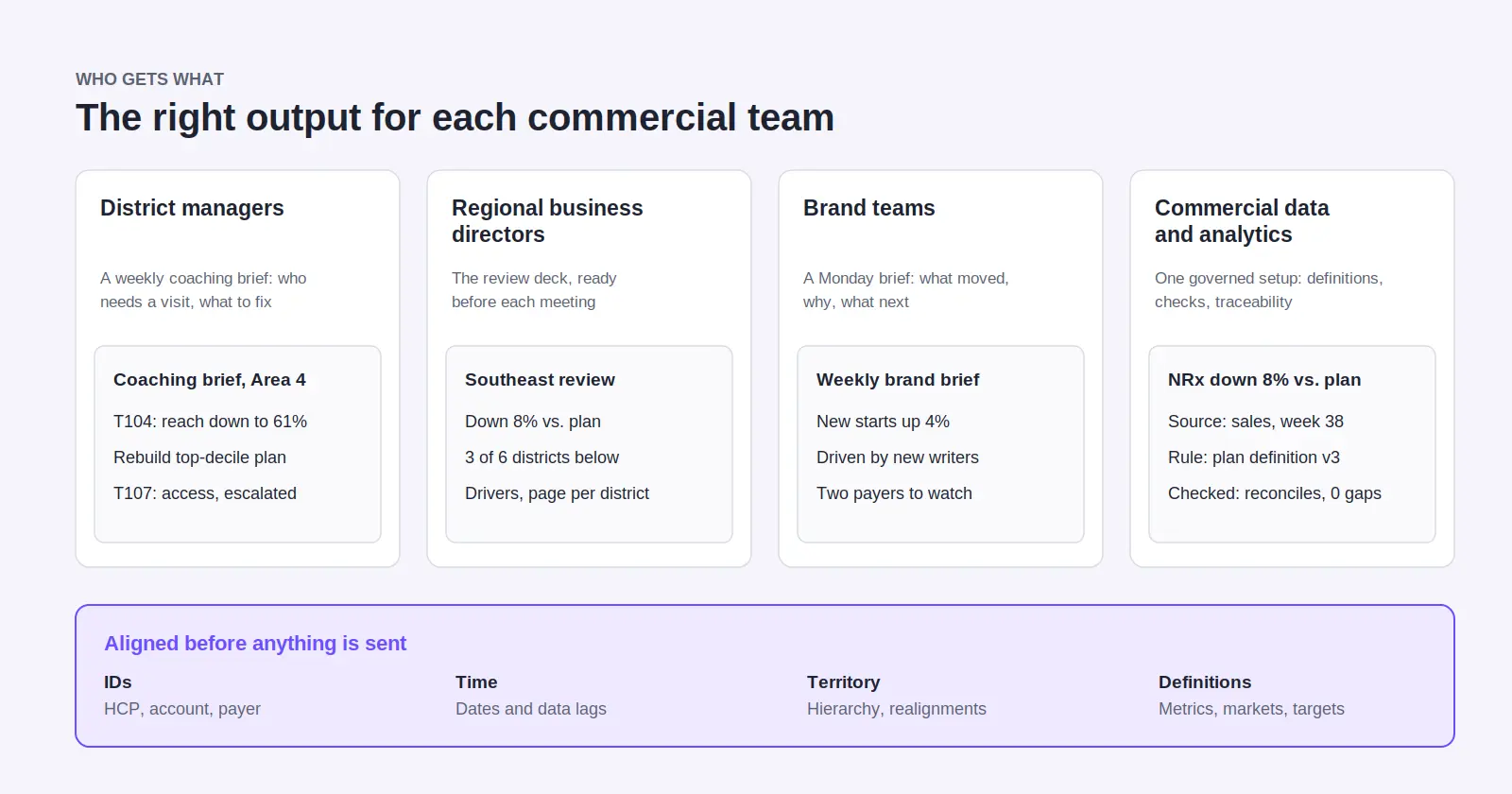
Each commercial team needs a different finished output from the same data: a coaching brief for district managers, a review deck for regional directors, a Monday brief for brand teams, a governed setup for data and analytics, and a tracker for launch teams.
The briefs quoted below are illustrative, built on the kind of data a pharma commercial organization works with every week. Customer results are labeled with their source.
What is the best AI analytics tool for pharma district managers?
A district manager needs a weekly coaching brief that says who needs a visit and what to fix, for example: "T104: reach down to 61% of target HCPs; rebuild the top-decile call plan. T107: access issue with a regional plan, escalated to market access." It should arrive in Teams or Outlook on Monday, not wait in a dashboard.
Best fit: Tellius, through a Field Effectiveness worker configured to run territory performance, HCP opportunity and coaching agents on a schedule. Alternatives: Veeva AI and Agentforce Life Sciences help reps prepare individual calls inside CRM, but neither documents a manager's brief across Rx, access and call data. More in the field force effectiveness comparison.
Which platform prepares a regional business review deck?
A regional business director needs the deck ready before each meeting, with the drivers and a page per district, for example: "Southeast review: down 8% versus plan, 3 of 6 districts below target." Before Tellius, Novo Nordisk's field leaders spent 10 days a quarter reconciling Excel exports; Novo reports that one plain-language question now yields a root cause, a scheduled Mission and a ready-to-act file in two days.
Best fit: Tellius, with a scheduled Mission that exports the deck to PowerPoint. Alternatives: Databricks Genie can email scheduled results as a PDF, and Snowflake CoWork's Deep Research produces a cited report, but a formatted deck per district is a build on either.
Which conversational analytics platform explains brand performance each week?
A brand team needs a Monday brief covering what moved, why and what to do next, for example: "New starts up 4%, driven by new writers in the Midwest. The competitor's copay program is gaining in two payers."
Best fit: Tellius, through a Brand Performance worker running driver investigation, payer and channel impact, and forecast risk. Alternatives: IQVIA's WhizAI answers brand questions on IQVIA data, and Komodo Health's Marmot handles patient-level questions such as switching. More on brand performance analytics.
How do commercial data and analytics teams keep AI answers governed?
Commercial data and analytics needs one governed setup every answer runs through. When an answer says NRx is down 8% versus plan, it should also show the source (sales data, week 38), the rule (plan definition v3), the check (reconciles, no gaps) and who approved the definition.
Best fit: Tellius, with governed Business Views, Mission version history and figures cited to query and source. Alternatives: Snowflake and Databricks govern access and definitions at the data layer, and both CoWork and Genie trace their answers. Power BI semantic models enforce row-level security inside Power BI.
Which platform supports pharma launch excellence?
A launch team needs to know early which launch assumptions are failing and who should respond: uptake versus forecast, access by payer, field readiness by territory, and specialty pharmacy and hub conversion. That means a readiness report before approval and a weekly tracker after.
Best fit: Tellius, through a Launch Effectiveness worker. Agios went live with Tellius at its launch with a commercial analytics team of a handful of people, and the team reports that work which took days now takes hours (self-reported; no baseline published). Alternatives: ZS ZAIDYN, Axtria and IQVIA support launch analytics, usually alongside services. More in the launch analytics comparison.
What has to line up before an AI answer reaches the field?
Whichever platform a team picks, four things need to line up before an answer reaches a district manager or brand lead. If any one is off, the number is wrong in a way only an expert would catch.
How does Tellius compare with Power BI Copilot, IQVIA, ThoughtSpot and Snowflake CoWork?
Each of these keeps a real advantage. Tellius's case rests on explaining why across sources and delivering the recurring work, which matters most when your analysts spend the week explaining dashboards rather than building them.
Tellius vs. Power BI Copilot and Tableau Next
Power BI and Tableau are licensed, governed and familiar, and Copilot and Concierge put a question box on reports people already trust. For "What was TRx last week in the Northeast?" that's often enough. The gap opens with the next questions.
Power BI keeps the edge on distribution in Teams and Office and on cost when it's already licensed. The two aren't exclusive: Tellius runs alongside existing Power BI, Tableau and Qlik dashboards and in Teams, so a team can keep its reports and add investigation and recurring work around them.
Tellius vs. IQVIA (WhizAI)
IQVIA's advantage starts with the data. Its prescription and claims data sit at the center of most US commercial analytics, and a team that runs almost entirely on IQVIA data gets answers close to the source, from the vendor that supplies it.
Most commercial questions don't stay inside one vendor's data, though. An access question pulls in payer formulary files, a field question pulls in CRM call activity and alignments, and a launch question may pull in specialty pharmacy and hub data from another provider. Tellius works on whatever data a team licenses, IQVIA's included, and runs the recurring deliverables as software the team operates. The deciding question is who does the recurring work after the data arrives.
Tellius vs. ThoughtSpot Spotter
Spotter holds a conversation, explains the drivers behind a change, runs Python for heavier methods and reaches other tools through MCP. For a company that wants one question-answering layer across sales, finance and operations, that breadth counts, and its analyst-facing agents for building models and charts are ahead of Tellius's.
In pharma commercial, the difference is what happens after the answer. A ThoughtSpot customer builds and maintains the pharma semantics, and someone turns Spotter's answers into the weekly brief or regional deck. Tellius configures the pharma definitions with the customer and runs that work as scheduled Missions for each commercial team.
Tellius and Snowflake CoWork
For a team whose data already lives in Snowflake, CoWork answers questions in place, traces Deep Research reports to source and emails scheduled answers, which covers a lot of analyst requests. Tellius runs on Snowflake too, inherits its role-based access and row-level policies, and reads its semantic views rather than rebuilding them. What Tellius adds on top is the pharma investigation logic, the formatted deliverables for each commercial team and the approval step before writes, which CoWork customers would build with custom tools.
What should a conversational analytics demo prove on pharma data?
A useful demo runs the same commercial scenarios on the same Rx, payer, CRM and territory extract for every vendor, and asks to see the finished output as well as the answer.
Demos on clean sample data make every platform look capable, so hand each vendor a few weeks of your own Rx, a payer coverage file, CRM call activity and the current alignment, and run the same four scenarios.
- NBRx variance. Ask why NBRx moved last month in one region. Look for drivers ranked by contribution, with the data week and metric definition next to the answer.
- District performance across a realignment. Ask for district performance versus plan for a quarter that included a territory change. Check whether the comparison uses consistent alignments and says so.
- Launch-to-date performance and HCP priorities. Ask which launch assumptions are off track and which HCPs the field should prioritize. Look for the cohort definition and the reasoning behind the list.
- Payer coverage and prescriptions. Ask how a formulary change affected new starts. Watch whether the platform separates association from cause.
Then ask the questions a production rollout depends on:
- If I ask the same question next Monday, will I get the same number from the same query?
- Can you show the query and source behind this figure?
- How do you handle the lag between weekly Rx data and monthly claims?
- Can this run every Monday and land in Teams as a finished brief or deck?
- What happens when the model doesn't know a definition? Does it ask, or guess?
- What can write to CRM or other systems, who approves it, and whose identity does it run as?
- Does this run on our IQVIA, specialty pharmacy and Veeva data where it sits, or does it need a copy?
- Which of these capabilities ship with the product, and which are configured or built during deployment?
- How many weeks until the first workflow is in production, and is pricing per seat, per usage or by workflow?
Conversational analytics for pharma: FAQs
Which conversational analytics platforms work with pharma commercial data?
Tellius, IQVIA, Komodo Health, ZS and Axtria build for pharma commercial data; IQVIA and Komodo work mostly on their own data. Tellius configures NBRx, TRx, payer and alignment definitions with each customer. Snowflake CoWork, Databricks Genie, ThoughtSpot and Power BI Copilot work once a team builds those definitions itself.
Which software can explain why NBRx changed across payer and territory?
Tellius breaks an NBRx change down by payer, channel, territory and prescriber segment and ranks the drivers by contribution. Databricks Agent mode, Snowflake CoWork's Deep Research and ThoughtSpot Spotter 3 investigate on data the customer has modeled. Power BI Copilot and Looker explain only where the model already holds that path.
Is conversational analytics the same as call or speech analytics?
No. In commercial pharma, conversational analytics means asking questions of business data, such as prescriptions, payer coverage and CRM activity, in plain language. Call and speech analytics analyze recorded conversations, which is a separate category.
Which tools deliver a finished district review or brand brief on a schedule?
Tellius Missions deliver briefs and PowerPoint or PDF decks on a schedule. Snowflake CoWork emails scheduled answers, Databricks Genie emails scheduled results as PDF, and ThoughtSpot schedules Liveboards. Formatting those into a district deck is left to the customer on the other platforms.
Which agentic analytics platforms are built for pharma commercial teams?
Tellius runs AI workers for brand performance, field effectiveness and launch, configured per customer, with approval before any write. ZS ZAIDYN and Axtria offer agentic platforms usually paired with services, IQVIA has announced agents built with NVIDIA, and Veeva and Salesforce run agents inside CRM.
Which platforms run on existing Snowflake or Databricks data?
Snowflake CoWork and Databricks Genie run natively on their own platforms. Tellius queries Snowflake, BigQuery and Redshift live and connects to Databricks, inheriting the warehouse's access controls. ThoughtSpot queries warehouses live, and Power BI and Looker go through their own semantic models.
Is Power BI Copilot enough for pharma commercial analytics?
For quick answers on a well-built Power BI model, often yes. It's limited to the measures already in the model, its data agents are read-only, and it needs Fabric or Premium capacity. Teams that need cross-source "why" answers and recurring briefs usually add a platform such as Tellius alongside it.
How long does it take to deploy conversational analytics for a pharma commercial team?
It depends on whether data feeds are already in a warehouse and whether teams agree on definitions. Warehouse-native tools start fast for analysts but need the pharma model built first. With Tellius, the first workflow typically follows connection of licensed feeds and agreement on definitions, which Kaiya Architect speeds up; ask every vendor for a dated plan.
How is conversational analytics software priced?
BI copilots price per seat plus capacity, warehouse-native tools by consumption, and pharma data and services vendors through enterprise contracts. Tellius prices with a platform fee plus add-ons by workflow or therapeutic area rather than per seat.
Do we need to replace our BI tool to add conversational analytics?
No. Tellius runs alongside existing Power BI, Tableau and Qlik dashboards and in Teams and Slack, so dashboards keep watching known metrics while investigation and recurring work happen around them.
Sources
Ratings reflect these sources as of October 8, 2026. Products in this category change quickly; vendors can send corrections with a public source.
- Tellius: Tellius 6.4 release, Novo Nordisk field analytics, Agios at launch
- IQVIA: Business intelligence and analytics (WhizAI), AI agents for life sciences, WhizAI and Snowflake partnership
- Snowflake: Snowflake CoWork overview, GA release note
- Databricks: AI/BI release notes, 2026
- ThoughtSpot: Spotter documentation, Spotter 3, pricing
- Microsoft: Copilot in Power BI, Fabric data agents
- Veeva: Veeva AI for Vault CRM, Vault CRM 26R2 release notes, Q1 FY27 prepared remarks
- Salesforce: Agentforce Life Sciences, June 2026, 140 organizations
- Komodo Health: Marmot launch, Healthcare Map on Snowflake Marketplace
- ZS: ZAIDYN Commercial, Dreamforce 2026 partnership
- Tableau: Tableau Next overview, April 2026 features
- Google: Looker Conversational Analytics GA, Conversational Analytics API release notes
- Axtria: InsightsMAx.ai launch coverage
See the weekly brief built on your own data
Bring a few weeks of your Rx, payer and CRM data. In a working session, Tellius will build the district coaching brief or the brand team's Monday brief on it, with every number cited to its source.
Get release updates delivered straight to your inbox.
No spam—we hate it as much as you do!


AI Agents for Pharma Commercial Teams: The 2026 Field Guide to Use Cases, Vendors, and What's Actually Real

This field guide examines the AI agent use cases that are actually being deployed across brand analytics, field sales, market access, forecasting, omnichannel engagement, incentive compensation, and commercial operations. The guide compares leading vendors and deployment approaches, highlighting the differences between AI copilots, agent frameworks, agentic analytics platforms, and purpose-built commercial AI solutions.
.webp)
Best AI Platforms for Pharma Commercial Analytics in 2026: 11 Platforms Compared
This guide compares the 11 best AI platforms for pharma commercial analytics in 2026, evaluating how each supports brand performance, market access, patient analytics, field force effectiveness, incentive compensation, and omnichannel engagement. It highlights a key shift in the market: traditional BI and SFE tools focus on reporting what happened, while newer AI platforms differentiate by investigating why performance changed. The post breaks down core capabilities like root cause analysis, data integration, governance, and agentic workflows—helping pharma teams identify which platforms can deliver faster, more actionable insights across commercial operations.