

How Agios Pharmaceuticals Runs AI-Native Commercial Analytics at Launch Scale

"Do more with the team you have" is a common mandate for commercial analytics teams large and small these days. But how does this work when your lean team is facing the biggest launch in company history and analytic needs—and turnaround speed expectations—are poised to shoot through the roof?
Agios Pharmaceuticals shared their approach to this problem in a recent PMSA webinar, with lessons for large and small teams alike from an AI-native commercial team that rose to the challenge.
Pre-launch Commercial Analytics and the impending wave
Agios Pharmaceuticals is a rare disease company whose commercial analytics function, led by Deepanshu Arora, consists of a handful of people serving market access, field, and leadership teams.
The pre-launch typical analytics process was that they fielded questions from the field, relied on offshore vendor for answers a couple of days later, then they went through rounds of back-and-forth before finally sharing answers to end users. Dashboards ran through a multi-vendor chain, with mockups in one place, the build in another, and data modeling in between, resulting in new dashboards taking weeks and enhancements landing every few months. As Deepanshu put it, "all resources were over-utilized, and more requests were always coming in than we could cater to." Pre-launch, however, this was still manageable, because turnaround expectations were relaxed.
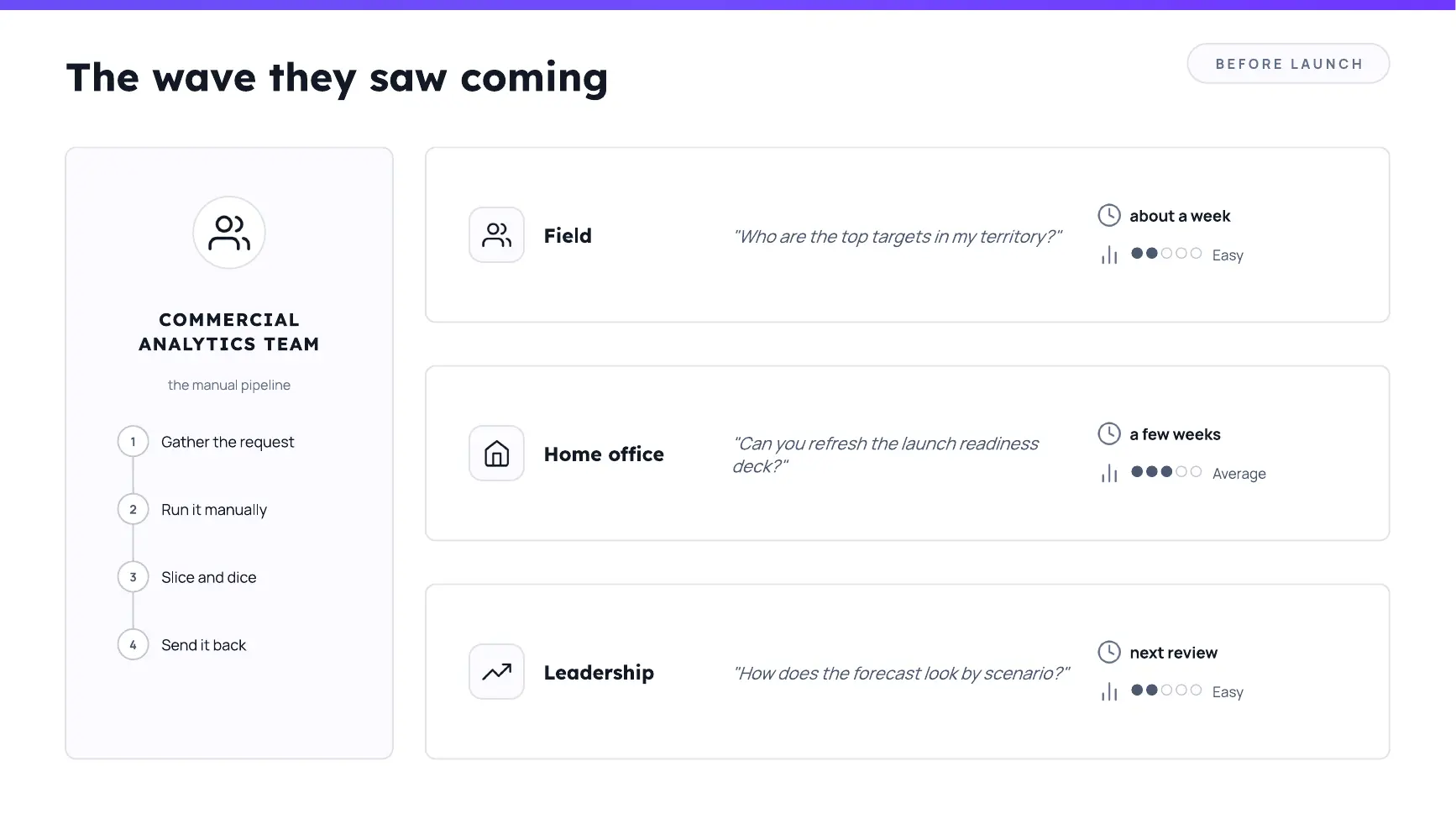
Post-launch, the math fundamentally changed
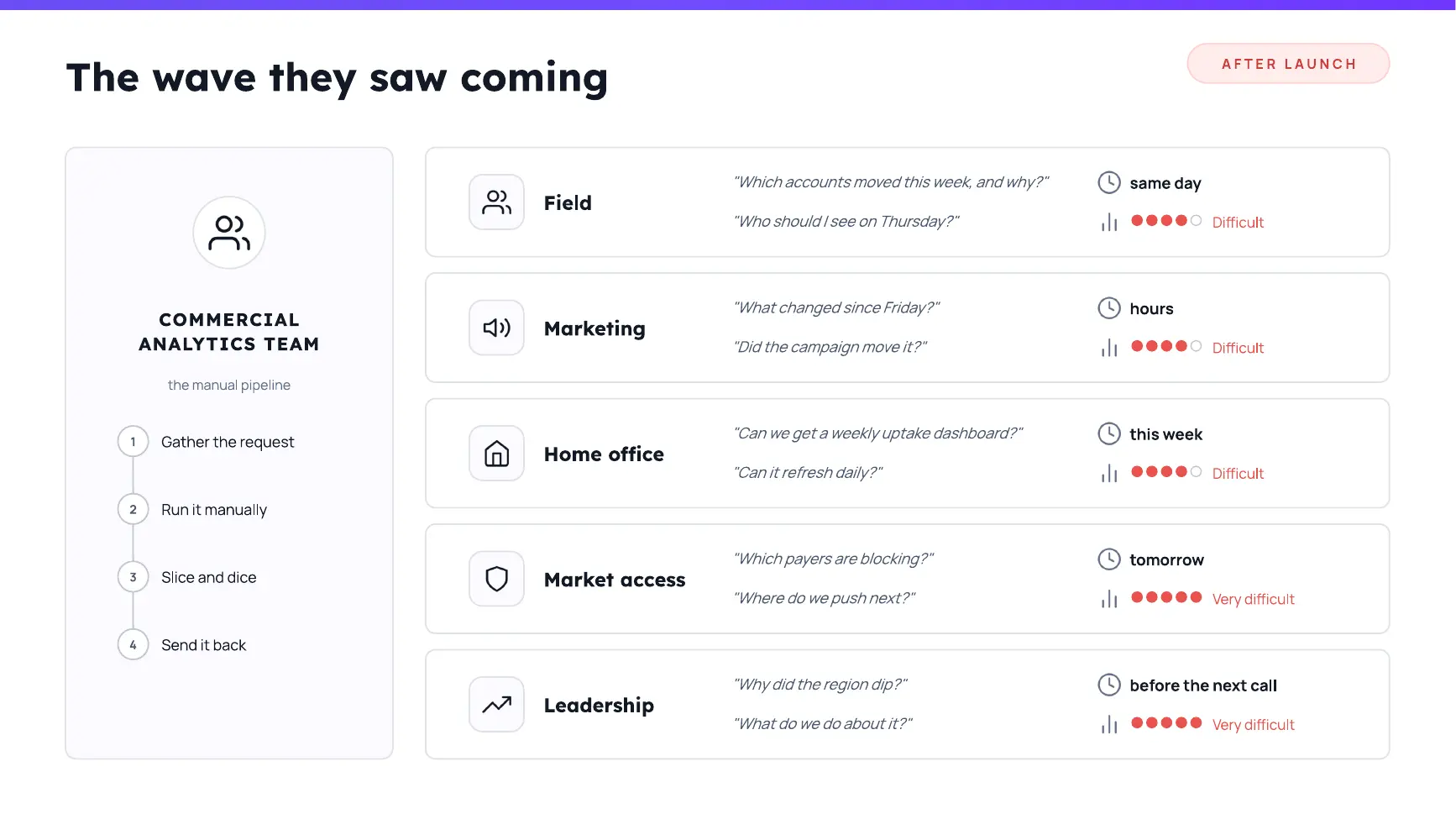
Launches pull in more stakeholders asking more questions whose answers stop being routine. "Any question and every answer we provide now impacts day-to-day business," he said, with the field wanting to know which accounts moved this week and expecting the answer the same day and leadership wanting to know why a region dipped before the next call, not at the next business review.
Unlike other teams that might have reacted when the pressure ramped up, Agios’s commercial team saw it coming a year out and began thinking through how to handle it before the queue backed up.
Where ChatGPT and Claude fell short
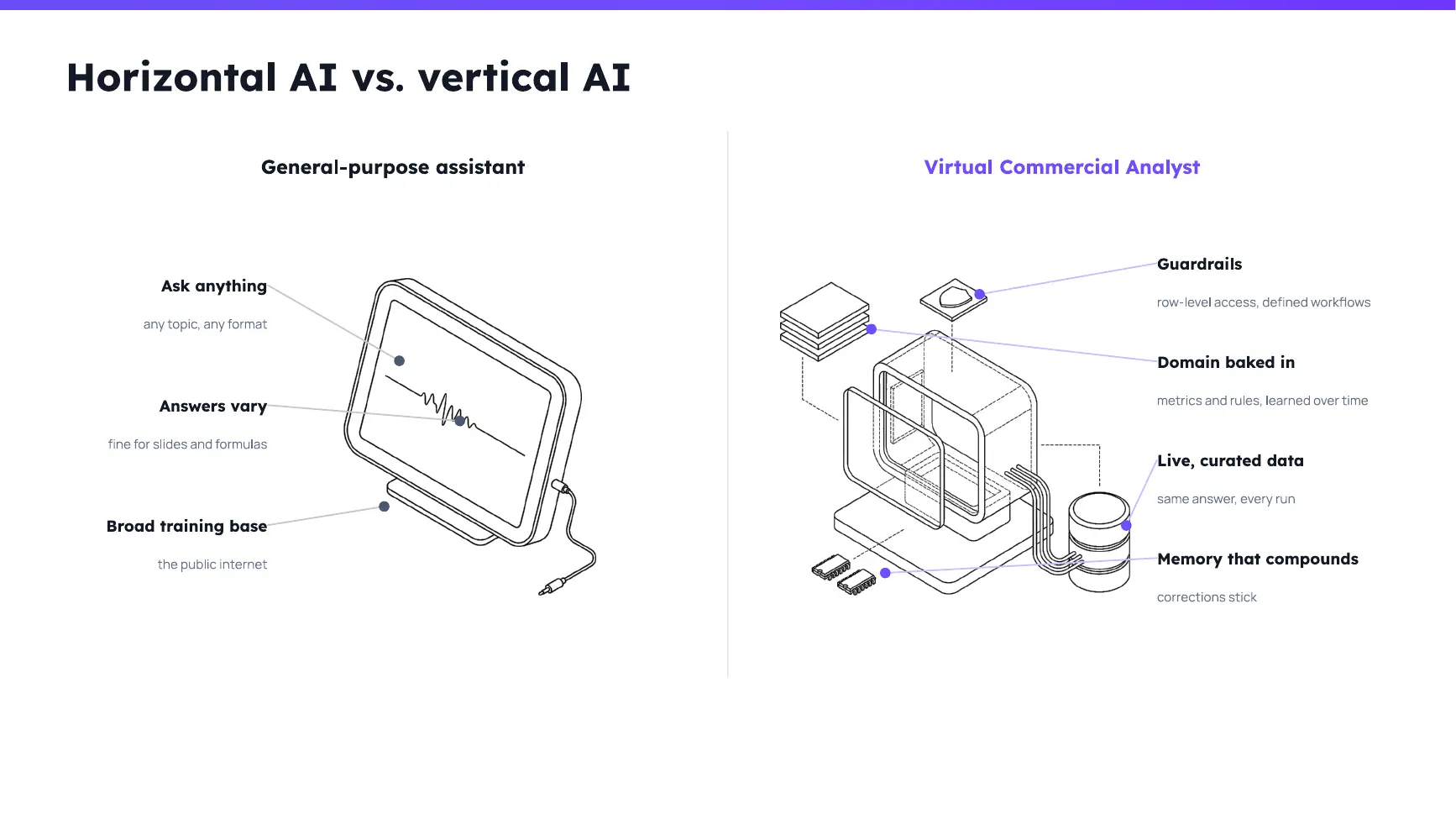
Agios is not an AI-skeptical shop. The team uses Claude, ChatGPT, and Copilot daily for email, slides, scheduling, and general analysis. Deepanshu was clear that those tools earn their keep, but that his team hit limitations with their horizontal AI assistants.
With horizontal AI, some variance in answers is fine. For commercial data, however, it isn't, because someone is making a call on the number. "We wanted more control on the semantic layer," he explained, "and to build the business context into it. Different terms mean different things at different organizations." A general-purpose model answering "why did this territory drop" without your metric definitions, business rules, and access controls baked in is a fast way to be confidently wrong. And critically, depending how they ask could get it wrong in slightly different ways.
So the team ran an evaluation of vertical AI platforms with parameters they defined up front: strength of the semantic layer, depth of reasoning, speed, and whether the answer stayed accurate and consistent under repeated questioning (e.g. does it hallucinate after five follow-ups? Tellius ranked highest on those tests, and the semantic and reasoning layer was the deciding factor.
The groundwork took weeks, not quarters
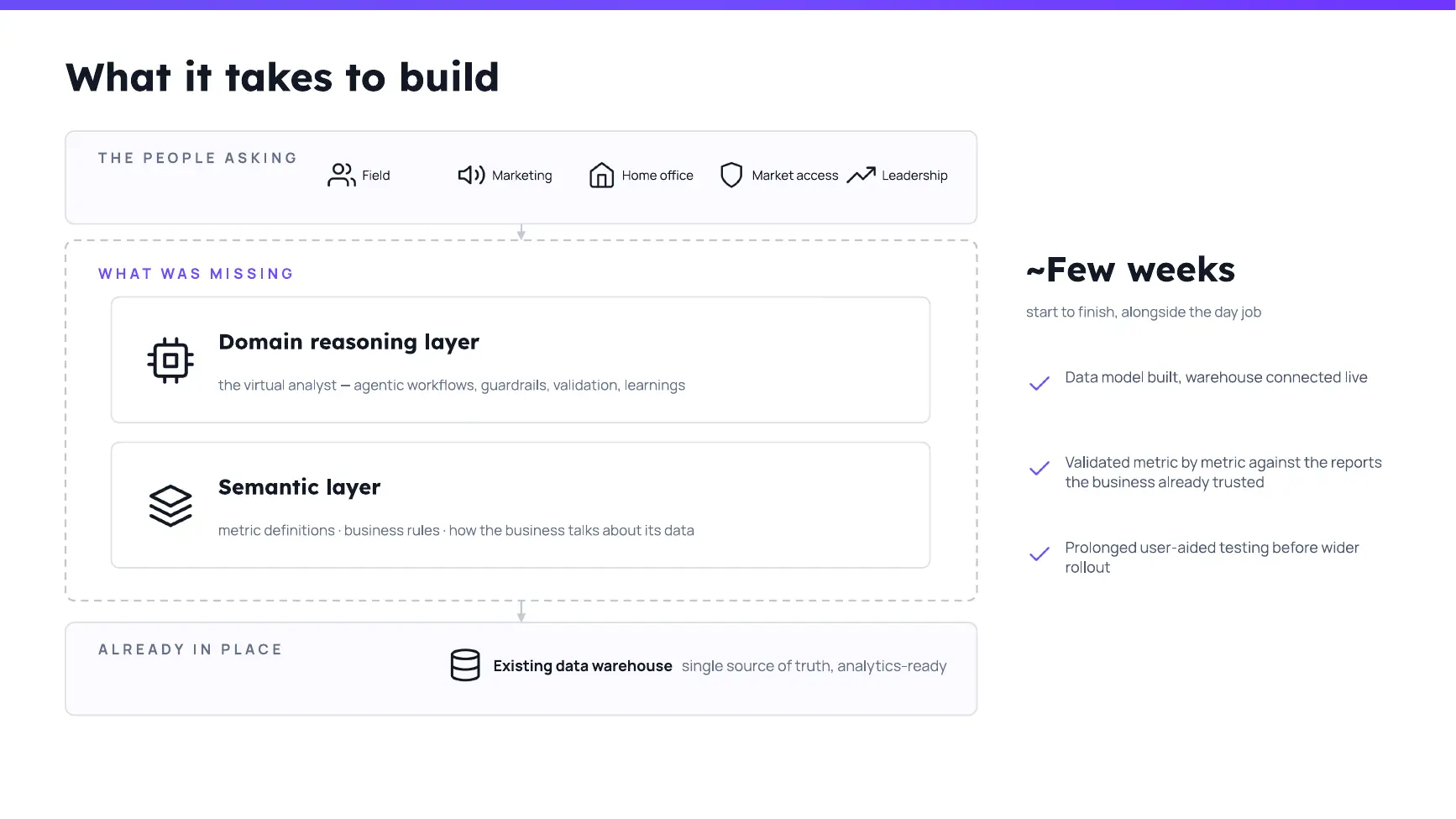
The objection Deepanshu hears most is that this must be a multi-month, multi-year setup project. It wasn't, and the reason is unglamorous: Agios had already done the data work. The warehouse was the single source of truth, structured in analytics and AI-ready architecture. His rule of thumb: "If a person can manage the data, AI will be able to manage the data as well."
On that foundation, the setup took a few weeks. Tellius connected directly to the data lake. The team defined business rules for key KPIs and metrics, set guardrails including row-level access so a rep sees only their own territory, and validated metric by metric against the reports the business already trusted. Then came the step most teams skip: they compiled frequent questions the market access, field, and home office stakeholders ask most, and tested the platform against that list until the answers came back right every time.
His framing for all of it: "Do not assume the AI will automatically know your organization. You have to train it like a new employee you would train. Do that groundwork diligently, because it is going to serve you for a long time to come."
What the virtual analyst grew into
The original ask was modest, a virtual analyst that could answer day-to-day questions quickly and take pressure off turnaround times. Since going live, the use cases outgrew the name and the same foundation runs:
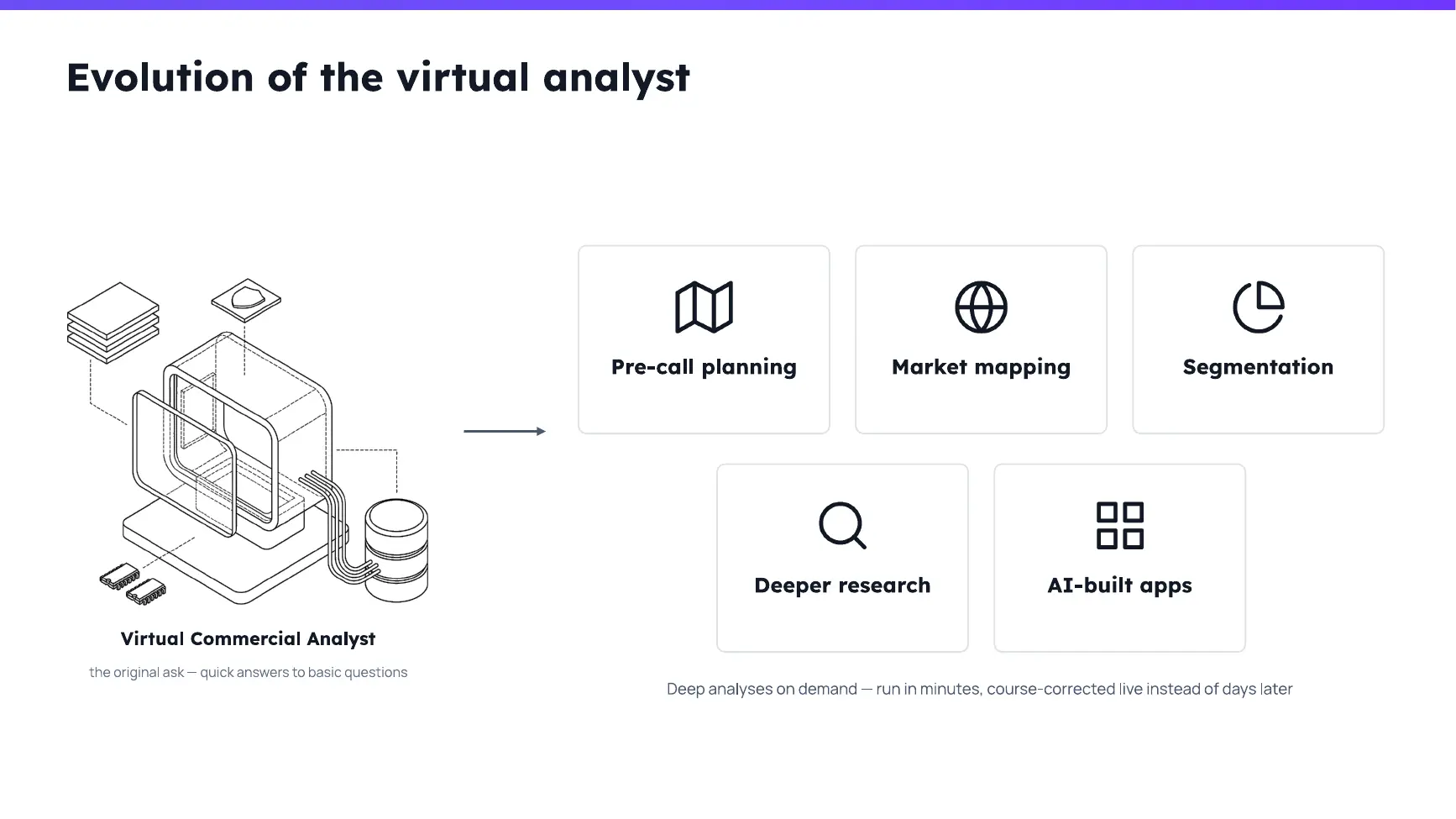
- pre-call planning, giving reps a 360-degree view of a physician before a conversation, from patient mix down to diagnosis history
- market mapping to size prevalence in new markets alongside customer and patient segmentation.
- "why" questions that used to be multi-week projects: why a trend broke, why a geography is underperforming, with the full diagnostic picture. Analyses that used to be a project now run in minutes while the team is still exploring the data.
"If we need to go back and forth, we do it live," Deepanshu said. "We course-correct immediately instead of waiting those couple of days." He added, "AI has skills. What it lacks is context, and that's where you come in."
Power users and everyone else
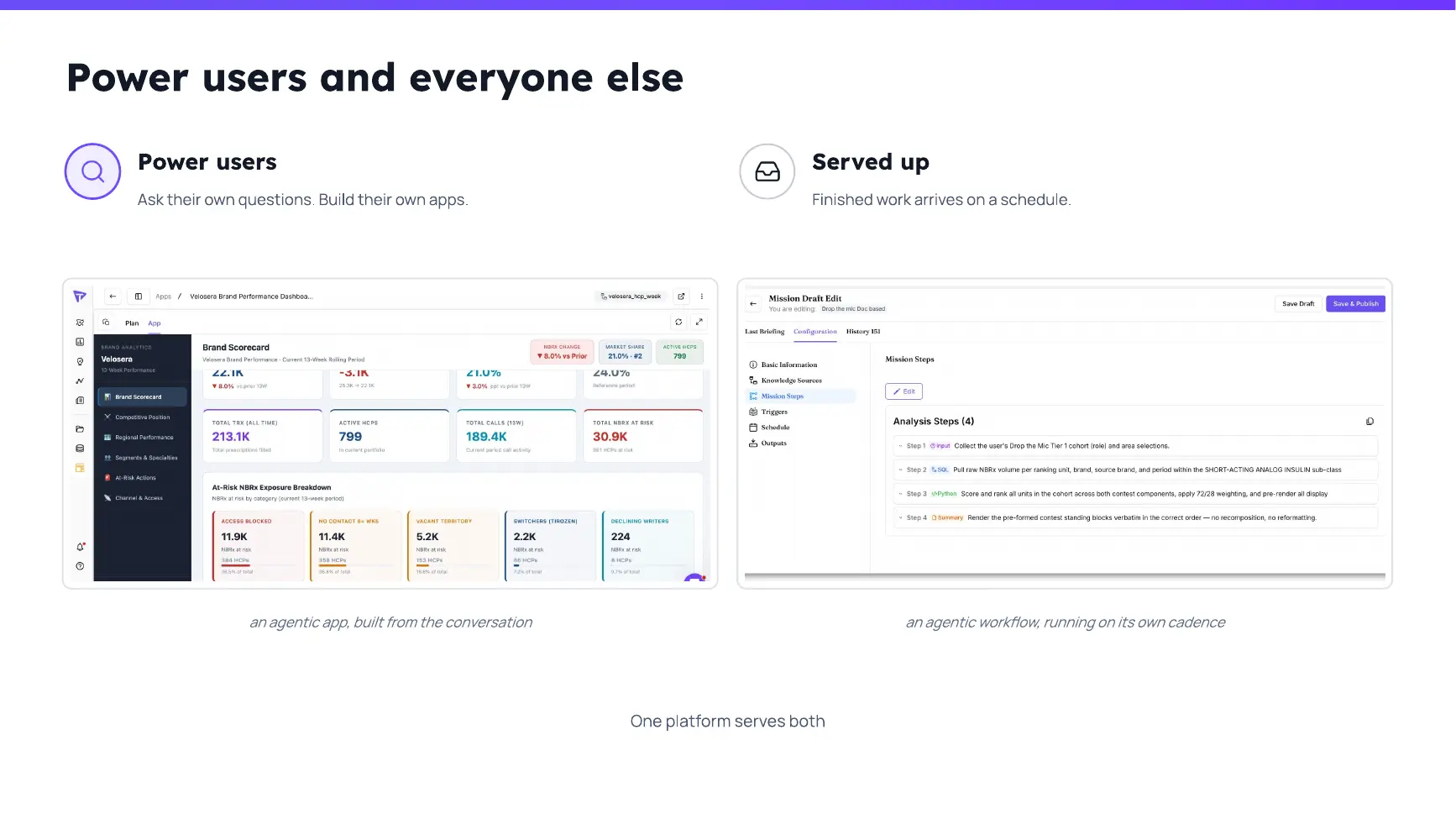
Not everyone at Agios wants to interrogate data, so the operating model is built as a spectrum. At one end sit power users. For example, the RVP of Sales can ask his own questions and build his own custom reports. Anyone with direct access gets trained on the prompts that work and, just as deliberately, on what the platform cannot do, because people who hear "AI" assume it does everything.
At the other end are people who want answers served to them. For the questions a lot of users ask, the team builds agentic workflows that encode the steps to follow and the structure of the output, so the platform handles a familiar question the same way every time. For recurring needs across low-power users, the team now builds agentic apps inside Tellius that behave like dashboards on the surface, with default answers up front and deeper exploration underneath. Users don’t care what's underneath whereas the analytics team cares a great deal, because those apps take a fraction of the time to build and can be changed in natural language, similar to apps from Lovable and Replit but grounded in analytic know-how and enterprise context.
What it added up to
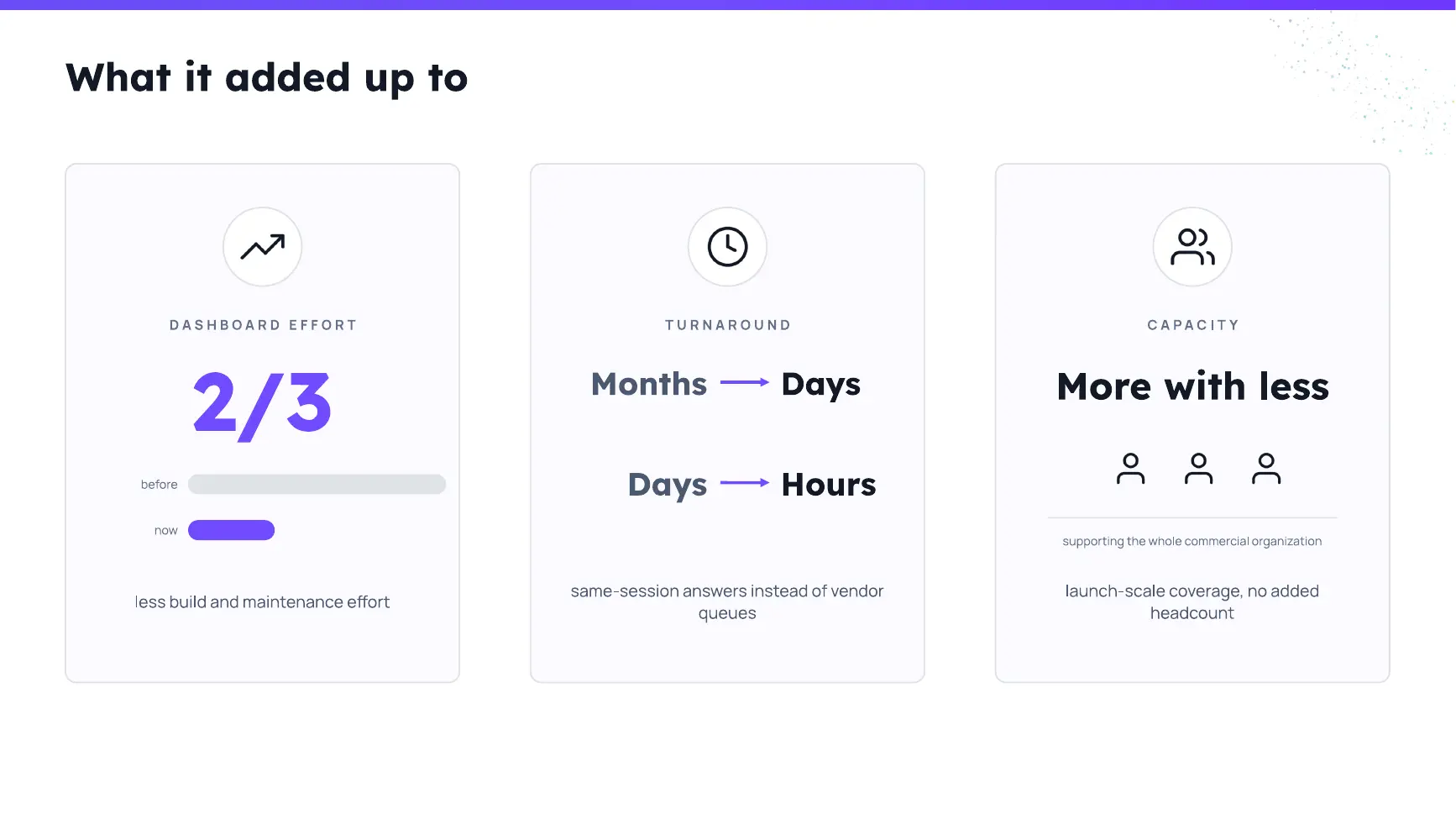
The vertical AI virtual analyst approach has driven meaningful efficiency for Agios Pharmaceutical. "What used to take months now takes days. What used to take days now takes hours." Static Excel and PowerPoint reports have largely been replaced by live Tellius apps and dashboards, which matters most post-launch, when the KPIs people care about shift week to week and a static report is stale before it circulates. The same sized commercial analytics team covers the whole commercial organization, through the launch and past it.
What waiting costs
The webinar's most repeatable lesson is about sequencing, and Deepanshu was blunt about the failure mode: "If you start when the pressure hits, panic kicks in and you are not diligent enough."
The groundwork that made Agios's speed safe, from the semantic layer to the metric-by-metric validation against reports the business already trusted, takes calendar time you cannot compress once a launch is live. The moment product hits the market, same-day becomes the standard turnaround, and a vendor loop measured in days starts failing daily in front of the field.
There's a second cost that compounds quietly. The capability curve is moving fast enough that teams already running are collecting upgrades the waiting teams never see. Building dashboards from prompts wasn't on Deepanshu's radar when the project started; the idea arrived months into production, and it landed on a foundation that was ready for it. "AI is evolving every day whether we like it or not," he said. "You just have to be cognizant of that fact and move with it." Doing nothing doesn't hold your position. It moves you backward relative to the teams and competitors who started years ago.
Advice for teams starting now
Asked what he'd tell someone at the beginning of this journey, Deepanshu came back to four things.
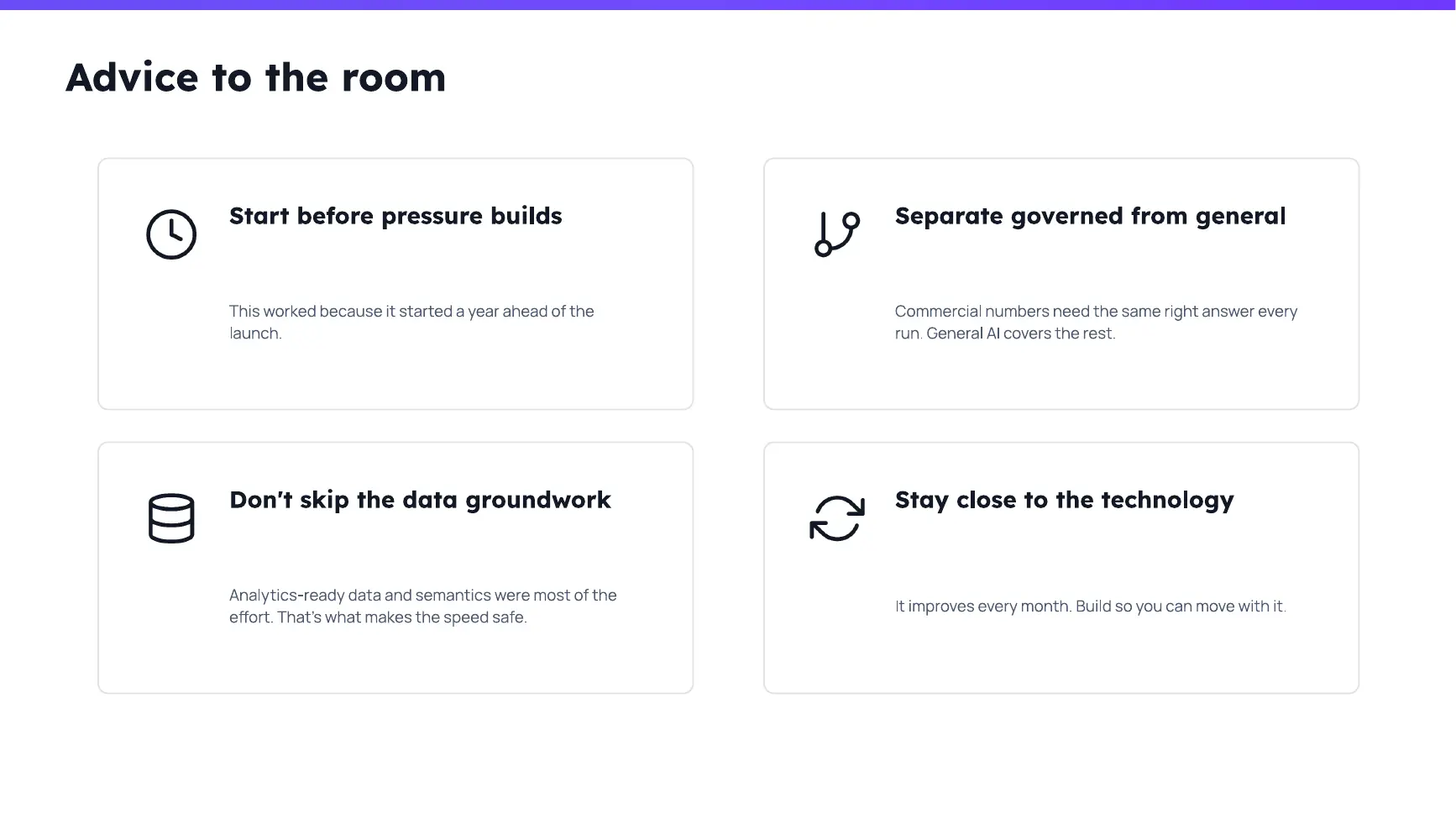
- Start before you need it, since the diligence that makes this work is a luxury of teams that aren't already underwater.
- Be clear about which questions need a governed, consistent answer and which can go to general-purpose AI, and don't cross the streams.
- Don't skip the data and semantic groundwork, because that is most of the effort and it's what makes the speed trustworthy.
- Stay close to the technology as it changes, since what looks advanced today becomes standard within months.
On measuring success, his advice was to define the metrics before the pilot starts. For Agios it was turnaround time on the most frequently asked questions. New metrics can join later, like the effort to build a dashboard the traditional way versus with AI, but the baseline gets set on day one.
If your team is staring down a launch with the headcount you have
Agios's story traces back to one structural problem: more requests than people, with a launch multiplying the requests while the headcount stays flat. That's the problem Tellius solves, with a governed semantic and reasoning layer on your data, agentic workflows that deliver the recurring work on a schedule, and apps your stakeholders can use without ever filing a ticket.
Get release updates delivered straight to your inbox.
No spam—we hate it as much as you do!

AI Agents for Pharma Commercial Teams: The 2026 Field Guide to Use Cases, Vendors, and What's Actually Real

This field guide examines the AI agent use cases that are actually being deployed across brand analytics, field sales, market access, forecasting, omnichannel engagement, incentive compensation, and commercial operations. The guide compares leading vendors and deployment approaches, highlighting the differences between AI copilots, agent frameworks, agentic analytics platforms, and purpose-built commercial AI solutions.