

Best Pharma Launch Analytics Platforms in 2026: What Each One Does Best
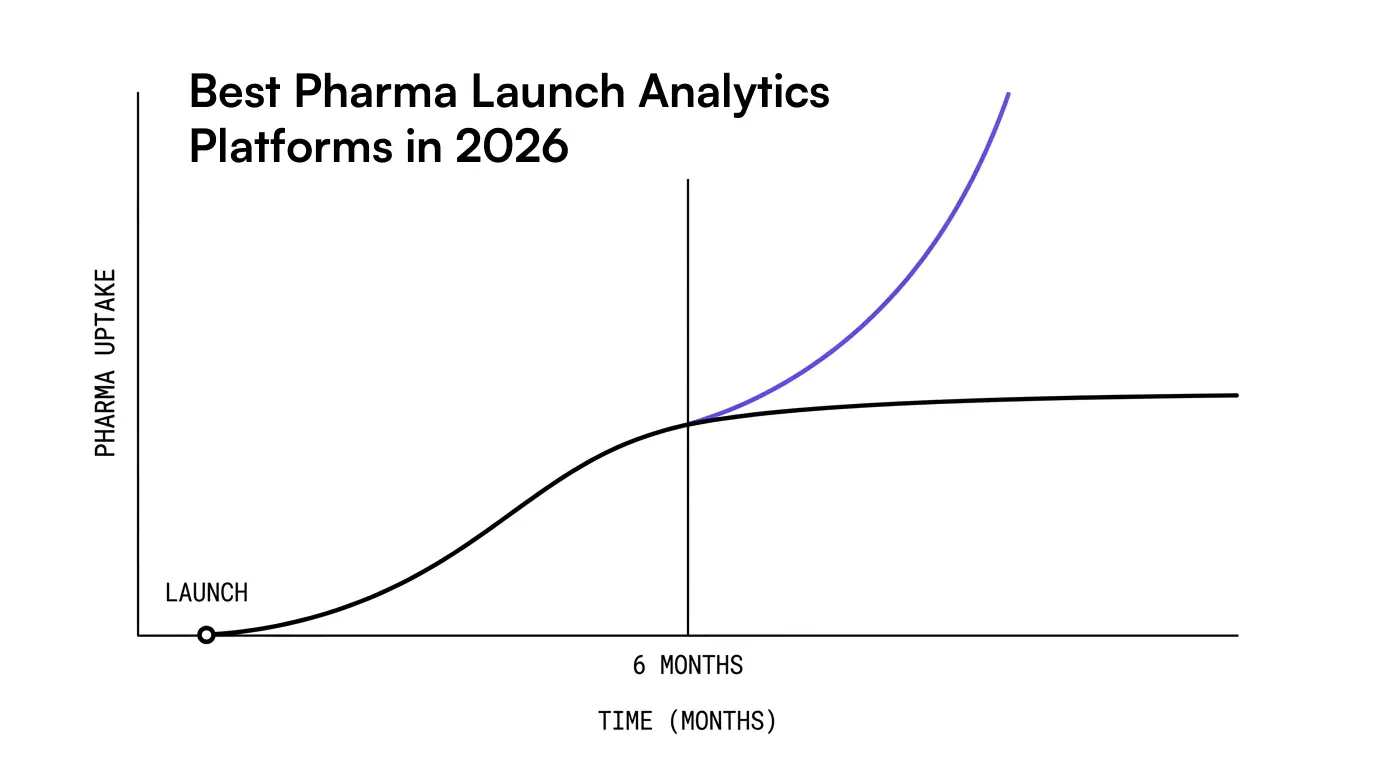

Pharma launch analytics is how commercial teams turn prescription, claims, payer, and field data into the targeting, forecasting, and uptake decisions that determine whether a new drug hits its numbers in the first two years. Unlike analytics for an established brand, it works against a committed plan on a short clock — the first six months set most of the five-year trajectory — so a slow answer is a missed quarter. Increasingly, agentic AI — systems that run a multi-step analysis on their own — compresses that cycle, explaining why a launch is behind plan in hours instead of days.
Most launches get one real shot. IQVIA reports that roughly 80% of launches continue on the trajectory they set in their first six months, so a slow start usually stays slow. And slow starts are common: EY's 2026 analysis found that 56% to 67% of new launches in major therapeutic areas miss their revenue targets, depending on the area.
There's no single tool that does all of this well. So this guide maps the landscape — the platforms launch teams rely on, what each one is good at, and where each one falls short — to help you assemble the stack that fits your launch. Getting that mix right is often the difference between hitting your number and explaining why you missed it.
Why pharma launch analytics is hard
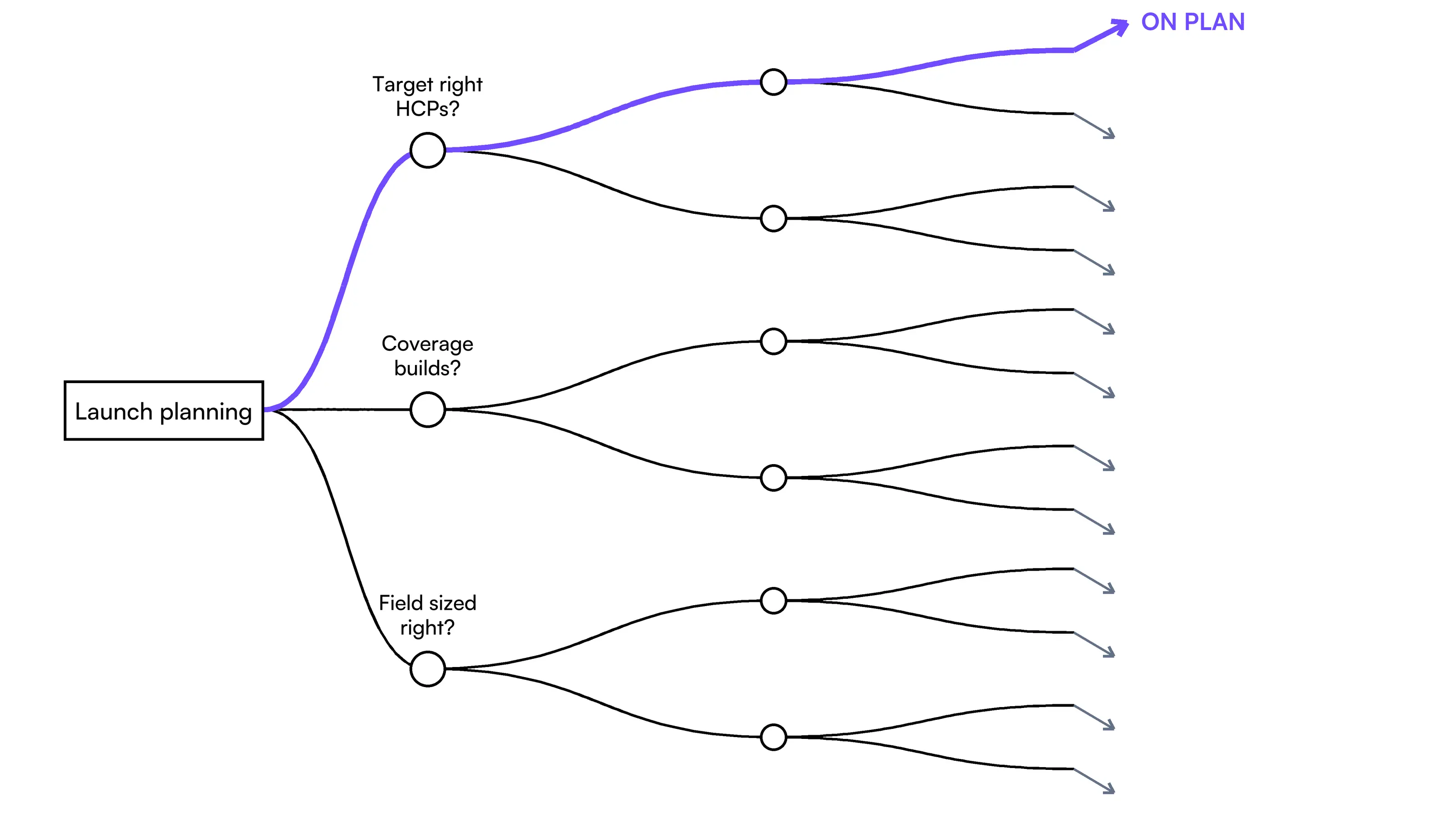
Pharma launch analytics is hard because the clock never lets up — first you have too little data, then too much of it, too fast. It's a bit like a rocket launch: you lock the trajectory in before you can see much, then the telemetry floods in faster than you can read it, and the window to fix a small early error is short. Before launch there's no prescription history to model on, so the first targeting models run on analogs, claims, and proxies. Once scripts start, the signal shifts under you: the targeting model you launched with gets retrained as real prescribing data replaces the proxies, because the signals that predict who writes first aren't the ones that predict who's still writing at month six.
Everything else compounds that. The work is measured against the plan you committed to, not a trend, so the gap between forecast and reality is what leadership watches — and you're often watching it with no trackers, no reporting, sometimes no field force. The timeline doesn't forgive: a mature brand can wait a week for an analyst to explain a dip; a launch can't, because the early months decide the rest.
A few related jobs sit outside the launch window. Optimizing a mature brand, defending against biosimilars at loss of exclusivity, running marketing-mix models, reconciling gross-to-net, publishing real-world evidence — all of it is real analytics work, and all of it runs for the life of the product. Analytics doesn't stop after launch; the questions just change as the brand matures.
Some disciplines that do matter at launch are deep enough to warrant their own comparison. We cover pharma market access analytics and HCP engagement platforms in separate guides, and touch them here only where they intersect the launch window. This guide stays focused on that window: the stretch when the product is new and the trajectory is still being set.
Why most launches miss
Once a launch is live, the data problem inverts. The scripts, claims, coverage, and field activity are all flowing now — often faster than a team can read them. Launches rarely miss because the data is missing; they miss because no one turns it into a decision in time.
Look at what separates the launches that beat their forecast from the ones that don't. A ZS retrospective on 340 launches (2008–2025) found that clinical differentiation, on its own, barely moves the needle — it lifts the overperformance rate from 44% to 49%. Add sustained manufacturer commitment, the unglamorous work of access infrastructure, patient support, and field capability, and the rate jumps to 67%. The molecule gets you in the game; the commercial system around it decides whether you win. Deloitte's review of 284 launches points the same way: midsize companies consistently out-launch big pharma, despite smaller budgets and less data. Execution beats raw data volume.
And a miss is usually visible early — in pull-through that lags coverage, in NBRx that plateaus, in a payer mix skewing the wrong way. The catch is that most reporting tells you what happened, not why, and reconstructing the why across claims, payer, and field data is slow, manual work the launch window has no patience for. In a mature brand, that lag is absorbable. In the six months that set a launch's trajectory, it's the difference between a course correction and a missed year.
So the binding constraint at launch isn't more data. It's how fast a team can turn the data it already has into an explained decision. Here's what that looks like in practice — the questions a launch team is actually asking, and what it takes to answer each one today:
Every one of these is a cross-source question, and every one is measured in days of analyst time today. That gap — between the question and the answer — is where launches quietly go off plan.
A cautionary tale: a forecast the market never agreed with
In May 2023, Astellas launched Veozah, the first FDA-approved non-hormonal treatment for menopausal hot flashes — a new mechanism for a symptom that affects millions, and a market the company had sized at $2 billion to $3.3 billion in peak sales. The launch had real weight behind it, down to a Super Bowl spot in early 2024. Then the payers answered. Coverage was slow to come, the roughly $6,600-a-year price ran about three times higher than cost-effectiveness analyses supported, and within the first year Astellas had cut its fiscal-year forecast from $375 million to $50 million. Actual sales came in around $25 million.
The drug worked and the need was real. But the launch didn't fail on efficacy. It failed because the demand the forecast assumed depended on access the market wouldn't grant — and the market said so almost immediately. Payers saw a first-in-class label priced well above cheaper hormonal options and were slow to cover it; Astellas itself pointed to payer coverage as the thing holding uptake back. The assumption that a new mechanism would pull through coverage on its own never survived contact with how payers actually decide.
That's the part worth studying. The miss wasn't buried in year two; it showed up in the first quarters, in coverage wins that didn't come and uptake running at a fraction of plan. A multibillion-dollar forecast met a market that wouldn't pay for it at that price, and the gap was visible in the early access data long before the guidance cut made it official. Reading that gap between forecast and reality — and acting on it early — is what separates a fixable first year from a lost one.
The lesson for launch analytics is direct. A launch forecast is a hypothesis about behavior — prescriber, payer, and patient — and the first months of real uptake are the test of it. The teams that come out ahead treat early variance against plan as something to investigate, not a number to explain away.
The nine jobs of launch analytics
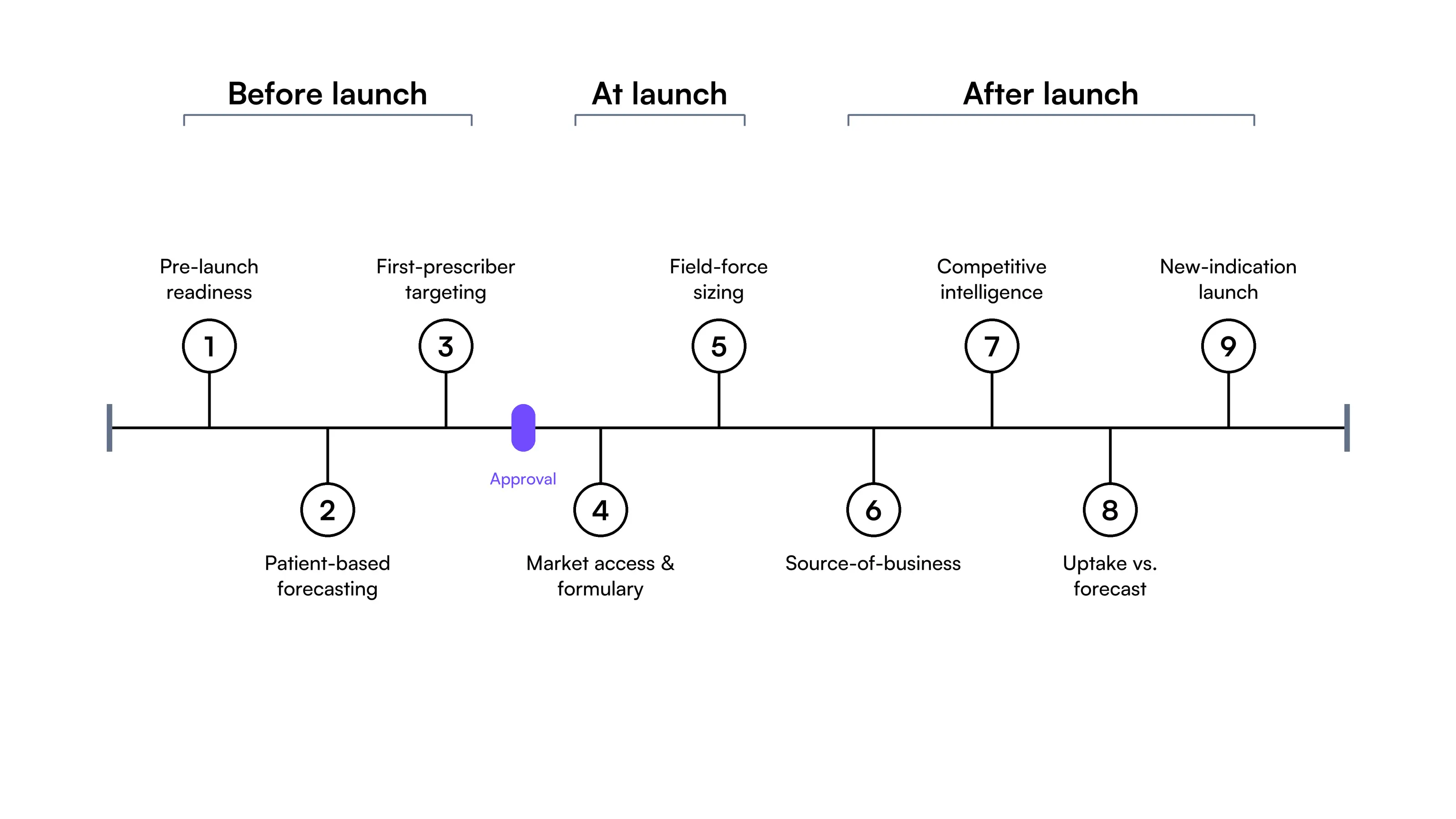
Where that speed matters most depends on the job at hand — because launch analytics isn't one task but a stack of distinct jobs that surface at different points in the launch, owned by different teams and fed by different data. Few platforms cover more than two or three well, which is why the tool that's perfect for one launch team is beside the point for another. Here's the work, in the order it tends to come up.
Best pharma launch analytics platforms in 2026
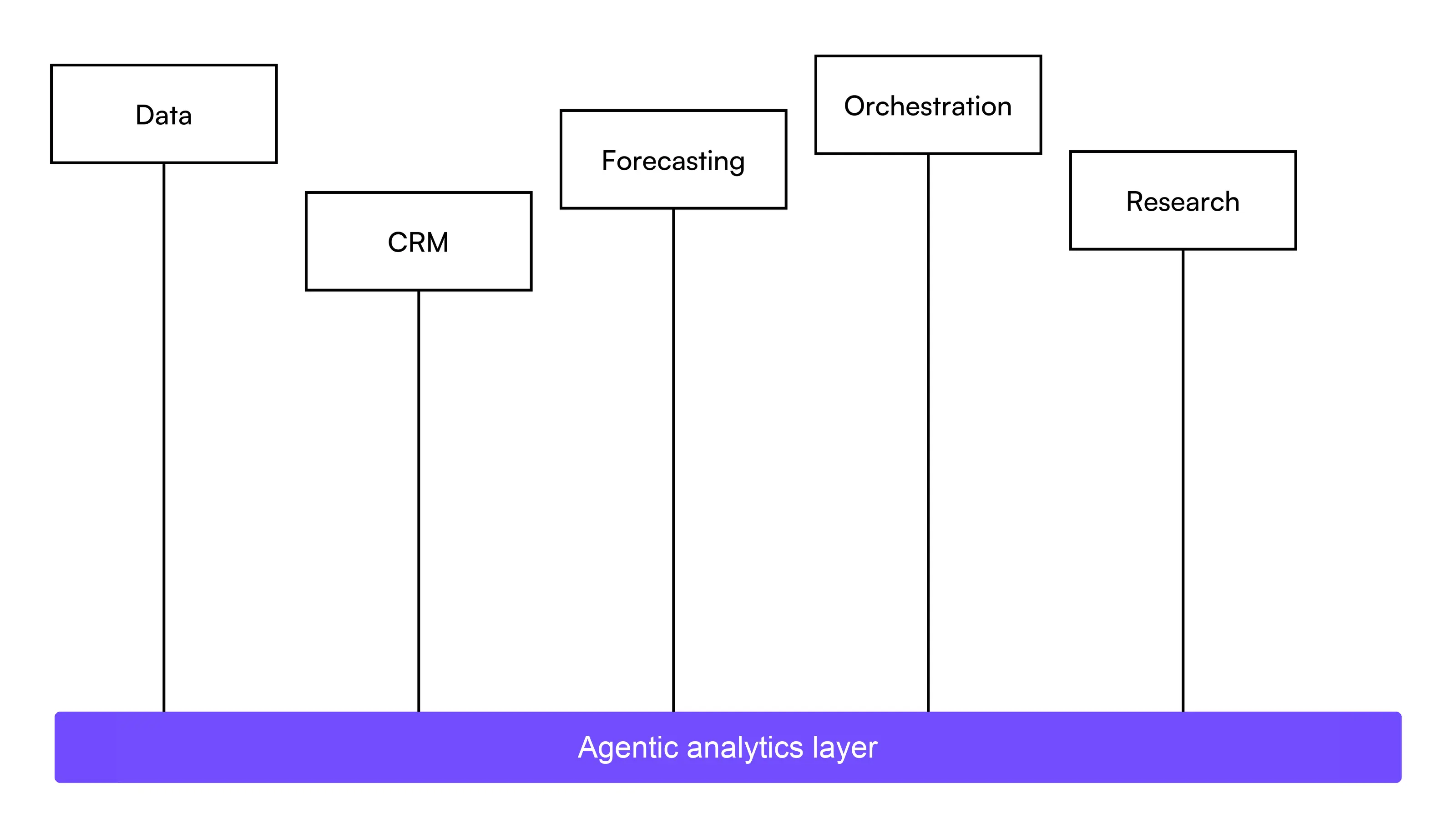
The launch-analytics market is a set of specialized tools, each built for one slice of the work. None of them covers the whole launch, so teams run several at once and still can't get a single, traceable answer to the question that matters most in the window: why are we behind the number? Here's what each tool is used for, and where each one stops. They're listed roughly by how much of a launch they touch today.
Most teams don't pick one of these. A launch stack usually runs two or three together, and the seams between them are where the answers get lost.
IQVIA. IQVIA supplies the syndicated prescription and claims data most launches are measured on, and sells launch-strategy consulting and forecasting alongside it. The data is deep, but it lives inside IQVIA's own ecosystem, and a cross-source question — why is uptake lagging in territories where coverage is strong — still means commissioning analysis and waiting on it. Cost sits at the top of the market.
Veeva. Veeva is the system of record for field activity and, through Crossix, ties media exposure to prescriptions. It captures what the field and the channel did. It doesn't forecast uptake or work out why a launch is tracking the way it is; that happens elsewhere, on data Veeva hands along.
ZS. ZS provides launch-readiness frameworks and forecasting methodology, delivered largely as consulting. The methodology is well-regarded, but the model is people and services rather than a product a team runs itself, so turnaround follows the pace of the engagement, not the pace of a live launch.
Axtria. Axtria builds the operational machinery of a launch: territory and incentive-comp design, field and marketing-mix analytics, increasingly packaged for emerging pharma. It runs the commercial engine. Diagnosing why performance is moving across data sources is a different job, and not the one it's built for.
Komodo Health. Komodo supplies patient-level claims and maps treatment journeys, which matters most for rare and specialty populations. Its coverage is U.S.-only, and it's a data source rather than an analysis layer — it shows where the patients are, not why a launch is or isn't reaching them.
ZoomRx. ZoomRx runs survey-based tracking of how HCPs receive launch messaging, off its own panel. It reads perception and recall. It sits apart from the claims and Rx feeds that show actual prescribing, so its signal has to be stitched to the rest of the picture by someone else.
Clarivate (DRG Fusion). DRG Fusion, released in 2025, offers pre-built dashboards on claims and social-determinants data, arranged by therapy area. The views are fixed and pre-built. It shows what the data says; it doesn't resolve why a number moved.
PharmaForceIQ / Aktana. After their January 2026 merger, the combined platform decides the next-best action for reps and channels and pushes it into the field. It acts on conclusions. It doesn't produce the analysis those conclusions rest on; that has to arrive from another system.
Tellius. Every tool above owns one slice — data supply, CRM, forecasting, orchestration — and hands the rest off. Tellius is an agentic analytics platform, purpose-built for pharma commercial teams, that sits across them. It connects to the launch data a team already licenses — IQVIA and Symphony Rx, claims, MMIT payer, specialty-pharmacy and hub feeds, and Veeva activity — and reasons over all of it at once, in the team's own terms: NBRx and TRx, pull-through, payer mix, formulary wins, territory and account. When uptake drifts from forecast, its AI agents decompose the variance — targeting versus access friction versus competitive entry — and trace it to the specific accounts and segments behind the gap: the manual, cross-source reconstruction that otherwise costs an analyst a week. It answers the questions from the table above — is it targeting, access, or the competitor; where is pull-through stalling — across every source at once, traceably, same-day, while the window is still open. Before launch, with no prescription data yet, it complements forecasting rather than replacing it, and earns its place once the first scripts land. Tellius works with 8 of the top 10 pharma.
A few specialists round out the field: ConcertAI for oncology real-world evidence, Trinity Life Sciences for launch-strategy and forecasting consulting, and Within3 for tying medical-affairs signal into commercial launch planning.
Build, buy, or consult
Once you accept that the hard part is the reasoning layer — the thing that explains why you're behind plan across a fragmented stack — the real question is how you get one. There are three paths, and most teams end up using more than one.
Build it. Stand it up yourself on Snowflake or Databricks with an internal data-science team. Full control, but 12 to 18 months, a bench you have to hire and keep, models you maintain — and a launch window that won't wait for any of it. Fits organizations with a mature data team and real runway before approval.
Consult it. Bring in ZS, Axtria, or IQVIA analysts. Deep expertise and judgment a tool can't replace, but it's people-paced: every cross-source question is an engagement, and the answers don't compound or scale. Fits building first-launch capability, or one-off strategic questions.
Buy it — as a platform plus a deployed team. Run an agentic analytics platform your own team operates, stood up and tuned by people who know pharma launch data — the connections to your IQVIA, Veeva, and payer feeds, the launch metrics and definitions, the first use cases. You get the domain expertise of a consulting engagement and a platform that keeps compounding after they leave, rather than answers that stop when the engagement does. You still license the underlying data feeds, and pre-launch it complements forecasting rather than replacing it. Fits teams whose questions have outpaced their analyst bench and who need answers while the window is open.
No serious launch buys a platform and walks away — the question is whether the expertise comes as an open-ended engagement that never scales, or as the team that stands up a platform your people then run themselves.
How to choose
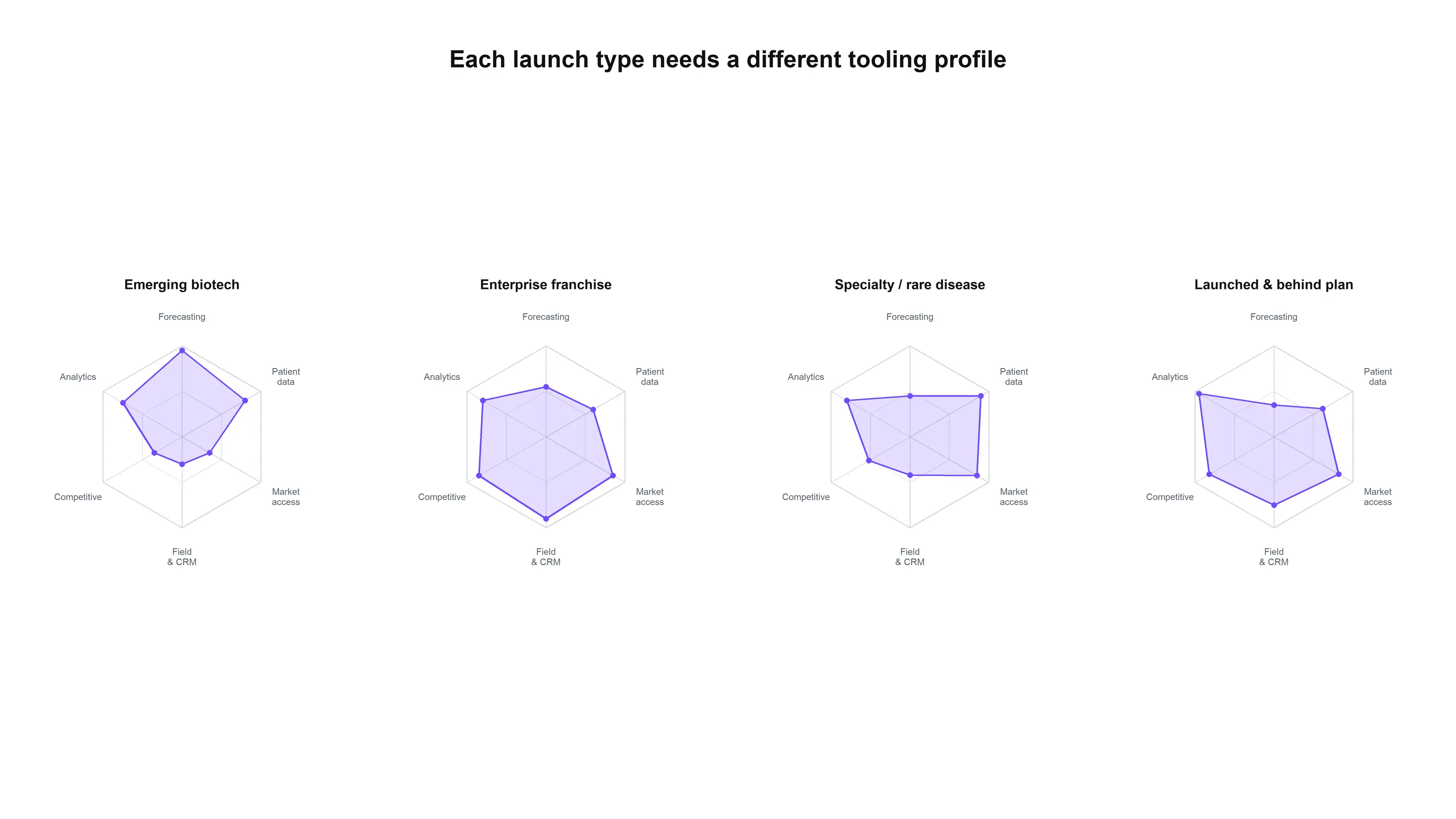
The right stack depends on what kind of launch you're running and how far into it you are. Four common situations, and a short checklist to pressure-test each one.
Emerging biotech, first launch. You're building from scratch against a hard FDA date, often before there's a field force. A readiness and forecasting partner — ZS, Axtria, or a consultancy like Trinity — stands up the foundation, and a patient-data source like Komodo or IQVIA supplies the market picture. The gap first launchers hit is the one between those tools: turning the data into decisions without a bench of analysts.
- Is your patient-based forecast tied to a live data feed, or frozen in a spreadsheet that ages the day you build it?
- When the model says one number and the IC goal says another, who reconciles them, and how fast?
- Can a non-analyst on your team get an answer without opening a ticket?
- Have you decided what you'll watch in week one, before there's a single script to watch?
Enterprise franchise launch. You already run IQVIA and Veeva, so data isn't the problem — connecting it is. The work is getting the syndicated data, CRM activity, and payer feeds to answer one question together, quickly.
- How long does a cross-source question take today, from asking to answer?
- When uptake misses, can you separate a payer-mix shift from a competitive loss without a manual deep dive?
- Does the answer trace, step by step, well enough to put in front of the brand lead?
- Are your IQVIA, Veeva, and access feeds queried together, or read in separate tabs?
Specialty or rare-disease launch. Success turns on finding a small population and securing access. A patient-journey source like Komodo usually anchors the stack, with RWD from Clarivate and access data alongside it. Because the counts are small and a handful of accounts can swing the read, the premium is on explaining variance fast.
- Can you see, this week, which accounts started patients and which stalled?
- Is coverage converting into filled scripts, or approving and then dropping at the pharmacy?
- When one territory moves, can you tell signal from noise before you act?
- Does your patient data connect to your field data, or live in a separate system?
Launched and behind plan. You're in the window, scripts are flowing, and the number is tracking under forecast — but the why is buried across payer, claims, and field data, and reconstructing it by hand takes a week you don't have. This is the moment the trajectory hardens, so the premium is entirely on explaining the variance and acting before the quarter closes.
- When you're behind, how long from "we're behind" to "here's why," in an answer you can act on?
- Can you separate payer-mix shift, competitive entry, access friction, and targeting — and quantify which is hurting most?
- Does the explanation trace to the specific accounts and segments behind the gap?
- Are you catching the drift weekly, or discovering it in the quarterly review after the window's closed?
Across all four, the tools differ but the gap is the same: each shows you a piece, and the question is whether anything reads across them fast enough — and traceably enough — to explain why plan and reality are pulling apart while you can still act.
By stage. Pre-launch, it's forecasting and targeting on proxy data — analog and patient-based models. Through the first 90 days, it shifts to reading early signal against plan: is coverage building, is NBRx ramping, where is the business coming from. The tools you lean on change as you move through those phases, which is the argument for a layer that spans them over a separate point tool for each.
Tellius vs. the alternatives
The two questions that come up most in a launch-analytics evaluation are how Tellius stacks up against the data incumbent and against the consulting incumbent. Both are the wrong frame, in the same way: they're different layers of the stack, and plenty of teams run both.
Tellius vs. IQVIA. IQVIA is a data and services company. It owns the syndicated prescription and claims assets a launch is measured against, and it sells the analysts who interpret them. Tellius owns no data; it connects to the feeds you license, IQVIA's included, and its AI agents reason across them so your own team can get answers without commissioning each one. The difference shows up in turnaround: an IQVIA cross-source question routes to their analysts and comes back in days; in Tellius, your own team runs it directly, traceable step by step. Teams that need the deepest data and global reach keep IQVIA for the feeds. They add Tellius when waiting on analysis has become the bottleneck.
Tellius vs. ZS. ZS and Tellius both promise to turn launch data into decisions, through opposite models. ZS is consulting-led, and its strength is methodology — forecasting rigor, analog frameworks, launch-readiness design — delivered mostly by people. That fits a team building first-launch capability that wants expertise beside it. Tellius is an agentic analytics platform your team runs — stood up and tuned by people who know pharma launch data, then operated in-house rather than through an open-ended engagement. The tradeoff is real: ZS brings judgment a tool can't, and Tellius brings that expertise plus a platform that compounds — speed and repeatability a pure services model can't. Emerging teams often start with ZS for the build, then bring in a platform like Tellius as the launch goes live and the questions outpace any engagement cadence.
The 2026 shift: agentic AI for launch
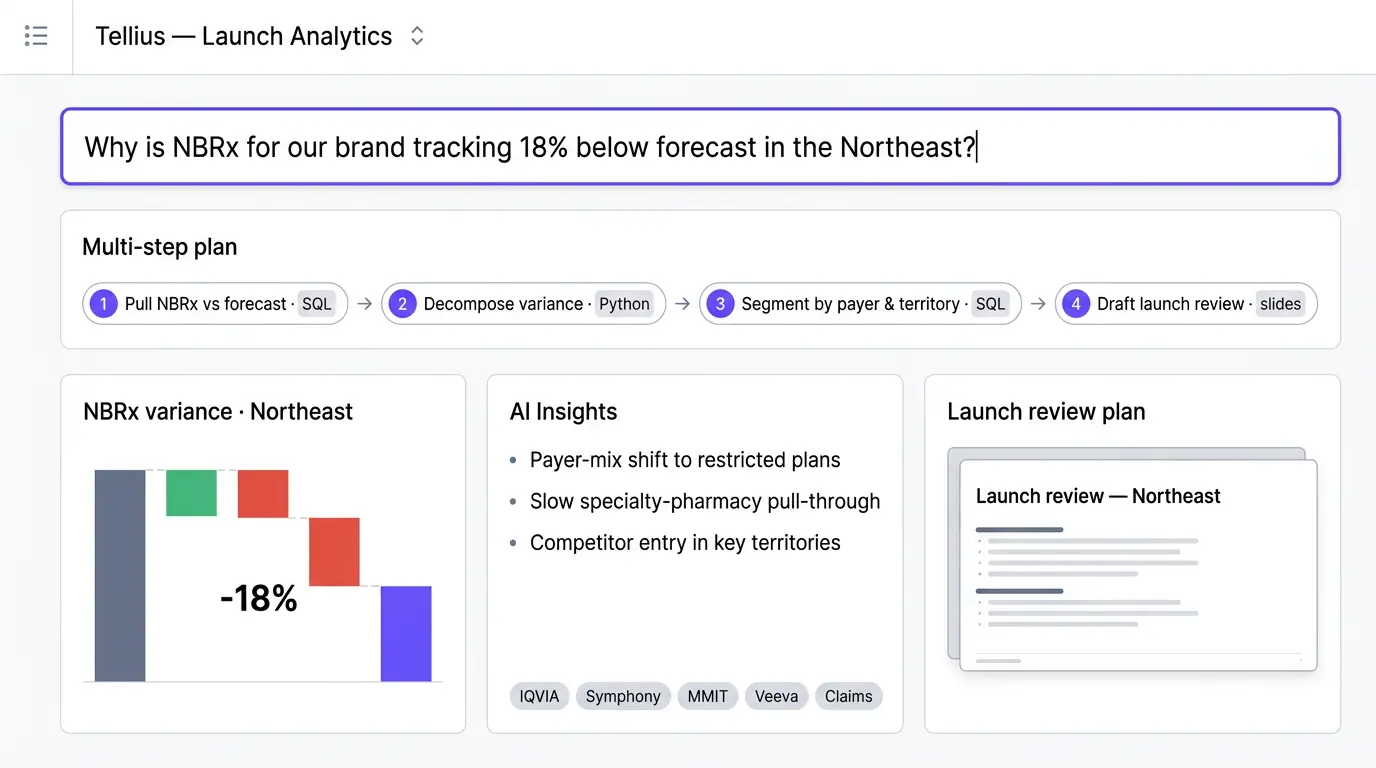
The way this work gets done is changing fast. Agentic AI — systems that run a multi-step analysis on their own rather than answer one question at a time — is compressing the launch-analytics cycle. Work that used to take days of manual pulling and slicing, like building analog benchmarks or chasing a variance back to its root cause, now runs closer to same-day. ZS frames the goal as a launch insights hub that lets teams pivot in days, not months; Within3 calls the same idea Launch Intelligence — reading the early signal and acting on it before the quarter closes.
This is the category Tellius is built for: an agentic analytics platform, purpose-built for pharma commercial teams, whose AI agents reason across launch data — IQVIA, claims, payer, and Veeva — to explain variance against plan while the window is still open, rather than answering one question at a time.
There's a catch, and the industry is starting to say it out loud. At Axtria Ignite 2026, the recurring warning was that agents "amplify what lies underneath them" — point one at a shaky data foundation and it just reaches the wrong answer faster. The numbers behind the caution are sobering: roughly 89% of AI pilots never reach production, and against pharma's 99.5% accuracy bar, a majority of generative-AI tools in medical use still hallucinate.
For launch, that reframes what to look for. When the window is short and the answer moves a forecast, speed isn't the test — trust is. The question to ask any agentic platform isn't how fast it answers, but whether you can see how it got there. That is why traceability — an answer that shows every step from source data to conclusion — matters more in pharma than in almost any other industry: a number you can't defend to a brand lead or a compliance review can't move a launch.
What the best launch teams do differently
The gap between a launch that beats forecast and one that misses usually isn't the molecule. The ZS analysis of 340 launches found clinical differentiation moves the overperformance rate only from 44% to 49%; what carries it to 67% is the operational follow-through around the drug. Advanced teams treat that follow-through as an analytics discipline, and a few habits set them apart.
They start the data work years out. High performers stand up the targeting model and the access plan 18 to 24 months before launch, so the infrastructure is live before the first script rather than assembled in the panic of launch month.
They engage payers during the trial. Leading teams build the access and value story into Phase 2 and 3, so coverage is moving before approval instead of after.
They connect their data, not just collect it. Mature teams don't only license IQVIA, Komodo, and Veeva; they wire them together, so a cross-source question returns one answer instead of three separate reports — increasingly with agentic AI doing the reasoning across them.
They watch leading indicators. NBRx and pull-through get reviewed weekly from day one, because the trajectory hardens fast and a lagging quarterly review surfaces the problem too late to fix it.
They put one name on the outcome. Launches run by a single accountable leader tend to outperform those run by committee, because decisions move at launch speed rather than meeting speed.
The throughline is simple. Advanced launch analytics isn't about holding more data than the competition. It's about turning that data into decisions faster, and earlier, than they do.
The bottom line
Veozah is the visible version of a launch miss — billions in projected peak sales undercut by an access gap that surfaced in the first year. Most misses are quieter: a few moderate gaps, slow access here, soft targeting there, compounding until the first-year number is out of reach. Either way the timing rhymes — by the time a quarterly review surfaces the problem, the six-month window that sets the trajectory has usually closed.
The stack you assemble decides whether you catch that drift in time. Data sources, the CRM, and forecasting partners each show you a piece; the question is whether anything reads across them fast enough — and traceably enough — to explain why plan and reality are pulling apart while you can still act. That's the job an agentic analytics layer does, and it's the gap most launch stacks still have.
If you're mapping your own launch stack, the related 2026 buyer's guides — market access, HCP engagement, brand analytics, and gross-to-net — go deeper on the adjacent decisions.
Get release updates delivered straight to your inbox.
No spam—we hate it as much as you do!


There isn't one. Launch analytics spans nine distinct jobs, and the platforms specialize: IQVIA and Komodo supply data, Veeva runs field execution, ZS and Axtria handle forecasting and ops, ZoomRx tracks message reception. Most teams combine two or three, then add an agentic analytics layer like Tellius to reason across them and explain why the number moved.
Yes — that's the core of what an agentic analytics platform does at launch. Rather than answering one question at a time, AI agents run a multi-step analysis across prescription, claims, payer, and field data, decompose the variance against forecast into its drivers — targeting, access, competitive entry — and trace it to the accounts and segments behind the gap, in hours instead of days.
Launch reporting shows what happened — TRx is down, coverage is up. Agentic analytics explains why, and does it proactively: AI agents monitor the launch, investigate anomalies, and surface the driver of a miss before a quarterly review would catch it. The shift is from you asking questions to the system surfacing answers you can act on.
No. Launch analytics is the data-and-decisions core inside the broader discipline the industry calls launch excellence, which also covers strategy, medical, and operational readiness. Analytics is the part that turns commercial and market data into the targeting, forecasting, and uptake decisions a launch runs on.
Patient-finding is usually the constraint, so a patient-journey data source like Komodo Health tends to anchor the stack, paired with access data for coverage. Because populations are small and a few accounts move the read, the priority is explaining variance fast — which is where an agentic analytics layer earns its place.
A readiness and forecasting partner such as ZS, Axtria, or Trinity builds the foundation against your FDA date, and a data source like IQVIA or Komodo supplies the market picture. The hard part is converting that into decisions without a large analyst team — the gap an agentic analytics platform is built to close.
Pre-launch work runs on proxies: epidemiology, analogs, and claims feed patient-based forecasts and the first targeting models. Data sources and forecasting partners do most of the lifting here. An agentic reasoning layer matters more once real prescribing data starts arriving and the question becomes why plan and reality diverge.
Tellius doesn't supply syndicated data like IQVIA or run the CRM like Veeva; it's an agentic analytics platform that sits across both. It connects to the feeds you already license and its AI agents reason over them to explain why a launch metric moved — the cross-source root-cause work those platforms hand off. Teams run it alongside them, not instead.
.webp)
Best AI Platforms for Pharma Commercial Analytics in 2026: 11 Platforms Compared

This guide compares the 11 best AI platforms for pharma commercial analytics in 2026, evaluating how each supports brand performance, market access, patient analytics, field force effectiveness, incentive compensation, and omnichannel engagement. It highlights a key shift in the market: traditional BI and SFE tools focus on reporting what happened, while newer AI platforms differentiate by investigating why performance changed. The post breaks down core capabilities like root cause analysis, data integration, governance, and agentic workflows—helping pharma teams identify which platforms can deliver faster, more actionable insights across commercial operations.