
AI-Powered Brand Analytics: Know What Moved TRx Before Your Next Meeting
Agentic analytics autonomously investigates TRx swings, decomposes changes across competitors and payers, and delivers root-cause explanations in minutes. Get continuous monitoring that catches formulary risks before they hit NBRx, conversational AI that answers “why” during planning, and resource optimization that maximizes ROI across constrained budgets. Read this to see how AI turns TRx movement into a defensible explanation by payer, competitor, segment, and channel, fast enough to use in the meeting.
What is AI-Powered Brand Analytics?
AI-powered brand analytics uses machine learning to unify prescription data, formulary intelligence, competitive activity, and promotional spend into a single governed view. This helps pharma commercial teams understand what actually drove TRx and NBRx changes, not just that they changed.
Unlike traditional reporting that shows lines moving without explanation, AI-powered brand analytics decomposes market share shifts by competitor, payer, segment, and geography. It forecasts NBRx trajectories using leading indicators, detects formulary risks before they hit prescriptions, and measures which promotional activities actually moved scripts.
Tellius is an AI-powered brand analytics platform purpose-built for pharma. It combines automated market share decomposition, NBRx forecasting, and multi-touch attribution with conversational analytics for instant answers and agentic analytics for continuous monitoring that catches performance shifts before quarterly reviews.
The Problem
Brand performance analytics shouldn’t be a guessing game
When TRx or share moves, teams need to know why—fast. This hub brings together the questions brand leaders ask to pinpoint drivers, reduce noise, and act with confidence.
Why teams can’t pin down what moved TRx

TRx swings week to week and most reporting just shows lines moving—without separating formulary changes, competitor activity, or prescriber behavior shifts.
When leadership asks “Why did we lose market share?”, the answer shows the outcome, not which competitors gained, which segments shifted, or which payer decisions drove the loss.
Teams still manually stitch prescription data, access data, and promotional spend from separate systems, then reconcile mismatches in Excel before building a narrative.
More than half of launch failures are tied to limited access. Too often formulary restrictions are discovered months late, when NBRx has already flattened and promo spend is chasing awareness instead of coverage.
Marketing claims the campaign drove growth. Sales credits speaker programs. Finance says formulary wins. Nobody has attribution showing which channels actually moved prescriptions.

How high-performing brand teams read their markets

Single source of brand truth: Prescription data, formulary status, competitive activity, and promotional spend sit in one semantic layer so every team uses the same governed logic.
NBRx as a leading indicator: Teams track new patient starts because NBRx often signals trajectory months before TRx. Predictive AI models can forecast NBRx trajectories 60-90 days ahead using leading indicators, giving teams advance warning before KPIs miss targets.
Automated market-share decomposition: When share moves, analytics breaks the change into competitor gains, segment shifts, new entrants, and payer mix. This shows exactly where volume was won or lost.
Multi-touch attribution: Teams measure which combinations of touches are associated with lift, not just which channel was active. This guides budget toward the activities that most consistently move prescriptions.
AI-powered anomaly detection that prevents the wrong story: When performance spikes or drops, anomaly detection separates seasonality from real drivers like access changes or competitor moves. This cuts misattribution and prevents wasted course corrections.
The results
The ROI of knowing what really drove the TRx swing
91
%

67
%

60-90
days

~50%

Why tellius
How AI Analytics Transforms Brand Performance

Unify
Connect prescription sources, formulary systems, promotional activity, and competitive intelligence in one platform. Semantic layer enforces consistent definitions so NBRx, market share, and source-of-business match across Marketing, Sales, and Finance.

Explain
AI agents decompose TRx and NBRx changes by competitor, segment, payer, and geography. Surface root causes showing which competitors gained share, which segments shifted, and which payer decisions drove changes. Generate narratives for brand reviews without analyst delays.

Act
Forecast which KPIs are likely to miss targets 60-90 days early using leading indicators. Predict formulary outcomes before they hit prescriptions. Test launch scenarios showing NBRx trajectory under different promotional strategies and payer access conditions.
Questions & Answers
What’s inside this guide
Below, we've organized real questions from brand managers and commercial analytics leaders into four parts. Every answer is grounded in actual practitioner debates.
Part 1: Fix the Data and KPI Foundations
Clean up vendor noise, definitions, and metric structure so everyone is working from one trusted brand story.
1. Why does it take 3 analysts and 2 weeks to prepare monthly brand performance reports?
Most brand reports are slow because teams have to pull data from many sources (CRM, marketing, access), fix mismatches, join them by hand, and then build charts and slide stories manually. Each cycle turns into three analysts reconciling numbers in Excel instead of spending time on what the numbers mean. This delay is why you often understand a 20% swing in TRx only weeks after it happens, when there’s little time left to react.
An analytics platform with a shared semantic layer can automate the data joins, keep KPI definitions consistent across brands, and refresh core views on a regular schedule. On top of that, AI narrative generation can draft the first version of the commentary (what changed, where, and by how much) so teams focus on interpretation and decisions instead of production work.
Tellius can combine structured metrics with unstructured context from field reports in Google Drive, Gong call summaries highlighting customer feedback themes, and competitive intelligence documents, generating comprehensive narratives that explain not just what changed but why, based on actual field intelligence rather than just numerical analysis.
2. What's the best way to analyze brand performance across 15 countries with different data standards?
Global brands have to deal with very different metrics and data standards across markets. U.S. teams track TRx and NBRx, European teams may use DDD (Defined Daily Dose), and emerging markets often report only units sold. Some countries provide data monthly, others quarterly, and the lag times vary. Platforms with semantic normalization can map all these local metrics into a common set of global KPIs while still preserving the original local definitions for in-country teams. This lets global leaders compare performance across 15 countries on a like-for-like basis without losing important local nuance.
3. Can modern analytics platforms handle the complexity of gross-to-net calculations?
Gross-to-net (GTN) calculations are complex because they have to model dozens of contract types, rebate tiers, and channel dynamics that all affect how much revenue you actually realize. Many organizations keep these GTN models in separate spreadsheets or offline tools, which leads to constant reconciliation headaches with the main BI environment.
Tellius semantic layer can encode this GTN business logic directly in the platform, so net price realization can be analyzed in real time without relying on external spreadsheets. This makes GTN analysis more transparent, easier to maintain, and better aligned with the rest of your commercial analytics.
4. What exactly is a semantic layer in analytics, and why does it matter for pharma?
A semantic layer is a translation layer that turns business language into data queries. It’s the dictionary between English and SQL. In pharma, it stores shared definitions so everyone calculates metrics the same way: for example, NBRx excludes samples, adherence uses PDC (Proportion of Days Covered), and HCP deciles are defined by territory.
When someone asks, “Show me share for new customers”, the semantic layer knows this means NBRx divided by class NBRx. This prevents teams from using different formulas for the same KPI and also enables natural language queries. Tellius semantic layer can be configured with pharma-specific business logic, hierarchies, and synonyms, so it understands that “scripts” means prescriptions and can return accurate, business-relevant answers.
5. How can we include HCP feedback as part of brand performance measurement?
Quantitative metrics show what is happening, but HCP feedback helps explain why and can act as a leading indicator. Track measures like Net Promoter Score (NPS), post-event feedback, and intent-to-prescribe surveys alongside sales data. Territories with higher HCP satisfaction scores often show better NBRx growth over time. Tellius can analyze free-text feedback collected by reps to surface common themes, including feedback captured in Gong call transcripts, forms, and documents, which can be ingested as unstructured data and analyzed alongside structured metrics in Tellius. If sentiment trends negative while sales still look stable, it’s an early warning sign of future decline and a trigger for proactive action.
6. How do we benchmark our KPIs against competitors or industry averages?
Comparing your performance to competitors or to the industry usually requires external data. Many teams use syndicated sources to see class-level totals and competitor market share.
For example, you might learn that your brand has 12% TRx share, while Competitor A has 40% and Competitor B has 30%. This tells you your true position in the market, not just whether your own numbers went up or down.
You can also benchmark quality metrics like adherence using published studies. If the industry average adherence is 50% at one year and your brand is 60%, it is a real advantage.
To make benchmarks usable, show them directly in your reporting as reference points (for example, “Our adherence: 55% vs industry: 50%”) so teams can quickly see whether a 20% share means leadership, parity, or clear room to grow.
7. How can I tell whether my brand's issue is awareness, adoption, or access?
- An awareness problem usually means most HCPs don’t know or think about the brand at all. You see low brand recall in surveys, low digital or field engagement, and a very small group of prescribers doing almost all of the writing.
- An adoption problem shows up when HCPs know the brand but don’t use it much. In research or rep feedback, they might say they have concerns about efficacy, safety, dosing complexity, or they simply prefer familiar options.
- An access problem appears when HCPs are trying to prescribe but patients are not getting on or staying on therapy. You see many prescription attempts but low fill rates, higher prior auth denials, more reversals at the pharmacy, and patterns where prescribing survives only in regions or plans with better coverage.
Tellius can line up promotional reach, prescription attempts, and actual fills to help you see which pattern dominates (for example, “high reach + low trials” pointing to adoption, or “high trials + low fills” pointing to access) so you know whether to fix awareness, clinical education, or payer strategy.
8. How can brand teams ask “why” questions about performance in plain English instead of writing SQL or waiting on analysts?
Conversational analytics lets a brand manager type or ask questions in plain language instead of writing SQL or waiting for a dashboard request. For example, they can ask “Why did prescriptions fall in this region last month?” and the system can automatically break results down by payer, specialty, or segment. They can then ask follow-up questions like “Show me the payer mix for that region” or “Compare this to last quarter” in the same flow.
Because the system is built on a pharma semantic layer, it can interpret terms like TRx, NBRx, and prior auth using the company’s approved definitions—so managers don’t need to know database field names or ask analysts to translate their questions.
9. How can non-technical brand teams explore data deeply without relying on analysts for every question?
Non-technical users need three main things: a common business language, an easy way to ask questions, and guided paths for common analyses.
- A semantic layer encodes metrics like TRx, NBRx, share, and pull-through so brand managers do not have to know how tables join or which filters to apply.
- Natural language query lets them ask questions in their own words and refine the analysis with follow-ups instead of rebuilding reports.
- Guided, reusable workflows for typical brand questions (such as source-of-business, launch tracking, or access impact) provide a structured way to explore the data.
Tellius brings these ideas together so brand teams can answer “why” questions themselves while analysts focus on deeper modeling instead of repetitive ad-hoc cuts.
10. Why do my TRx numbers change every time our syndicated prescription data feed updates their projection methodology?
This drives brand analysts insane. You build a quarterly forecast using September syndicated Rx data, then in October the vendor "updates their methodology" and suddenly last month's TRx numbers are 8% different. Your forecast is now wrong, your leadership deck shows contradictory numbers, and nobody knows which version to trust.
The problem is that syndicated data providers use proprietary projection algorithms that change without warning when they add or lose pharmacy partners. Without a platform that tracks vendor methodology changes, flags when historical data gets restated, and creates audit trails showing which version of the data was used for each analysis, brand teams waste days every quarter reconciling reports that were accurate last month but wrong today.
11. Why did three different people give me three different definitions of "NBRx" for the same brand?
- Marketing says NBRx excludes samples and refills
- Sales Operations includes 30-day lookback
- Finance uses a 90-day new patient definition
All three claim they're using "the standard NBRx metric", but they're calculating completely different numbers. This happens because most companies don't have a centralized business logic layer that enforces consistent metric definitions across teams. Everyone pulls their own data, applies their own filters, and creates their own version of truth.
Analytics platforms with semantic layers solve this by storing a single, governed definition of every metric so "NBRx" means the same thing whether Marketing, Sales, or Finance runs the report.
12. Why do brand teams still wait 48–72 hours for performance data when market conditions change daily?
Most brand analytics still run on overnight batch processing. Data moves in steps: CRM exports, claims feed delivery, warehouse loading, then dashboard refresh. So a Monday change often isn’t visible until Wednesday.
This delay creates real problems:
- A competitor moves pricing or messaging on Monday, but you’re still looking at last week’s view.
- A payer changes coverage, and you lose days before you even see the impact.
This happens because traditional platforms were built when real-time data movement was expensive. Each copy-transform-load step adds 12–24 hours.
How modern platforms reduce the lag:
- Streaming pipelines for fast-moving signals (CRM, digital, promo events) so data refreshes in hours.
- Direct queries to operational systems for some use cases, so you don’t always wait for warehouse loads.
- Smart refresh schedules: update daily/weekly metrics more often; refresh slower data (market research) less often.
Most real setups are hybrid: fast data updates frequently, slow data updates when it arrives. The goal is simple: brand reviews should show current signals, not last week’s story.
13. When syndicated data vendors restate history or change methodology, how do we prevent KPI chaos and maintain consistent brand narratives?
This problem destroys trust. You build a forecast using September syndicated data. In October, the vendor updates methodology and September TRx/NBRx changes. Decks conflict, forecasts look wrong, and people stop believing the numbers.
The root issue: syndicated vendors use proprietary projection methods that can change when coverage shifts or algorithms update. Most platforms don’t track versions.
Data version governance fixes this with four capabilities:
- Immutable snapshots + metadata: store not just numbers but feed version, coverage estimate, and ingestion time.
- Restatement detection: automatically flag when historical periods change vs prior versions and quantify the differences.
- Version-controlled reporting: lock a deck or review to a specific feed version so numbers don’t silently change later.
- Variance explanation reports: when leadership asks “why did last quarter change?”, you can show exactly what changed, where, and why.
This is essential for credibility. When teams can explain restatements clearly, they stop wasting time defending numbers and can focus on decisions.
14. Can conversational AI help brand teams answer “why” questions without breaking governance, especially when metrics get restated or definitions vary by team?
Yes, if it’s built on governed metrics. Brand teams need answers that are consistent, auditable, and safe to put in leadership decks.
Brand conversational analytics works when it can do four things:
- Use governed KPI definitions (semantic layer): “NBRx,” “share,” “pull-through,” and “net price” must mean the same thing across Marketing, Sales Ops, and Finance. Or the AI will confidently give different answers to different people.
- Show the “version of truth”: brand data often changes when syndicated vendors restate history or change methodology. Conversational AI has to tell you which data version it used and whether numbers were restated.
- Answer in executive slices: brand leaders ask questions like “What drove share change—access, competition, or promotion?” The system must break results down by payer, channel, segment, and geography without manual slicing.
- Keep an audit trail: if the AI says “share fell due to payer restrictions,” the user should be able to click into the supporting cut (payer segment, timing, affected lives/HCP cohorts) so the answer is defensible.
The real limitation is not “can the AI chat.” It’s whether your brand metrics are standardized, versioned, and traceable. When they are, conversational analytics becomes a fast way to get answers in the meeting, without creating a new spreadsheet debate afterward.
Part 2: Explain What's Really Driving Brand Performance
Move from “TRx is down” to clear, segment-level reasons across promotion, access, competition, and patient behavior.
1. How do you measure brand performance when 60% of prescriptions are influenced by formularies we don't control?
Formulary restrictions mean brand teams really only have control over roughly 40% of prescriptions, but they’re still judged on 100% of the results. When access tightens, even great execution can look bad because formulary changes hide the true impact of the team’s work.
Analytics that split prescriptions into “accessible” (where the brand is covered and can be influenced) versus “restricted” (where coverage blocks use) make this clear. This way, teams can focus on the battles they can actually win and set realistic expectations with leadership about what performance is truly achievable.
2. Why can't our dashboards tell us which specific events caused TRx changes?
Traditional dashboards can show trends and period comparisons, but they usually can’t tell you what event actually caused a change like a formulary win, a competitor launch, or a new safety communication. Real root cause analysis means drilling several levels deeper to find the specific payer changes, physician segments, or geographic pockets that are driving the variance.
AI-generated insights can improve this by quantifying how much each factor contributed (for example, X% from a formulary loss, Y% from fewer calls) and suggesting concrete interventions, turning variance analysis more actionable.
3. What would a true 360° brand analytics dashboard include?
A real 360° brand view connects data from early development all the way through commercial performance. This includes:
- clinical pipeline status and trial milestones
- regulatory timelines and label expansions
- patent expiry and loss-of-exclusivity dates
- market access coverage by payer
- prior authorization and step-edit rules
It also needs to factor in Inflation Reduction Act (IRA) and other pricing policy impacts, plus the core commercial metrics like NBRx, TRx, and market share by segment. This unified dashboard also acts as an early warning system so teams can adjust strategy early.
4. How can I attribute growth to sales rep efforts versus digital marketing campaigns?
Multi-touch attribution models look at all touchpoints to separate the impact of field and digital. You pull data on rep calls, emails, webinar attendance, and digital impressions, then analyze how they correlate with prescription lift while controlling for overlap.
Advanced analytics might show that physicians with 3+ rep visits plus digital exposure write 20% more prescriptions than those with digital exposure alone, revealing channel synergy. Some teams also run A/B tests by region to isolate the effect of different channel mixes. The result is clear guidance like: “In Q3, growth was 60% field-driven, 30% digital, 10% other factors”, which you can use to adjust budget and resource allocation.
5. How do I interpret TRx and NBRx trends to understand my brand's overall performance?
- TRx reflects the overall base of treated patients. NBRx is a better signal of how many new patients are starting on your treatment.
- If TRx is steady but NBRx is rising, it often means you are winning new patients but also losing some existing ones.
- If NBRx is flat while TRx declines, the issue may be adherence and persistence rather than demand at the top of the funnel.
Industry research also shows that NBRx can lead TRx by several months, so watching NBRx closely gives brand teams an earlier warning of where TRx will go next.
6. What KPIs matter most when evaluating weekly or monthly brand performance?
On a weekly basis, it is more useful to watch leading indicators than to chase every small move in TRx. For example,
- NBRx trends
- the number of new writers
- activity with high-value HCPs
- early signals from key payers
On a monthly basis, you can add deeper KPIs like
- market share
- source of business (new vs switch vs add-on)
- key access metrics (approval rates or pull-through on recent formulary wins)
You also want to track measures of sustainability like persistence and refill behavior, even if they move more slowly. The key is to limit the dashboard to a small set of KPIs that clearly link to decisions, instead of overwhelming the team with dozens of charts that no one acts on.
7. What are the key drivers behind prescription growth or decline for pharmaceutical brands?
Prescription performance usually moves because of a mix of four forces: promotion, access, competition, and the patient experience.
- Promotion covers things like call activity, digital campaigns, and peer programs that influence awareness and consideration.
- Access covers formulary status, prior authorization rules, and patient out-of-pocket costs, which decide whether prescriptions can be filled and kept.
- Competition includes new entrants, label expansions, or safety events that shift physician confidence and habit.
- The patient experience includes effectiveness, side effects, dosing convenience, and follow-up support, which affect whether patients stay on therapy.
Key driver analysis in Tellius helps brands separate which of these forces is most strongly linked to recent changes so they can focus their response where it matters.
8. Which factors typically cause sudden TRx declines that don't match field execution?
When TRx (total prescriptions) drops suddenly but reps are still working hard, the cause is usually outside the rep’s control. Common reasons include:
- Insurance changes: a big plan may move your drug to a worse tier, add prior auth, or start preferring a competitor, so fewer scripts get filled.
- Generic launches: once a cheaper generic is available, pharmacies often switch patients at the counter.
- Safety worries: new safety signals, warnings, or even rumors can make doctors pause or slow down prescribing.
- Supply or distribution problems: if wholesalers, specialty pharmacies, or local pharmacies can’t get stock, prescriptions don’t turn into fills.
Analytics helps by showing where the drop is happening (by payer, region, or pharmacy type), so you can quickly see which of these is the most likely cause.
9. How do I determine whether brand changes are driven by HCP behavior or payer decisions?
When your brand moves up or down, you want to know: is it the doctors, or the payers? If it’s mainly HCP behavior, you’ll see changes across many payers at once:
- more or fewer HCPs writing
- changes in how many patients they start
- shifts in depth of use, no matter which plan the patient is on.
If it’s mainly payer decisions, the drop is more targeted:
- volume falls mostly in certain plans or benefit types
- you see more denials, reversals, or abandoned fills in those payer segments
By comparing prescription attempts, fill rates, rejection reasons, and patient out-of-pocket costs across payers, you can see whether doctors still want to use the brand but patients can’t get on therapy.
Part 3: Predict What Happens Next & Where to Focus
Turn leading indicators, AI, and agentic workflows into early warnings and prioritized growth bets.
1. How is an agentic analytics platform different from traditional BI when you’re tracking brand performance and KPI drivers?
Traditional BI tools mostly answer questions that users already know to ask, through fixed dashboards and scheduled reports. An agentic analytics platform watches the data continuously and looks for unusual changes on its own, then drills through geography, specialty, payer, and competitive dimensions to find likely causes.
In a brand review, this means the system can show up with a ready explanation of last month’s share shift by market or segment. Agentic workflows can also chain these steps together:
- from detecting a change
- breaking it down
- checking key drivers and history
- summarising the findings in plain language
In addition, they also learn over time which patterns your teams care about most and prioritising those alerts.
2. Is there a way to predict formulary wins/losses before they hit our TRx?
Formulary decisions are often made months before they actually go live, but most teams only react after they see TRx change. Predictive analytics can change this by using signals like P&T (Pharmacy & Therapeutics) committee meeting schedules, competitor contract timing, and historical decision patterns to forecast likely formulary wins or losses. With these forecasts, teams can train the field force early and adjust inventory before access changes hit prescriptions, instead of scrambling after the fact.
3: Should we build or buy predictive analytics for brand forecasting?
Building predictive models in-house requires data scientists, infrastructure, and ongoing maintenance, which many organizations don’t have the capacity to support. Buying a commercial solution is usually faster to deploy, but out-of-the-box models may not fully reflect your specific market dynamics or connect easily to your proprietary data.
Tellius offers pre-built pharmaceutical forecasting models that can be customized with your own data, giving you a balance between speed to value and company-specific accuracy.
4. Can analytics help us identify which prescribers are switching from our brand?
Yes. To see which prescribers are switching away from your brand, you need to track their behavior over time, not just look at aggregate reports.
Longitudinal, patient-level analysis shows when a physician stops starting new patients on your drug or begins moving existing patients to a competitor. Most organizations only see roll-up trends, so they miss these early warning signs. Analytical platforms with patient-journey analytics can flag prescribers whose behavior is changing and mark them as “at risk”, so the field team can intervene before the switching pattern accelerates.
5. Can we predict which KPIs will miss targets next quarter?
Yes. Leading indicator analysis looks at early signals (such as samples requested, speaker program attendance, and formulary discussions) to forecast future prescription trends and KPI performance. Traditional statistical models often struggle with the non-linear relationships and many interactions in pharmaceutical markets, so they miss patterns that show up before a KPI slips.
Machine learning models in platforms like Tellius can learn complex relationships between these leading indicators and lagging outcomes (for example, TRx 60-90 days later) and then forecast which KPIs are likely to miss target, with confidence intervals around the predictions. Tellius Kaiya can automatically build these models, detect anomalies when leading indicators start to behave differently from patterns that usually lead to hitting targets, and run what-if scenarios to show how different actions could change the outcome. Together, this gives brand teams 60-90 days of advance warning so they can adjust tactics before KPIs actually miss their goals.
6. How can I tell if a new formulary win is translating into more prescriptions?
Link your formulary data with your prescription data at the payer/plan level.
- Formulary data tells you which plans cover your drug, what tier it’s on, and what restrictions apply (prior auth, step edits).
- Prescription data tells you whether that coverage is actually turning into NBRx.
Don’t just count covered lives. Measure conversion, using a metric like “NBRx per 1,000 covered lives” for each payer. This shows which formulary wins create real volume versus wins that look good on paper but don’t move prescriptions.
After the win, track that payer’s NBRx share month by month. If there’s little improvement after about 3 months, it usually means uptake is blocked, often because physicians don’t know about the access change or the plan’s restrictions are still causing friction. This is where targeted pull-through programs should focus.
7. How do I find early warning indicators before TRx declines show up in the market?
TRx usually moves last; by the time it drops, earlier signals have already changed.
- To see trouble sooner, brand teams watch new patient flow first: NBRx, starter program enrollments, and sample use. If those start to slow, TRx will often follow.
- They also track access signals like prior auth approval rates, how long approvals take, and changes in patient out-of-pocket cost, because rising friction here often leads to future drops in fills.
- On the interest side, falling email open rates, fewer site visits, or less webinar attendance can show that HCP attention is shifting or a competitor is gaining mindshare.
When you monitor these signals together, you can spot a possible decline early and investigate what’s going wrong, instead of waiting for the TRx curve to finally show the damage.
8. How can AI warn us when something unusual is happening in our prescription trends before it becomes a big problem?
AI-based anomaly detection learns what “normal” looks like for your brand across regions, channels, and segments, taking into account known seasonality and typical fluctuations. It then flags patterns that do not fit this history, such as a sharper-than-usual drop in a specific payer segment or an unexpected spike in a certain specialty.
Because the model can watch many combinations of dimensions at once, it can spot issues that might be missed in high-level dashboards. These alerts can trigger deeper analysis to understand whether the anomaly is tied to access, competition, or execution. This turns monitoring from a manual, retrospective exercise into something more proactive.
9. Can driver analysis reveal which factors most impact brand performance?
Yes. Driver analysis can show which factors have the biggest impact on brand performance.
Traditional “driver trees” are often static PowerPoint diagrams. They might link calls → awareness → TRx, but they become outdated as soon as the market shifts.
AI-based driver analysis is stronger because it can test many drivers at the same time such as promotion, access, competition, patient mix, and channel mix. It can also check how they interact. It does not look at one variable in isolation.
The hard part is connecting the full chain: operational activity (calls, reach) → intermediate outcomes (awareness, trial) → business results (TRx, revenue).
More advanced approaches go a step further. They estimate what happens if you change one driver while holding others steady. This gets closer to the real question brand teams ask: “If we adjust this lever, what changes?”
In practice, this turns the driver tree into a living model that updates as new data arrives, especially when a semantic layer keeps metric definitions and relationships consistent without manual rework.
10. How can AI agents help brand teams identify HCP or payer segments that offer the highest near-term growth opportunities?
AI can scan across many slices of the business to find segments where there is a clear gap between potential and actual performance.
- For HCPs, this might be physicians who see many eligible patients but use the brand less than peers with similar access.
- For payers, it could be plans where coverage is relatively favorable but pull-through is weak compared to other plans with similar benefits.
Models can rank these opportunities by expected impact, so teams see where an extra push is most likely to generate new starts or share gain.
11. Our forecast missed by 40% last quarter. How do I figure out if it was data quality, bad assumptions, or market changes?
Leadership wants to know why the forecast was wrong, but most BI tools can't decompose forecast error into root causes. Was the miss because
- your syndicated prescription data coverage shifted mid-quarter (data quality), or
- the team assumed 12% market share growth when the category only grew 3% (bad assumptions), or
- a competitor launched mid-quarter (market changes)?
Traditional dashboards show you missed by 40% but can't tell you which of the 15 forecast inputs was wrong. Platforms with forecast variance analysis can automatically compare your assumptions against actual outcomes across market share, pricing, formulary access, and competitive dynamics, showing you which assumptions broke and by how much. Without this, brand teams argue for weeks about whose fault it was instead of fixing the forecasting model.
12. Can AI agents autonomously monitor brand performance across 50+ metrics and alert me only when something actually needs my attention?
Brand managers can’t realistically monitor dozens of KPIs across payer, geography, specialty, and channel. Dashboards force people to check lots of charts and still miss issues.
Agentic monitoring changes this: AI continuously watches metrics across segments and alerts you only when changes are meaningful and actionable.
- Anomaly detection: learns “normal” patterns (seasonality, day-of-week effects, promo cycles) and flags unusual shifts.
- Auto-investigation: when something moves, it checks likely causes (competition, access, promotion, engagement).
- Prioritization: ranks issues by business impact, confidence, and whether your team can act.
- Plain-language summary: what changed, where, likely why, and what to do next.
A good alert is not “NBRx down.” It’s: “NBRx down in these payers/segments; likely driver; recommended action; risk if it continues.” That lets leaders focus on the few items that actually matter.
13. How can AI optimize resource allocation across brand segments when field capacity and promotional budgets are limited?
Brand planning is a constraint problem: limited reps, limited budget, limited access-team bandwidth, but many segments with performance gaps. Traditional planning often spreads resources evenly or follows habit (“we always spend this much here”).
AI-based resource optimization aims to maximize return across the portfolio given real constraints.
- Opportunity scoring + feasibility: ranks segments by “gap vs potential,” but also by whether you can realistically execute (capacity, access limits).
- Optimization across goals: balances growth, protecting strong segments, budget limits, field capacity, and minimizing disruption.
- Marginal return curves: finds where extra spend stops paying off (diminishing returns) so you don’t over-invest in low-response areas.
- Scenario testing: “What if we move reps/budget from mature segments to higher-growth pockets?”
- Dynamic updates: recalculates when market conditions change (payer win/loss, competitor event, safety signal).
The results look like: “Here’s the best reallocation we can execute with current constraints, and what it’s expected to change.” This is how planning becomes evidence-based instead of political.
Part 4: Platform Comparison & Evaluation
Evaluate brand analytics platforms on their ability to connect prescription data with formulary and promotional sources, decompose TRx movements into actionable drivers.
1. What is the best brand analytics platform for pharma commercial teams?
The best brand analytics platform for pharma needs five capabilities most platforms lack.
First, multi-source data unification without manual assembly. The platform must connect prescription feeds from IQVIA or Symphony, formulary status, promotional activity, and competitive intelligence into one governed view. According to IDC research, data analysts spend roughly 82% of their time on searching for, preparing, and governing data, thereby leaving less than 20% for actual analysis. A purpose-built platform eliminates this overhead by handling pharma data integration natively.
Second, governed metric definitions across stakeholders. NBRx, market share, and source-of-business calculations must produce identical results whether Marketing, Sales, or Finance runs the report. The platform should enforce these definitions through a semantic layer, eliminating the reconciliation debates that consume meeting time.
Third, automated decomposition of performance changes. When TRx or share moves, the platform should separate the contribution from competitor activity, access shifts, promotional changes, and segment dynamics without manual pivot table work.
Fourth, leading indicator tracking. The platform should monitor NBRx velocity, new prescriber trends, and early access signals to project where TRx will be in future quarters, giving brand teams time to respond before misses become inevitable.
Fifth, proactive anomaly detection. The platform should flag unusual patterns (competitive share gains, formulary risks, promotional response changes) before they appear in standard reports.
Tellius is purpose-built for pharma brand analytics and meets all five criteria. It combines conversational analytics for instant performance explanations with agentic monitoring that surfaces competitive threats and access risks continuously.
2. How is brand analytics different from combining multiple BI dashboards?
BI dashboards show data. Brand analytics connects data to explain what happened and why.
Most brand teams today use separate dashboards for prescriptions, access, promotion, and competitive intelligence. Each dashboard answers its own narrow question, but none can answer "why did share drop and what should we do about it?"
Brand analytics unifies these sources and applies pharmaceutical logic to generate explanations. When share drops, the platform automatically checks whether competitors gained in the same segments, whether payer restrictions tightened, whether promotional reach changed, and whether new market entrants affected the category. It quantifies contribution from each factor and ranks them by impact.
The practical difference is time and confidence. According to a TDWI survey, 37% of respondents spend 61-80% of their time on data preparation rather than analysis, with another 28% spending 41-60% of their time on the same. With brand analytics, brand leads get ranked explanations without manual data assembly, and the analysis methodology stays consistent across runs rather than varying by analyst.
3: How does brand analytics compare to building custom solutions in-house?
Building brand analytics capabilities on your data infrastructure is possible, but requires assembling many components: integrations with prescription data vendors, formulary sources, and CRM systems; data models reconciling different product hierarchies and time periods; business logic encoding NBRx definitions, share calculations, and attribution windows; machine learning models for forecasting and anomaly detection; and visualization layers for brand teams.
Time to value. Custom builds typically require extended development cycles measured in months. Purpose-built platforms can deliver initial value within weeks.
Analytical depth. Custom builds require data science resources to develop decomposition algorithms, forecasting models, and anomaly detection. Purpose-built platforms have these capabilities pre-built and calibrated for pharmaceutical data patterns.
Maintenance burden. Syndicated data vendors change methodologies, formulary vendors update formats, and business definitions evolve. Custom builds require ongoing engineering to adapt. Purpose-built platforms handle these changes as part of managed operations.
Organizational risk. Custom builds depend on specific team members who understand the logic. According to HubSpot research, average sales rep turnover across industries runs around 35%. Analytics teams face similar churn, and when key contributors leave, institutional knowledge goes with them.
Build if you have dedicated engineering resources, extended runway, and require no platform addresses. Buy if you need brand analytics capabilities within a quarter or two.
4. What questions should we ask vendors when evaluating brand analytics platforms?
When evaluating brand analytics vendors, push beyond demo polish to understand how the platform handles real pharmaceutical challenges.
Data integration depth. Can you connect our specific prescription data vendor without custom development? How do you handle product hierarchy differences between prescription data and internal systems? What happens when we need to add a new data source mid-year?
Performance explanation capability. When market share changes, can the platform automatically show contribution from competition, access, promotion, and market dynamics? Can it distinguish correlation from likely causation? How does it handle situations where multiple factors changed simultaneously?
Forecasting approach. What leading indicators does your forecasting use beyond historical TRx trends? What accuracy have customers achieved? How does the model adapt when market conditions change significantly?
Metric governance. How do you ensure Marketing, Sales, and Finance use the same NBRx definition? Can you version-control metric logic and show audit trails?
User adoption. What percentage of brand team members—not just analysts—actively use the platform after six months? How do non-technical brand leads interact with the system?
Vendors who provide specific pharmaceutical customer examples and offer to demonstrate their platform against your actual data challenges are worth serious consideration.
5. How long does it take to deploy brand analytics and see initial value?
Deployment follows four phases, with initial value typically visible within two months.
Phase one: data connection and validation (weeks 1-4). Connect prescription feeds, formulary data, and promotional activity sources. Validate product matching, time period alignment, and data quality. Identify and address gaps in source coverage.
Phase two: metric configuration and governance (weeks 3-6). Configure NBRx definitions, market share calculations, and source-of-business logic aligned with how your organization defines these metrics. Establish governance so definitions remain consistent across stakeholders.
Phase three: analysis deployment (weeks 5-9). Deploy performance decomposition for priority brands. Enable brand leads to explore drivers through conversational interface. Configure standard views for brand reviews.
Phase four: forecasting and monitoring (weeks 7-12). Activate leading indicator tracking and forecasting models. Configure anomaly detection for competitive and access risks. Tune alert thresholds based on business priorities.
Initial value is the ability to explain why brand performance changed without manual analysis. This typically arrives within the first two months. Full deployment with forecasting and proactive monitoring completes within three months.
6. What ROI should pharma teams expect from brand analytics?
ROI materializes across four categories: speed, accuracy, efficiency, and protected revenue.
Analysis speed improvement. Reducing time from "share dropped" to "here's why and what to do" from weeks to same-day changes response capability. Brand teams can address competitive threats, access changes, and promotional gaps while the situation is still developing rather than after damage has accumulated.
Forecast accuracy gains. Leading indicator-based forecasting typically achieves better accuracy than simple trend extrapolation. Better forecasts reduce inventory waste, improve demand planning accuracy, and prevent the scramble when quarterly results surprise leadership.
Analyst productivity recapture. According to Blue Hill Research, a typical data analyst spends roughly two hours per day on data preparation (approximately 500 hours annually). Automating monthly variance analysis and performance decomposition frees a substantial portion of this time, shifting capacity from report production to strategic analysis.
Revenue protection through earlier detection. Identifying formulary threats, competitive share gains, or promotional response changes weeks earlier than quarterly reviews enables faster response. For brands with significant revenue at stake, earlier detection translates directly to protected revenue.
Typical payback period depends on brand size and competitive dynamics, but organizations generally see returns within the first year from analyst productivity gains and revenue protection.

"I have a very positive overall experience. The platform is perfectly suitable to business users who don't have technical knowledge and who need information instantaneously. Huge productivity gains!"


Continue the journey
Dig into our latest content related to brand performance
.webp)
Best AI platforms for Pharma Brand Analytics in 2026: 10 Platforms Compared

The blog explores how modern AI-powered analytics platforms are evolving beyond static dashboards into conversational, agentic systems capable of automating complex analytical workflows and surfacing deeper business context. Rather than simply reporting what happened, the strongest platforms help commercial pharma teams uncover why performance changed, identify growth opportunities, and operationalize faster, more confident decisions across brand strategy, field sales, and commercial operations.
How Agentic Analytics Is Transforming Pharma Brand & Commercial Insights (With Real Use Cases)
Pharma brand and commercial insights teams are stuck in the 5-system shuffle, Excel export hell, and a constant speed-versus-rigor tradeoff. This practical guide explains how agentic analytics, a pharma-aware semantic layer, and AI agents transform brand analytics—unifying IQVIA, Symphony, Veeva, and internal data, offloading grunt work, and delivering fast, defensible answers that actually shape brand strategy.
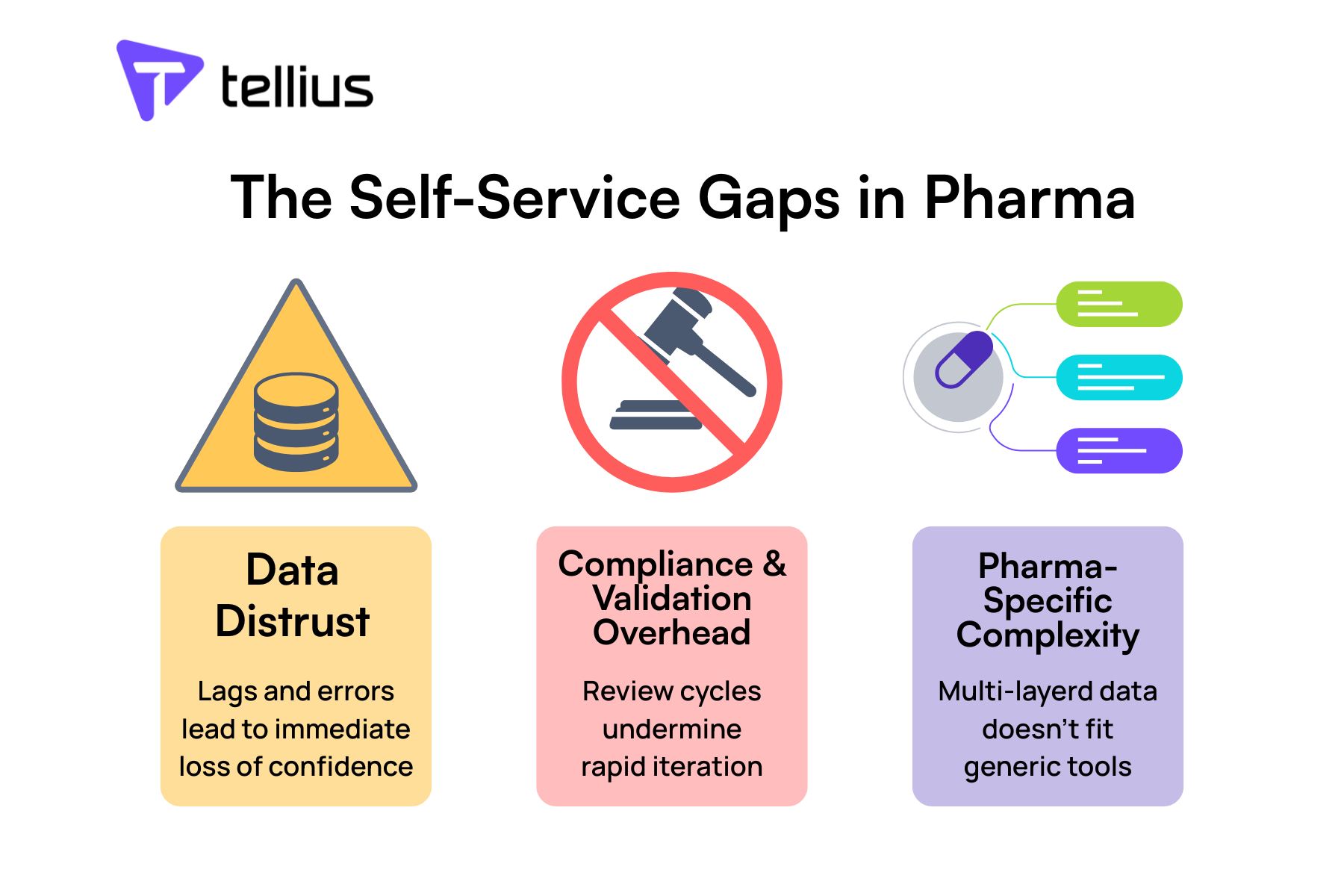
Why Self-Service Analytics in Pharma Has Failed—And What It Takes to Fix It
The path from dashboard sprawl to true self-service isn't just about better technology—it's about unlocking your team's ability to act on insights in real-time. While traditional BI tools force pharma teams into endless workarounds, AI-powered platforms like Tellius are purpose-built for the complexity, compliance requirements, and speed demands of commercial pharma.

Heading
Heading 1
Heading 2
Heading 3
Heading 4
Heading 5
Heading 6
Lorem ipsum dolor sit amet, consectetur adipiscing elit, sed do eiusmod tempor incididunt ut labore et dolore magna aliqua. Ut enim ad minim veniam, quis nostrud exercitation ullamco laboris nisi ut aliquip ex ea commodo consequat. Duis aute irure dolor in reprehenderit in voluptate velit esse cillum dolore eu fugiat nulla pariatur.
Block quote
Ordered list
- Item 1
- Item 2
- Item 3
Unordered list
- Item A
- Item B
- Item C
Bold text
Emphasis
Superscript
Subscript
Heading
Heading 1
Heading 2
Heading 3
Heading 4
Heading 5
Heading 6
Lorem ipsum dolor sit amet, consectetur adipiscing elit, sed do eiusmod tempor incididunt ut labore et dolore magna aliqua. Ut enim ad minim veniam, quis nostrud exercitation ullamco laboris nisi ut aliquip ex ea commodo consequat. Duis aute irure dolor in reprehenderit in voluptate velit esse cillum dolore eu fugiat nulla pariatur.
Block quote
Ordered list
- Item 1
- Item 2
- Item 3
Unordered list
- Item A
- Item B
- Item C
Bold text
Emphasis
Superscript
Subscript
Heading
Heading 1
Heading 2
Heading 3
Heading 4
Heading 5
Heading 6
Lorem ipsum dolor sit amet, consectetur adipiscing elit, sed do eiusmod tempor incididunt ut labore et dolore magna aliqua. Ut enim ad minim veniam, quis nostrud exercitation ullamco laboris nisi ut aliquip ex ea commodo consequat. Duis aute irure dolor in reprehenderit in voluptate velit esse cillum dolore eu fugiat nulla pariatur.
Block quote
Ordered list
- Item 1
- Item 2
- Item 3
Unordered list
- Item A
- Item B
- Item C
Bold text
Emphasis
Superscript
Subscript
Heading
Heading 1
Heading 2
Heading 3
Heading 4
Heading 5
Heading 6
Lorem ipsum dolor sit amet, consectetur adipiscing elit, sed do eiusmod tempor incididunt ut labore et dolore magna aliqua. Ut enim ad minim veniam, quis nostrud exercitation ullamco laboris nisi ut aliquip ex ea commodo consequat. Duis aute irure dolor in reprehenderit in voluptate velit esse cillum dolore eu fugiat nulla pariatur.
Block quote
Ordered list
- Item 1
- Item 2
- Item 3
Unordered list
- Item A
- Item B
- Item C
Bold text
Emphasis
Superscript
Subscript
Heading
Heading 1
Heading 2
Heading 3
Heading 4
Heading 5
Heading 6
Lorem ipsum dolor sit amet, consectetur adipiscing elit, sed do eiusmod tempor incididunt ut labore et dolore magna aliqua. Ut enim ad minim veniam, quis nostrud exercitation ullamco laboris nisi ut aliquip ex ea commodo consequat. Duis aute irure dolor in reprehenderit in voluptate velit esse cillum dolore eu fugiat nulla pariatur.
Block quote
Ordered list
- Item 1
- Item 2
- Item 3
Unordered list
- Item A
- Item B
- Item C
Bold text
Emphasis
Superscript
Subscript
The Challenge Every Pharma Commercial Leader Faces
You're drowning in data from IQVIA, claims databases, CRM systems, and competitive intelligence platforms—yet when executives ask "Why did our numbers change?" the answer is always: "We'll need a few days to investigate."
The Problem Isn't Lack of Data — It's Lack of Insights
Traditional dashboards show what happened, not why
Root cause analysis takes days or weeks of manual investigation
Non-technical users can't explore data without submitting IT requests
Insights arrive too late to prevent revenue loss
Multiple tools and data sources create fragmented views
Field teams spend 40% of their time preparing reports instead of selling
Agentic Analytics Changes Everything
Deploy AI agents that work 24/7—continuously monitoring your business, automatically investigating changes, and proactively alerting you to risks and opportunities. From weeks of manual analysis to seconds of AI-generated insights. From reactive reporting to agentic intelligence. From data silos to unified, self-operating analytics.
Introducing Pharma Intelligence
Unified decision intelligence across your entire commercial operation
Pharma teams depend on fast, accurate insights across HCP targeting, field execution, market access, contracting, brand growth, patient services, and incentive compensation. Pharma Intelligence brings all these capabilities together—powered by AI analytics and agentic workflows—to help organizations unify data, explain performance, detect risks, and drive next-best actions across every commercial function.
📊 Analytics Solutions for Every Commercial Function
📊
Analytics Solutions for Every Commercial Function
Each hub addresses critical challenges with unified data, instant root cause analysis, and AI-powered insights. Choose your area to explore how we solve your specific pain points.

Field Force Sales Effectiveness
📝
34 Questions
⏱️
6,000 words
Pharma teams depend on fast, accurate insights across HCP targeting, field execution, market access, contracting, brand growth, patient services, and incentive compensation. Pharma Intelligence brings all these capabilities together—powered by AI analytics and agentic workflows—to help organizations unify data, explain performance, detect risks, and drive next-best actions across every commercial function.
Critical Capabilities:
HCP targeting & segmentation (AI-powered scoring)
Territory performance vs. potential (real-time)
Call quality & message effectiveness (NLP analysis)
Prescriber churn prediction (early warning alerts)
Pre-call planning (automated contextual briefs)

Brand Performance & KPIs
📝
31 Questions
⏱️
6,500 words
Transform business reviews and root cause analysis with instant TRx/NBRx explanations, automated market share decomposition, and complete narrative generation. Uncover hidden opportunities worth millions while reducing prep time from 2 weeks to 2 days—eliminating the endless Excel work and manual investigation cycle.
Critical Capabilities:
TRx/NBRx anomaly detection & auto-explanation
Market share decomposition (instant driver analysis)
Root cause analysis (multi-variable, seconds not days)
Business review automation (narrative + visuals)
Competitive intelligence (continuous tracking)

Market Access Performance
📝
30 Questions
⏱️
5,500 words
Track formulary changes, prior auth approval rates, and payer mix shifts with unified access intelligence—identifying exactly where coverage restrictions cost you scripts before they impact revenue. Get automated alerts on formulary movements, access barriers, and abandonment patterns with recommended interventions.
Critical Capabilities:
Formulary impact alerts (position change detection)
Prior authorization tracking (approval rate trends)
Payer mix dynamics (coverage shift analysis)
Abandonment prediction (access barrier identification)
Copay program ROI (effectiveness measurement)

Contracting & Payer Strategy
📝
30 Questions
⏱️
5,500 words
Optimize contract performance with unified tracking of rebate effectiveness, volume commitments, and ROI across all payer agreements. Model negotiation scenarios, measure contract impact in real-time, and identify which agreements deliver value and which underperform—with recommended actions before renewals.
Critical Capabilities:
Performance vs. expectations (continuous tracking)
Rebate effectiveness (automated optimization)
Scenario modeling (what-if negotiations)
Gross-to-net decomposition (contract-level)
Value-based outcomes (automated tracking)

HCP Targeting & Segmentation
📝
30 Questions
⏱️
5,500 words
Identify high-potential prescribers with AI-powered lookalike modeling, calculate physician lifetime value in real-time, and dynamically adjust segmentation as market conditions change. Find opportunities before competitors while optimizing targeting continuously—without manual deciling or static segment updates.
Critical Capabilities:
High-potential identification (AI-powered scoring)
Lookalike modeling (predictive targeting)
Prescriber LTV calculation (real-time updates)
Dynamic micro-segmentation (adaptive)
Acquisition optimization (prescriber journey)
⚡
Two Powerful Approaches to Analytics Transformation
⚡ Two Powerful Approaches to Analytics Transformation
Combine conversational interfaces for instant answers with agentic intelligence that works proactively—solving both immediate needs and long-term efficiency.

Conversational Analytics & AI Foundations
📝
25 Questions
⏱️
4,500 words
The foundation: Ask questions in plain English and get instant answers. Conversational interfaces democratize data access, automated root cause analysis explains why metrics moved, and predictive models forecast future performance. Essential AI capabilities that transform static dashboards into interactive intelligence.
Foundational AI Capabilities:
Conversational analytics (natural language queries)
Automated root cause analysis (driver decomposition)
Predictive modeling (prescription trend forecasting)
Machine learning (segmentation & targeting)
Unified data integration (IQVIA, CRM, claims, digital)

Agentic Analytics: AI Agents That Work 24/7
📝
25 Questions
⏱️
4,500 words
The evolution: AI agents work continuously 24/7—monitoring your business, automatically investigating anomalies, and proactively alerting you to risks and opportunities before you ask. Move from asking questions to receiving answers you didn't know you needed. This is what separates reactive analytics from agentic intelligence.
Agentic Capabilities:
24/7 monitoring (continuous surveillance)
Automatic anomaly investigation (self-initiated RCA)
Proactive risk alerts (before revenue impact)
Self-optimizing workflows (adaptive intelligence)
Automated business narratives (review generation)
Platform & Technology Questions
Understanding Pharma Intelligence and agentic analytics at the platform level
What is agentic analytics for pharmaceutical commercial operations
Agentic analytics represents the evolution from reactive reporting to proactive intelligence. Unlike traditional analytics where users must ask questions and wait for answers, agentic analytics deploys AI agents that work continuously—monitoring your business 24/7, automatically investigating anomalies, and proactively alerting you to risks and opportunities before you ask. In pharmaceutical commercial operations, this means AI agents track hundreds of metrics across brand performance, field execution, market access, and HCP engagement simultaneously. When meaningful changes occur—like a TRx decline, formulary restriction, or prescriber disengagement—agents automatically perform root cause analysis and deliver specific, actionable recommendations with full context.
How does Pharma Intelligence unify data across commercial functions?
Pharma Intelligence automatically integrates data from IQVIA (prescription trends, market share), Symphony (claims data), CRM systems (Veeva, Salesforce for field activity), payer databases (formulary status, prior auth rates), competitive intelligence, and internal systems. The platform creates a unified semantic layer that harmonizes these disparate sources, resolving HCP identities, aligning geographies, and standardizing metrics. This means field teams, brand managers, market access leaders, and contracting teams all work from the same single source of truth. When an AI agent detects a TRx decline, it can instantly correlate field activity, payer changes, competitive moves, and HCP prescribing patterns—insights impossible when data sits in silos.
What's the difference between AI analytics and agentic analytics?
AI analytics provides conversational interfaces and automated insights—you ask "Why did NBRx decline?" and get instant answers with root cause analysis. This is valuable and represents a major improvement over traditional BI. Agentic analytics goes further: AI agents work autonomously without human prompting. They continuously monitor your business, automatically detect meaningful changes, investigate root causes on their own, and proactively send you alerts with recommendations. Think of it as the difference between having a very smart assistant who answers your questions (AI analytics) versus having a team of analysts working 24/7 who investigate issues and bring you insights before you know to ask (agentic analytics). Most organizations need both layers working together.
What ROI can we expect from deploying agentic analytics?
Typical pharmaceutical companies see $10-17M in annual value creation per brand with 6-9 month payback periods and 1,700%+ first-year ROI. Value comes from four areas: analyst time savings (70-85% reduction, ~$645K annually), proactive issue detection (catching formulary changes, prescriber churn, access barriers 2-4 weeks earlier saves $3-4M), AI-identified opportunities (underserved segments, high-potential HCPs, contract optimization worth $5-10M), and improved forecasting accuracy ($2-3M in better resource allocation). Beyond quantifiable ROI, organizations report dramatically improved executive satisfaction, faster business reviews (2 weeks to 2 days), and field teams spending time selling instead of preparing reports. The platform essentially pays for itself within the first quarter through time savings alone.
How do AI agents work across field force, brand, and market access?
AI agents operate across all commercial functions simultaneously, detecting insights that span multiple teams. For example: an agent monitoring market access detects Aetna added step therapy requirements affecting 8,200 covered lives. It automatically investigates the brand impact (estimated -$2.3M TRx), identifies affected territories and HCPs, analyzes which field reps need to adjust messaging, and calculates the patient support program implications. Within minutes, the agent sends coordinated alerts to market access (escalate with payer), brand team (update forecasts), field leadership (prioritize affected HCPs), and patient services (expect abandonment increase). This cross-functional intelligence—impossible with siloed tools—enables coordinated responses that protect revenue.
How long does deployment take and what resources are needed?
Typical deployment takes 6-12 weeks from kickoff to full production. Week 1-3: Data integration (IQVIA, CRM, claims, payer sources). Week 4-6: Semantic layer configuration and pharma-specific metric definitions. Week 7-9: Agent deployment, alert configuration, and user training. Week 10-12: Optimization and rollout. Required resources: Executive sponsor (5% time), 2-3 business analysts (50% time during deployment), IT liaison (25% time for data access), and key business users for UAT. Post-deployment, platform is largely self-operating—AI agents handle monitoring and investigation automatically. Most organizations need only 1-2 FTEs for ongoing administration, far less than traditional BI platforms that require constant analyst support.
How does this compare to traditional pharma analytics platforms?
Traditional platforms (Tableau, Power BI, Qlik) require users to build dashboards, write SQL, and manually investigate every question. Pharma-specific platforms (IQVIA OCE, Veeva CRM Analytics) provide pre-built reports but still require manual analysis. Neither offers AI agents that work autonomously. With agentic analytics, AI agents continuously monitor and investigate automatically—no dashboard building, no SQL, no waiting. Conversational interfaces let anyone ask questions in plain English. Root cause analysis happens instantly, not in 3-5 days. Business reviews generate automatically. Most importantly: you receive insights proactively before issues impact revenue, rather than discovering problems in retrospective reports. Organizations typically keep existing platforms for specific use cases while Pharma Intelligence becomes the primary decision intelligence layer.
How Agentic Analytics Transforms Your Workflow
How Agentic Analytics Transforms Your Workflow
Unified Data Integration
Automatically connect and harmonize data from IQVIA, Symphony, CRM (Veeva, Salesforce), claims databases, competitive intelligence, and internal systems. No more manual data pulls or Excel wrestling.
Ask Questions in Plain English
Conversational analytics lets anyone ask questions like "Why did NBRx decline in the Northeast last month?" and receive instant answers with automated driver analysis. No SQL, no waiting for reports.
Deploy AI Agents
Agentic analytics agents work 24/7—continuously monitoring hundreds of metrics across all dimensions. When meaningful changes occur, agents automatically investigate root causes, quantify business impact, and send prioritized alerts with specific, actionable recommendations. No human prompting required.
Receive Proactive Insights & Recommendations
Get specific, prioritized alerts with context and next steps: "Prior auth denials increased 18% with Aetna in Q3. Estimated TRx impact: -$2.3M. Root cause: New step therapy requirement. Recommend: Escalate to market access team within 48 hours, review formulary status across all major payers." Know what to do, not just what happened.
Jump to Your Specific Challenge
AI agents answer your questions across three levels: foundational understanding, agentic capabilities, and business impact measurement.
🎯
Understanding Challenges & Best Practices
🎯 Understanding Challenges & Best Practices
🤖
AI Agents & Agentic Capabilities
🤖 AI Agents & Agentic Capabilities
💰
Platform Evaluation & Business Impact
💰 Platform Evaluation & Business Impact
Real Results from Deploying Agentic Analytics
How AI agents deliver measurable business impact across pharmaceutical commercial operations
Top 10 Pharma — Oncology Brand
85% reduction in monthly review prep with automated business narratives
AI agents identified $12M opportunity in underserved community oncology
Proactive formulary alerts detected risk 3 weeks earlier, saved $8M
ROI: 2,200% in first year with agentic monitoring
Specialty Pharma — Neurology
Analyst team reduced from 4 FTEs to 2 with agentic automation
15% NBRx improvement through AI-optimized HCP targeting
Agentic anomaly detection prevents $3-5M revenue loss annually
Payback period: 7 months from agent deployment
Mid-Size Pharma — Cardiovascular
AI agents generate weekly reviews in 2 hours vs. 2 days
Root cause analysis: instant vs. 3-5 days of manual investigation
Agents found $18M in hidden payer contract optimization opportunities
Executive satisfaction: 4.2 → 9.1/10 with agentic insights
Calculate Your ROI from Agentic Analytics
See what you could save by deploying AI agents across your commercial operations
Typical ROI from Agentic Analytics Deployment
Value from AI agents: Analyst time savings ($645K), proactive issue detection ($3-4M), AI-identified opportunities ($5-10M), improved forecasting ($2-3M), 24/7 monitoring & investigation (at fraction of human cost)
Ready to Deploy Agentic Analytics?
Join leading pharma companies using AI agents to monitor 24/7, investigate automatically, and deliver proactive insights—reducing analysis time by 70-85% while protecting millions in revenue.
Explore Agentic Analytics Resources
What is Agentic Analytics?
Complete Technology Guide
Customer Success Stories
Real Results from Agent Deployment
Pharma Intelligence Platform
Unified Decision Intelligence
Expert Webinars
Live Agentic Analytic Demos