

Tellius on Snowflake: Deterministic, Finished Agentic Work

You've already done the hard part. Your data is consolidated in Snowflake and governed by Horizon, and with Cortex Analyst, CoWork, and CoCo, your business users can ask a question and get an answer in seconds, with the generated SQL shown right there. Those agents will even take a run at the harder question, the why behind a number. But a single generated query describes the move; it doesn't run the rigorous, multi-step root-cause analysis that explains it. The agents are horizontal by design, so they don't bring your domain's metrics or methods. And because the SQL is generated fresh each time, the number itself can shift from one run to the next. So the real analysis still routes to your analytics team, the backlog you hoped self-service would clear is still there, and finance won't put its name on a figure that moves between runs.
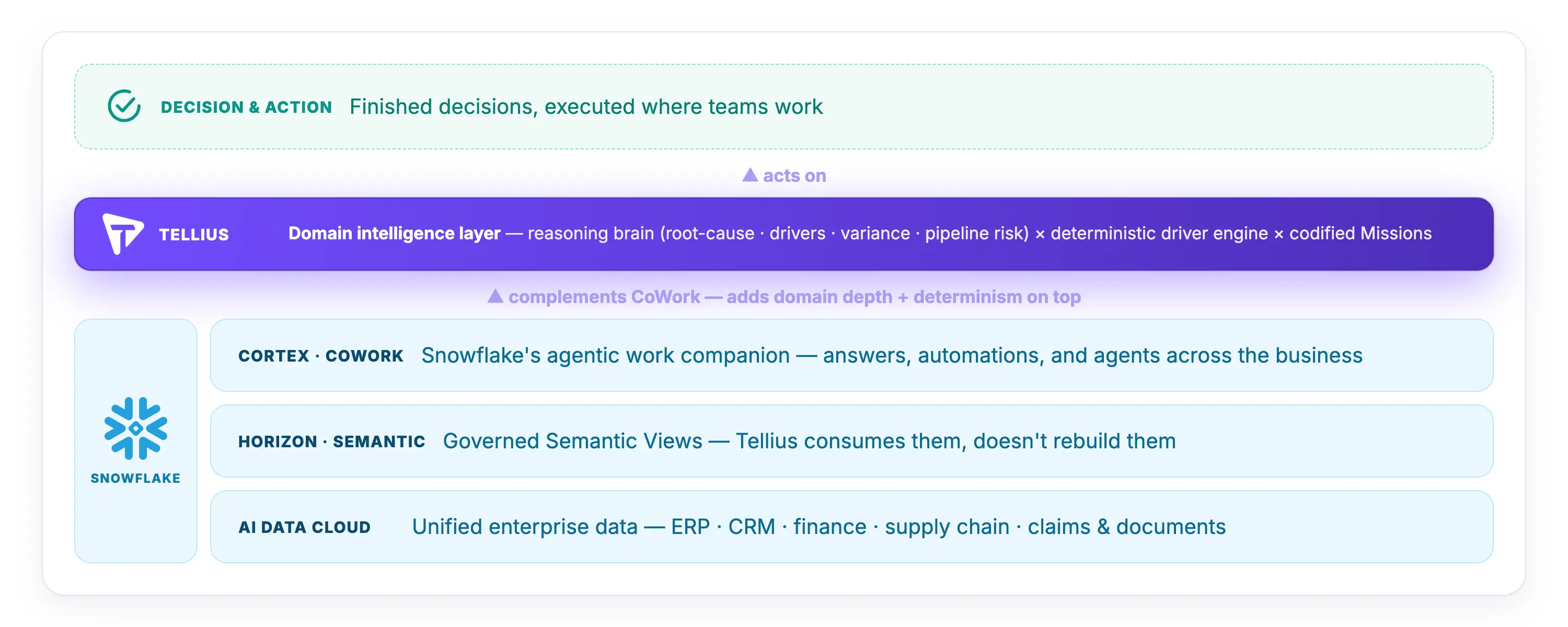
Tellius is the layer that finishes the job. It reasons across all of it, structured tables and unstructured documents alike, and returns the why behind every number as deterministic, defensible work: the same answer every run, traced to source, delivered as a finished brief or deck. No data movement, in-perimeter, on the spend you already own.
What can you do with Tellius on Snowflake that the native agents can't?
Cortex Analyst, CoWork, and CoCo are good at what they do: turning a question into SQL, putting that in front of a business user, and helping an engineer build. Tellius adds a different set of jobs on top of them. Three stand out.
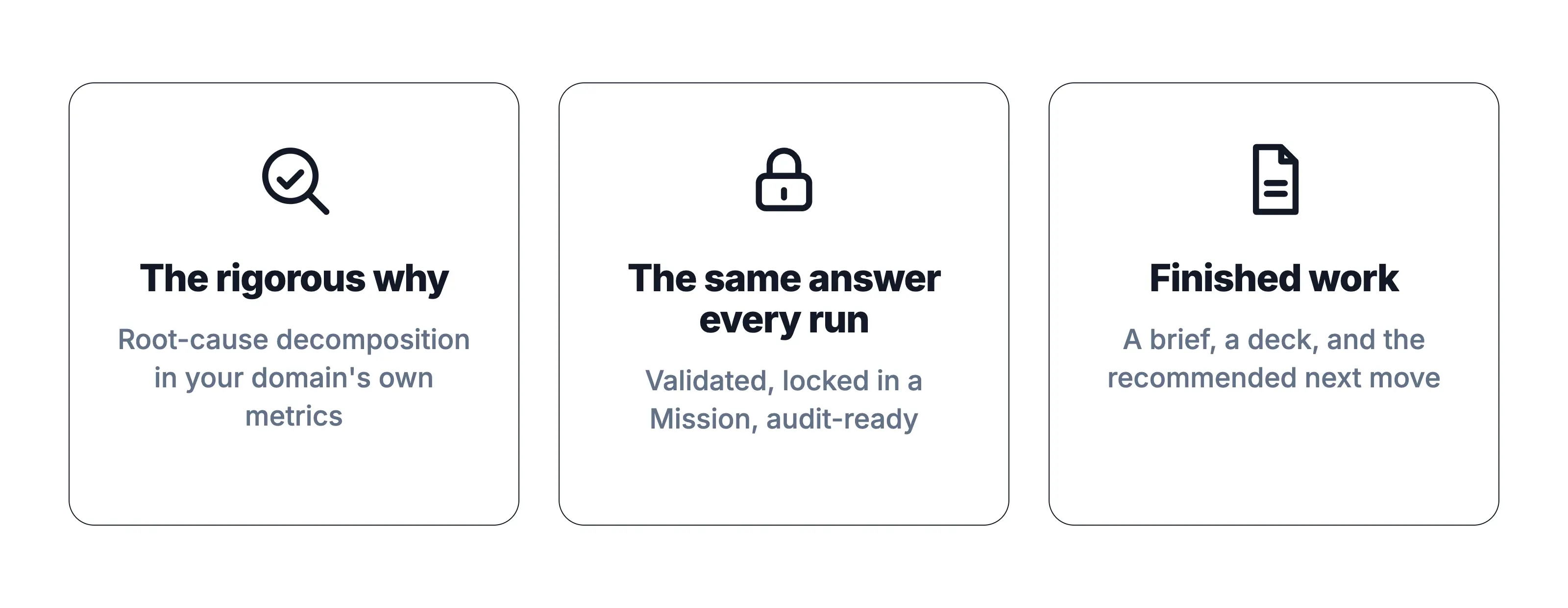
- Run the rigorous why, in your domain's terms. Cortex Analyst and CoWork take a run at the why, but a single generated query describes a move; it doesn't decompose it, and it doesn't know what your business's metrics mean. Tellius breaks a move into quantified drivers, runs the statistical work, and explains it in the terms your business defines: why NBRx fell in the Northeast, why category share slipped at a retailer, why you came in off plan.
- Get the same answer every run, ready for an audit. Because the native agents generate SQL fresh each time, the number can shift from one run to the next. Tellius validates the data, locks the spec inside a Mission, and traces every figure through Horizon lineage, so the answer holds between runs and in front of finance.
- Receive finished work, not a chat reply. Tellius hands back a brief, a deck, and a recommended next move, written back to Snowflake as a governed table and pushed to Veeva, Salesforce, or Slack. Not a chart someone still has to write up.
These hold across pharma, CPG, FP&A, and RevOps: one engine, your industry's vocabulary, inside your Snowflake perimeter.
Snowflake gives you the number. Tellius gives you the why behind it.
Snowflake is a powerful data and AI foundation. Your governed data lives there, Cortex Analyst turns questions into SQL, CoWork puts that in front of business users, and Horizon keeps it all governed and traceable. What that stack doesn't give you is the diagnostic layer: the why behind a number, an answer that survives finance pushing on it, and the finished write-up. Those questions still go to an analyst, and into a queue. That gap is where decisions get made late, or on a guess.
It's fair to ask whether to wait for the native agents to close it. Waiting doesn't help, for three reasons. First, this is a different layer, not an immature version of Cortex Analyst. Driver decomposition that knows what a formulary tier means is a different kind of computation from text-to-SQL, and it doesn't arrive by making text-to-SQL faster or more accurate. Second, adopting Tellius isn't a bet against Snowflake. Tellius reads native Snowflake objects and is callable over MCP, so as Cortex and CoWork improve, Tellius improves alongside them and gets called by them. You don't have to guess where Snowflake's roadmap goes to come out ahead. Third, waiting has a running cost: every quarter the bottleneck holds, the late and best-guess decisions keep stacking up. (As of June 2026, Cortex Sense and parts of the CoWork agentic stack are still in preview, but even at general availability they're built to be horizontal, which is the point.)
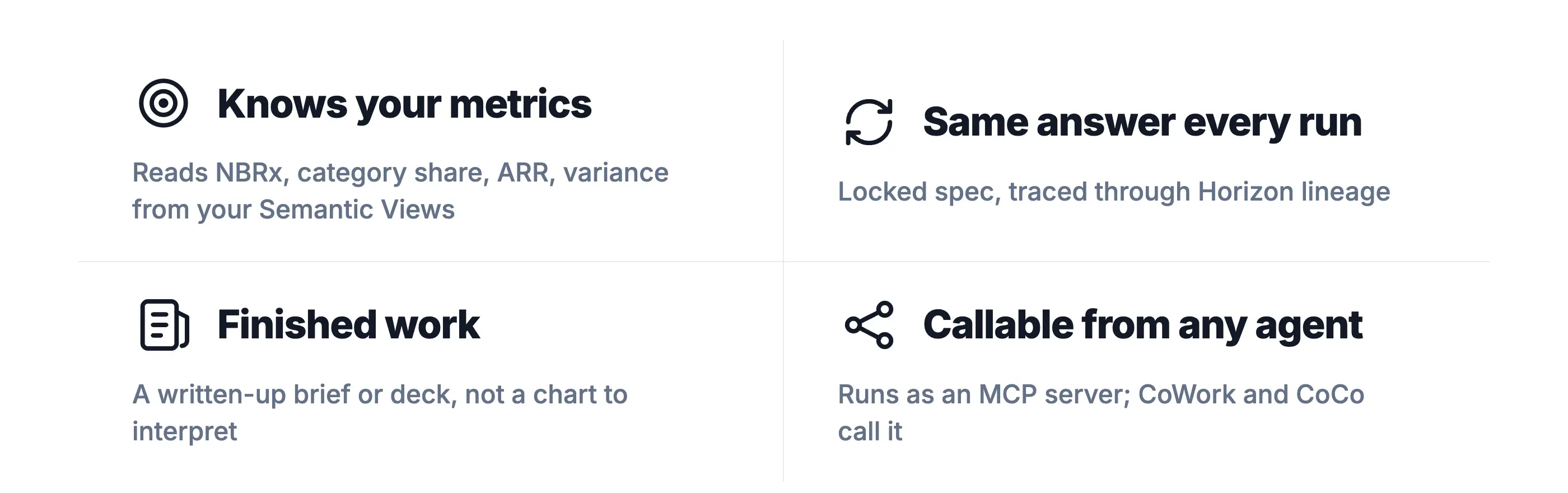
That layer comes down to four things.
DOMAIN: Tellius knows your business's metrics
AI that reasons is everywhere. Reasoning that knows your business isn't. Cortex Analyst and CoWork are horizontal: they write SQL against whatever semantic model exists, but they don't know what NBRx, category share, variance-to-plan, or pipeline risk mean, or how to decompose them. Tellius reads those metrics from your Semantic Views and runs the analysis in your business's own definitions. When a pharma team finds NBRx down 12% in the Northeast, Tellius breaks it into drivers traced to source: prior-auth rejections −3.1 pts (MMIT), copay-card expiry −2.2 pts (IQVIA/claims), a competitor launch −1.4 pts (IQVIA/Veeva). Cortex Analyst and CoWork take the question and the SQL; Tellius takes the rigorous, domain-aware why.
DETERMINISTIC: the same answer every run
A CFO can't defend a number that changes between runs. Because Cortex Analyst generates SQL fresh each time, the same question can resolve through a different join path and return a different number (the classic chasm and fan traps). Tellius validates the data, locks the spec inside a Mission, and traces every figure through Horizon lineage, so next week's rerun returns the same 3.1-point prior-auth driver, tied to the same MMIT record. In Snowflake's own evaluation, GPT-4o text-to-SQL accuracy fell to 51% on their internal BI benchmark, against 90%+ on the academic Spider set.
DELIVERY: finished work, not another prompt
Most AI analytics hands you a chat reply or a chart you still have to write up. Tellius hands you the finished work: a brief, a deck, a recommended next move, written back to Snowflake as a governed table and pushed to the tools your team uses. When a fleet operator's margin erodes, Tellius delivers a nine-slide deck with the finding written up: 5.0% of $15.33B in gross revenue in the low-margin tier, all of it in three departments. Same engine as the pharma example, a different industry's P&L.
OPEN: callable from any agent, connected past Snowflake
Tellius reads Snowflake Semantic Views, inherits Horizon governance, and consumes dbt, and it runs as a Model Context Protocol (MCP) server, so CoWork, CoCo, or any agent in your stack can call it: a business user asks in CoWork, CoWork invokes Tellius underneath, and the finished analysis comes back in the same surface. It also reaches past Snowflake-resident data, with 30+ connectors to the systems your answers depend on.
How does a Tellius Mission produce an answer you can audit?
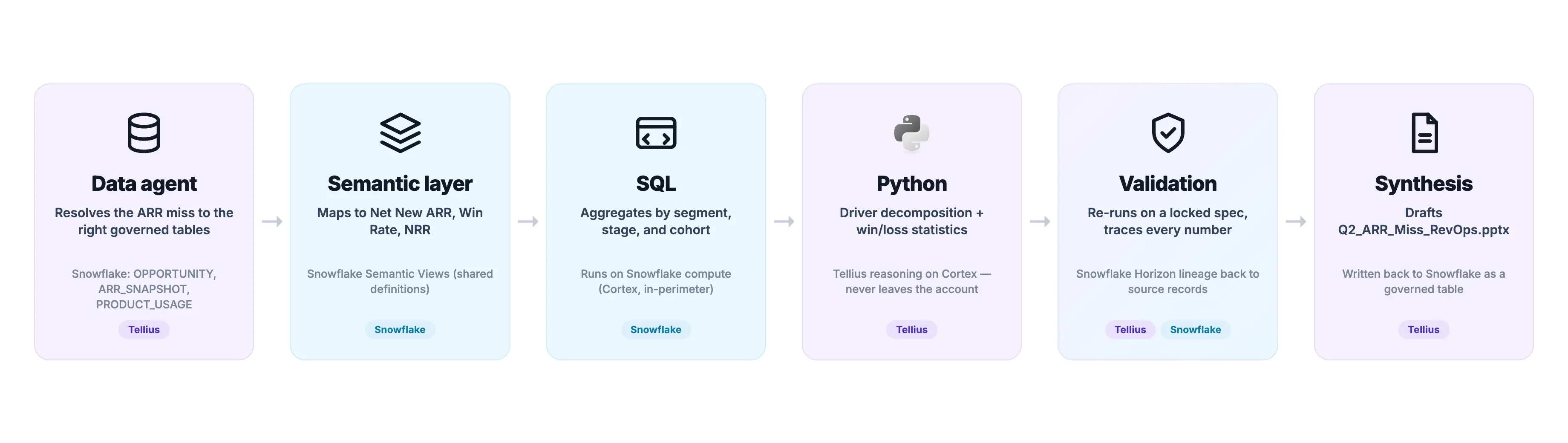
How do you trust a number an AI produced? You watch how it got there. A Tellius Mission is the unit of work behind every answer: an autonomous, ordered pipeline that resolves the question, runs the analysis, checks itself against its own spec, and writes up the result. Every step is inspectable, which is exactly what lets you put the output in front of a board.
- Data agent resolves the question to the right governed tables.
- Semantic layer maps it to your defined measures and dimensions.
- SQL executes against Snowflake.
- Python runs the heavier statistical work SQL can't.
- Validation re-runs the analysis on a locked spec and traces every number to source.
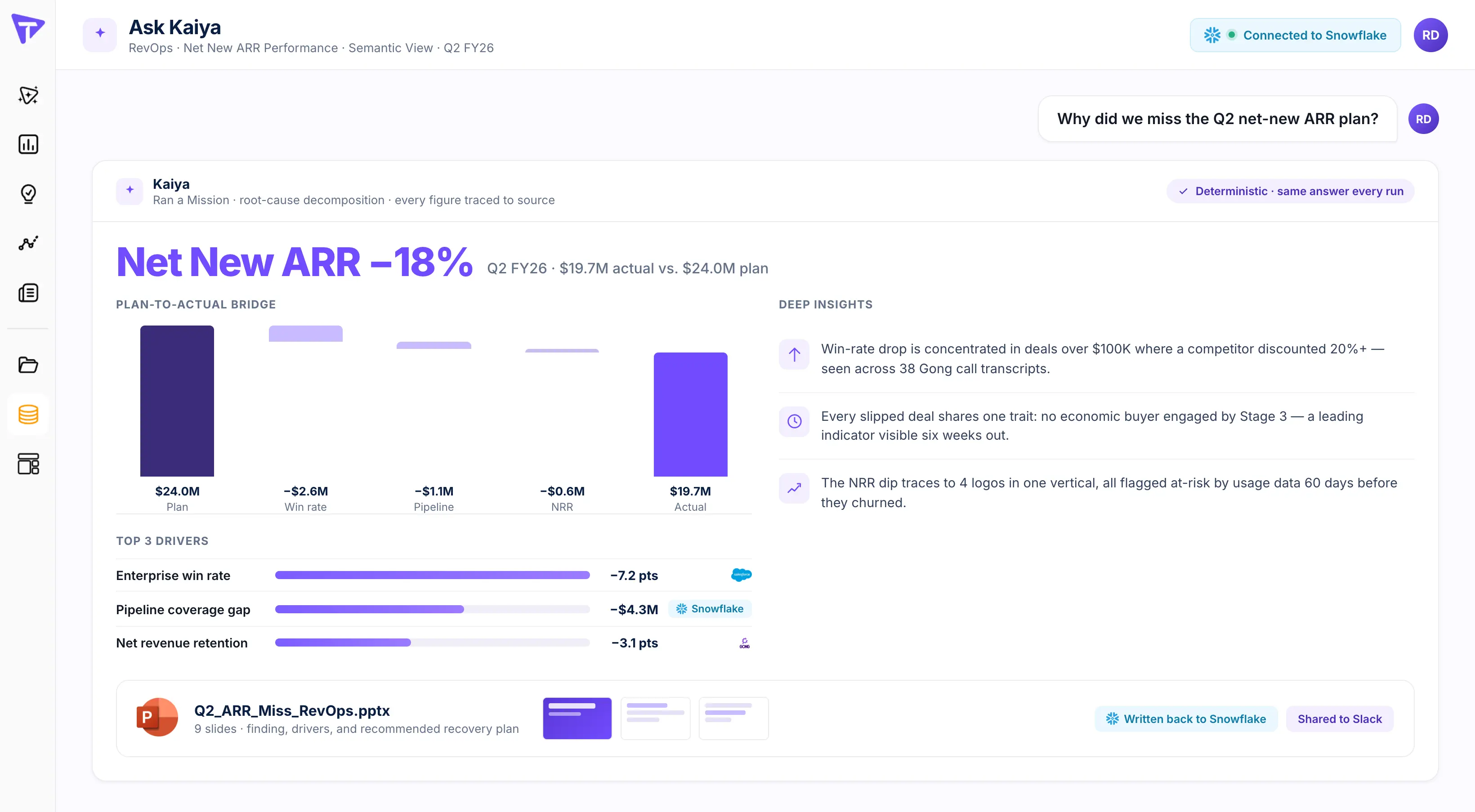
- Synthesis drafts the deliverable — here, a nine-slide
Q2_ARR_Miss_RevOps.pptx.
The validation step is where determinism stops being a promise: the same locked spec produces the same number, and every figure carries its lineage. The synthesis step is where it becomes finished work: not a chart to interpret, but a deck with the finding written up and ready for the room.
From one answer to a standing workflow: Apps, Missions, and Artifacts
Most teams ask the same questions every week, and that's where automated workflows make sense. Tellius packages recurring Missions into agentic Apps: a scheduled, parameterized bundle of Missions that runs on its own cadence and hands back the same finished deliverables every time in interactive form. The Mission is the multistep governed analysis; the App is the standing workflow that runs it on a schedule; the Artifacts are what lands on someone's desk — a brief, a deck, a writeback table — pushed to the tools your team already works in. Here's what that looks like in two industries.
Weekly access-erosion brief (Pharma)
A field-access App runs every Monday before the team logs in such that for each region, its Mission decomposes the week's NBRx change into source-traced drivers — prior-auth rejections from MMIT, copay-card expiry from IQVIA and claims, a competitor launch from Veeva — validates the figures against a locked spec, and traces every one through Horizon lineage. The Artifacts: a one-page access brief per territory, written back to Snowflake as a governed table and pushed to Veeva for the reps who need it. No analyst assembles it, and because the spec is locked, the same brief arrives every week.
Monthly category-share and trade-spend review (CPG)
At period close, a category App runs a pair of Missions: one decomposes category-share slippage at each key retailer into the drivers behind it, the other scores trade-spend ROI by promotion and flags the spend that isn't earning its keep. The Artifacts: a retailer-ready review deck and a writeback table marking the promotions to cut, pushed to the category team's Slack. This recurring review that used to take an analyst a week, is now delivered finished on the first of the month.
How does Tellius run on Snowflake without moving data?
Tellius adds a single reasoning layer on top of Snowflake. It reads governed data, runs on Snowflake's own AI inside your perimeter, serves the result to any agent, and records every finished analysis back to the warehouse, so the data never leaves Snowflake and your governance never diverges.
READ — governed data and Semantic Views. Tellius reads the warehouse and consumes Snowflake Horizon and Semantic Views as the shared meaning layer, building semantics only where none exist yet. It inherits Snowflake's RBAC, row-level security, and lineage, so every user sees exactly what they're already permitted to see.
RUN — on Cortex, in-perimeter. Tellius runs its reasoning on Snowflake's native Cortex AI inside your account, on committed Snowflake spend. Because the compute runs where the data lives, nothing is copied to an outside tool, and the AI-governance review is typically a shorter one.
SERVE — callable via MCP. Tellius is a Model Context Protocol (MCP) server, and, when you want it, a full UI. Snowflake's CoWork business-user agent, its CoCo coding agent, or any agent in your stack can call Tellius for the hard part: the deterministic why-analysis and the finished work. In practice, a business user asks a question inside CoWork, and Tellius answers underneath it. Same surface, deeper reasoning.
RECORD — back to the warehouse. Every finished analysis is written back to Snowflake as a governed, auditable table, then fans out to the tools teams already work in: Veeva, Salesforce, Slack, email. The answer doesn't sit in a chat window. It lands where the work happens.
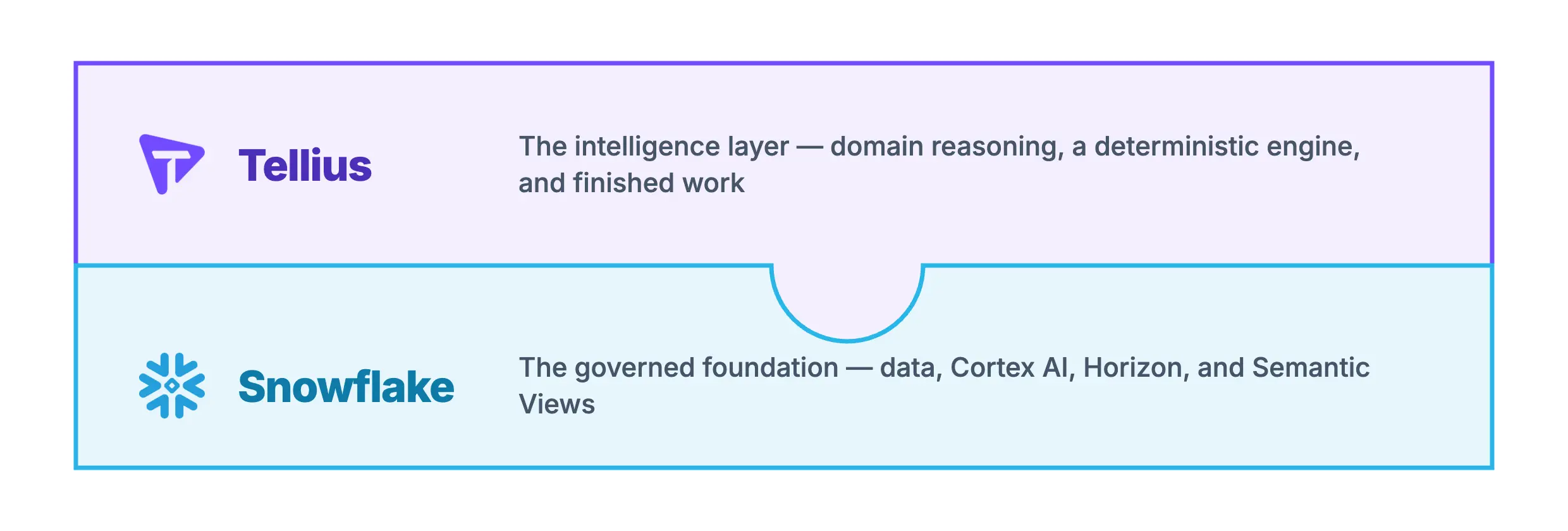
Net-net: Snowflake is the foundation consisting of governed data, Cortex AI, Horizon, Semantic Views while Tellius is the intelligence layer on top ie domain reasoning, a deterministic engine, and finished work.
The cost of waiting
The cost of waiting is measurable. One global pharma Managed Markets Finance team cut an analysis from three weeks to four days and surfaced a $5M recoverable rebate. PepsiCo reports root-cause analysis running 12 times faster. Novo Nordisk reports 88% time savings. (These are customer-reported figures.)
So the real question isn't whether Cortex and CoWork improve. They will. It's this: how many decisions will your team get wrong over the next twelve months, acting on a guess about why the numbers moved?
How do you get started with Tellius on Snowflake?
Getting Tellius onto your Snowflake account is three steps, with no separate procurement cycle and no data migration.
- Get it on Snowflake Marketplace. Through Marketplace Capacity Drawdown, your committed Snowflake spend buys Tellius, so it draws down against capacity you've already budgeted. (Requires ACCOUNTADMIN and an eligible region.)
- Point it at your governed data. Tellius reads your Semantic Views and inherits Horizon RBAC, row-level security, and lineage. It queries in place through Live Mode rather than copying tables out, and connects over AWS or Azure PrivateLink, so nothing crosses your perimeter. Because no new copy is created, the AI-governance review is typically a shorter one.
- Ask your first question. Pose it in CoWork or the Tellius UI, and Tellius runs the Mission, returns the finished brief or deck, and writes the analysis back to Snowflake as a governed table.
One note on cost. Cortex AI services bill on tokens rather than warehouse credits, which is harder to forecast, and Snowflake doesn't yet offer native resource monitors for AI services. (Snowflake introduced separate AI Credits on April 1, 2026, at $2.00 per credit globally and $2.20 regionally.) Running deterministic, reusable Missions through Tellius gives you a steadier unit of cost on top of that consumption: the same Mission, the same locked spec, the same traced answer, instead of open-ended token spend on one-off prompts.
See it on your own Snowflake data
The fastest way to judge this is on your own data. Bring a question your team is stuck on this quarter — a regional NBRx drop, a margin leak, a variance no one can explain — and we'll run it live, on your committed spend, without anything leaving your perimeter.
Get release updates delivered straight to your inbox.
No spam—we hate it as much as you do!


Tellius on Snowflake is a Decision AI layer that runs on the Snowflake AI Data Cloud and turns governed data into finished, defensible analysis. It reads your Semantic Views and unstructured documents, reasons over them using Cortex AI inside your account, and returns the why behind a number along with the recommended next move, delivered as a brief, a deck, or a writeback. The data never leaves Snowflake.
Cortex Analyst is a text-to-SQL tool, and CoWork can orchestrate it to take a run at broader questions. It shows you the SQL it generates, so it's transparent. But a single generated query describes a number; it doesn't run the multi-step root-cause decomposition that explains it, it doesn't bring your domain's metrics and methods, and because the SQL is generated fresh each run the figure can shift. Snowflake's own documentation notes Cortex Analyst doesn't generate insights for broader business questions like "what trends do you observe?" Tellius adds the diagnostic layer on top: domain-aware root-cause and driver analysis that returns the same auditable answer every run. Cortex Analyst handles the SQL; Tellius handles the rigorous why.
No. Tellius complements them. CoWork can call Tellius over MCP for the diagnostic work it doesn't do natively, so a business user asks a question inside CoWork and Tellius answers underneath it in the same surface. Money you put into Cortex makes Tellius more useful, and the reverse holds too.
No. Tellius queries your data in place through Live Mode and runs on Cortex AI inside your account, so nothing is copied to an outside tool. It inherits Horizon RBAC and row-level security, and connectivity runs over AWS or Azure PrivateLink. Because the perimeter doesn't change, the AI-governance review is typically a shorter one.
Yes. Tellius runs as a Model Context Protocol (MCP) server, so CoWork, CoCo, or any MCP-capable agent in your stack can invoke it. The user stays in the Snowflake-native surface while Tellius does the deeper reasoning and returns finished work.
Three steps: get Tellius on Snowflake Marketplace through Capacity Drawdown (drawing down committed spend), point it at your governed data via your Semantic Views, and ask your first question in CoWork or the Tellius UI. It requires ACCOUNTADMIN and an eligible region, with no separate procurement cycle and no data migration.
Tellius runs root-cause and driver analysis across pharma (NBRx and TRx, access, copay), CPG (category share, trade spend), FP&A (variance-to-plan, GL), and RevOps (forecast and pipeline risk). It also reasons over unstructured documents like PDFs, contracts, and call transcripts alongside your tables. One engine, your industry's vocabulary, inside your Snowflake perimeter.
Yes. Tellius validates data first, locks the query spec inside a Mission, and traces every figure through Horizon lineage back to source, so the answer is reproducible between runs and defensible in an audit. That matters where text-to-SQL can drift: in Snowflake's own evaluation, GPT-4o text-to-SQL accuracy came in at 51% on their internal BI benchmark.
.webp)
Tellius Kaiya vs. Glean, Hebbia, Snowflake Cortex, and DIY RAG: A Buyer's Guide to Agentic Analytics Across Structured and Unstructured Data

This buyer's guide compares Tellius Kaiya, Glean, Hebbia, Snowflake Cortex, and DIY RAG approaches across structured analytics, unstructured document intelligence, agent orchestration, governance, semantic understanding, explainability, and total cost of ownership. Learn where enterprise search tools excel, where warehouse-native AI fits, where custom RAG stacks create maintenance challenges, and why a dedicated agentic analytics platform may be the best choice for organizations looking to automate investigation, root-cause analysis, and decision-making across both structured and unstructured data.