

Budget vs. Actual: How to Verify a Favorable Variance Before You Reforecast

A favorable expense variance can shrink after a reclass while the work behind it remains unaccounted for. Reconcile actuals, establish what happened to the work, and correct the comment before the wrong story reaches the forecast. A favorable variance needs verification before it changes the forecast.
What is a budget vs. actual report?
A budget vs. actual report compares approved budget with recorded results for the same period and reporting scope. The difference is the budget variance. It shows where performance departed from plan; finance then investigates the cause before changing the forecast.
For the expense examples in this article, use variance = budget − actual and variance % = (budget − actual) ÷ budget × 100. A $1,000,000 expense budget and $800,000 of actuals produce a $200,000 favorable variance, or 20% of budget. If the budget is zero, the percentage is undefined; show the amount and explain the cause.
For expenses, spending below budget is favorable and spending above it is unfavorable. For revenue, exceeding budget is favorable and falling short is unfavorable. Some reports use actual − budget instead, so label the convention and the favorable/unfavorable status explicitly. Under the budget − actual convention used here:
The Association for Financial Professionals recommends investigating material variances, including favorable ones, to establish the cause, controllability, and responsibility. The same verification applies to unfavorable variances: reconcile the number and check the business event before changing the outlook.
Verify a favorable variance before changing the forecast
Before treating a favorable expense variance as a saving, reconcile actuals and plan on the same basis, then establish what happened to the planned work. A reclass can change the amount; work moved within the fiscal year changes timing, not full-year spend, if the scope and cost remain unchanged. Keep any unexplained balance open with an owner and a review date, and send a marked correction to everyone who received the earlier number.
A favorable year-to-date variance alone is not evidence of a full-year saving. Leadership may still ask to take it out of the forecast within the hour. Say yes too early and the amount returns next quarter as a miss, on a reforecast you signed. Hold it back without evidence and you become the finance partner who sits on good news.
An actuals cut is a general-ledger extract as of a given date. A later cut can move a charge into the cost center after the reporting pack has gone out. A quiet vendor line can reflect deferred work or a supplier change that never reached the budget. The hypothetical case below follows that investigation through to a corrected pack and a review record you can copy.
Reconcile the budget vs. actual report before explaining the variance
Here's the scenario at the end of Q2. A cost center with $1,000,000 of year-to-date budget shows $800,000 of actuals in the country expense pack. The $200,000 favorable variance has already reached leadership. A later GL cut includes a posting that changes the actuals, and the implementation vendor budgeted for the year has almost nothing recorded against it.
You open the planning pack on one screen and the finance-control file, cut by GL account, vendor, and cost center, on the other. They disagree, as they usually do, and the pull is to explain the variance anyway because the commentary is due and the number is close enough. A fluent driver story sitting on a number that does not tie is the worst thing to carry into a review, because someone will ask which number is right and the story dies with the answer.
So the boring checks come first. Reporting period, budget version, account and cost-center mappings, currency, extract timestamp on each file. In this case the $800,000 actual came from an earlier extract, and in that cut a $25,000 charge was sitting in a neighboring cost center. The later cut carries the reclass that moved it home. Corrected actuals are $825,000. The year-to-date favorable variance is $175,000. The whole corrected variance relates to the implementation vendor: its year-to-date budget is $200,000, and the reclass brings its recorded expense to $25,000. The other $800,000 of cost-center expense is on budget. That leaves $175,000 of planned implementation expense to investigate.
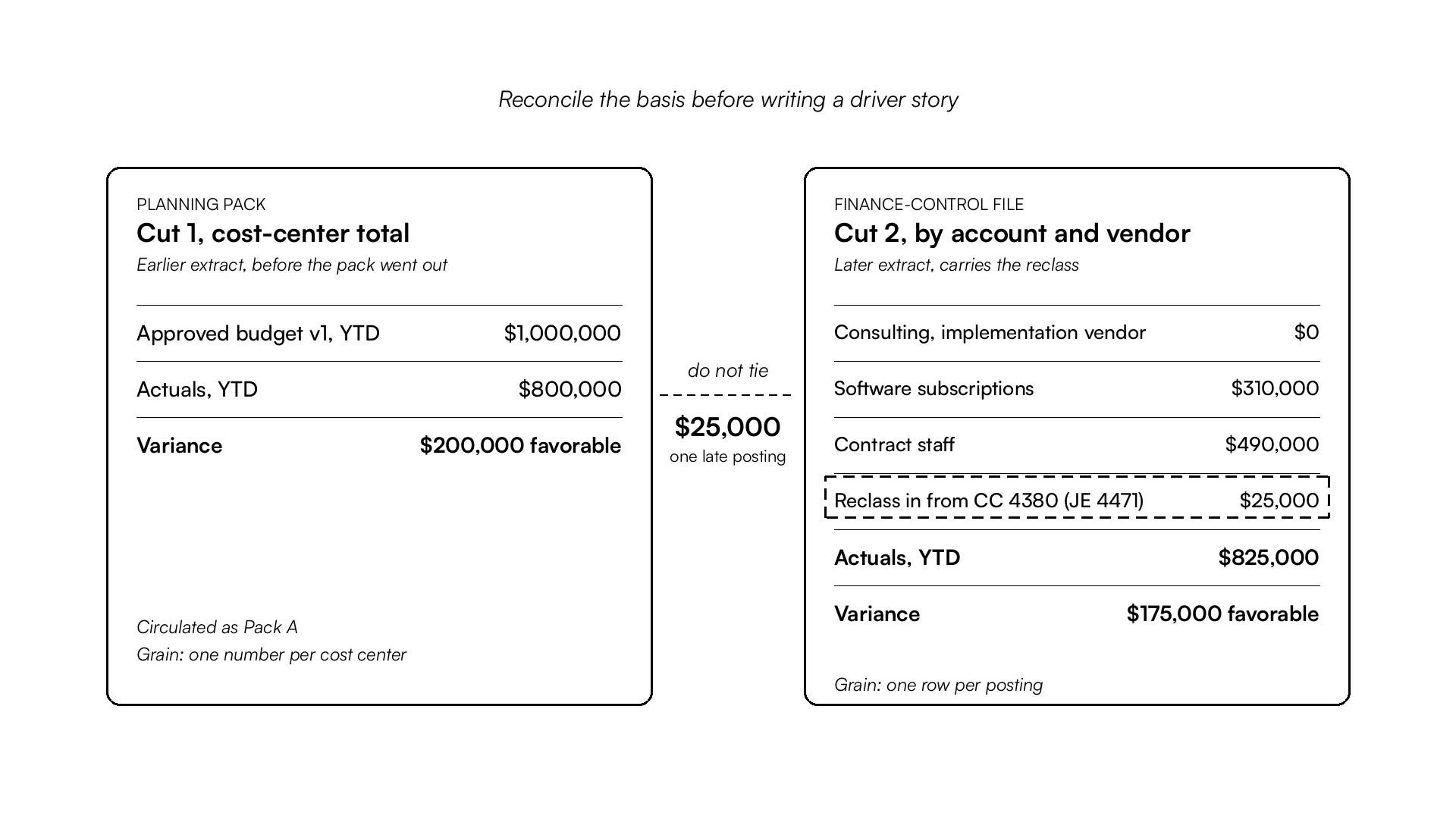
Reconcile the dated extracts before explaining the variance.
The bridge is short: $200,000 reported, less $25,000 moved in by the reclass, equals $175,000 corrected. Nobody did anything wrong here. Two cuts at two grains produce this kind of gap in ordinary close weeks, the reclass belongs to Accounting, and reclasses tend to land after the pack has gone out. What belongs to you is the consequence. An executive line built on $200,000 now needs correcting, even though $175,000 is still favorable and still material, and leadership will not make that distinction for you.
Keep both versions of the pack and the reclass entry, with the actuals timestamp against each. If the planning total still will not tie to the GL detail on the same basis after those checks, the variance stays unreconciled and the explanation waits.
Investigate the favorable variance: trace missing vendor spend to the work
The corrected total explains where the money landed. It says nothing about the business event, which is the part leadership is asking about. The implementation vendor has $200,000 of year-to-date budget and $25,000 of recorded expense after the reclass, and that single observation is consistent with at least five stories: the work slipped, it was canceled, it was booked under another vendor or account, the supplier has not invoiced yet, or the budget assumed work nobody ever intended to do. The quiet vendor line leaves the cause unresolved.
Search GL and vendor activity for the same scope under a different name or account, because a "saving" that is really a rename shows up here. Then pull the project's own record, meaning the purchase order, the open commitment, and the milestone schedule, for what was committed and when the work is now expected. If a service was performed before the cutoff and no invoice has arrived, assess the unbilled work with Accounting under the company's cutoff and accrual policy. A missing invoice by itself does not show that the work moved to a later period.
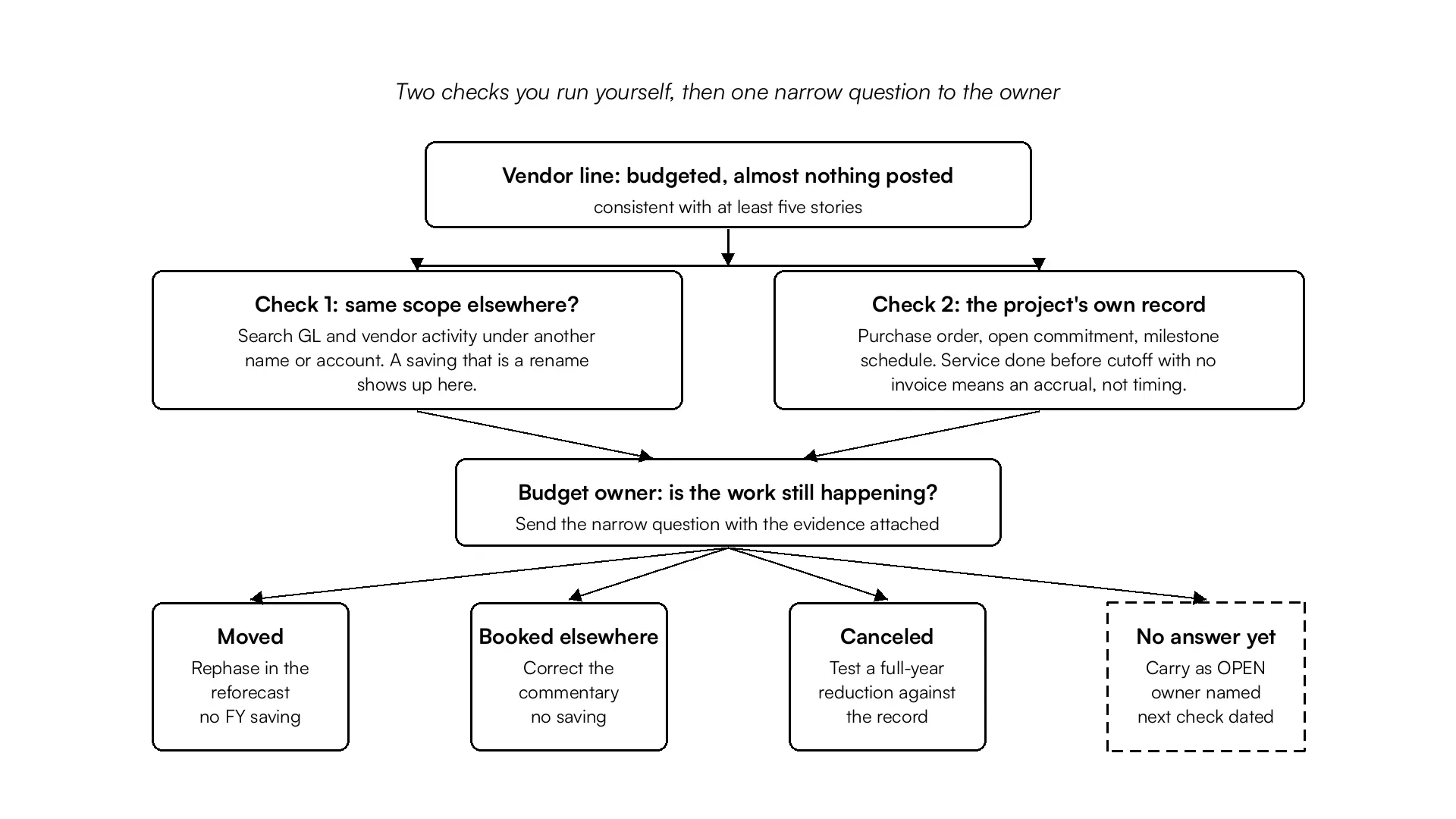
Trace the scope across accounts and project records before asking the owner.
Neither test answers the question that decides the reforecast, which is whether the business still intends to do the work. Only the budget owner knows that. Owners are busy, and they answer broad questions with "let me check" and narrow ones with an answer, so send the narrow one with the evidence attached. In this case the owner confirms that $120,000 of implementation work has moved into Q3 of the same fiscal year. The project schedule supports the new date, and you confirm no service was performed in the period. The owner has not confirmed what happened to the remaining $55,000. The alternate-vendor and alternate-account searches are still running. There is no basis to call that amount canceled scope, and no basis to call it a saving either.
When the ledger, the project record, and the owner disagree, the review shows the disagreement. Picking the most convenient of three answers is how a saving gets booked that nobody signed off on, and it gets found six months later by someone with less patience than you.
Separate confirmed timing from the unexplained budget variance
A timing variance shifts when expense occurs. A permanent variance changes the expected total for the forecast horizon, for example through a verified scope reduction. The $175,000 now reconciles, but the explanation is incomplete. A deck template with a row for every dollar creates pressure to fill the gap with an assumption.
The $175,000 corrected variance is $120,000 of confirmed timing plus $55,000 open. Both lines add up. Only the timing line is a finding. The pull is to close the gap with something plausible, a rate saving here or a quietly canceled workstream there, so the bridge reads as complete. A complete bridge looks like competence. It is also a $55,000 guess presented to leadership with the same confidence as the reclass, which was real.
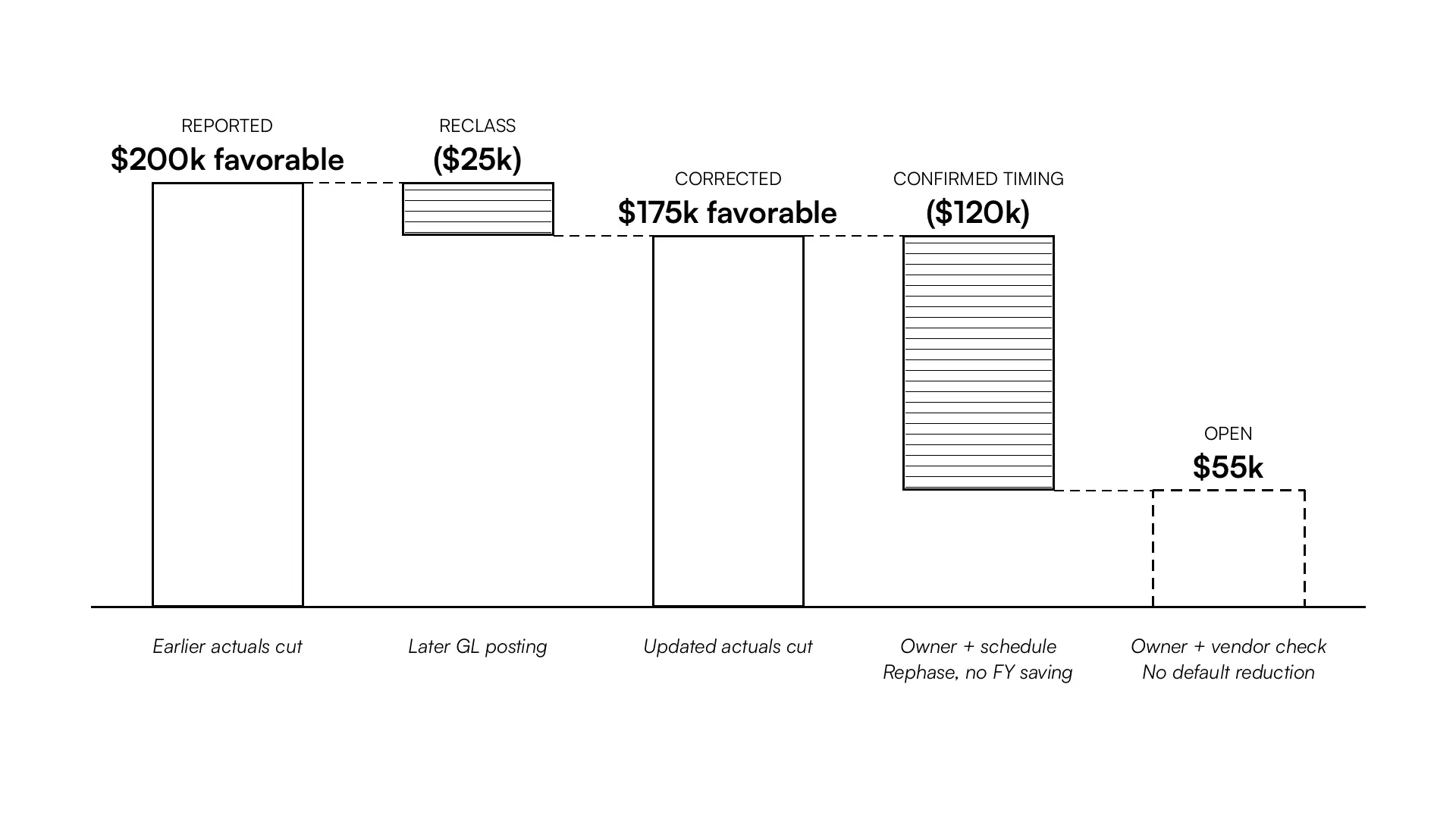
The corrected amount reconciles; $55,000 still needs an explanation.
The $120,000 changes the quarterly phasing if the documented schedule holds. With the scope and total cost unchanged, moving it within the fiscal year leaves full-year expense unchanged. It moves in the reforecast, with the schedule date and the owner's confirmation recorded against it. The $55,000 gets no default treatment at all. One defensible interim position is to leave the planned spend in the latest estimate (LE), name the assumption in the commentary, and set a date by which the owner confirms or the transaction search resolves it. Policy on open items varies by company, so check yours before adopting this treatment as written. A favorable year-to-date variance alone is not evidence of a full-year saving. The forecast reflects the latest supported outlook under company policy; any approved change to an unresolved assumption should carry its rationale and approver in the review record.
Correct the variance report and commentary when the source or story changes
Pack A went out with the $200,000 figure and an as-of date. Its country comment called the absent vendor charge likely delayed work, which was a fair reading at the time and was never dressed up as a verified saving. Pack B has to say something narrower and better supported: $175,000 on the updated cut, $120,000 of confirmed timing, and $55,000 open.
Writing Pack B is the easy part. Pack A is already in someone's deck, and that someone has probably repeated the number to their own boss by now. Editing the workbook in place fixes the file and leaves every recipient of the earlier version presenting a number that no longer exists, usually upward. So list who received Pack A, send a short marked correction or a replacement pack that names what changed, and keep Pack A on file as the record of what leadership saw and when. Against that record, log the new actuals cut, the reclass entry, the owner's confirmation date, the forecast version, and the follow-up on the open item. It takes less time than the meeting it prevents, the one where two versions of the same number meet in front of a steering committee.
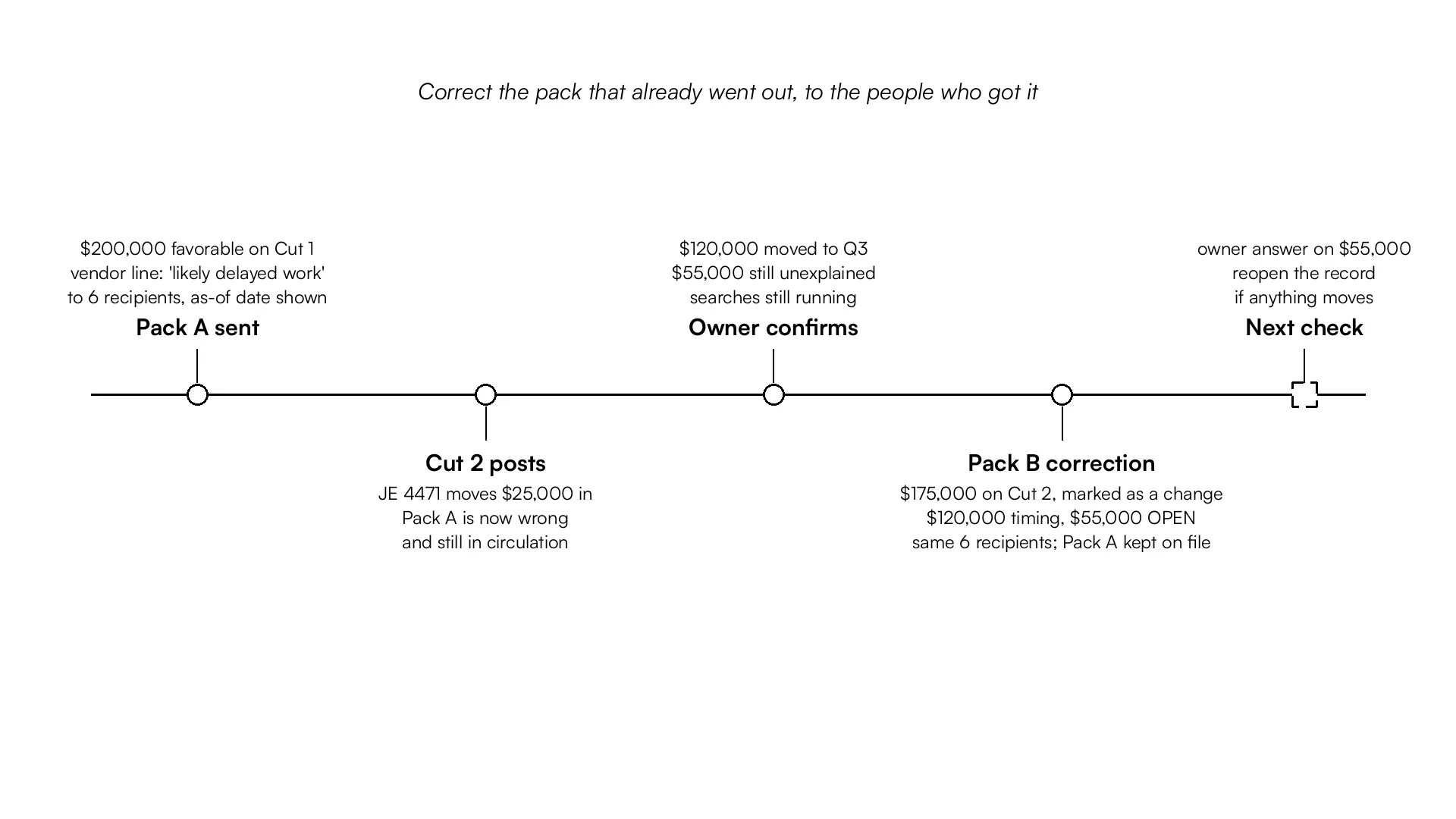
Send the correction to everyone who received the original number.
One leadership line that carries all of it:
Regional packs use different formats, and a country note gets rewritten on its way into the group report. The facts in that line are the ones that have to survive the rewrite. The commentary moves when the evidence does, and the correction goes to the same people who got the original. A correction sent to half the original list is how two truths end up in circulation at once.
Keep a variance analysis record that survives the next close
Explanations expire after they circulate. A later invoice, another reclass, a revised project date, a replacement-vendor posting, or a change in the owner's story will overturn part of what this review concluded, and whoever inherits the next close needs to know what was known at the time and on what basis. Usually that person is you, three months on, with no memory of why the $55,000 was left in and a vague feeling that it was deliberate. The bridge is the meeting view. The record is what survives the meeting.
When new evidence arrives, compare it with the approved version of the record, show the delta, and append a new status rather than overwriting the history. If the $55,000 resolves as canceled scope, test a full-year reduction against that record. If it turns up under another vendor, correct the commentary and declare no saving. AFP's budgeting guidance draws the same line for the plan as a whole: the approved budget stays fixed and is monitored through variance analysis, while the forecast is updated as business activity changes. The review record ties the approved baseline to the current outlook for this cost center.
How Tellius supports an FP&A variance investigation
Tellius is an AI platform for finance and FP&A teams. An FP&A Variance Worker is a proposed workflow to evaluate on a customer's data. Its intended handoff is the reconciled number, supporting evidence, open questions, and draft commentary together for review. The named worker and the full source-to-brief sequence below are a deployment design, not an out-of-the-box finance result.
By the next review you need Pack B. Next month there will be another Pack A on a different cost center, with its own late posting and quiet vendor line. The evidence is spread across the ledger, planning files, project records, and owner messages, with different dates and levels of detail. An investigation has to reconcile those sources and apply your team's rules for timing, materiality, and forecast treatment before the pack is ready.
The proposed Spend vs. Budget Mission would prepare a corrected cost-center pack. That pack would show the actuals cut, reclass, and corrected variance against the source entry; bring the project schedule and owner's confirmation together behind the $120,000 timing item; and carry the $55,000 as open with an owner and next review date. The workflow would also draft the marked correction to Pack A, the proposed rephase, and the narrow follow-up question for the budget owner.
For the proposed reclass check, compare the dated journal-level extracts using the same period, account, cost-center mappings, and currency. Trace the $25,000 change to its journal entry and preserve the earlier cutoff. If the source history cannot establish the movement, carry it as an unreconciled difference for review. The owner follow-up would state the $120,000 already confirmed, ask what happened to the remaining $55,000, identify the searches still open, and include a reply-by date. Finance reviews the draft before it is sent.
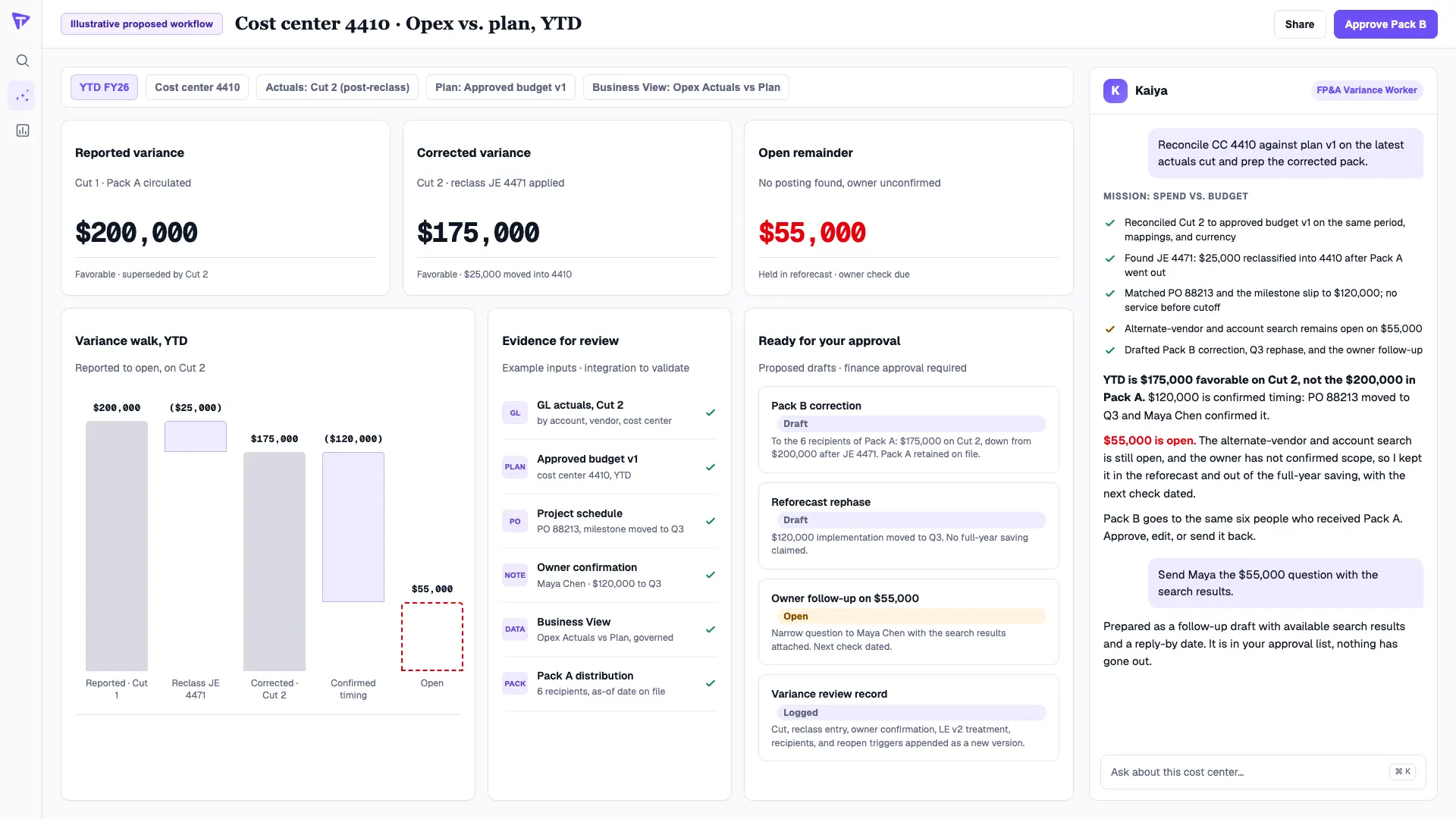
Illustrative proposed workflow using the hypothetical case. The inputs represent finance records to configure and validate; finance approves the pack and forecast treatment.
Business Views provide governed measures and mappings, and Deep Insights investigates drivers visible in the prepared data. Kaiya Missions supports scheduled investigations and delivery of finished briefs. Those platform capabilities provide the foundation; the finance workflow needs the following configuration and review:
A quiet vendor ledger cannot establish whether the business moved or canceled the work. The budget owner supplies that answer, and finance checks it against the available evidence. Planning-system writeback and automatic correction distribution require separate validation; they are not assumed here.
For broader driver decomposition and AI methods, see AI-powered variance analysis for FP&A. This article focuses on verifying a budget vs. actual number and deciding how the evidence should affect the reforecast.
Frequently asked questions about favorable budget variances
When is a favorable budget variance actually a saving?
A favorable expense variance supports a savings claim when verified evidence shows a reduction in expected full-year expense. Confirm the scope, remaining obligations, and replacement costs, then apply company forecast policy. A low year-to-date actual alone does not establish that reduction.
How does a timing variance affect the reforecast?
An in-year timing variance changes the phasing of expense without reducing the full-year total when scope and cost are unchanged. Record the revised schedule and owner confirmation. A move into another fiscal year needs a separate assessment of both years' outlooks.
What should happen when a variance changes after the report has gone out?
Send a marked correction to everyone who received the original number. Identify the updated actuals cutoff, what changed, the revised explanation, and any open balance. Preserve the earlier pack as the record of what leadership saw at the time.
Can AI investigate budget variances?
AI can assemble available evidence, analyze data-visible drivers, and draft commentary in a configured workflow. The budget owner confirms business intent, Accounting determines recognition, and finance approves forecast changes. Validate the required sources and finance checks on your data before relying on the output.
Get release updates delivered straight to your inbox.
No spam—we hate it as much as you do!

.webp)
14 Best AI Tools for Finance Teams in 2026 | Comparison Guide

AI is rapidly reshaping how finance teams plan, analyze, and report on business performance. This guide compares 14 of the best AI tools for finance teams in 2026, covering platforms for financial analysis, forecasting, reporting, and automated insights. It explains how modern AI tools help finance professionals move beyond spreadsheets and manual reporting by automating data integration, uncovering drivers behind financial performance, and generating faster forecasts and variance explanations. The article also provides a practical framework for evaluating finance AI tools—highlighting which platforms are best for FP&A, financial analysis, operational planning, and executive reporting in today’s AI-driven finance stack.
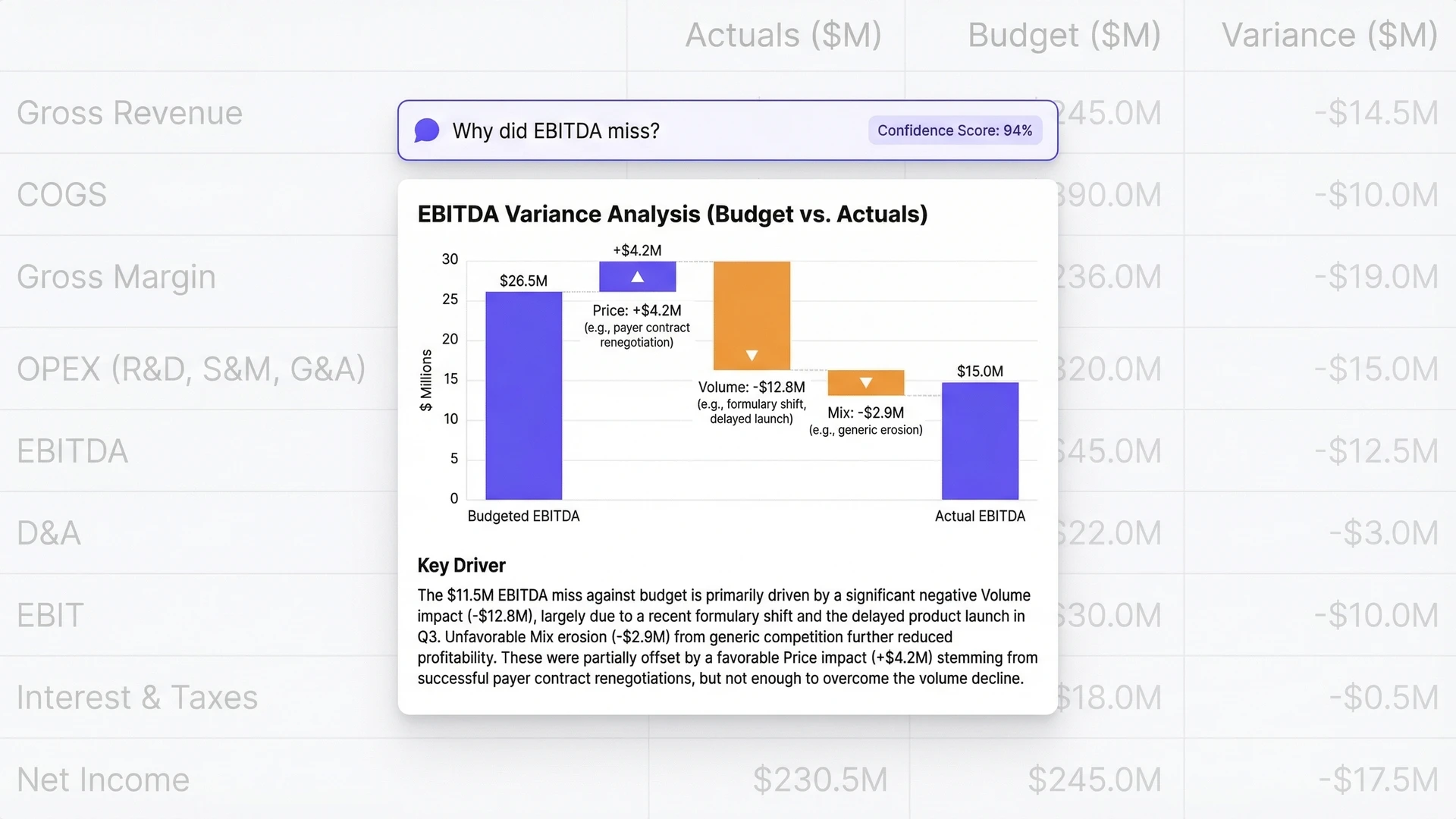
What Is AI-Powered Financial Analytics? 2026 Guide
AI-powered financial analytics is transforming how finance teams analyze performance, forecast outcomes, and explain business results. Instead of relying on manual spreadsheets and static dashboards, modern AI analytics platforms use machine learning, natural language interfaces, and automated analysis to uncover the drivers behind financial metrics in seconds. This guide explains how AI-powered financial analytics works, the core technologies behind it, and how finance teams use it for tasks like variance analysis, forecasting, anomaly detection, and executive reporting. It also explores how AI shifts finance from reactive reporting to proactive, insight-driven decision-making by automatically identifying trends, investigating root causes, and generating clear explanations of what’s impacting business performance.
From Numbers to Narratives with Generative AI: Revolutionizing Financial Planning & Analysis
Conversational FP&A AI analytics promises to transform raw data into powerful financial insights and narratives that move the business forward, powered by generative AI.