

12 Best AI Variance Analysis Software Tools for FP&A in 2026

Any AI can explain a variance. Buy the one that shows its work.
AI variance analysis software for FP&A is software that compares closed actuals to a budget or forecast, finds the drivers behind each material variance, attaches the evidence, and produces a month-end explanation that a reviewer can check and sign.
Every month the books close and the actuals disagree with the plan. Before the review meeting, FP&A has to explain each material line: which plan version it was measured against, what drove it, whether it reverses, and which budget owner stands behind the explanation. Those answers are spread across the ledger, the planning model, billing, the CRM, vendor contracts and a budget owner's inbox. The FP&A Trends Survey 2025 found that 46% of FP&A time goes to collecting and validating data, so nearly half the team's hours go into assembling explanations instead of testing them.
Generative AI made the paragraph cheap. Planning platforms, close tools and general assistants now draft variance commentary in seconds, and 59% of finance leaders told Gartner in its 2025 AI in Finance Survey that their function uses AI. The bottleneck moved downstream. Reviewers receive more fluent commentary than before, and each sentence still has to be traced to its rows, its plan version and its owner before the CFO sees it.
This guide compares 12 tools on that month-end explanation, from tie-out to the signed management pack, the monthly package of variance commentary, bridges and supporting schedules that the head of FP&A and the CFO review. It doesn't rank planning platforms, which the FP&A software roundup covers. For cross-system variance investigation that has to arrive as a reviewable management pack, our editorial pick is Tellius, the only platform in this comparison whose public materials describe all six capabilities we scored.
Which AI variance analysis software is best for your FP&A team?
The right tool depends on which part of the month-end explanation your current stack leaves to a person. When the drivers sit outside the planning model and the pack has to survive review, Tellius covers the most of that workflow in the evidence we reviewed. A team whose priority is planning inside an existing platform, or accounting-led close controls, may reasonably choose differently.
Key: Full means the reviewed evidence supports every component of the criterion within the scope stated. Partial means it supports some components, and the cell names what is missing or unverified. Not verified means the sources we reviewed don't establish the capability, which is different from finding that a product can't do it. No product is rated "Not supported," because no source we reviewed establishes a limitation.
How we evaluated:
- Ratings come from public product documentation, help-center articles, release notes and product pages reviewed in October 2026. We did not test any product hands-on. Where a vendor publishes product documentation, we used it. Tellius's ratings rest on its own finance product page and app screens built on sample data.
- The first nine products are FP&A tools judged on budget-versus-actual and forecast-versus-actual variance. The last three are close tools, judged on how they explain account movements during the close. They're included because the same controller often answers both questions in the same week.
- Rows are ordered within each group by how many of the six capabilities the evidence supports. There are no numerical weights and no calculated score.
- Tellius is ranked first as an editorial recommendation for one workflow: investigating variances across systems and delivering a reviewable management pack. It is the only row with support in all six columns, and the only one whose materials describe timing with a reversal date and a dated owner commitment. FloQast and BlackLine document an evidence-and-approval trail as complete as Tellius's for account-level flux.
Which column does your stack leave to a person? Bring last month's pack and the systems its drivers were hiding in.
What should AI variance analysis software do?
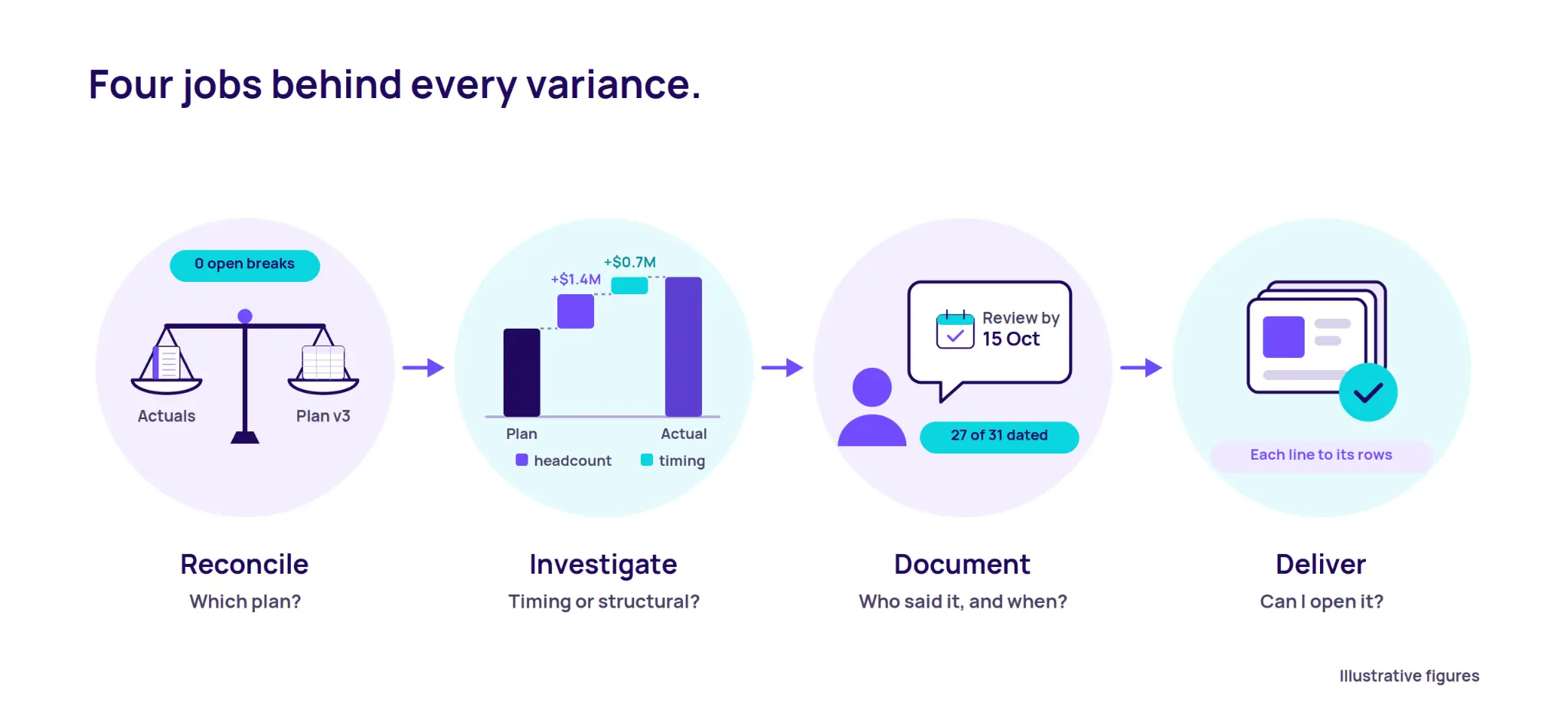
It should do four jobs in order: reconcile the numbers, investigate the drivers, document who explained each line and on what evidence, and deliver a pack a reviewer can sign. Each job has a second question, the one a reviewer asks after the first answer lands. The table splits the timing call out of driver investigation because it decides whether the forecast moves.
Reconcile before you explain. Variances often turn out to be booking errors. CFI's guide to FP&A storytelling uses an accrual true-up as its example of a forecast miss, and a CPA firm's budget-vs-actual guide warns that large favorable variances frequently turn out to be timing, a missed accrual or an unrecorded expense. When the miss is a booking error, the tie-out has to come before the commentary.
Investigate at the grain the driver lives at. Plans are usually built by account and department, while the driver sits a level below, in vendor invoices, billing or the CRM. A tool that only sees the planning model can rank the model's dimensions but can't open a vendor the plan never listed. AI-powered variance analysis for FP&A covers how the decomposition itself works.
Put a date on timing. The same CPA guide separates a timing difference from a permanent change to the run rate by whether the variance repeats. Without a reversal date, nobody can check next month whether "timing" reversed, and it turns into a standing excuse. Budget vs. actual: verify the variance before you reforecast walks through that call.
Get the owner's answer on record. Jumpstart Partners' variance guide suggests asking a budget owner whether an overrun was timing, a scope change or something the forecast should absorb, instead of treating the review as punishment. That answer helps next month only if it is recorded with a date and the rows behind it, which is why the comparison scores owner follow-up and reviewer approval separately.
Deliver something a reviewer can open. Float's guide to the monthly reporting pack asks for commentary that explains each material variance in a sentence or two and says whether it changes the forecast. If there are no rows under a sentence, the reviewer is signing a story.
AI variance analysis software profiles
1. Tellius
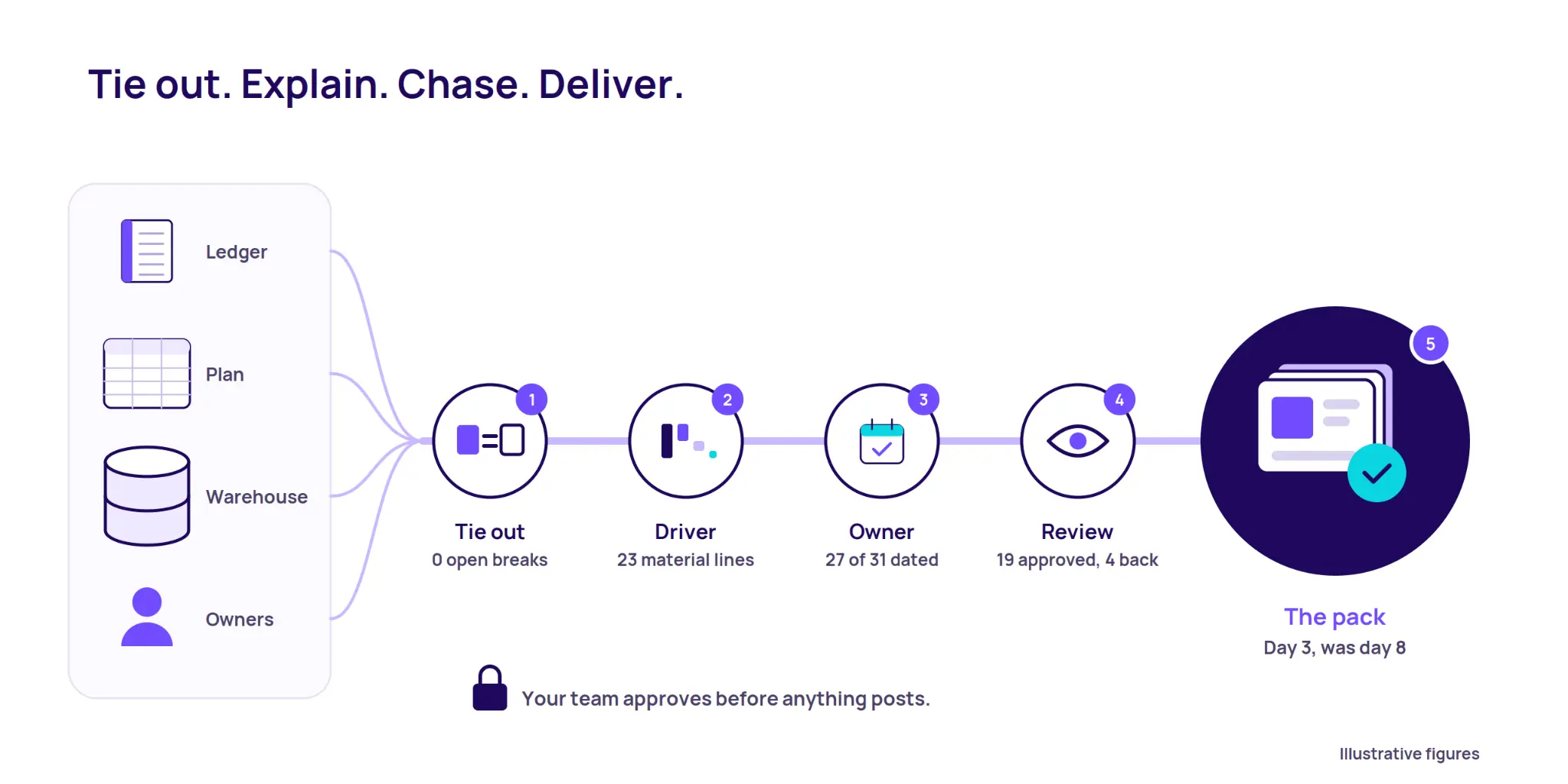
Tellius is an AI platform for finance and FP&A teams that ties out closed actuals, explains each material variance against the approved plan and delivers the management pack for review. It fits teams whose drivers sit outside the planning model, in billing, CRM or vendor detail, and whose pack has to hold up in front of a CFO.
The workflow runs on setup done with the Tellius team before the first close, covering plan versions, cost center hierarchies, materiality thresholds, approvers and the cadence of owner questions. Reclasses, forecast changes and postings are proposed with their evidence and wait for a person to approve them.
- Reconciliation. Closed actuals are checked against the trial balance and the approved plan version. A break becomes a case for the controller, and the pack doesn't publish until it clears.
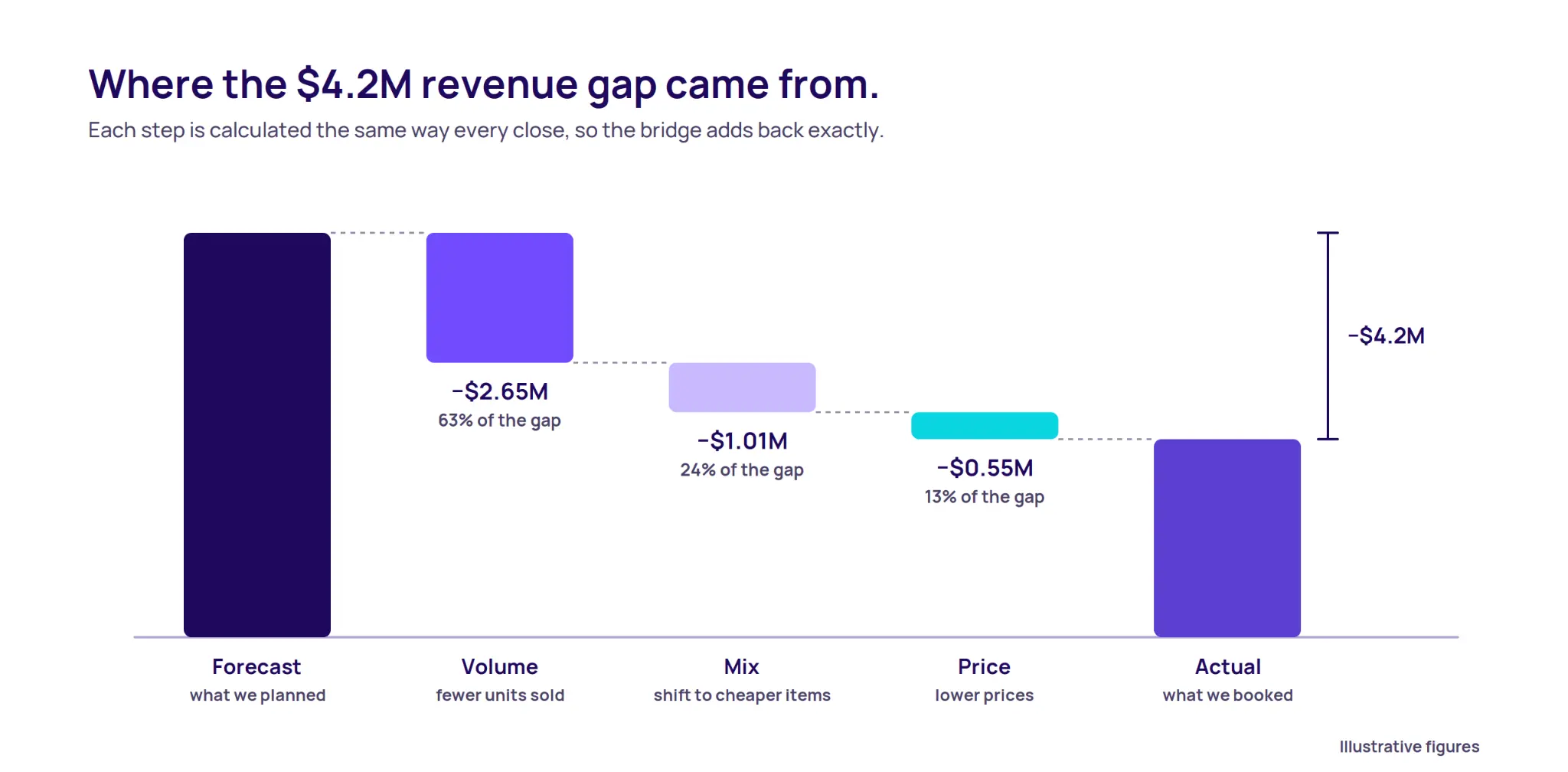
- Drivers. Cost variances split to vendor, cost center and headcount, and revenue and margin to price, volume, mix and FX down to SKU and customer. The bridge method is fixed, so the same question returns the same bridge every close.
- Timing. Each line is classified as permanent, timing or unexplained, and a timing line carries a reversal date that the next close checks.
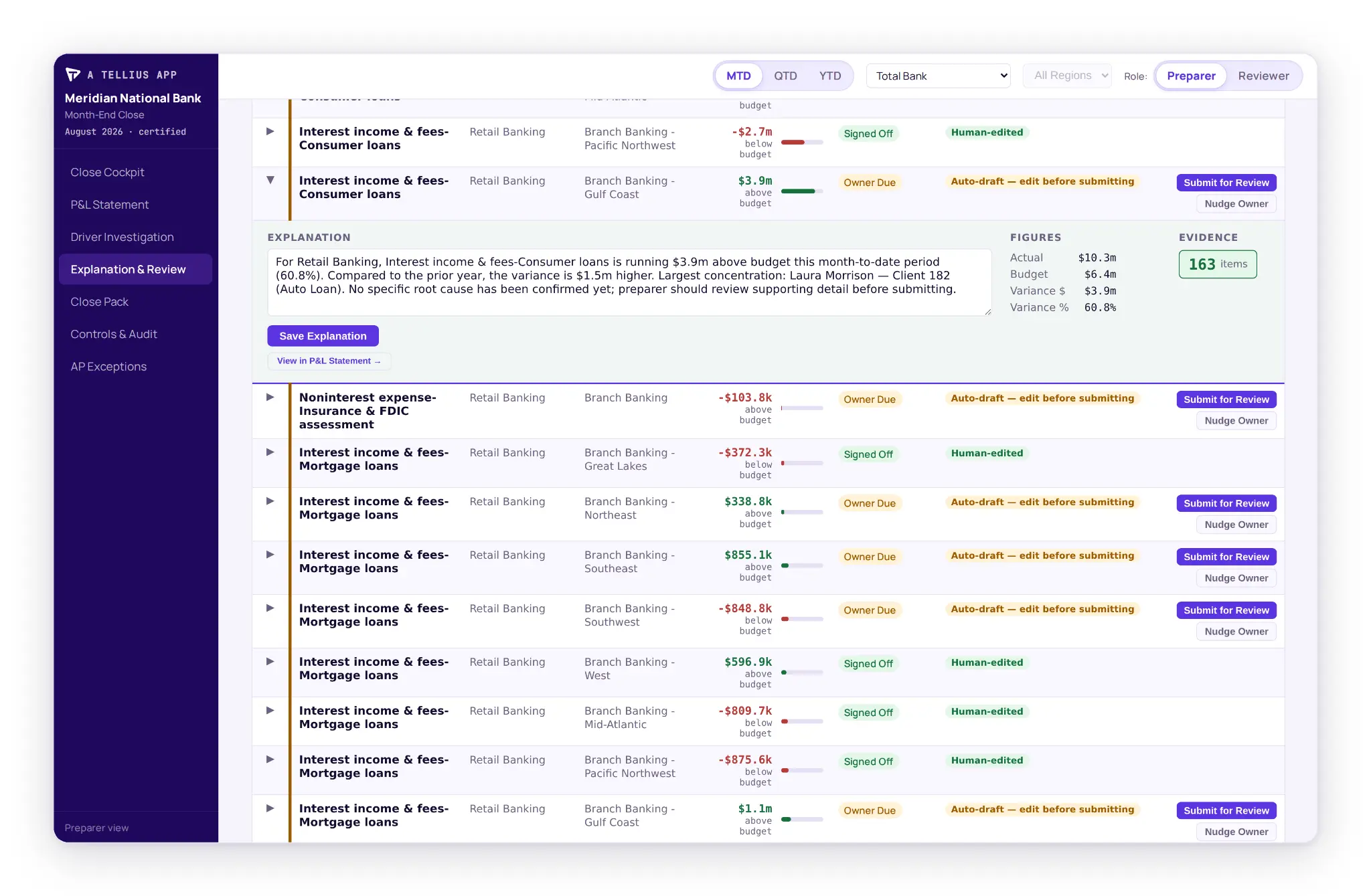
- Owners. Each budget owner gets one question with the rows attached, chased on a set schedule in Teams or email. The answer becomes a dated commitment, and a line nobody answers goes into the pack marked unresolved.
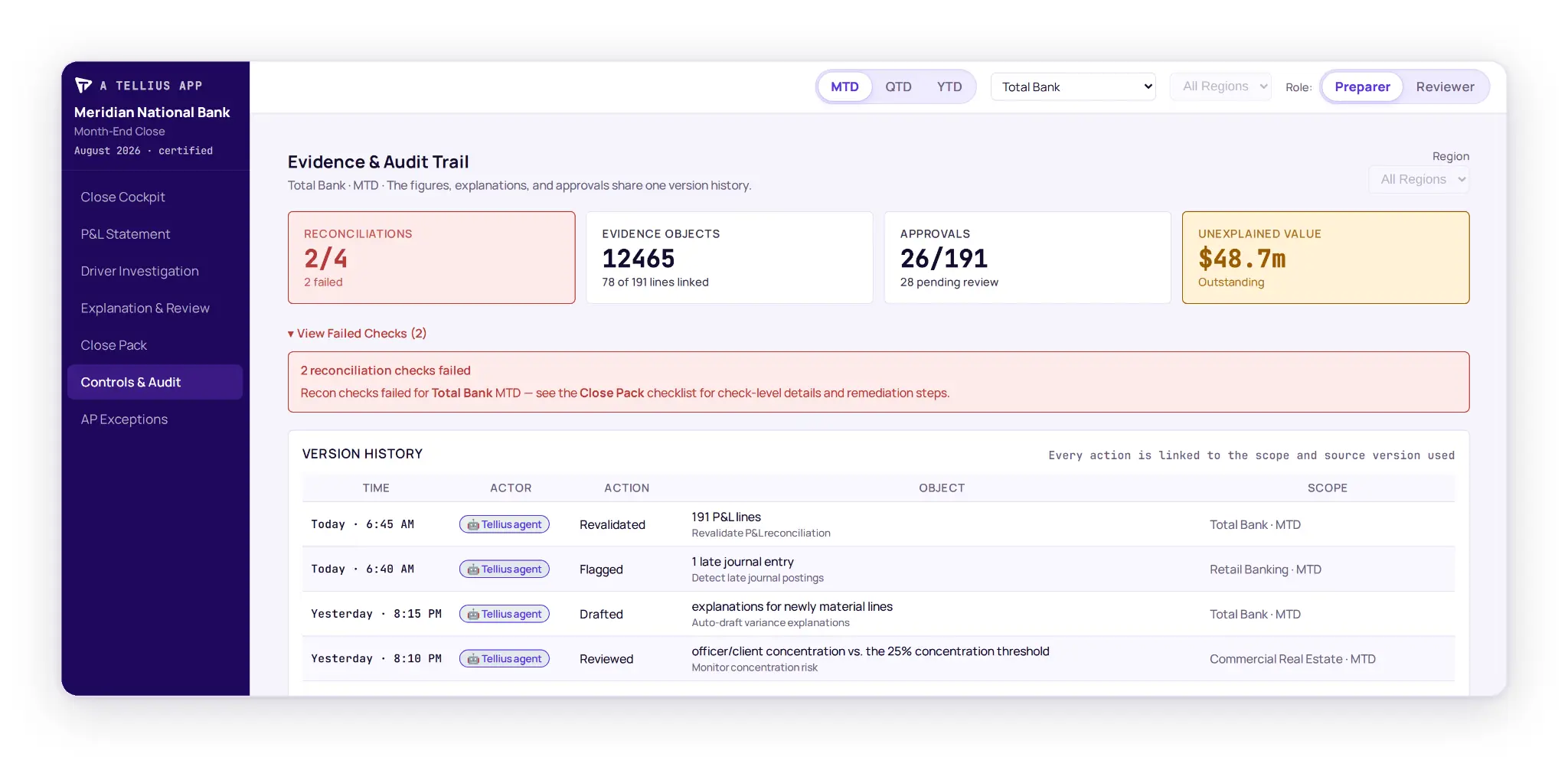
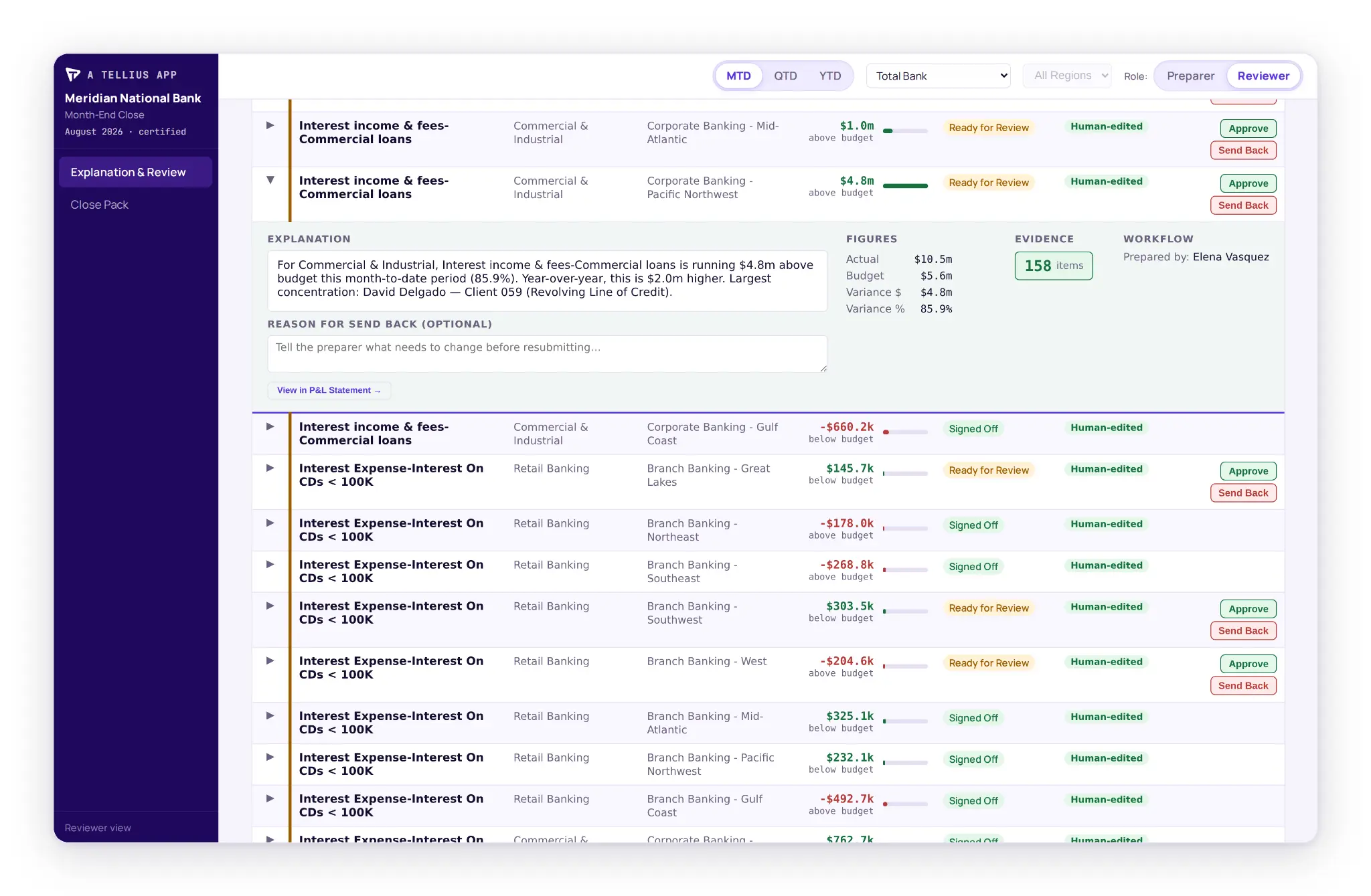
- Evidence and approval. Every sentence opens to its rows, the owner who explained it and the reviewer who approved it or sent it back.
- The pack. Commentary and evidence arrive in Excel and PowerPoint, rebuilt after late corrections.
Tellius reads the ledger, the plan and the warehouse you already run, inside Snowflake or Databricks or as a hosted service, and works beside your planning platform and close tool.
A VP of Finance at a specialty manufacturer, quoted on Tellius's customer page, credits asking for monthly variances directly with cutting the team's close cycle in half. Tellius has been named a Visionary in the Gartner Magic Quadrant for Analytics and BI Platforms for five consecutive years.
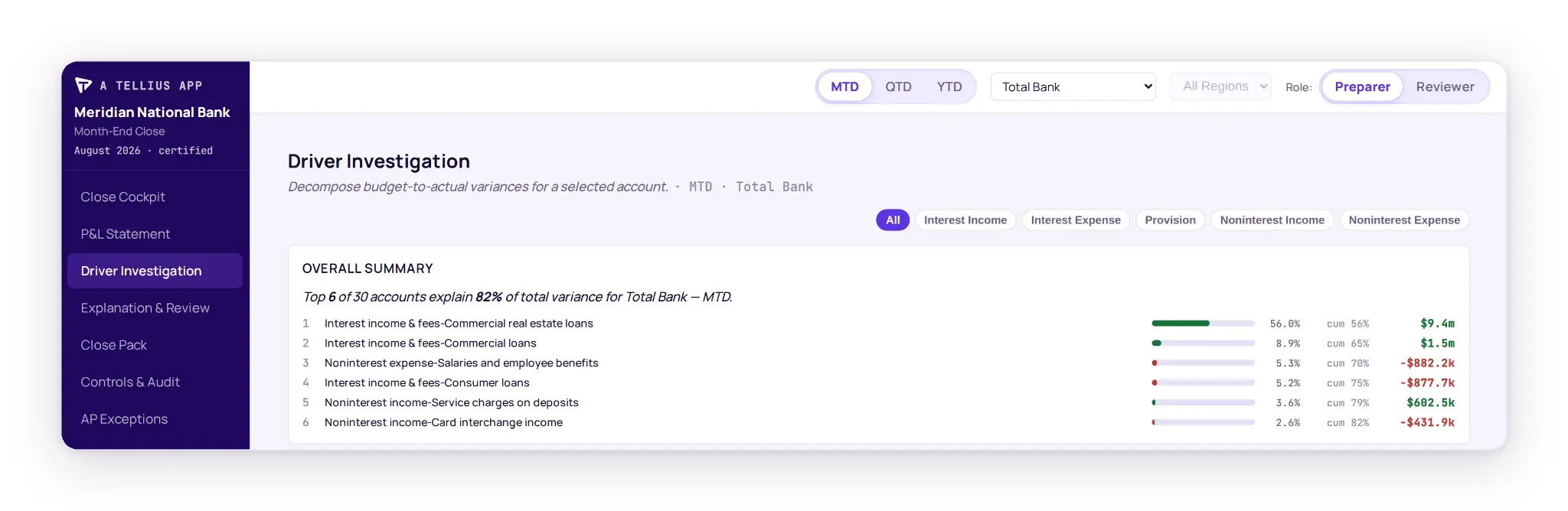
2. Cube
Cube's Analyst Agents rank budget-versus-actual variances by amount and percentage and drill from a flagged figure to the GL transactions behind it, in Cube and in Excel, Sheets, Slack and Teams. Department leads can be tagged in Cube to explain a variance. Ask how a timing explanation gets a reversal date, and whether an owner's answer is dated and approved before it reaches the board deck.
3. Aleph
Aleph's Scan runs flux and variance analysis on models synced from source systems into Excel or Google Sheets, drafts commentary beside each variance and drills to the underlying transaction. Before shortlisting it, find out how explanations are collected from budget owners and what approval record the commentary carries when the pack goes out.
4. Microsoft 365 Copilot (Finance agent)
The Finance agent's variance analysis, in preview, flags variances in an Excel pivot table against criteria written in plain language, explains drivers from the underlying data and drafts a report with comments that can be saved as a template. It works on the workbook in front of it. The agent's reconciliation feature is a separate dataset comparison, not a step in the variance run, so licensing, preview status and where the tie-out and owner follow-up happen all need settling up front.
5. Board
Board's FP&A Agent runs variance, root-cause and EBITDA variance analysis, splitting EBITDA changes into volume, price, mix and cost, and brings external economic drivers into the explanation. The analysis runs on the dimensions the Board model holds. In a demo, ask for transaction-level drill-through and for the record of timing, owner answers and reviewer approval on a single line.
6. Datarails
Datarails consolidates ERP, CRM, HR and Excel data, its Genius assistant answers budget, forecast and variance questions in chat, and Storyboards turns the results into presentations. The open questions for month-end are whether a variance drills to transactions and whether owner explanations and approvals are captured before the presentation goes out.
7. Workday Adaptive Planning
The Planning Agent's Data Exploration skill finds the top five dimensions driving a variance on an open matrix report, with the top three contributors in each, and writes narrative summaries. It is available to Planning Agent customers in the US, Canada, Europe and Singapore. Drivers held in billing or the CRM have to be in the Adaptive model for the agent to rank them, so confirm what loading that takes and how explanations get approved.
8. Pigment
Pigment's Analyst Agent runs a user-defined mission, such as comparing actuals with AOP or budget for net income, revenue, gross margin and OPEX, and a Supervisor agent assembles the final report. It works on data in the Pigment model and is available to customers who request it. Reversal dates, owner follow-up and reviewer sign-off aren't described in its launch material, so ask how each would be handled.
9. Vena
Vena Copilot routes requests to an Analytics Agent that drills across time, region, product line and cost center, and a Reporting Agent that builds variance reports in native Excel connected to Vena. Admins can review every Copilot question and response. Confirm how each explanation is tied to transaction-level evidence and approved before the report is shared.
10. FloQast
FloQast's AI Variance Analysis compares GL balances with prior periods or budget under rules and thresholds you set, drafts transaction-based explanations, and moves each line from preparer sign-off to reviewer sign-off to finalization. It is available to NetSuite customers with SuiteAnalytics and to Workday customers. Because it explains account movements, a price/volume/mix bridge and budget-owner commitments would sit outside it.
11. BlackLine
BlackLine's Verity Flux drafts transaction-level explanations of why consolidated account balances changed, traceable to source transactions and approved by your team, and Verity Narrate turns them into commentary. The variance it explains is a period-over-period balance movement, so plan comparisons and driver bridges have to come from somewhere else in the stack.
12. Numeric
Numeric's AI flux writer drafts explanations from transaction-level data and historical trends using templates your team provides, with drill-down to the transactions, and its reports cover budget versus actual as well as period over period. Its public material doesn't describe a reviewer approval record or a price/volume/mix decomposition, so check both.
Can Copilot, ChatGPT or Claude replace variance analysis software?
No, not for the pack a reviewer signs. General-purpose assistants (as distinct from the Finance agent profiled above) draft useful first-pass commentary from what you hand them, but they don't hold the plan version, the cost center hierarchy or the owner's answer, and they leave tie-out, follow-up and sign-off to your team. Learnsignal's guide to Copilot for finance teams notes that Excel Copilot doesn't reach external data sources unless they are already integrated with your Microsoft 365 environment. A FreeAcademy lesson on AI flux analysis warns that a model given no driver will invent a plausible one.
➔ They only see what you hand them. A worksheet holds the numbers, not the plan version, the hierarchy or the contract behind a recurring spike.
➔ They can answer differently each time. Unless the method is fixed somewhere, the same bridge asked twice can split the drivers differently.
➔ They fill gaps with plausible reasons. Without the driver in the data, the model writes the likeliest-sounding explanation, which is also the one a busy reviewer is least likely to question.
➔ They stop at the paragraph. There's no owner question, no date and no reviewer record, so the commentary is still chased, checked and signed by hand.
An assistant still earns its place for formulas and first drafts. The signed pack needs the plan version, the rows and the approvals held somewhere the reviewer can open.
How should you evaluate variance analysis software?
Run every vendor on a month you've already closed, and ask the second question at each step.
- Hand over a closed month and ask which plan version the tool compared against. Then switch the version and see whether the explanation changes with it.
- Pick the largest line and ask for the rows. Not a chart, the transactions.
- Ask how much of the variance reverses and when. If "timing" comes back without a date, you have your answer.
- Ask the tool to bridge a revenue miss into price, volume and mix, then run the same bridge again. The two answers should match to the dollar.
- Ask who in the business confirmed each explanation, where that confirmation lives, and who approved the final sentence.
- Introduce a late correction and ask for the pack to be rebuilt.
A tool that passes all six produces a pack your reviewer can sign without redoing the work.
Tellius vs. Board for variance analysis
Board suits finance teams that want planning, forecasting and analysis in one model, and its FP&A Agent brings variance, root-cause and EBITDA analysis into that model with external economic drivers alongside. Its reach ends at what the Board model holds. Tellius reads the ledger, the plan and the transaction detail beneath them, then carries each explanation through the owner's answer and the reviewer's approval.
If the drivers you need already live in your Board model, its agent may cover the analysis. When the month-end explanation has to reach below the plan and survive review, Tellius runs beside Board without replacing it.
Tellius vs. Workday Adaptive Planning for variance analysis
Workday Adaptive Planning's Planning Agent answers variance questions in plain language on an open matrix report, ranking the model dimensions behind a variance and writing a narrative summary. For planners who live in Adaptive, that removes manual report building. Tellius works at a different point in the month. It starts from the closed ledger, checks the plan version, decomposes drivers below the plan's grain, and turns each explanation into an owned, dated, reviewable line in the pack. Tellius connects to Adaptive through a pre-built integration, so the plan stays where it is.
Workday's Planning Agent gives planners fast answers in context while they plan. Once the books close and the explanation needs evidence, a named owner and an approval, Tellius picks up the work.
Tellius vs. FloQast for variance analysis
FloQast is built for the accounting close, and its AI Variance Analysis fits that job. It drafts a transaction-based explanation for each material GL account, compares balances with prior periods or budget against your thresholds, and routes each line through preparer and reviewer sign-off. FP&A is asked a different question: why results missed the approved plan, which drivers caused it, whether it reverses, and what the budget owner commits to. Answering that takes price, volume and mix, a timing call with a date, and an owner's dated answer.
FloQast stays the system for explaining account movements and running the close. Tellius ties out against the closed books and explains the plan miss FP&A has to present.
Variance analysis terms used in this guide
Disclosure: This comparison was researched and published by Tellius, and Tellius is one of the twelve platforms in it. Ratings reflect public documentation and product pages reviewed in October 2026, including Tellius's own, and no product was tested hands-on. "Not verified" means we found no public evidence, not that a product lacks the capability. Capabilities change quickly, so confirm current details with each vendor. If you represent a platform here and believe we have mischaracterized it, tell us and we will review the section. Tellius app screens show sample data.
The real test is a month you've already closed. Bring the pack your team signed and see how many of its sentences open to their rows.
Get release updates delivered straight to your inbox.
No spam—we hate it as much as you do!


Tellius is the best fit when the explanation has to survive a reviewer and the drivers sit outside the planning model. It ties actuals to the ledger and approved plan version first, decomposes drivers below the plan's grain, gets a dated answer from each budget owner, and delivers a pack where each sentence opens to its rows. Spreadsheet-native tools such as Aleph and Cube suit teams that want commentary inside Excel, and close tools such as FloQast and Numeric suit accounting teams explaining balance movements.
Tellius classifies each line as permanent, timing or unexplained, and timing carries a reversal date checked the following cycle, so an early invoice doesn't become a forecast change by accident. In the documentation we reviewed for the other eleven tools, none describes a timing state with a reversal date. Close tools explain account movement, not run-rate.
Tellius decomposes revenue and margin variances into price, volume, mix and FX down to SKU and customer, with a fixed method so the same bridge returns every run. Board's FP&A Agent splits EBITDA changes into volume, price, mix and cost inside the Board model. For the other planning tools, a price/volume/mix bridge wasn't verified in the agent documentation we reviewed, and close tools explain balances, not plan misses.
Tellius sends each budget owner a question with the rows attached, chases it on a set schedule and records the answer as a commitment with a date that the next close checks. Cube lets department leads be tagged to explain a variance, and FloQast assigns preparers to explain flagged accounts, but neither describes a dated commitment in the material we reviewed.
Tellius reads the transaction detail, billing and CRM data underneath the plan, while a planning copilot explains the variance within the dimensions its model holds. Because the driver often sits one level below the plan's grain, Tellius runs beside the planning platform instead of inside it.
Tellius is built for plan-versus-actual variance and works beside your close tool without replacing it. Flux analysis explains why an account balance moved period over period and belongs to accounting. Budget-versus-actual variance explains why results missed an approved plan and belongs to FP&A. BlackLine, FloQast and Numeric are built for the first, and Tellius ties out against the close before it explains the second.
Tellius keeps three things on every line: the rows behind the number, the plan version it was compared against, and the person who explained it with a date. With any tool, open the sentence to its rows, confirm the plan version, check who approved it, then rerun the same question and confirm the numbers match.
Tellius proposes a reclass or a forecast change with its evidence and waits for a person to approve it, and nothing is written back until someone does. Planning tools change their own models, and close tools post entries under their own controls. Ask each vendor, in writing, what moves without a human.
Tellius offers a read-only replay of one closed month for one business unit over thirty days, run on the ledger, plan and warehouse you already have. Full rollout is guided by the Tellius team, who configure your plan versions, hierarchies, materiality thresholds and approvers with your FP&A team.
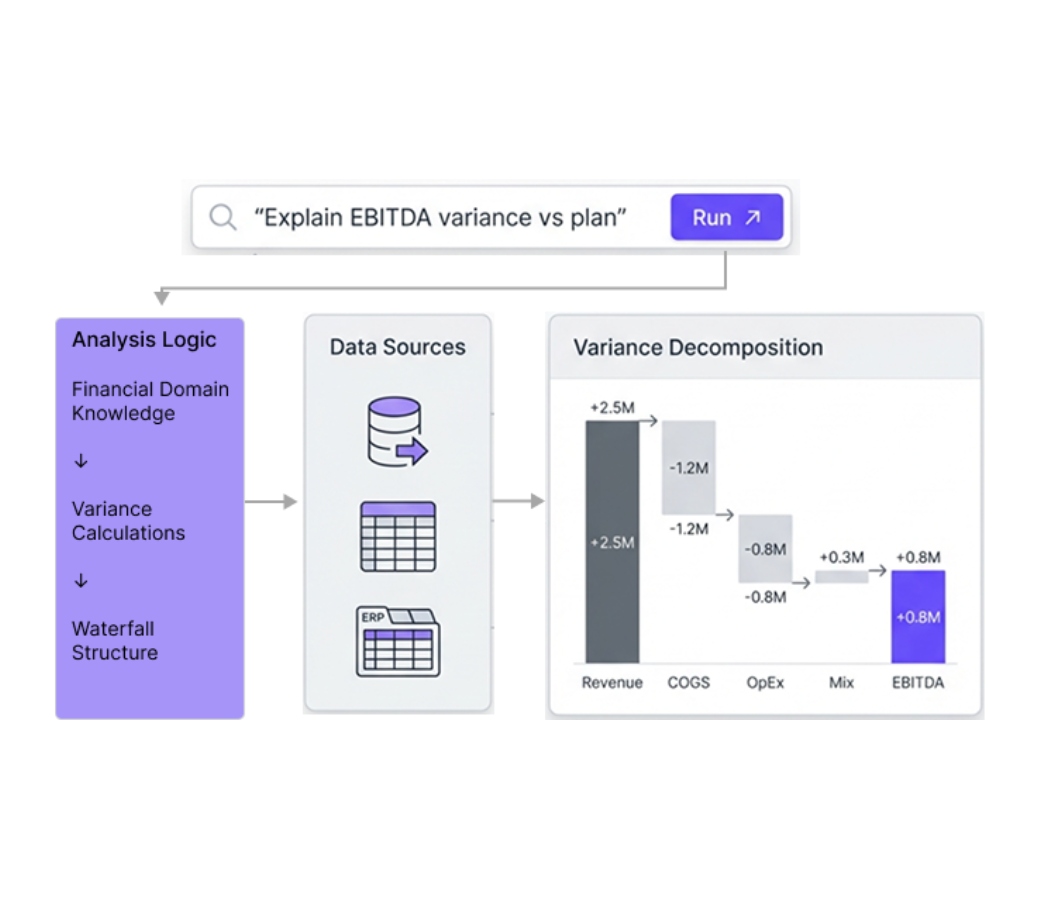
AI-Powered Variance Analysis for FP&A: Root Cause in Seconds, Not Days

AI-powered variance analysis automates the painful “why did we miss budget?” work that FP&A teams currently do in Excel over 3–5 days every close. Instead of testing price, volume, mix, region, and channel hypotheses one by one, an AI platform connects to ERP, planning tools, and warehouses, decomposes budget-vs-actual gaps across all drivers in parallel, and ranks the true root causes in seconds—often at dimensional intersections humans don’t check. A governed semantic layer keeps definitions for revenue, EBITDA, and variance consistent, while agentic analytics continuously monitors KPIs, triggers investigations when thresholds are breached, and generates executive-ready narratives and P/V/M breakdowns automatically. The blog explains what AI does not replace (finance judgment, strategic decisions, stakeholder storytelling), addresses common objections around messy data and trust, outlines an 8–12 week implementation path, and offers a checklist for evaluating variance analysis platforms—highlighting when this kind of AI is a strong fit for finance teams.
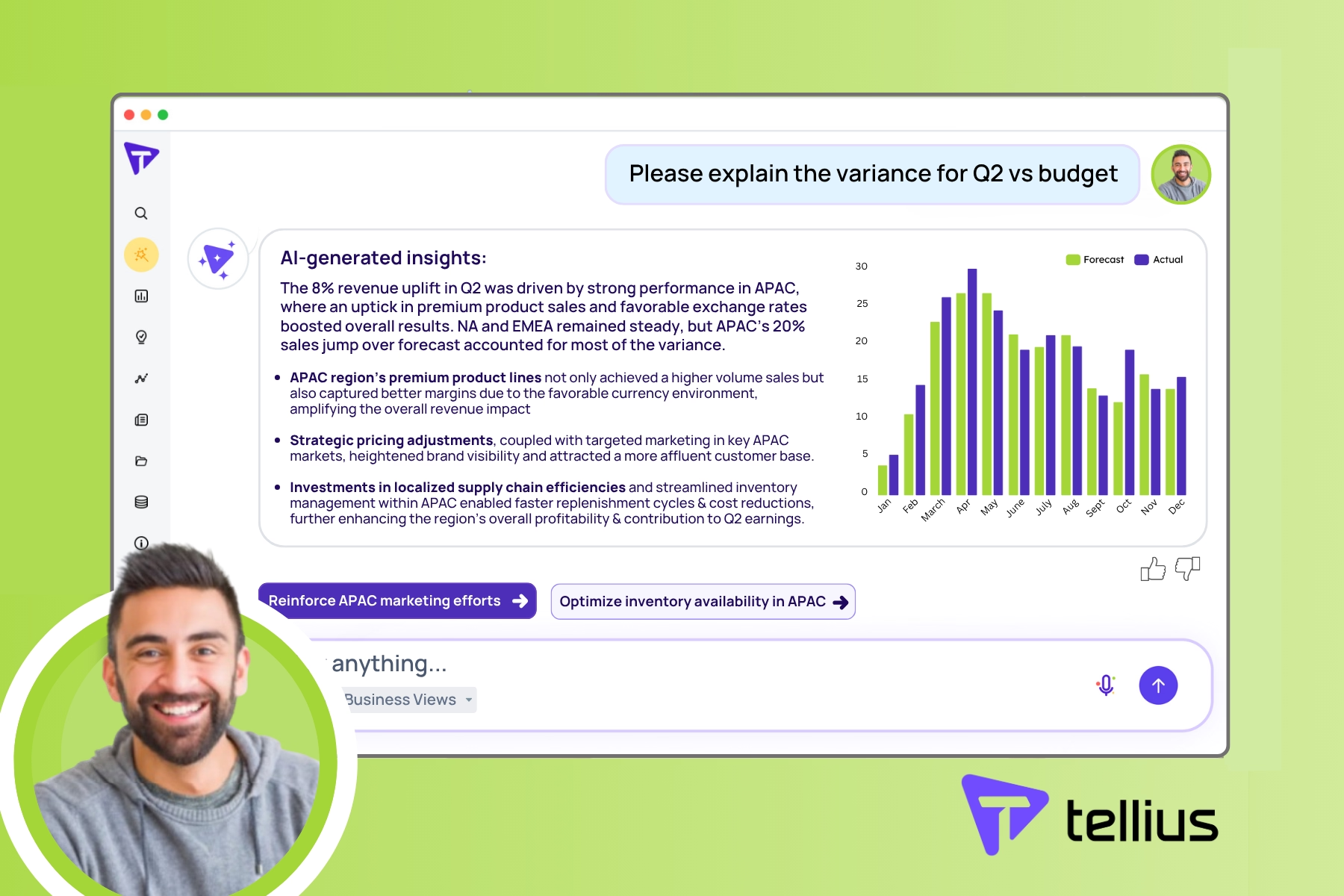
How AI Variance Analysis Transforms FP&A
Learn how AI-powered variance analysis is transforming how organizations uncover and act upon financial insights.