

Pharma payer contract analytics: What your rebate systems cover and where the manual work sits

A worksheet for checking what your systems handle in a payer deal review, and where new capabilities could cut manual work
Payer contract analytics is how a pharma manufacturer connects the pre-deal model it approved with evidence of what the deal delivered: access by plan, patient utilization and net results. Rebate platforms, formulary data and gross-to-net (GTN) modules each hold part of that evidence, but they don't produce the review on their own. That's still largely the job of analysts who must pull exports, match payer names and reconcile finance figures by hand. Without this important work, rebates keep going out for preferred access nobody has checked, and the team approves the next rebate proposal without knowing whether the last one moved patient share or net revenue.
Since most pharmaceutical firms hold hundreds of payer contracts, that manual work repeats every rebate cycle. This guide walks through what your current tools do well, where manual steps slow the review down, and highlights which of those steps AI can add value to.
What you'll take away from this guide
- Map what your rebate, formulary and GTN systems already cover, and where the most manual reconciliations occur today
- Compare what IntegriChain, IQVIA, MMIT, Model N, Precision AQ, Vistex and Tellius contribute
- See where AI is useful (and isn't) when it comes to recurring reviews, payer mapping changes, coverage-versus-claims checks, and more
- Get a worksheet to assess your team's maturity and potential in each area
Which parts of a payer deal review your current systems leave to analysts
Owning a rebate platform, formulary data, and a GTN module doesn't tell you which modules are licensed, which are configured and which your team uses each month. Each covers a piece of the review, but joining those pieces into one answer—and maintaining this compounding context for future decisions—usually falls to analysts and leadership.
The table below takes each of those pieces in turn, with what an analyst does today and what it costs when that work slips.
The rest of this guide shows how to take those steps off your team: what a reliable review needs, which tools help, where AI fits and where it doesn't, and how to test any approach against your own data.
This guide doesn't cover accruals, forecasting or the gross-to-net calculation itself. If that's where your gap is, see our comparison of gross-to-net platforms. For a step-by-step method to measure whether a deal paid off, see how to measure payer contract pull-through and net value.
What should a payer contract analytics review show before you trust it?
A useful payer deal review answers a specific contracting question from your own sources and says what it can't conclude yet. Whether your analysts, service provider, or software tool answers this question, the output should be something your contracting lead could take into a renewal discussion, with every input traceable and every unresolved issue visible.
The questions below work as a checklist for any review, whether your team builds it today or you're comparing other ways to run it.
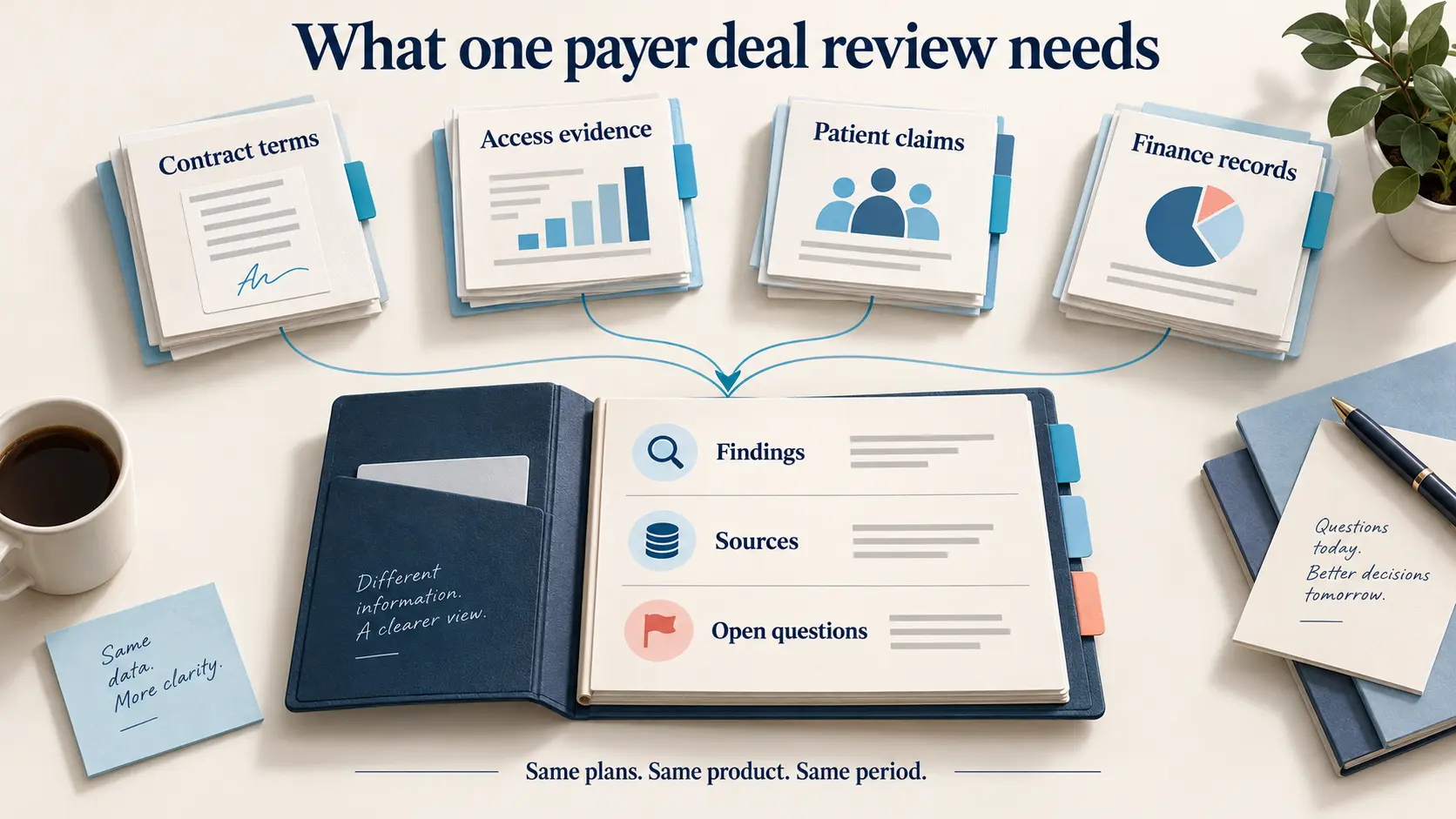
Traceability is the first thing to check. Pick one result and trace it back to the formulary or policy passage, or the claim record, it came from. A summary that can't point to its source gets rechecked by hand before anyone relies on it.
Payer identity is the next place reviews break. A claim can carry an insurer's name while benefit verification later shows a PBM managing the benefit, and policy data may use a third label for the same plan. Check how payer, plan and PBM identities are reconciled when sources disagree, who approves the mapping, and what happens to earlier results when it changes.
Then look at where the data lives. Claims, specialty pharmacy and policy sources often sit in separate environments, and not every team has mastered them in a warehouse. Know which sources a review can read in place, which have to be loaded, and who keeps those feeds running. Keep the data you license separate from the tools that analyze it: a tool that runs on claims data doesn't come with that data.
If a review has no open items at all, ask what happened to the evidence that disagreed. The clause-to-plan checks behind the access line are covered in how teams verify contracted access across eligible plans.
Ways to run a recurring payer deal review
Teams run this review in a few ways, and the approaches often combine.
What separates them is who handles each change once the review is running: a new measure, a new source, a remapped payer or a changed definition. The same test works for any approach. After the first run, change a payer mapping or a source, rerun the review, and see how long it takes someone else to reconstruct the result. If a critical source or owner is missing, fix that first, because no approach produces a reliable review without it.
Payer contract analytics products and what each contributes
The table below lists what each product is useful for in a payer deal review, and what it may still leave to your team.
Tellius publishes this guide and is one of the seven offerings, listed alphabetically and described from each vendor's public pages as of October 15, 2026. Public pages show described scope, not hands-on performance, so confirm license scope, configuration and support for your own setup.
IntegriChain ICyte
IntegriChain delivers market access as a combination of data, applications, analytics and managed services on its ICyte platform. ICyte Access Analytics tracks payer contract performance and payer compliance with contracted formulary position and policy restrictions. Payer Analytics compares post-deal performance with deal assumptions across utilization trends, reject rates and market share. That covers much of the review this guide describes, so an ICyte customer should test it first. The open question is delivery: which parts come from applications your team runs, which from IntegriChain analysts, and which of your sources the deployment covers.
IQVIA Gross-to-Net
IQVIA Gross-to-Net holds contract terms and conditions in one platform and runs pre-deal, forecasting and post-deal analytics from proposed, executed and modified agreements, with claim-level detail behind contract-level forecasts. A team already running it for GTN has a strong base for the financial half of a deal review. The pieces to check are plan-level access evidence, such as policy restrictions and claim rejects, and patient utilization: whether they come from IQVIA data licensed separately, and who builds the review that joins them.
MMIT Contract Validation
MMIT Contract Validation automates the check of whether payers and PBMs placed a product where the contract says. It compares formulary and medical-benefit terms against MMIT's coverage data and produces violation reports with supporting documentation, mainly for the rebate team that verifies position before paying. A validation finding shows that a position was off. Estimating what that cost in utilization or net revenue is a separate analysis, so ask how findings leave the product, at what grain, and how they reach the people who do that work.
Model N payer suite
Model N's payer suite pairs Payer Management, for contracts, plans and rebate calculation, with Validata for script-level claims validation and Formulary Compliance for plan- and formulary-level position checks before rebates are paid. Formulary Compliance also reports compliance trends for account management and future negotiations. Formulary is an optional add-on to the payer suite, so start by listing what you own. Then ask how outputs built to process rebates correctly are carried into the post-deal review, and who does that work.
Precision AQ DecodeRx Payer
DecodeRx Payer maps payer and plan names across transaction, claims, formulary, specialty pharmacy, hub and contract rebate data, with a curated payer master behind it. It doesn't evaluate deals. It belongs on this list because inconsistent payer identity is a common reason a deal review gets rebuilt by hand, and some teams need payer mapping fixed before more analysis helps. The evaluation question is how its mapping feeds your other tools and how mapping changes are versioned.
Vistex
Vistex covers contracts, pricing, rebates, chargebacks and government programs for life sciences, much of it sold as SAP solutions by Vistex. Its payer contract management brings contracts, plans, formularies, utilization data and rebate settlement into one place, with analytics on top. In a Vistex shop, much of the data a deal review needs already passes through it. What to confirm is which modules and analytics produce a deal-level review, which evidence sources feed it, and how much of it is implementation work.
Where AI helps in a payer deal review, and where it doesn't
AI is good at the repetitive joining and checking that eats analyst time. It's weaker wherever the answer depends on judgment, on context that isn't in the data, or on proof of cause.
A quick way to judge any AI output here is whether it shows its work: a cited source for every finding, and an open question wherever the evidence runs out.
How Tellius runs a recurring payer deal review
Tellius is an AI worker platform for pharma commercial and market access teams, built on pharma domain expertise, your business rules and ontology, and governed context. AI workers run recurring work such as payer deal reviews, payer mapping changes and coverage-versus-claims checks, orchestrataing each job and delegating multiple steps to AI agents that check scope and sources, investigate what changed across contract, policy, claims and finance data, and draft a review with findings, cited sources, open questions and proposed owners. Pharma teams configure and validate the workflow against their own datasources and licensed 3rd-party data sources, approving definitions and review rules, then the AI worker spots what changed, pulling linked evidence and comparing policy with claims, runs on a schedule as a Kaiya Mission.
The table below shows how the workflow handles the places where AI falls short.
Configured workflow: the review reaches the contracting team only after scope and source checks, and a mapping fix reaches the next run only after people approve it.
Testing a payer deal review on your own data
Now that you know what's available and where each option falls short, here's a ready-to-use worksheet. Place each of the four jobs from the first table in the column that matches how your team does it today.
Questions about payer contract analytics
Which tools handle which part of a payer deal review?
Each covers a different part. IntegriChain ICyte and IQVIA Gross-to-Net offer post-deal analytics, MMIT and Model N validate formulary position, and Precision AQ maps payer identity. When the missing work is a recurring review across contract, policy, claims and finance evidence, Tellius runs it as a configured AI worker workflow. For a broader comparison of market access platforms, see the best pharma market access analytics platforms.
Can we use MMIT Contract Validation alongside a payer contract analytics workflow?
Yes. MMIT Contract Validation checks whether payers and PBMs placed a product as contracted. A payer contract analytics workflow uses those findings as one input, next to claims, utilization and finance data, to estimate what a position gap meant. A violation report is not a financial impact on its own. Confirm how findings are exported, and at what grain, before assuming a native connection.
Can payer contract analytics help with rebate audits and disputes?
Yes, as a complement to the rebate system. Tools such as Model N Validata and MMIT Contract Validation check claims and formulary position before rebates are paid. The audit work that follows still means comparing PBM invoices with agreement terms, checking invoiced utilization against claims, and assembling support for each disputed line, and that's where analysis across sources saves time. Contract operations still decides which disputes to pursue.
Does the software include claims and formulary data, or do we supply it?
It depends on the vendor. Tellius analyzes data you already license, such as claims and policy data. MMIT's validation runs on MMIT's own coverage data, and other vendors bundle or resell data assets. Confirm what's included, what you license separately and whether your data agreements permit the intended use. Software availability doesn't establish data availability.
How does the software reconcile payer, plan and PBM names across sources?
Through a mapping someone owns. The same plan can appear under an insurer's name in claims, a PBM's name after benefit verification and a third label in policy data. Ask the vendor to show how ambiguous identities are flagged, who approves a mapping change and how earlier results are preserved when it changes. Dedicated payer masters, such as Precision AQ DecodeRx Payer, exist for this job.
Who maintains the review when source files, payer mappings or metric definitions change?
Name the team before you commit. Depending on the approach, it's your analytics team, an outside services team or a mix. Test it directly: change a source file or payer mapping after the first run and watch the second run. A configured workflow still needs an owner for definitions and approvals.
How does the review handle contract amendments, retroactive policy changes and restated claims?
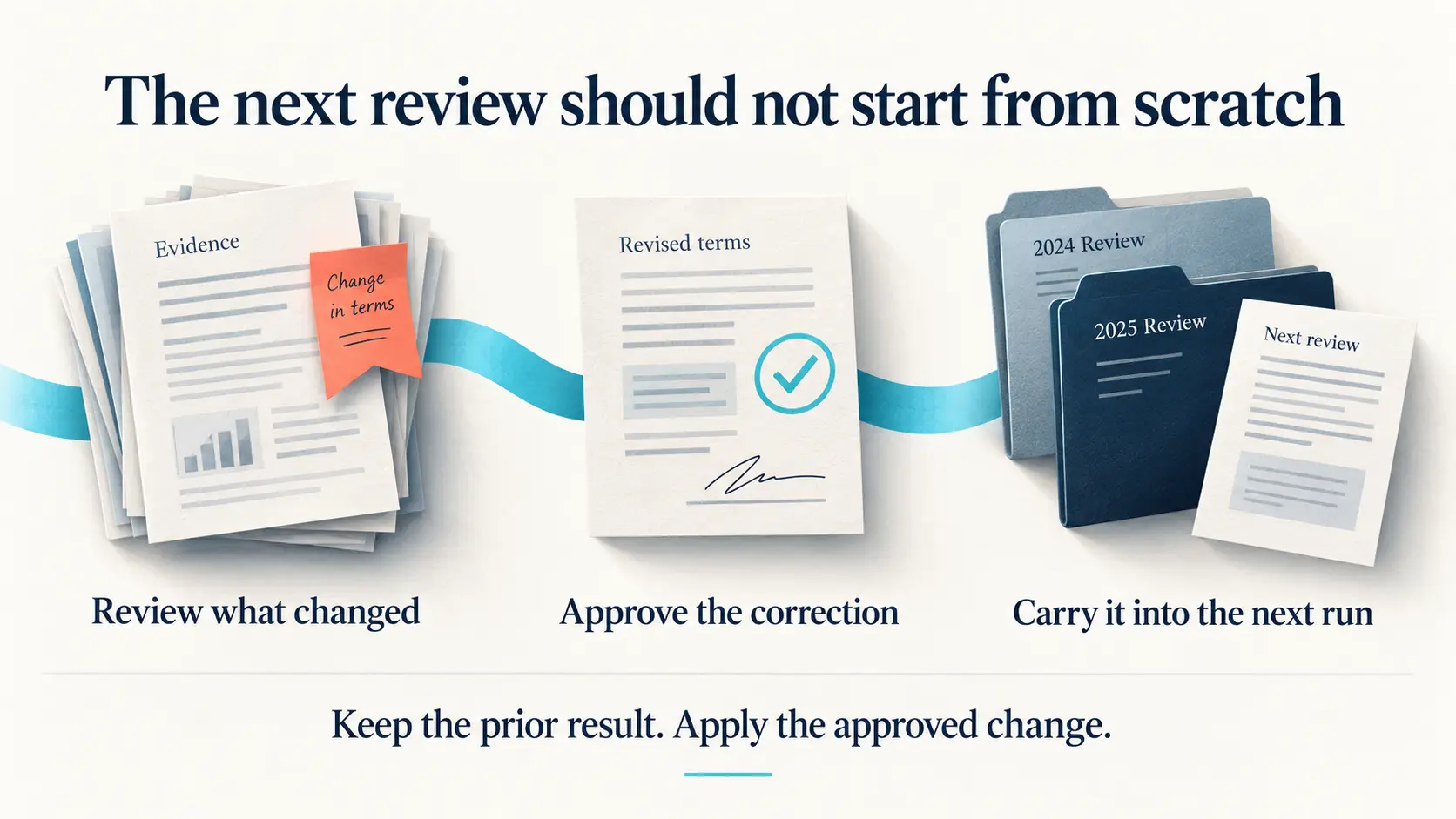
Check it on a real amendment or restatement. The review should keep prior contract and source versions, show which inputs changed, recompute the affected findings and separate restated data from changed business performance. Without that split, a restated claims file can look like a drop in pull-through.
What should a payer deal review test prove before you rely on it?
That the review answers one of your contracting questions from your own evidence. Your reviewer should be able to trace the result, see what's unresolved, reproduce the eligible population and inspect a second run after a correction. The worksheet above keeps different approaches comparable.
Walk through your payer deal review with Tellius
Bring a recent payer deal review and its approved pre-deal model to a working session. We'll map what that review needs against what your current stack produces and show where the remaining work sits.
Get release updates delivered straight to your inbox.
No spam—we hate it as much as you do!


.webp)
Payer contract analytics: how to size a formulary deal and prove pull-through

Winning favorable formulary access is only the first step in a successful payer strategy. The real challenge is determining whether a contract will generate profitable prescription growth—and proving that improved access translates into measurable pull-through. This guide explains how payer contract analytics enables market access, finance, and commercial teams to model the financial impact of formulary agreements before they're signed and continuously measure performance after launch. Learn how leading organizations combine formulary intelligence, claims, hub services, specialty pharmacy data, and field execution metrics to evaluate rebate effectiveness, forecast contract ROI, monitor payer performance, and identify opportunities to improve pull-through.

Market Access Analytics for Pharma: Detect Payer Changes Before TRx Falls
This blog explains how AI-powered market access analytics helps pharma teams spot payer policy changes—formulary shifts, new PA requirements, and tier moves—within days instead of waiting 60–90 days for claims reports. By combining a pharma-native semantic layer, data federation across formulary, claims, hub, and specialty pharmacy sources, and agentic analytics, the platform automatically investigates access issues, quantifies TRx impact, and delivers finished decks and models. The result is earlier detection, faster performance diagnosis, and field activation while there’s still time to protect scripts and pull through new access wins.