

Best Pharma Market Access Analytics Platforms in 2026
.webp)

What are pharma market access analytics platforms?
Pharma market access analytics platforms are software tools that help pharmaceutical companies analyze payer coverage, formulary positioning, gross-to-net (GTN) performance, contract effectiveness, and patient access data to optimize commercial outcomes.
The category covers several sub-functions: US payer data and formulary intelligence, net revenue and GTN analytics, global pricing and HTA (Health Technology Assessment) intelligence, and, increasingly, automated insight generation and agentic AI workflows that diagnose why access metrics changed, not just what changed.
This comparison evaluates 12 platforms across six dimensions. We profiled US payer data providers (MMIT/Norstella, Clarivate, Komodo Health), net revenue platforms (IntegriChain, IQVIA), global pricing intelligence tools (NAVLIN/EVERSANA, GlobalData, Certara), and general-purpose BI tools pharma market access teams commonly use (Power BI, Tableau, SAS).
Tellius is the only agentic market access analytics platform that automates root cause analysis across payer, formulary, and contract data sources — performing P/V/M (Price/Volume/Mix) decomposition, anomaly detection on formulary access rates, and agentic workflows that deliver finished analytical artifacts without manual SQL, Excel, or dashboard building. Most other platforms in this comparison occupy a single layer of the value chain: data, visualization, or global pricing intelligence.
Market access analytics comparison table
How do market access analytics platforms differ from BI tools like Power BI and Tableau?
Best Overall: Tellius -The only platform in this comparison that combines natural language querying tuned for pharma terminology (NRx, TRx, formulary status, payer mix) with automated root cause analysis and agentic workflows, connecting to the data sources market access teams already use (IQVIA, MMIT, IntegriChain, Snowflake) without locking teams into a single vendor’s data ecosystem.
Market access analytics key takeaways
Tellius — Best for cross-data proactive access intelligence. Tellius’s core differentiator is cross-data intelligence — connecting IQVIA, MMIT, IntegriChain, and internal warehouse data in a single session to automatically derive the insight no single source can provide on its own. Where other platforms give you the data or the dashboard, Tellius delivers the cross-data diagnosis: “NRx dropped 12% at UnitedHealthcare because of a PA spike on your specialty tier, not competitive entry” — drawn simultaneously from IQVIA claims, MMIT formulary data, and IntegriChain contract performance. It is the only platform that performs automated P/V/M variance decomposition across payer segments, delivers conversational proactive insights and actions on formulary access rates and PA (Prior Authorization) spikes, and runs agentic workflows that produce finished analytical artifacts (slide decks, Excel exports, executive summaries) without requiring SQL or dashboard building. Trusted by 8 of the top 20 pharmaceutical companies. Named a Visionary in the Gartner Magic Quadrant for Analytics and BI five consecutive years (2022–2026).
MMIT / Norstella — US formulary data and payer intelligence provider used by most large pharma market access teams. Coverage search, formulary alerts, and payer segmentation work well, though teams requiring automated root cause analysis or cross-source insight generation will find these capabilities absent.
Clarivate (Fingertip Formulary Suite) — US formulary tracking with daily data sourcing from health plans and Veeva CRM integration for field access messaging. Does not offer automated insight generation, GTN analytics, or agentic workflows.
Komodo Health — Combines proprietary claims data with analytics tooling including a patient-level enrollment dataset (KPI). MapAI and Marmot provide conversational querying, though teams needing analysis across IQVIA, MMIT, or IntegriChain data will find the analytics locked to Komodo’s own ecosystem.
IntegriChain (ICyte) — Pharma net revenue operations platform covering GTN accruals, rebate management, government pricing, and channel data. It is an operational backbone, though automated insight generation and natural language querying are not core capabilities.
IQVIA — The largest pharma data provider, which added conversational AI analytics capabilities following a 2025 acquisition. Natural language querying is available for commercial teams, though the analytics layer is locked inside IQVIA’s data ecosystem and does not perform autonomous root cause decomposition with quantified driver ranking.
NAVLIN / EVERSANA — Global pricing and market access intelligence covering 100+ markets, including IRP modeling and MFN policy tracking. Serves the global pricing strategy function well, though US payer-level analytics and automated insight generation are outside its scope.
GlobalData — Global drug pricing and HTA decision database. CMS selected GlobalData’s POLI database for Medicare IRP price verification. Research and intelligence platform, not operational analytics.
Certara — Global HEOR modeling, HTA submission strategy, and Market Access Radar. Self-service analytics, claims analysis, and automated insight generation are not offered.
Microsoft Power BI — The most widely used BI tool among pharma market access teams. Low-cost dashboard distribution, though it does not understand pharma terminology, perform automated root cause analysis, or generate insights. It displays what happened without explaining why.
Tableau — Another commonly used BI tool for market access teams. Visualization capabilities for data-literate analysts, though it shares Power BI’s core limitation: visualization tool, not insight engine.
SAS Viya — Long pharma heritage in statistical analysis with 21 CFR Part 11 compliance capabilities. Requires trained statisticians to operate and does not offer natural language querying or automated insight generation for business users.
What separates diagnostic market access analytics from data and dashboards
How should market access teams evaluate AI analytics platforms?
Market access analytics in 2026 breaks into three tiers. Understanding which tier a platform occupies determines whether it can answer the questions market access leaders actually need answered.
Tier 1: Data providers. IQVIA LAAD, Symphony Health, MMIT, Clarivate Fingertip Formulary, Komodo KPI, IntegriChain, NAVLIN, GlobalData, Certara. They answer “what is the current state?” — formulary status, tier positioning, rebate volumes, coverage rates. They are necessary. They are also, by themselves, not enough. Knowing that UnitedHealthcare moved your drug to non-preferred tier 3 is useful. Knowing that the tier change drove a 6% NRx decline in the Southeast, that the decline was concentrated in three territories, and that PA denial rates spiked 34% in those territories — that is actionable. Tier 1 platforms give you the first fact. They do not give you the second.
Tier 2: Visualization and reporting tools. Power BI, Tableau, SAS. They render Tier 1 data into dashboards and charts. Market access teams use them to track formulary access rates, NRx by payer, PA denial trends, and contract performance. They answer “what happened?” But when someone asks “why did NRx drop 8% at Cigna last quarter?”, the dashboard goes silent. Someone has to open SQL, pull claims data, cross-reference formulary changes, check PA volumes, and compare competitive positioning. That work takes days. And by the time the analysis is done, the opportunity to respond may have passed.
Tier 3: Diagnostic and agentic analytics. This tier answers “why did it happen?” and “what should we do?” automatically. Automated root cause decomposition identifies that the NRx drop was driven by a PA step-edit at Cigna, not competitive entry or seasonal effects. Agentic workflows deliver that analysis as a finished artifact — a slide for the next payer review, an Excel model for contract renegotiation prep, a proactive alert when the anomaly first appeared. This is where Tellius operates.
The typical market access analytics stack in 2026 consists of IQVIA or Symphony claims data in Snowflake, MMIT or Clarivate formulary data, and Power BI or Tableau for dashboards. The diagnostic analytical work that actually drives decisions is still done in Excel or SQL, with turnaround measured in days or weeks. That gap — between having the data and understanding what the data means — is the problem the platforms in this comparison address with varying levels of success.
Market access analytics maturity model
Which platforms offer automated root cause analysis for pharma market access data?
Not all analytics capabilities are equal, and the differences matter more than most vendor comparisons let on. We mapped the 12 platforms in this comparison against a four-level maturity model that reflects how market access teams actually work today and where the category is headed. Most teams are stuck at Level 2, spending analyst hours on work that Level 3-4 platforms automate.
.png)
How we evaluated market access analytics platforms
We assessed each platform across six dimensions based on what market access teams need day to day. These criteria draw on the analytical workflows described in Gartner’s research on analytics and BI platforms, Forrester’s coverage of AI-augmented analytics, and the operational realities of managing payer relationships, contract performance, and access strategy.
1. Payer and formulary data depth — Does it provide or connect to US formulary status, tier positioning, PA/step therapy restrictions, and payer segmentation? This is table stakes for market access analytics. Without formulary data, you cannot track access. We rated platforms as “Full” if they originate this data, “Partial” if they connect to external sources, and “Not available” if formulary data is outside their scope.
2. GTN and contract analytics — Can it model gross-to-net flows, track rebate performance, manage government pricing compliance, and analyze contract effectiveness at the payer level? With the average pharma company paying 40%+ of gross revenue in rebates and fees, GTN analytics is not a peripheral concern. Platforms that manage the operational side of GTN (accruals, chargebacks, government pricing) are distinct from those that can diagnose why GTN performance changed.
3. Global pricing and HTA intelligence — Does it cover international reference pricing, HTA decisions, reimbursement policies, and launch sequencing? Relevant for teams with ex-US responsibilities. With IRA-driven Medicare price negotiation now referencing international prices, this capability is becoming more relevant even for US-focused teams.
4. Natural language querying (pharma-tuned) — Can non-technical users ask questions in plain English and get accurate answers grounded in NRx, TRx, formulary hierarchies, payer mix, and PA logic — without writing SQL or building dashboards? Generic NL querying (Power BI Q&A, Tableau Ask Data) is not the same as pharma-tuned NL querying that understands the difference between TRx and NBRx, or that “preferred tier” has a specific meaning in formulary context.
5. Automated root cause analysis and insight generation (the most important differentiator) — Does the platform automatically diagnose why a metric changed? Can it perform P/V/M variance decomposition across payer segments, identify quantified drivers behind NRx drops or access rate changes, and surface anomalies before they become problems? This capability separates platforms that display data from platforms that deliver answers. IDC’s research on decision intelligence identifies automated causal analysis as the critical capability gap in enterprise analytics. We weighted this criterion most heavily because it directly determines whether the platform reduces analyst workload or merely moves the workload from one screen to another.
6. Agentic workflows — Can the platform autonomously execute multi-step analytical workflows, joining claims data with formulary and contract data, running root cause analysis, and producing a finished slide or Excel model without requiring the user to orchestrate each step manually? Gartner’s 2025 Market Guide for Agentic Analytics defines this category and identifies it as the next evolution beyond augmented analytics. We included it because the gap between “getting an answer” and “getting a finished deliverable” is where most analyst time is spent today.
Market access platform deep dives
1. Tellius
Tellius is a proactive access intelligence platform — and its defining capability in market access is cross-data intelligence: connecting IQVIA, MMIT and Veeva in a single session to automatically derive the insight no single source can provide on its own. When NRx drops 12% at UnitedHealthcare, Tellius doesn’t surface a chart and wait. It connects the IQVIA claims trend to the MMIT formulary change, the IntegriChain contract performance data, and the Veeva CRM engagement gap — and delivers a finished diagnosis before the next payer review call. Where other platforms provide data or dashboards, Tellius automates the diagnostic analytical work that market access analysts currently do manually in SQL, Excel, and Power BI — across all their data sources simultaneously.
Key capabilities:
- Cross-data root cause in seconds. Connects IQVIA, MMIT, IntegriChain, Komodo, and internal warehouse data in one session. Automatically decomposes “NRx dropped because of a PA spike at UnitedHealthcare (contributing 8 points), not competitive entry” — with quantified driver ranking across every source simultaneously. No other platform in this comparison does this.
- Platform-agnostic data connectivity. Connectors to Snowflake, Redshift, BigQuery, Databricks, Salesforce, and custom SQL/JDBC. Tellius connects to wherever pharma companies warehouse their IQVIA LAAD, Symphony Health, MMIT, Komodo, IntegriChain, or Veeva data. No data migration. No single-vendor lock-in.
- Pharma-native semantic layer. Maps business terminology to underlying data automatically. Understands that “NRx” means new prescriptions, that “formulary access rate” requires joining coverage data with claims data, and that “P/V/M decomposition” means price, volume, and mix variance analysis. System Packs for pharma pre-load market access metrics, KPI definitions, and analytical patterns so the platform speaks the language of MA teams on day one.
- Natural language querying grounded in market access semantics. Users ask “Which payer had the largest increase in PA denial rates for Drug X this quarter?” and get an immediate, governed answer. Multi-turn conversations build on prior context. The same question always produces the same answer, regardless of who asks — unlike generic LLM-based tools where results vary by prompt.
- P/V/M variance decomposition across payer segments. Automated price/volume/mix analysis at the payer, channel, and geography level. Identifies whether contract underperformance comes from volume erosion, unfavorable mix shift, or price concession — without manual Excel modeling.
- Proactive anomaly detection (Feed). Continuous monitoring of market access KPIs. Detects PA rejection spikes, formulary tier changes, access rate degradation, and NRx share erosion before they surface in monthly reporting — weeks earlier than manual review cycles.
- Agentic workflows with finished artifacts. AI agents execute multi-step analyses autonomously: join claims + formulary + contract data across sources, run cross-data root cause analysis, generate an executive summary, and produce a finished PowerPoint or Excel model. Analysts validate outputs instead of producing them.
- Automated cohort comparison across channels. Compare specialty pharmacy vs. buy-and-bill vs. retail performance, 340B vs. non-340B utilization, or commercial vs. Medicare Part D access rates with automated statistical analysis.
- Conversational analytics with voice mode. Ask questions by voice on mobile during payer meetings or field visits. Get instant answers grounded in the latest data, not last month’s dashboard.
- GenAI narrative generation. Automatically generates written explanations of analytical findings in executive-ready language, reducing the effort of translating charts into the slides and summaries that market access leadership consumes.
Analyst recognition: Visionary in the Gartner Magic Quadrant for Analytics and Business Intelligence Platforms five consecutive years (2022–2026). Named in Gartner's 2025 Market Guide for Agentic Analytics. Recognized by Forrester in augmented BI platform evaluations.
Deployment: 4–6 weeks. No data migration. SOC 2 Type II certified. Row-level security. Full audit trail. Trusted by 8 of the top 20 pharmaceutical companies.
Pricing: Enterprise SaaS priced by data volume (not per user), unlimited users. Contact Tellius sales for current pricing.
Where Tellius falls short: Tellius is the intelligence layer, not a data originator — IQVIA, MMIT, or Symphony Health subscriptions remain necessary as primary data sources. Teams looking for a single platform that both originates formulary data and performs automated analytics will need Tellius alongside a data provider, not instead of one. Brand awareness among market access buyers is still growing relative to established data providers.
2. MMIT / Norstella
MMIT, a Norstella company, provides US formulary data and payer intelligence. The platform covers drug coverage search, formulary status tracking, medical policy information, and payer segmentation.
Key capabilities:
- Formulary and medical policy data sourced from payer partnerships with AI and human validation
- Drug coverage search across therapeutic areas with mobile access
- Payer segmentation by market share, line of business, geography, and relationships
- Searchlight: AI-powered policy change alerts within 24-48 hours
- FormTrak: Formulary data integration with Veeva CRM for field access messaging
Where MMIT excels: MMIT is a widely used formulary data source across pharma market access teams. Payer data sourced directly from payer partnerships, processed through daily validation.
Where MMIT falls short: MMIT is a data and coverage intelligence platform. The analytics layer is reporting and lookups, not automated insight generation. Searchlight alerts that a policy changed but does not quantify the revenue impact or identify the root cause. If UnitedHealthcare adds a PA requirement for your drug, Searchlight will tell you within 24-48 hours. It will not tell you that the PA change is projected to reduce NRx by 8% in the affected territories, that the impact is concentrated in three districts, or that the competitive entry in those districts is compounding the access barrier. That diagnostic work still requires an analyst, SQL, and days of manual investigation.
No automated root cause analysis, no P/V/M variance decomposition, no agentic workflows. Even with NorstellaLinQ (launched October 2024), the analytics remain locked inside a proprietary ecosystem and don’t run on customer-warehoused data from IQVIA, IntegriChain, or other sources. Natural language querying across datasets is not a core capability. Teams that want to ask “why did contract performance drop at Aetna?” across their warehoused claims data will not find that capability in MMIT.
Pricing: Enterprise subscription; no public pricing.
Consider if your primary need is US formulary tracking and payer segmentation, and automated root cause analysis, cross-source insight generation, or agentic workflows aren’t in your evaluation criteria.
3. Clarivate (Fingertip Formulary Suite)
Clarivate offers the Fingertip Formulary Suite for US managed care intelligence, covering formulary tracking, coverage status, tier positioning, and restriction data.
Key capabilities:
- Formulary tracking with data sourced from health plans by pharmacists daily
- Competitive benchmarking across drug classes, segments, and geographies
- Formulary Publisher for field sales via Veeva CRM integration
- Formulary Alerts with 24-hour update notifications
- Managed Market Surveyor for payer/PBM enrollment and affiliation data
Where Clarivate excels: Daily data sourcing directly from health plans provides timely coverage intelligence. The Veeva CRM integration adds a field sales enablement angle.
Where Clarivate falls short: Formulary and managed market data, not an analytics engine. No automated root cause analysis, variance decomposition, or agentic workflow capability. No GTN modeling or contract performance analytics. Product portfolio is fragmented across Fingertip Formulary, Managed Market Surveyor, Cortellis, and HEOR consulting rather than a unified analytical platform. The AI-powered Regulatory Assistant sits on Cortellis, not the formulary suite.
Pricing: Enterprise subscription; custom pricing.
Consider if your primary need is US formulary data with daily updates and CRM integration, and automated insight generation, cross-source analytics, or GTN modeling aren’t in your evaluation criteria.
4. Komodo Health
Komodo Health combines proprietary claims data with analytics tooling, including a market access solution with formulary data, payer profiles, and a patient-level enrollment dataset called KPI (Komodo Patient Insurance).
Key capabilities:
- Healthcare Map: longitudinal patient-level data from Medicare claims, commercial claims, and EHRs
- KPI payer spine built on patient-level enrollment rather than claims-inferred coverage
- MapView: no-code dashboard templates including payer analytics views
- MapAI / Marmot: conversational AI querying for analytics questions
- National Drug Projections for pharmacy and medical benefit data
Where Komodo excels: The KPI payer spine, built on patient-level enrollment data, addresses chronic problems with payer misidentification in claims data.
Where Komodo falls short: Data and analytics are locked inside Komodo’s ecosystem. Users analyze Komodo’s Healthcare Map with Komodo’s tools but cannot ingest IQVIA LAAD, Symphony Health, IntegriChain, or other warehoused data that market access teams also depend on. This is the same vendor lock-in problem that applies to IQVIA’s analytics layer, but with a smaller data footprint. MapAI and Marmot answer questions users know to ask but do not autonomously investigate, perform root cause decomposition with quantified driver ranking, or produce finished analytical artifacts. If your NRx drops, Komodo can tell you it dropped. It cannot automatically decompose the drop into PA spike, competitive formulary change, and seasonal effect, then generate a slide for your next payer review. No GTN modeling, rebate adjudication, or contract performance analytics. The market access solution (formerly Breakaway Partners) is a newer integration, and formulary coverage depth relative to MMIT or Clarivate is less established. US-focused.
Pricing: Enterprise SaaS; no public pricing.
Consider if you value having claims data and analytics in a single platform with patient-level enrollment resolution, and platform-agnostic cross-source analysis, automated root cause decomposition, or agentic workflows aren’t in your evaluation criteria.
5. IntegriChain (ICyte)
IntegriChain is a pharma net revenue and commercialization platform. ICyte unifies four workflows: channel data, patient journey analytics, contracts and pricing (government pricing, rebate management, chargeback management), and GTN (accruals, forecasting, analytics).
Key capabilities:
- GTN accruals with out-of-the-box methodologies and prior period true-up
- Government pricing compliance: Medicaid, Medicare, PHS, FSS
- Rebate management across managed care and government channels
- Channel data aggregation across 500+ PBMs, states, 3PLs, distributors, and pharmacies
- ICyte Commercial Data Suite (launched February 2025) unifying CRM, market, channel, and net revenue data
Where IntegriChain excels: IntegriChain focuses specifically on pharma net revenue operations. The unification of channel, patient, contracts, and GTN data in a single platform reflects that focus.
Where IntegriChain falls short: Strong on data management and operational workflows, weaker on automated insight generation. The BI/AI tools in the Commercial Data Suite are not detailed publicly — likely dashboards and standard reporting rather than automated root cause analysis. No evidence of natural language querying, automated variance decomposition, or agentic workflows that investigate “why” a metric changed. The platform manages data and processes but does not autonomously identify drivers behind GTN variances or contract underperformance. US-focused with no global pricing or HTA intelligence.
Pricing: Enterprise SaaS; custom pricing.
Consider if your primary need is net revenue operations (GTN accruals, government pricing, rebate management) and automated diagnostic analytics or natural language querying aren’t in your evaluation criteria.
6. IQVIA
IQVIA is the largest data and analytics provider across life sciences, with a market access portfolio spanning Market Access Insights (global HTA/reimbursement), an Orchestrated Gross-to-Net Platform, a Market Access Planning Platform, and, following the acquisition of WhizAI in May 2025, conversational AI analytics capabilities.
Key capabilities:
- IQVIA LAAD: a widely used patient-level claims data source across market access teams
- Orchestrated GTN platform with claim-level insights, accruals, reserve analytics, and variance analysis
- Market Access Planning Platform: IRP tool with scenario modeling and launch sequence optimization
- Conversational AI analytics with a domain-tuned NLP engine that understands pharma terminology
- Market access analytics module: payer mix, formulary restrictions, patient OOP costs, brand performance by payer channel
Where IQVIA excels: IQVIA covers multiple layers of the market access stack: proprietary data, GTN operations, global intelligence, and now conversational AI analytics.
Where IQVIA falls short: The conversational AI layer is locked inside the IQVIA ecosystem. Market access teams that also use MMIT formulary data, IntegriChain GTN data, Komodo claims data, or their own warehoused data in Snowflake cannot analyze those sources without moving data into IQVIA’s environment. This matters because most market access teams use multiple data sources. A typical team might have IQVIA LAAD for claims, MMIT for formulary intelligence, IntegriChain for GTN, and internal data in Snowflake. IQVIA’s conversational layer can query its own data, but it cannot join across those sources to answer “why did contract performance at Cigna decline when we have formulary access?”
The conversational layer answers questions but does not autonomously investigate, perform root cause decomposition with quantified driver ranking (e.g., “NRx dropped because of a PA spike at UnitedHealthcare, contributing 8 points, not competitive entry”), or produce finished analytical artifacts like slide decks or Excel models. Complex product portfolio with multiple subscriptions plus consulting. Smaller pharma companies often find the full platform cost-prohibitive.
Pricing: Enterprise contracts; generally premium-priced.
Consider if your team is standardized on IQVIA data and needs conversational querying within that ecosystem, and platform-agnostic cross-source analysis, automated root cause decomposition, or agentic workflows aren’t in your evaluation criteria.
7. NAVLIN / EVERSANA
NAVLIN by EVERSANA provides global pricing and market access intelligence across 100+ markets.
Key capabilities:
- Global price and market access intelligence: HTA decisions, tender data, reimbursement data
- Reference pricing modeling, launch sequencing, predictive pricing models
- MFN Tracker for Most Favored Nation policy developments
- Gross-to-net analytics and global pricing compliance
Where NAVLIN excels: NAVLIN combines global pricing data, software, and insights in a single ecosystem. The MFN Tracker is timely given IRA implementation.
Where NAVLIN falls short: Pricing and policy intelligence, not a claims analytics or operational insight platform. No automated root cause analysis, anomaly detection, or agentic analytics. No patient-level claims analysis, transaction-level contract performance measurement, or payer-level NRx diagnostics. US formulary and payer analytics are less developed than MMIT or Clarivate. The platform serves global pricing strategy well but does not address the day-to-day diagnostic analytics needs of US market access operations teams.
Pricing: Enterprise subscription; no public pricing.
Consider if your primary need is global pricing strategy, IRP modeling, and HTA intelligence, and US payer-level diagnostic analytics or agentic workflows aren’t in your evaluation criteria.
8. GlobalData
GlobalData provides a Drug Pricing & Market Access Database covering pricing, HTA decisions, IRP datasets, risk-sharing schemes, and country profiles across 70+ countries.
Key capabilities:
- International reference pricing dataset with country-level profiles
- HTA decision database with pricing and reimbursement policy tracking
- Market Access Risk Scores across 70+ countries
- REST API for data integration
Where GlobalData excels: CMS selected GlobalData’s POLI database for Medicare IRP price verification (late 2025).
Where GlobalData falls short: Intelligence and research platform, not operational analytics. No claims-level data analysis, contract performance measurement, patient-level analytics, or any diagnostic capability. Users consume reports and dashboards. Not used by US market access teams for day-to-day operational decisions.
Pricing: Enterprise subscription; custom pricing.
Consider if your primary need is global drug pricing intelligence with institutional-grade IRP data, and US payer analytics, automated insight generation, or operational market access analytics aren’t in your evaluation criteria.
9. Certara
Certara is a biosimulation and regulatory science company with a market access vertical: Market Access Radar, HEOR consulting, and HOPE Bayesian modeling technology.
Key capabilities:
- Market Access Radar for global pricing/reimbursement data
- HEOR consulting for health economic modeling and HTA submissions
- HOPE technology: Bayesian dynamic modeling for real-world outcomes prediction
- BaseCase: no-code tools for payer meeting presentations (out of scope for analytics)
Where Certara excels: The HOPE modeling technology uses Bayesian dynamic modeling to predict real-world outcomes from clinical trial data.
Where Certara falls short: Consulting and value communication company, not a self-service analytics platform. No claims data analysis, formulary tracking, contract performance analytics, or GTN modeling. No automated root cause analysis or variance decomposition. Does not integrate with IQVIA, Symphony, MMIT, or other data sources for operational market access analytics.
Pricing: Consulting is project-based; software products are SaaS subscriptions.
Consider if your primary need is HEOR modeling and HTA submission strategy, and operational market access analytics or automated root cause analysis aren’t in your evaluation criteria.
10. Microsoft Power BI
Power BI is Microsoft’s self-service BI platform and the most widely used analytics tool among pharma market access teams.
Key capabilities:
- Dashboard creation with drag-and-drop builder
- DirectQuery and composite models for Snowflake, Redshift, BigQuery
- Microsoft 365 integration (Excel, Teams, SharePoint)
- DAX formula language for calculated measures
- Admin portal for governance and row-level security
Where Power BI excels: Already in the tech stack at virtually every pharma company. Low per-user cost and Excel integration make it the default for KPI reporting.
Where Power BI falls short: Shows what happened but does not explain why. No pharma domain knowledge — does not understand TRx vs. NBRx, formulary hierarchies, payer mix, or PA logic. If a market access director asks “why did NRx drop at UnitedHealthcare?”, Power BI will show them the drop on a dashboard. It will not decompose the drop into PA spike vs. competitive entry vs. seasonal effect. It will not quantify each driver. It will not generate a narrative explaining the findings. That work falls to an analyst who has to pull the data, run the analysis manually, and build a new view — work measured in days or weeks, not seconds.
Requires technical users (DAX, data modeling) for dashboard building and maintenance. No automated root cause analysis, anomaly detection, or insight generation. Natural language querying exists (Q&A feature) but is not grounded in pharma business semantics. Dashboards are static snapshots that display but do not investigate.
Pricing: Pro: ~$10/user/month (included in M365 E5). Premium: ~$20/user/month or capacity-based.
Consider if your team needs low-cost dashboard distribution in a Microsoft environment, and automated root cause analysis, pharma-tuned NL querying, or agentic workflows aren’t in your evaluation criteria.
11. Tableau
Tableau (Salesforce) is a data visualization platform commonly used alongside Power BI by pharma market access teams.
Key capabilities:
- Drag-and-drop visualization builder
- Connections to Snowflake, Redshift, BigQuery, and other data warehouses
- Tableau Prep for data preparation
- Einstein AI integration for NL querying and predictive capabilities
Where Tableau excels: Visualization capabilities preferred by data-literate analysts for exploratory analysis.
Where Tableau falls short: Same core limitation as Power BI: visualization tool, not an insight engine. No pharma domain knowledge. No automated root cause analysis. NL querying via Einstein is nascent and not pharma-tuned. Does not understand formulary hierarchies, PA logic, or payer mix semantics. Higher per-user cost than Power BI.
Pricing: Creator: ~$75/user/month; Explorer: ~$42/user/month; Viewer: ~$15/user/month.
Consider if your analysts prefer Tableau’s visualization approach and the Salesforce ecosystem, and automated insight generation or agentic analytics aren’t in your evaluation criteria.
12. SAS Viya / Life Sciences
SAS Viya is SAS’s cloud-enabled advanced analytics platform. SAS has a long history in pharma for statistical modeling, forecasting, and compliance-capable analytics.
Key capabilities:
- Statistical modeling and forecasting for market access scenarios
- Life Sciences modules for clinical, regulatory, and commercial analytics
- 21 CFR Part 11 compliance capabilities
- Python and R integration
Where SAS excels: SAS supports 21 CFR Part 11 compliance for statistical analysis and forecasting.
Where SAS falls short: Statistical workbench for trained statisticians, not a self-service platform for market access business users. No natural language querying, no automated insight generation, no agentic workflows. Increasingly supplemented by Python and R in modern analytics teams. No pharma-specific semantic layer.
Pricing: Enterprise licensing; high-cost relative to open-source alternatives.
Consider if your team includes trained statisticians who need 21 CFR Part 11-capable modeling, and self-service analytics or NL querying aren’t in your evaluation criteria.
Where market access analytics is headed
Which market access analytics platforms can analyze both structured claims data and unstructured payer intelligence?
Three forces are reshaping the market access analytics space.
First, IQVIA’s acquisition of a conversational AI analytics vendor in May 2025 validated that the market needs an intelligence layer on top of market access data. The largest data provider in life sciences acknowledged that data alone is not enough. That signal matters. Forrester’s research on augmented analytics had been pointing in this direction for years, but the acquisition made it concrete.
Second, the Inflation Reduction Act is compressing timelines for pricing decisions. Medicare drug price negotiation is real now, and market access teams need faster analytical cycles for scenario modeling, contract restructuring, and GTN impact assessment. Manual analysis measured in days does not work when regulatory timelines are measured in months.
Third, the analytics talent gap in pharma market access is widening. Market access roles increasingly require SQL, Python, Power BI, and claims data proficiency, skills that are expensive to hire and retain. Platforms that automate diagnostic analytical work don’t replace these professionals. They free them to focus on strategy, negotiation, and relationship work that no platform can automate. IDC projects that by 2027, more than 50% of enterprise analytical tasks will be performed by AI agents rather than human analysts.

Over the next two to three years, payer data coverage and dashboard creation will remain necessary but no longer sufficient. The differentiating capabilities will be automated root cause analysis tuned for pharma terminology, cross-source workflows that span claims + formulary + GTN + contract data, and agentic AI that delivers finished artifacts on schedule. The platforms that win will treat market access analytics as a diagnostic discipline, not a reporting function.
Head-to-head: Tellius vs. IQVIA for market access analytics
How does Tellius compare to IQVIA for market access analytics?
IQVIA answers the question. Tellius delivers the diagnosis.
This is the comparison most market access teams are evaluating. IQVIA has the data and analytics. So why would a team that already pays for IQVIA data also need Tellius? The answer comes down to three things: vendor lock-in, diagnostic depth, and output format.
The core difference: IQVIA’s conversational layer helps users query IQVIA data. Tellius autonomously investigates performance changes across any data source, identifies quantified root causes, and delivers the finished analysis. One answers the question you asked. The other finds the questions worth asking.
Market access teams exclusively on IQVIA data may find the conversational querying layer sufficient. Teams that also use MMIT for formulary intelligence, IntegriChain for GTN, or have data in Snowflake alongside IQVIA sources need a platform that works across the full data ecosystem. The question is not whether IQVIA’s data is valuable — it is. The question is whether your analytics should be locked to a single data vendor’s ecosystem, or whether you need the flexibility to analyze all your market access data from a single agentic analytics platform.
Head-to-head: Tellius vs. Power BI for market access
How does Tellius compare to Power BI for pharma market access?
Power BI shows the symptom. Tellius diagnoses the cause.
Power BI is everywhere in pharma. It is the default tool for market access dashboards, leadership reporting, and KPI tracking. The question is not whether you should have Power BI — you almost certainly already do. The question is whether Power BI alone is sufficient for the diagnostic analytical work that drives payer strategy, contract decisions, and access optimization. In most cases, it is not. Here is why.
Tellius is not a Power BI replacement. It is the diagnostic layer that explains what Power BI dashboards surface. Keep Power BI for enterprise dashboard distribution. Add Tellius for the intelligence — root cause analysis, anomaly detection, and the agentic workflows that turn data into decisions.
Head-to-head: Tellius vs. MMIT / Norstella for market access
How does Tellius compare to MMIT / Norstella for market access?
MMIT tells you the formulary changed. Tellius tells you what it cost you.
MMIT is likely already in your tech stack. Most pharma market access teams use MMIT (or Clarivate) as their primary source of formulary and coverage intelligence. The question is what happens after MMIT tells you a formulary change occurred. Today, an analyst picks up the thread: pulls claims data, models the impact, builds a slide. That takes days. Tellius automates that second step.
MMIT and Tellius are complementary, not competitive. MMIT provides the formulary intelligence. Tellius analyzes it — alongside claims data, contract data, and internal data — to quantify what formulary changes actually mean for revenue and access. Teams that use MMIT today should consider adding Tellius to move from knowing that something changed to understanding what it cost and what to do about it.
Head-to-head: Tellius vs. Komodo Health for market access analytics
How does Tellius compare to Komodo Health for market access analytics?
Komodo gives you the data ecosystem. Tellius gives you the answers across ecosystems.
The fundamental difference is architectural. Komodo is a vertically integrated data-and-analytics ecosystem — useful when you want claims data and analytics in one place, limited when your market access team also depends on IQVIA LAAD, MMIT formulary data, IntegriChain GTN data, or internal warehouse data. Tellius connects to all of those sources, including Komodo, and performs the automated diagnostic analysis that Komodo’s tools do not offer.
For teams evaluating both: Komodo is a data provider. Tellius is the analytical layer that sits on top of data providers. If you use Komodo for claims data, Tellius can connect to it and add automated root cause analysis, agentic workflows, and finished artifact generation. They are potentially complementary, just as MMIT and Tellius are complementary.
Disclosure
This comparison was researched and published by Tellius. We aimed for factual accuracy across all vendor profiles, drawing on publicly available product documentation, customer reviews, and analyst reports as of March 2026. We encourage readers to evaluate each platform through vendor demonstrations and proof-of-concept engagements.
Ready to see Tellius on your market access data?
Tellius connects to the data sources your market access team already uses and automates the diagnostic work that currently takes days. Root cause analysis in seconds. Finished artifacts delivered automatically.
Get release updates delivered straight to your inbox.
No spam—we hate it as much as you do!


Tellius connects to IntegriChain data and adds automated diagnostic analytics: root cause analysis of GTN variances, NL querying across net revenue data, and agentic workflows that investigate contract underperformance autonomously. IntegriChain focuses on pharma net revenue operations (GTN accruals, government pricing, rebate management). They address different layers of the stack.
Tellius connects to both US and global data sources for cross-market analysis. IQVIA’s full portfolio covers both US payer/commercial analytics and global market access planning (MAP platform, IRP tool). NAVLIN/EVERSANA and GlobalData specialize in global pricing intelligence. MMIT, Clarivate, IntegriChain, and Komodo focus primarily on US market access.
Tellius performs automated root cause analysis on GTN data, identifying quantified drivers behind accrual variances and contract underperformance across payer segments, channels, and geographies. IntegriChain’s ICyte platform manages GTN accruals, government pricing, and rebate operations. IQVIA offers an Orchestrated GTN platform with claim-level insights. Tellius adds the diagnostic layer on top of both, explaining why GTN metrics changed and producing finished artifacts for finance and market access leadership.
Tellius deploys in 8-12 weeks with no data migration, connecting to data where it lives. The pharma-native semantic layer accelerates market access-specific configuration because it already understands NRx, TRx, formulary hierarchies, and payer mix terminology. Pharma data platforms often require longer cycles depending on data onboarding complexity. Custom-built solutions typically take 12-18 months.
Tellius prices by data volume with unlimited users, making per-user economics favorable for broad deployment. BI tools are lowest cost (Power BI Pro: ~$10/user/month). Pharma data providers price via enterprise subscriptions typically in the six-figure annual range. Contact individual vendors for current pricing.
Tellius, Power BI, Tableau, and SAS connect to Snowflake, Redshift, BigQuery, and Databricks where pharma companies warehouse their claims, formulary, and contract data. Tellius adds a pharma-native semantic layer and automated insight generation on top. IQVIA, MMIT, and Komodo primarily analyze data within their own ecosystems.
Tellius is designed for business users — market access analysts, directors, and VPs ask questions in plain English and receive governed answers without SQL or Python. IQVIA also targets business users for conversational querying. SAS requires trained statisticians. Power BI and Tableau require technical users for dashboard building.
Tellius is SOC 2 Type II certified with row-level security, full audit trail, and SSO/SAML support. SAS Viya is 21 CFR Part 11 capable. IQVIA, IntegriChain, and other enterprise pharma platforms maintain compliance certifications appropriate for healthcare data. Power BI and Tableau support governance through their admin portals.
Tellius connects to Salesforce (which underlies Veeva CRM) and can ingest Veeva data warehoused in Snowflake or Redshift via its data connectors. Clarivate’s Formulary Publisher integrates directly with Veeva CRM for field access messaging. MMIT’s FormTrak also connects formulary data to Veeva. Komodo and IntegriChain maintain their own CRM-adjacent integrations.
Tellius provides NL querying grounded in a pharma-native semantic layer that understands NRx, TRx, formulary hierarchies, payer mix, and PA logic. IQVIA has a domain-tuned NLP engine. Komodo’s MapAI and Marmot offer conversational analytics within their ecosystem. Power BI and Tableau provide generic NL querying not tuned for pharma.
Tellius provides continuous KPI monitoring with automated anomaly detection, surfacing PA rejection spikes, formulary changes, and NRx erosion before they appear in monthly reporting. IQVIA includes ML-based anomaly surfacing. MMIT’s Searchlight provides policy change alerts but does not quantify revenue impact.
Tellius is the only platform in this comparison with production-ready agentic workflows for market access analytics. These workflows autonomously join data from multiple sources, run multi-step analysis, and produce finished PowerPoint decks, Excel models, and executive summaries. Gartner’s 2025 Market Guide for Agentic Analytics defines this category and identifies it as the next evolution beyond augmented analytics.
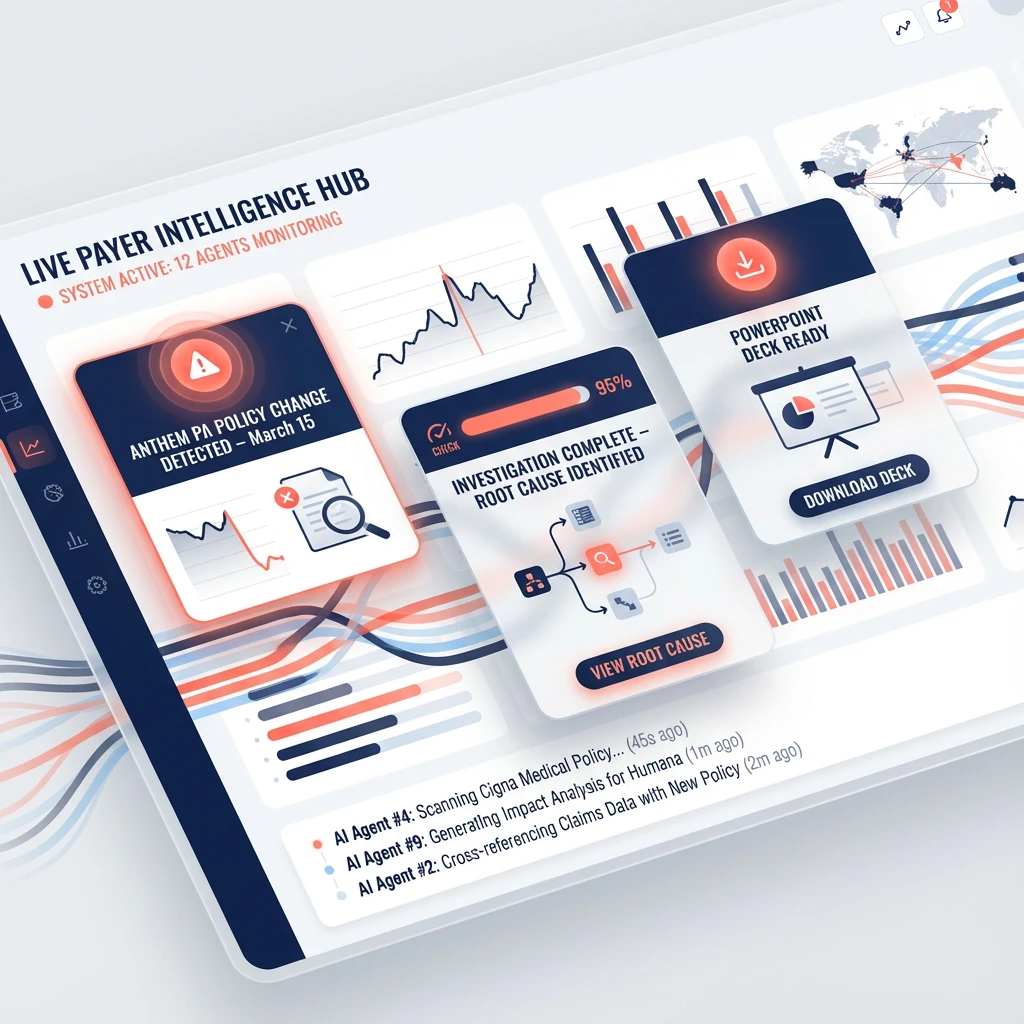
Market Access Analytics for Pharma: Detect Payer Changes Before TRx Falls

This blog explains how AI-powered market access analytics helps pharma teams spot payer policy changes—formulary shifts, new PA requirements, and tier moves—within days instead of waiting 60–90 days for claims reports. By combining a pharma-native semantic layer, data federation across formulary, claims, hub, and specialty pharmacy sources, and agentic analytics, the platform automatically investigates access issues, quantifies TRx impact, and delivers finished decks and models. The result is earlier detection, faster performance diagnosis, and field activation while there’s still time to protect scripts and pull through new access wins.