

How Market Access Teams Verify Contracted Access Across Eligible Plans

A market access team negotiates away a step therapy requirement for three eligible plans. After the term takes effect, Plan C's policy still lists the step, while Plans A and B have removed it. Plan D lists it too, but the agreement excludes that plan's book. Before contacting the payer, the account lead needs to establish why Plan C is a potential implementation gap and Plan D falls outside the agreement.
That distinction is manageable across four plans. Market access teams face a large and changing set of plan policies, books of business, benefits, and indications. Each document takes time to interpret, and the review repeats as policies and agreements change. A payer-level “preferred” label can hide a restriction in an eligible plan or turn an excluded book into a false exception.
Contracted access verification checks the approved access term against each eligible plan and its current policy evidence. The account team needs a brief showing confirmed policy matches, potential gaps, and unresolved cases, with the sources and checks behind each finding.
Why payer-level preferred status does not prove plan-level implementation
Contract validation asks whether downstream evidence aligns with agreement terms. Clause-to-plan verification first establishes exactly which plans, books, benefits, products, and dates each clause governs. For a negotiated step removal, that means identifying the policy governing the eligible book before treating a preferred label as confirmation.
An agreement might cover a commercial fully insured book while excluding certain self-funded employer groups. An amendment might change the implementation date. The payer hierarchy helps locate those relationships, but the agreement determines the obligation. Otherwise, the account team risks taking a disagreement about its own mapping to the payer.
An access report may compress several books into one payer row. The reviewer needs the underlying plan and term before deciding whether there is anything to escalate.
Define the plans and terms the agreement governs
Contracting or legal approves the interpretation. Market access analytics then translates it into the records needed to test the obligation. The useful starting point is a clause that has already caused disagreement, with its signed amendment and eligible-plan schedule beside it.
This approved scope, sometimes called the implementation footprint, answers:
- Which product, indication, and pharmacy or medical benefit does the clause govern?
- Which payer, PBM, plan, line of business, and employer book are included or excluded?
- What position or restriction change was promised?
- When must it take effect, including any transition provision?
- Which amendment and policy versions govern the review period?
- Which source takes priority when payer documents and licensed records disagree?
The mapping needs enough detail to survive a change of reviewer. A policy shared by several plans needs those links recorded. Different rules within one plan's employer books need separate entries. An unresolved alias belongs with a named data owner, not silently folded into the parent payer.
The eligible-plan list also has to exist independently of the policies arriving in a feed. A missing plan can otherwise disappear from both the numerator and denominator, leaving a reassuring completion rate. Every eligible plan needs a row, even when its policy is missing.
Publication, effective, and retrieval dates serve different purposes. A document downloaded on October 4 might describe an October 1 change or a rule starting November 1. Keeping those dates separate prevents a fresh download from passing as proof of timely implementation.
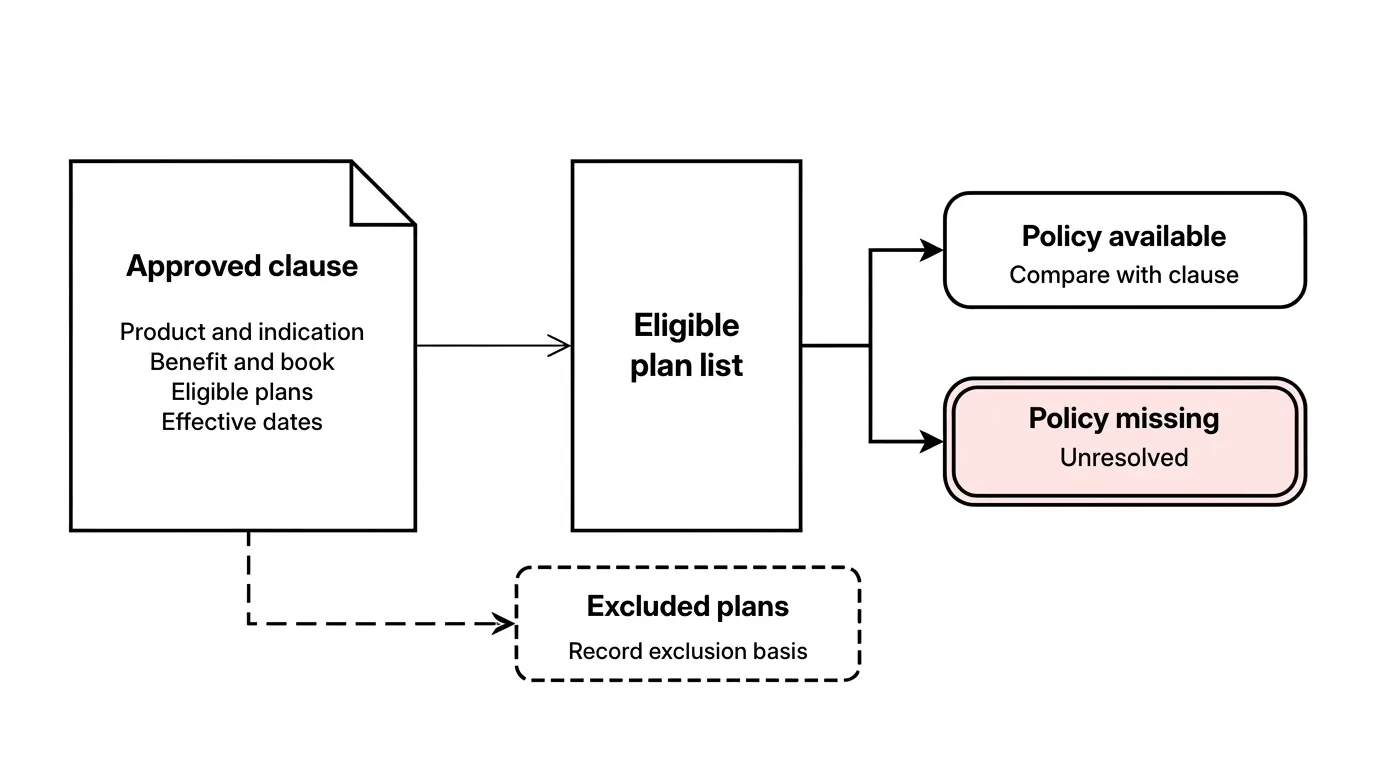
How to verify a contract clause across downstream plans
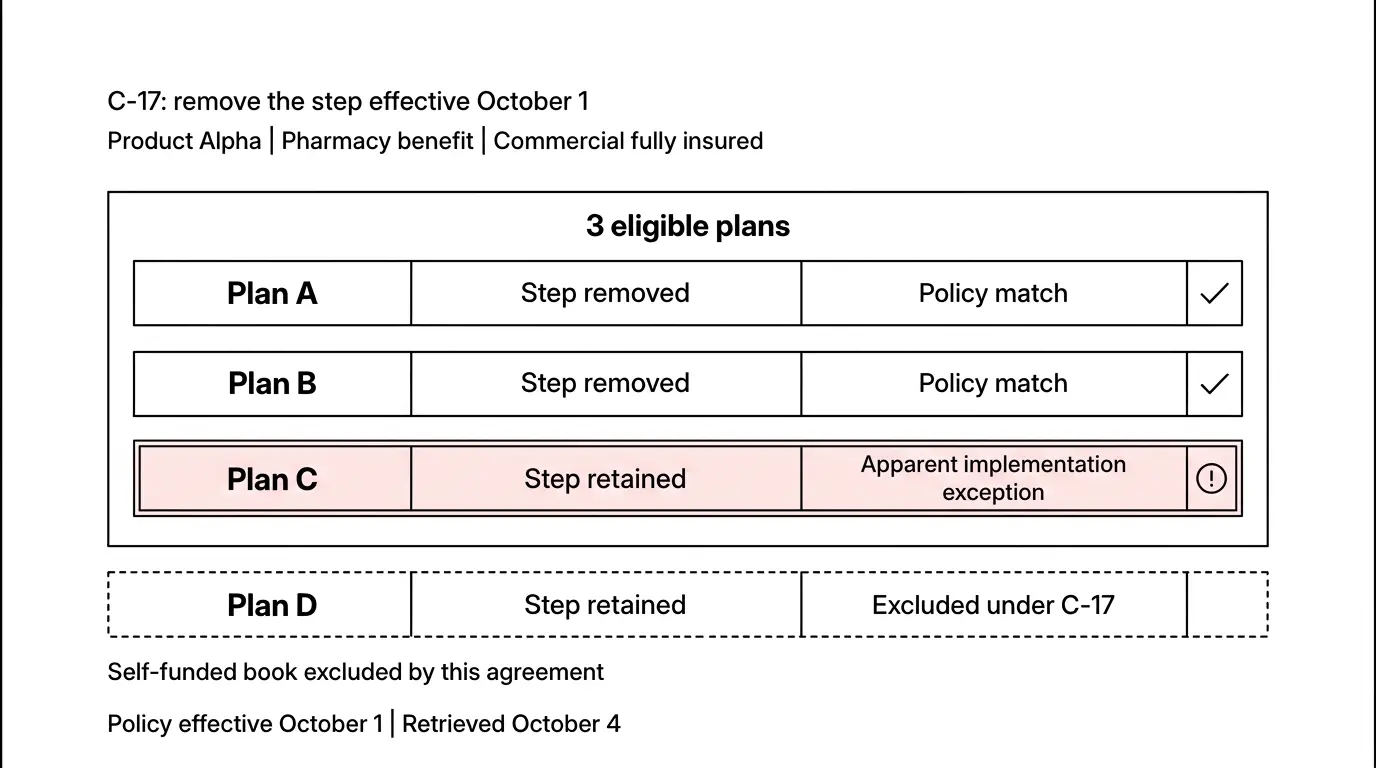
Consider an illustrative agreement for Product Alpha. Amendment C-17 requires removal of a named pharmacy step edit for Plans A, B, and C in a commercial fully insured book, effective October 1. Plan D's self-funded book is explicitly excluded. No transition period applies.
On October 4, the analyst reviews policies effective October 1. Plans A and B have removed the step. Plans C and D retain it. The result is two policy matches, one apparent implementation exception, and one excluded plan.
Plan C deserves investigation. Plan D's exclusion comes from C-17; self-funded status alone does not determine whether a book is covered by an agreement.
Reconcile the evidence before flagging an exception
A restriction is a potential gap only after the reviewer establishes that the obligation and policy apply to the same plan, book, benefit, indication, and period. Use these checks for every eligible review record:
Tellius's payer policy validation method covers the source comparison. If a licensed feed retains an older rule while the governing policy shows the step removed, that is a data correction to resolve. If the current governing policy still carries the step after the obligation starts, and the other checks pass, the account lead has a documented potential gap to raise.
In the C-17 example, the reconciliation is three eligible plans due for review = two policy matches + one potential gap + zero unresolved cases. Plan D is recorded separately with its exclusion basis. This example has one review record per plan. When a plan spans several books, benefits, or indications, reconcile at that finer level before summarizing plan counts; a partial match must not become a fully confirmed plan.
For an infused product, the negotiated change might instead remove a prior-therapy requirement from a medical policy. The reviewer follows that passage for the named indication across eligible medical plans. Pharmacy tier data answers a different question.
What a formulary or medical-policy deviation proves
A reviewed deviation identifies where the plan's implementation differs from the approved term. Its review state determines the next action.
A match confirms the documented policy for the period checked. An obligation governing claim adjudication also needs operational checks. For Plan C, step-related rejections after October 1 would strengthen the investigation, while successful claims could reflect exceptions or individual approvals.
Contracting and rebate operations determine whether a reviewed finding changes rebate eligibility under the agreement's measurement period, exceptions, and cure provisions. An exception queue is a starting point for that review, not an instruction to change an invoice.
What belongs in a Clause-to-Plan Implementation Ledger
The Clause-to-Plan Implementation Ledger connects each obligation to its reviewed plan records, source passages, owner, and resolution history. An account lead should be able to open an entry and reconstruct the finding without asking the analyst to rebuild it.
For Plan C, that entry looks like this:
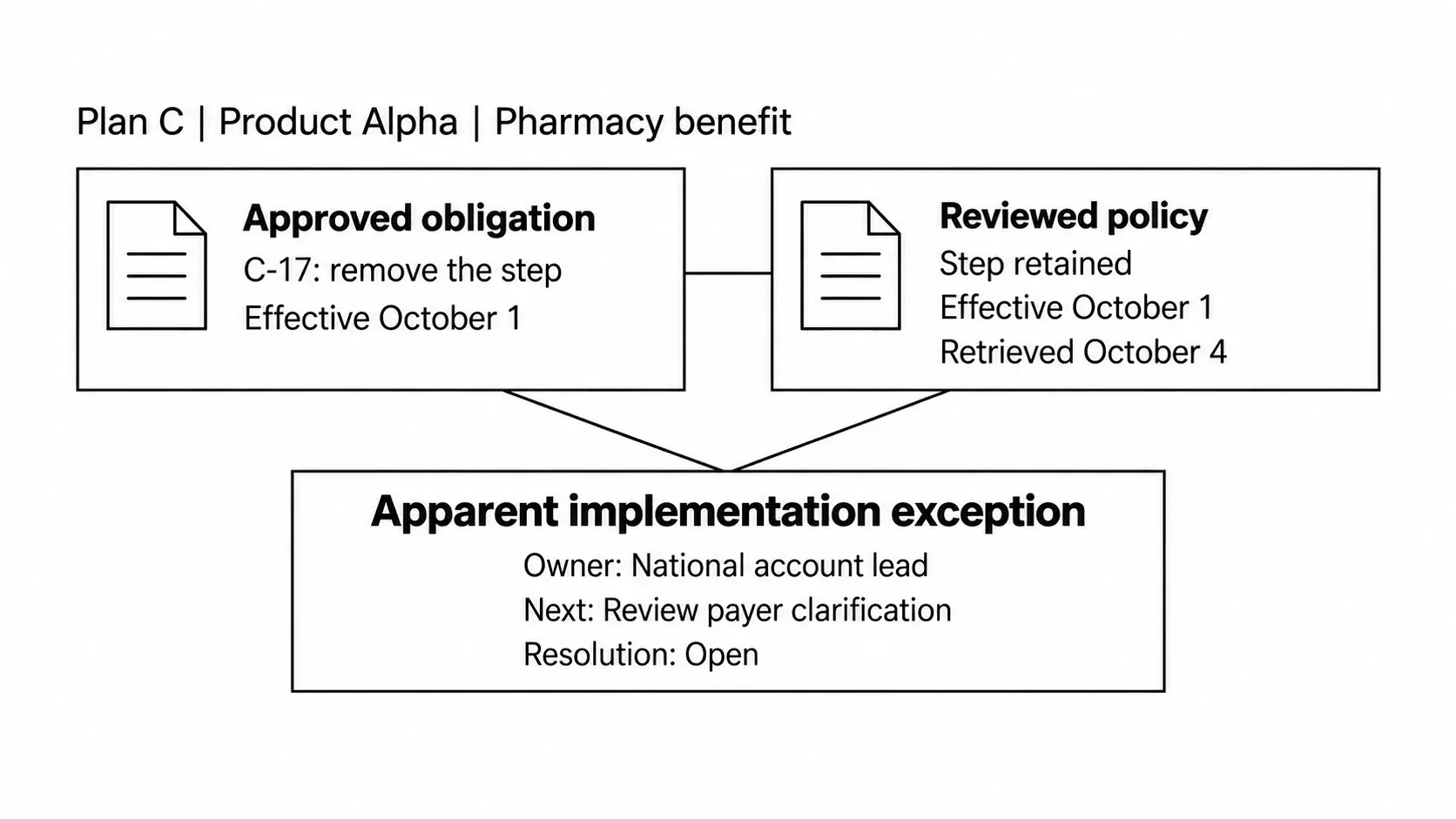
If the payer corrects Plan C on October 12, the ledger adds that event alongside the October 4 finding and the new policy's effective date. Overwriting the old row would erase the history needed to answer the next question: was the term implemented on time?
Review completeness and policy conformity need separate counts. In this example, all three eligible plans have usable policies, but only two match the term. A later run with a missing Plan C policy would report two matches and one unresolved case, rather than a complete two-plan review.
An open finding also needs a closure condition. A payer's reply that the product is preferred leaves the original step-edit question unanswered. The ledger should identify the replacement policy or other document that resolves the finding, who accepted it, and the period the resolution covers.
The separate payer contract analytics scorecard addresses incremental prescriptions and net economics. Even a fully implemented access term can miss the deal's economic case.
How a Tellius market access worker prepares the account brief
A Tellius market access worker checks the approved term against the eligible plans and current policy evidence, then prepares the account team's review brief. It brings together the governing clause, plan mappings, dated policy passages, findings, and owner questions so the account lead can review Plan C before the payer meeting.
This illustrative workflow is powered by Kaiya Missions. A manufacturer would configure and validate it against its own agreements, permitted sources, approved interpretations, and review rules. The example describes the work to configure; it is not evidence of a completed customer deployment.
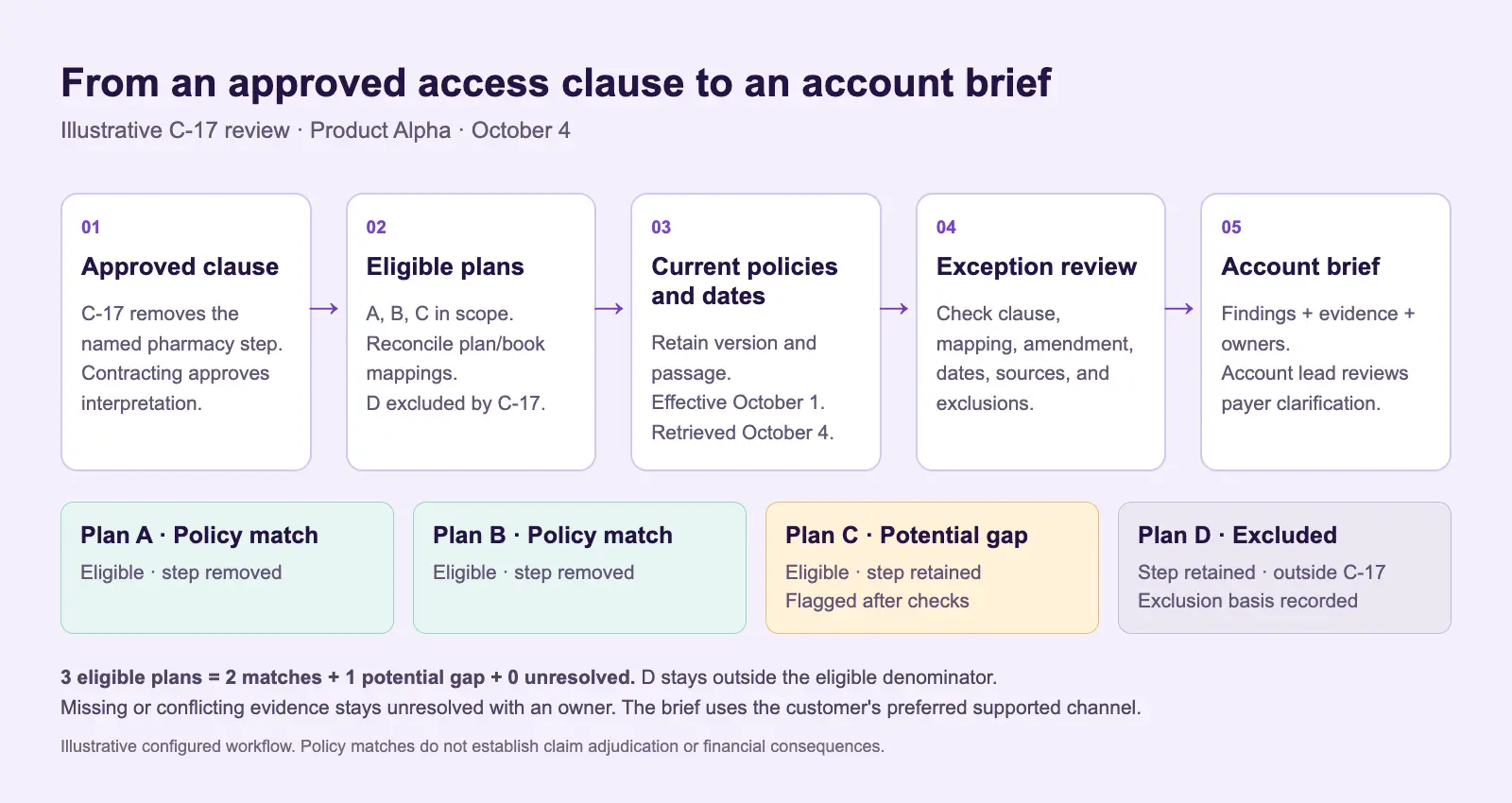
The recurring work spans sources that rarely share the same identifiers or dates. Contract passages carry the obligation, plan hierarchies carry the relationships, and payer documents carry the rule being tested. The configured worker applies the approved mapping and comparison rules as those records change, preserves missing-policy rows, and prepares the updated ledger and account brief. Delivery can use the customer's preferred supported channel; the review checks stay the same.
Approved mappings and corrections can be retained as business context for subsequent reviews, with the ledger preserving the dated resolution history. Changes in scope or policy still require a fresh comparison. People approve payer outreach and decide contract and financial consequences.
What decision a contracted access review supports
The account lead now has a request the payer can answer:
The response may identify a mapping error, an amendment, or a policy correction. Each closes a different question. An unresolved implementation issue stays open with an owner, while confirmed implementation followed by poor patient access moves to adjudication, fulfillment, or affordability analysis.
The next account review begins with the clause and the unresolved finding. It no longer depends on everyone agreeing what the parent-level access label was supposed to mean.
Questions about contracted access verification
What if an eligible plan has no current policy available?
The plan remains in the eligible denominator with an unresolved review. The owner requests the missing policy and records the gap. Removing the row would overstate review completeness.
Does a formulary discrepancy change rebate eligibility?
Only if it meets the agreement's financial conditions. Contracting and rebate operations review the period, exceptions, and cure provisions before changing payment treatment.
What should an account team bring to a payer?
The approved clause, eligibility mapping, dated policy passage, amendment history, and a specific clarification request. Claims findings, if included, need their own cohort and observation window.
Do patient rejections prove that contracted access was not implemented?
Rejections can strengthen an investigation when they match the negotiated restriction, but other causes remain possible. Reviewers need to connect the event to the clause and plan before drawing a compliance conclusion.
Review one clause against its eligible plans
Bring an access term, its eligible-plan schedule, and the policy documents to a working session. Work through the reconciliation checks and identify the matches, potential gaps, and unresolved cases that belong in an account review brief.
A pilot should compare preparation time, eligible-plan coverage, and false exceptions against the team's existing review of the same cases. A faster brief is useful only if it preserves the missing plans and exclusions that made the manual review difficult.
Get release updates delivered straight to your inbox.
No spam—we hate it as much as you do!


.webp)
Best Pharma Market Access Analytics Platforms in 2026

This blog compares the best pharma market access analytics platforms in 2026, evaluating how each solution helps teams navigate complex payer dynamics, pricing strategies, and access barriers. It highlights a key shift in the market: traditional BI tools struggle with fragmented, slow-moving data, while modern platforms combine real-time data integration, semantic understanding, and AI-driven automation. The guide outlines what to look for—such as multi-source data federation, explainable insights, and automated root cause analysis—and shows how leading solutions enable faster detection of payer changes, improved pull-through, and more proactive, data-driven market access decisions.

How AI Helps Market Access Teams Overcome Data & Analytics Struggles
Market access teams at pharmaceutical & life science organizations are critical to commercial success. Here's how AI-powered approaches can help.