

Best AP Recovery Audit and P2P Audit Software in 2026: 16 Spend Recovery Tools Compared

Spend recovery and P2P (procure-to-pay) audit tools—also referred to as accounts payable recovery audit or overpayment recovery tools—are software and services that compare what a company paid its suppliers versus what it should have paid in order to either stop the payment or recover money. These tools are useful for finding duplicate payments, overpayments, prices above contract, missed discounts, unclaimed credit notes, errors in payment terms and rebates never claimed.
Most of these tools also report the root cause of each discrepancy, so the record and process behind it can be fixed.
What is the difference between an AP recovery audit and a pre-payment audit?
An AP recovery audit looks back at paid history, often several years of it, and claws back overpayments from suppliers after the money has left. It is usually bought as a service from an outside firm that keeps a share of what it recovers.
A pre-payment, or prevention, audit runs its checks before the pay run, inside the ERP or P2P suite or beside it, so a bad payment never goes out. It is usually software sold on subscription, and most of it focuses on duplicates and supplier statements.
The line is blurring. Some software now scans past payments for the errors a recovery audit would find, and most recovery firms also sell prevention tools. Getting money back from suppliers still takes people, whether they work for you or for a firm.
Which AP recovery audit and P2P audit tool is best for your team?
It depends on which questions and actions your team currently struggles to perform in a timely manner. Determining this has gotten harder for two reasons.
First, audit firms, software vendors and consultancies are all coming at the problem from different directions. Recovery audit firms now sell software, AP suites have added their own duplicate checks, and AI startups pitch agents for the same work, so most vendor pages end up describing overlapping capabilities in nearly identical words, while general AI assistants such as Copilot and ChatGPT now read contracts well enough to tempt teams to skip a dedicated tool, even though they don't sit inside the payment run.
Second, the evidence is scattered. Contracts live in a CLM or shared drive, prices in the ERP, invoices in an AP tool, and rebate terms in someone's spreadsheet. A tool that sees one of those systems answers only part of the question. Often the record that needs fixing is internal, such as a contract master that wasn't updated or a PO still carrying an old price.
The table below compares recovery audit firms and AP control software on the checks that separate them: whether each one prices lines against the contract, catches errors before payment, names what went wrong and recovers rebates.
Why each capability matters:
- Checks the line against the contract term: compares each invoice line's price with the contract term in force on the invoice date. Without it, a PO carrying an old price passes every match.
- Checks before payment: runs its checks before the pay run, not after the money has left. Stopping a wrong payment costs far less than chasing a supplier for it months later.
- Clears false variances: applies units, currency and tolerance before calling something an error. Otherwise reviewers spend their time on differences that were never real.
- Names the record that was wrong: says whether the contract, the PO or the invoice needs fixing. Fixing the source is what stops the same error next quarter.
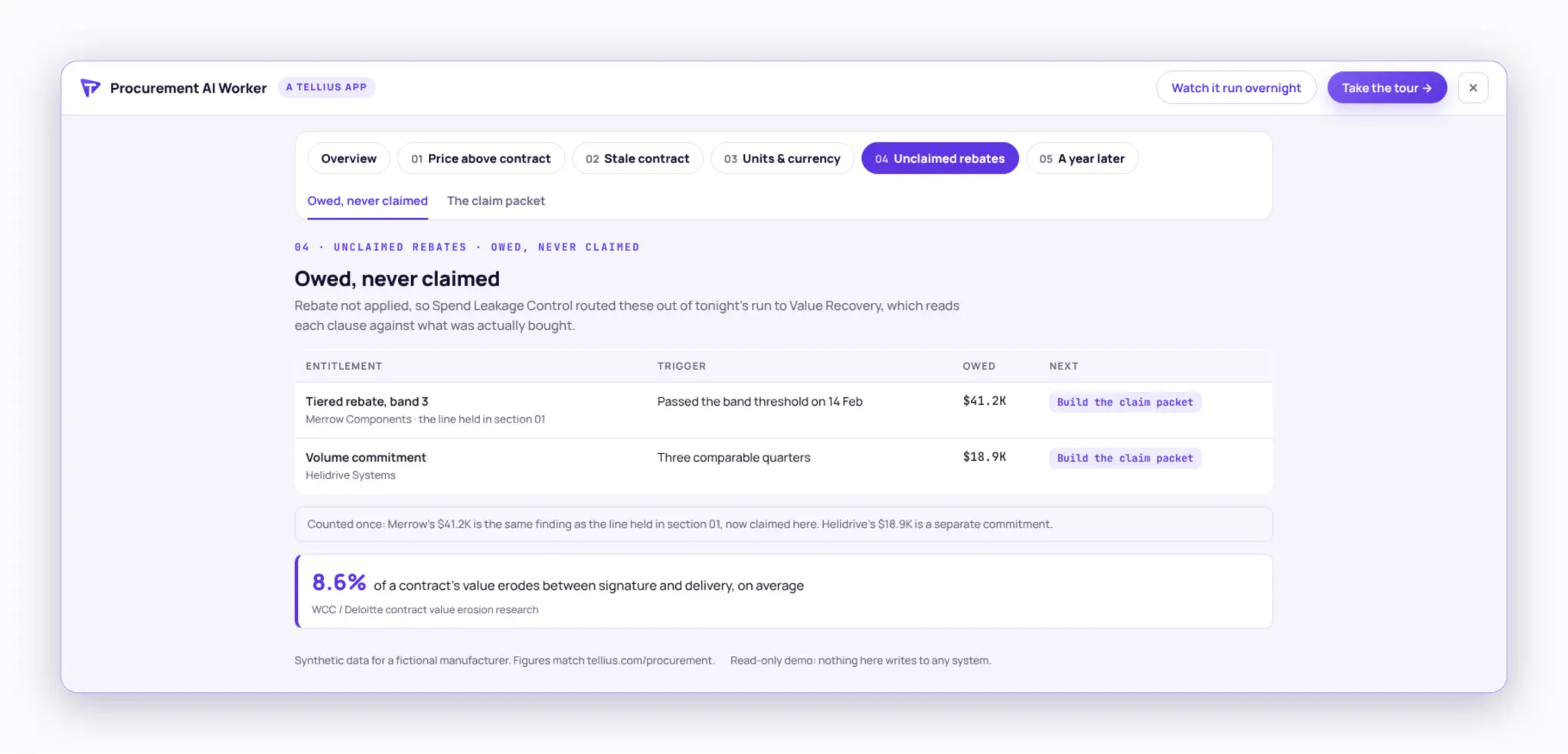
- Recovers rebates and entitlements: finds money owed under rebate, volume or price protection terms, and builds the claim. No invoice is wrong when a rebate goes unclaimed, so nothing else flags it.
- Prepares the fix or claim for approval: hands a person a ready fix or claim to approve. Findings that still need assembling tend to sit in a queue.
How we evaluated: Ratings reflect public product pages, filings and announcements reviewed in October 2026. No product was tested hands-on.
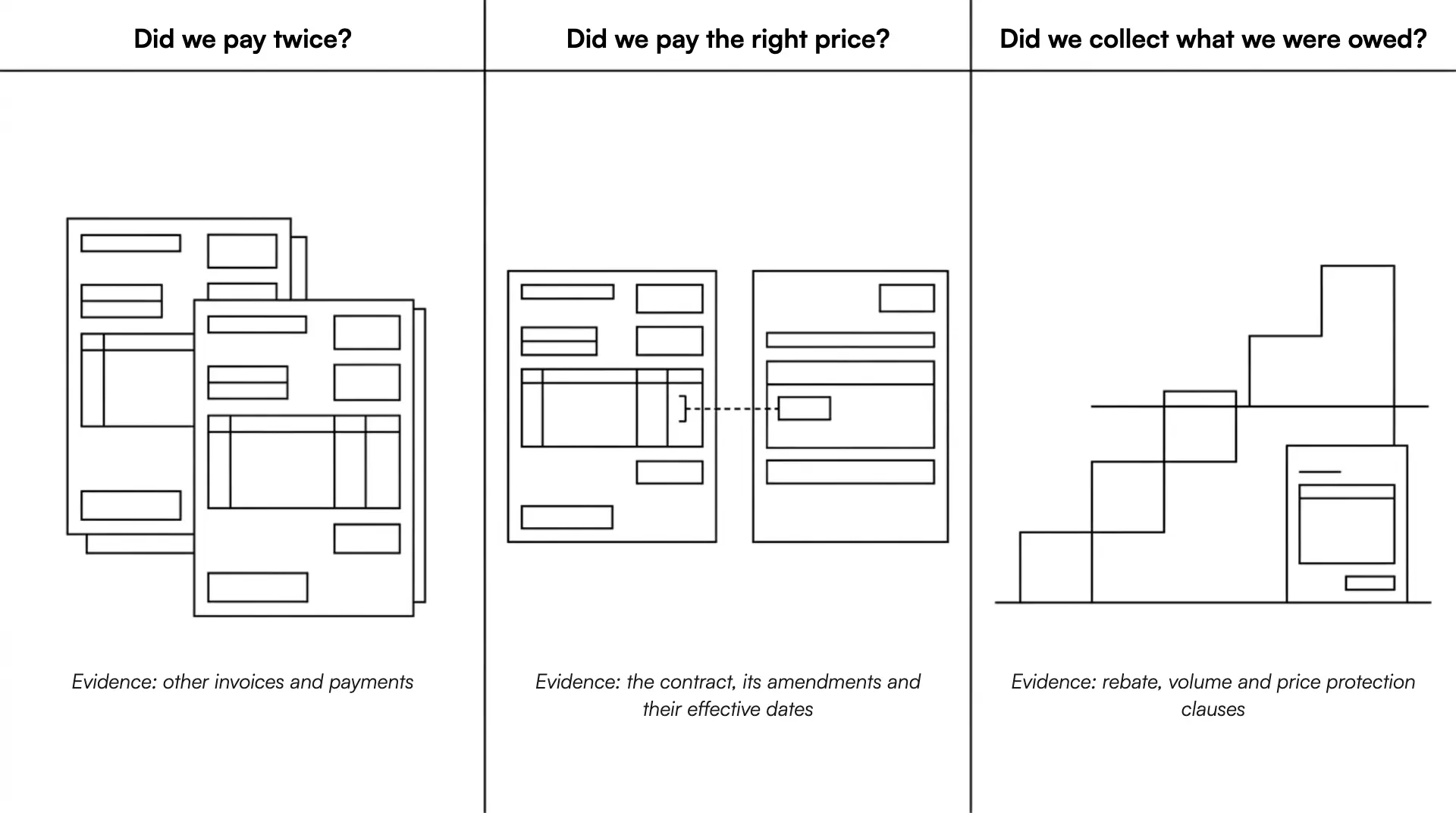
Most tools catch duplicate payments. Catching prices above contract and unclaimed rebates means reading the contract itself.
What does each AP recovery audit and spend recovery tool do?
1. Tellius
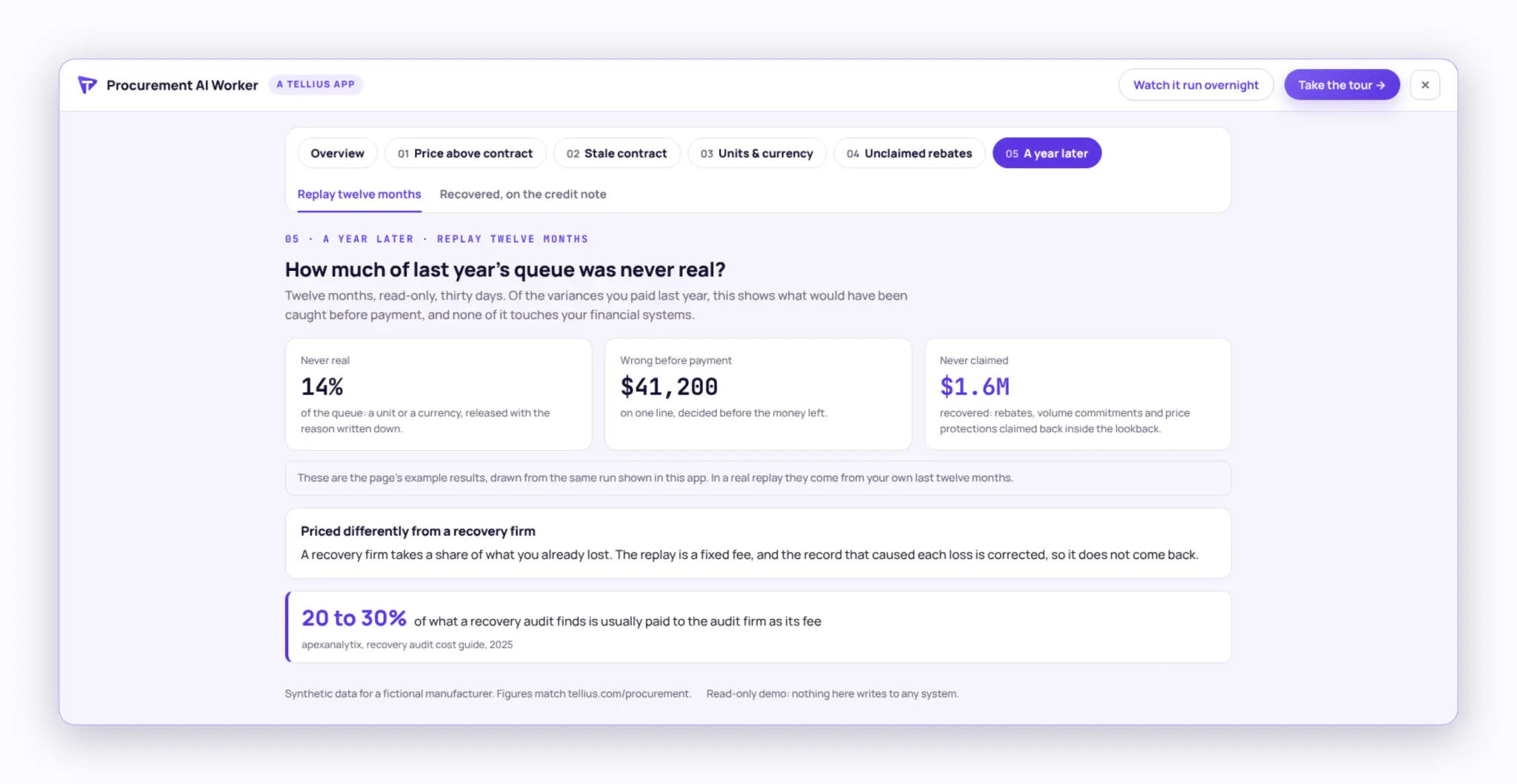
Tellius is an AI platform for procurement and finance teams. It checks each invoice line against its contract before payment, names the record behind each overcharge, and recovers rebates suppliers owe. Spend Leakage Control runs nightly before payment,s Value Recovery runs quarterly, and every fix or claim waits for a person to approve it.
- Contract term. Pulls the contract, amendments, price and material masters and the PO, and applies the term in force on the invoice date, including index-linked formulas.
- False variances. Converts units and currency as the contract specifies and releases differences under your materiality band, with the reason logged.
- The wrong record. Assigns each exception one of twelve causes, so the contract, the PO or the invoice gets fixed at the source.
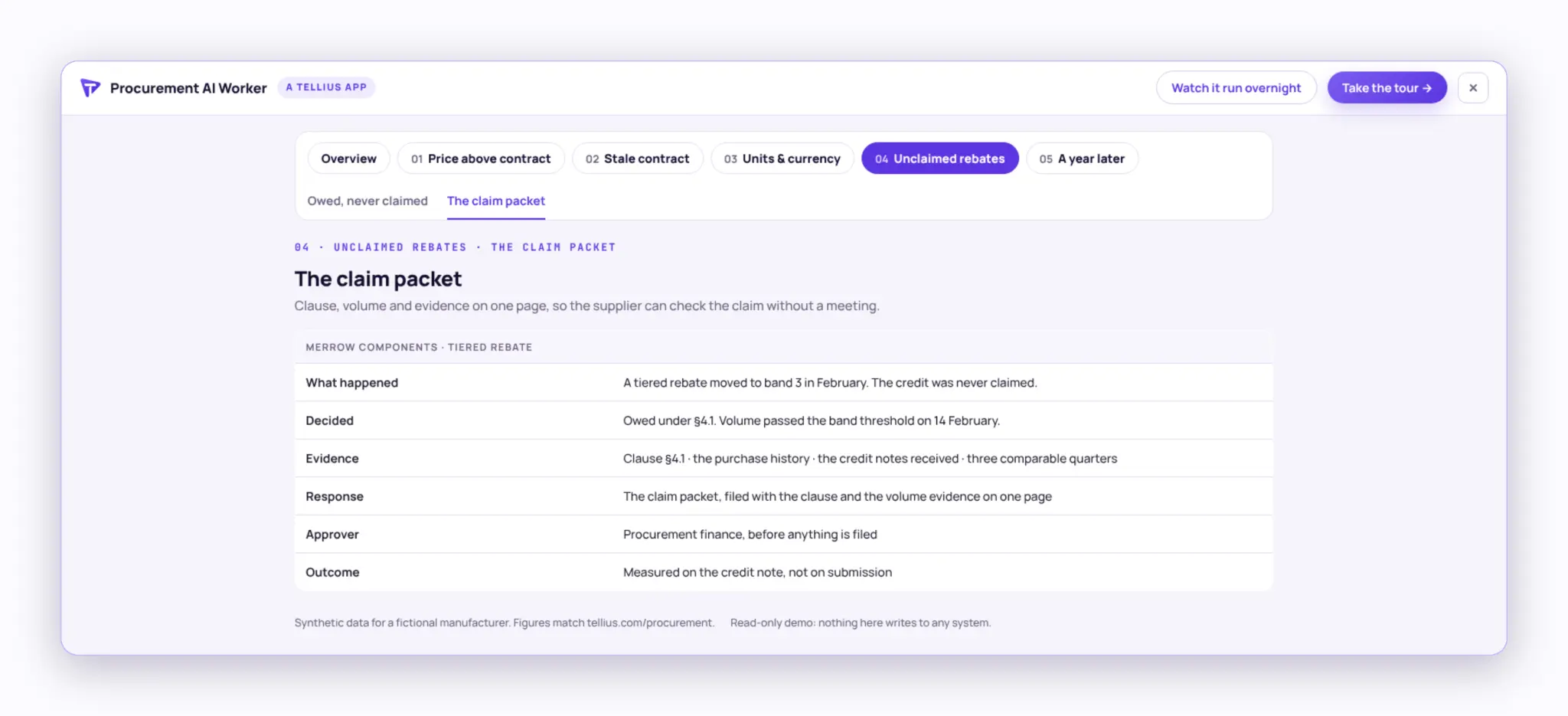
- Rebates and approval. Reads rebate, volume and price-protection clauses each quarter and builds a one-page claim. Buyers approve fixes up to $250,000, and the controller approves anything larger.
Tellius reads SAP, Oracle, Coupa, Ariba and Ivalua plus your contract system, runs in your Snowflake or Databricks or hosted, and sits beside your existing duplicate and statement controls. It has been named a Visionary in the Gartner Magic Quadrant for Analytics and BI Platforms for 5 consecutive years.
2. PRGX
PRGX audits paid history for duplicate payments, missed rebates and prices that broke the contract. It also sells overpayment-prevention software that screens invoices before payment. Ask how a price above contract is caught before payment, not months later. For how continuous checking compares with an annual audit, see our guide to the best AI procurement software in 2026.
Consider if your main need is an outside team to audit paid history and chase suppliers, and checking each line against its contract term before payment isn't in scope.
3. apexanalytix
apexanalytix pairs a contingency recovery audit with prevention software. Its firststrike product blocks duplicates and other overpayments before payment, and smartvm manages the vendor master. The audit itself covers statement credits, rebates and pricing errors. Ask how one invoice line is checked against its amendment before it is paid.
Consider if you want a post-payment audit with duplicate blocking up front, and the amendment and effective date behind each line can wait for the audit.
4. Strategic Audit Solutions
Strategic Audit Solutions runs a 100 percent contingency recovery audit, with rebates and pricing in scope. Teams that want predictable fees can buy its AuditSUITE360 software instead, relaunched in 2025 with modules such as DupeDEFENSE for duplicates and StatementSYNC for statements. Ask how prices are checked against the contract before payment.
Consider if you want a contingency audit with optional duplicate and statement software, and price errors can be found after payment.
5. CPRS (Pearl)
CPRS is a 100 percent contingency audit firm. Its Pearl platform supports pre-pay reviews, duplicate and statement credit recovery, and an explanation of each error. Ask whether rebates are in scope.
Consider if duplicates and statement credits are your main leak, and rebate claims aren't part of what you need recovered.
6. Genpact Post-Payment Audit
Genpact runs post-payment audit as a service, with contract audits, root-cause drill-down and claim tracking. Because it works after payment, ask what stops a wrong line before the payment run.
Consider if you want a managed audit of paid history, and stopping a price above contract before the pay run isn't a requirement.
7. Transparent
Transparent is a Dutch P2P recovery audit firm with global coverage that works on a "no recovery, no fee" basis. Its audits cover overpayments, overbillings, duplicates, missed discounts, unknown credits, rebates and VAT errors, and it sells duplicate-prevention software called Qlarity. Ask how a price above contract is checked when the PO agrees.
Consider if you need a contingency audit across several countries, and a contract price check before payment isn't part of the brief.
8. FlexTecs
FlexTecs is a technology-enabled recovery audit firm. It runs retail recovery audits, AP recovery audits and contract compliance reviews, and sells FlexTrap prevention software alongside them. Ask how the software checks a line against the contract term before payment.
Consider if you want an audit firm that also sells prevention software, and you don't need tiered rebates and volume discounts tracked each quarter.
9. Cotiviti
Cotiviti runs recovery audits, contract compliance reviews and SmartP2P Alerts for retail and enterprise clients, centered on retail supplier deductions and merchandise payment arrangements. Ask what it does for non-retail supplier contracts.
Consider if your leakage sits in retail supplier deductions and merchandise deals, and your other supplier contracts don't need a price check before payment.
10. SpendMend
SpendMend runs contingency recovery audits for healthcare systems and medical manufacturers, covering historical payments, contract compliance and supplier statements. Its Trulla software handles pharmacy procurement and is separate from the recovery work. Ask whether rebates and contract pricing are in scope, or only duplicates and statement credits.
Consider if you run a healthcare system and want a contingency audit, and your team already tracks supplier rebates.
11. FISCAL Technologies
FISCAL Technologies runs duplicate and risk checks before payment on its NXG Forensics platform, and reconciles supplier statements. It also recovers missing credits found when statements are reconciled. Ask how it would find a rebate the supplier never put on a statement.
Consider if duplicates, supplier risk and statements are your priority, and pricing each line against its contract before payment isn't part of the evaluation.
12. Basware
Basware builds controls into its P2P suite. Basware AP Protect (formerly Glantus) checks invoices for duplicates and errors before posting. Basware also lists Statement Matching and an AP Audit & Recovery service. Ask how a price is checked against the contract.
Consider if your invoices already run through Basware, and contracts held in other systems don't need checking line by line.
13. Xelix
Xelix screens the payment run for duplicates and errors. Its modules cover transactions, supplier statements, a supplier helpdesk and the vendor master, and it can scan up to two years of history for past duplicates. Xelix positions itself as a replacement for the historical recovery audit. Ask how a line priced above contract is caught when the PO agrees.
Consider if duplicates and statement gaps are your main risk, and unclaimed rebates are a smaller leak for you than duplicates.
14. Coupa SpendGuard
Coupa SpendGuard flags duplicate invoices, unusual invoice patterns, and mismatches between contracted rates and billed amounts, inside Coupa. Ask who decides which record was wrong after an alert.
Consider if your spend already runs through Coupa, and contract amendments and rebate terms held outside Coupa don't need checking.
15. Oversight
Oversight monitors payables for duplicates, policy breaches and invoice fraud, and reconciles supplier statements. It covers P2P, T&E and purchase cards, and SAP Concur sells it as Concur Detect by Oversight. Ask whether contract prices and rebates are in scope.
Consider if your main concern is policy breaches and fraud across payables, expenses and cards, and checking prices against the contract term isn't a requirement.
16. AppZen
AppZen uses AI agents for duplicate detection and PO matching. It also lists vendor statement reconciliation among its 2026 agent templates. Ask how a line is checked when the PO itself carries the wrong price.
Consider if you want AI agents to speed up AP matching, and you trust the PO to carry the contract price.
What should spend recovery and P2P audit software check?
Overpayments come from paying the same bill twice, paying more than the contract price, or never collecting what a supplier owes. Each takes different evidence to catch, which is why few tools cover all of them well. Payment fraud and bank-detail checks are a separate problem and aren't covered here.
Paying twice. Duplicates usually slip through with a slightly different invoice number or under a second vendor record. A 2026 City of Richmond audit found 50 of them. The ones the city had missed were small, and about a quarter had no purchase order.
Paying above contract. Catching this takes the contract, its amendments and the date each term took effect, which is why most tools skip it. Hot take: your three-way match checks the price against the wrong document. It confirms the invoice agrees with the PO, never that the PO agrees with the contract, so an old price on the PO passes. Our guide to why invoices get blocked in three-way matching covers the mechanics.
Unclaimed rebates. When a rebate tier is crossed or a volume discount is earned, no invoice is wrong, so nothing gets flagged. Procurement negotiates rebates and AP pays invoices, but collecting them is rarely anyone's job. Gartner Peer Insights' definition of AP recovery audit services counts missed discounts and unclaimed credit notes as losses alongside duplicates.
Why do duplicates get past your ERP's duplicate check?
Every ERP (the finance system that holds your ledger) has a duplicate check. It compares a new invoice with earlier ones on supplier, invoice number, date and amount. In many setups, a match is only a warning that a clerk can click past.
The check looks for an exact match. The duplicates that get through are rarely exact:
- One team keys an invoice as "INV-5521," and another keys the same invoice as "5521-OPS."
- One copy's number starts with "0123," and the other's starts with "123."
- Texas auditors found duplicates paid to one company under different vendor numbers. Their reason was ordinary: "Several vendors work with multiple agencies and are set up with more than one vendor number."
A good duplicate check is now table stakes. The harder leaks never look like a duplicate. A price above contract or a rebate nobody claimed passes every match, which is why the price and rebate checks matter more.
How does an AP recovery audit work, and what does it cost?
A recovery audit firm starts by taking copies of your supplier list, payments, invoices and contracts. It runs its own tests and sends you a list of claims. You approve the ones you agree with. The firm then asks each supplier for a credit or refund, and keeps a share of what comes back.
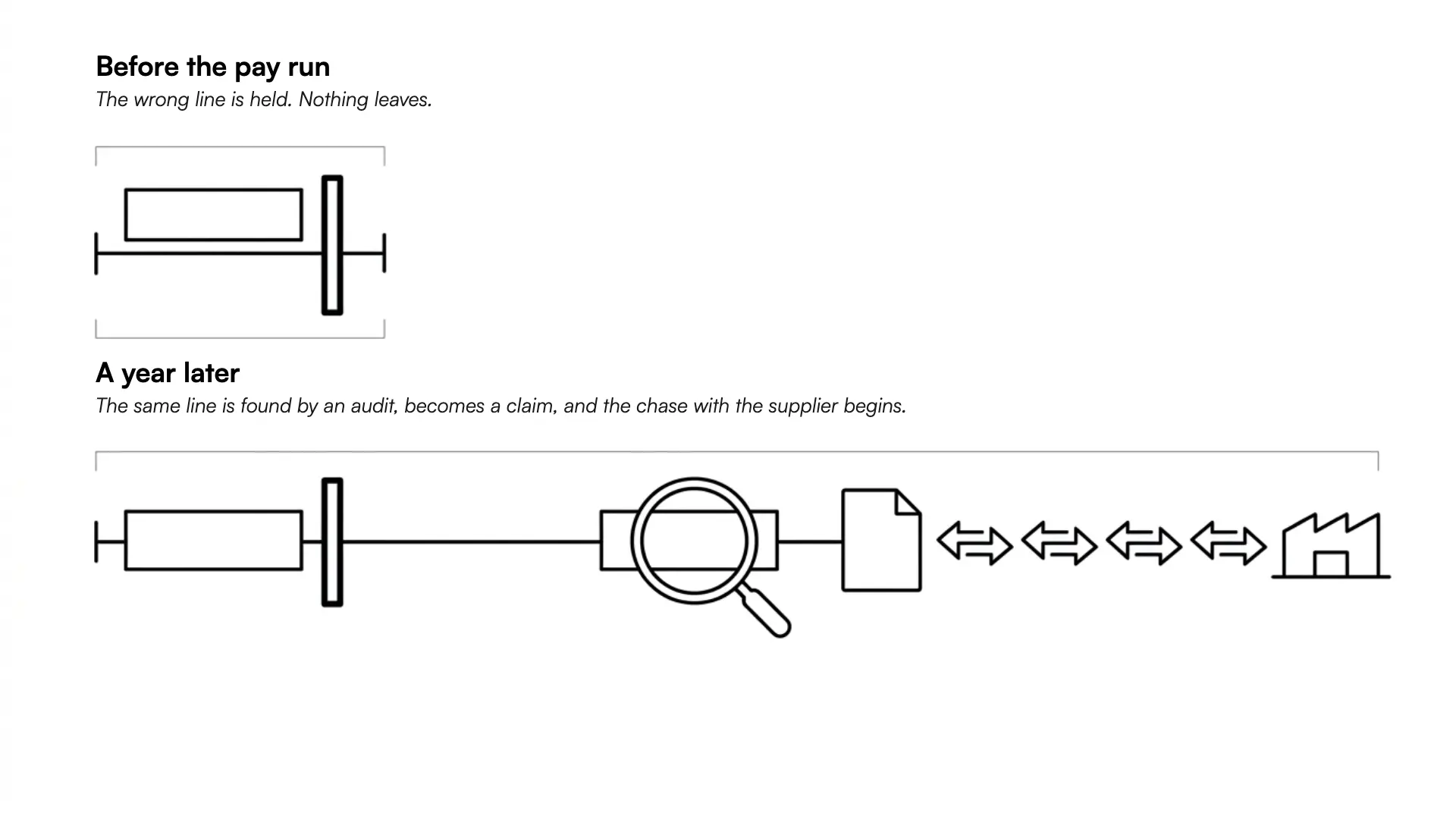
It is late by design. Texas's 2021 recovery audit covered four years of payments. By the time the report came out, the oldest of them were more than five years old. Each month of delay gives a supplier time to dispute, merge, close or stop answering.
Found is not the same as recovered. In the Texas engagement, only about a quarter of the valid claims had been collected by the time the contract ended. Ask any firm for its recovered-to-found ratio on a reference client.
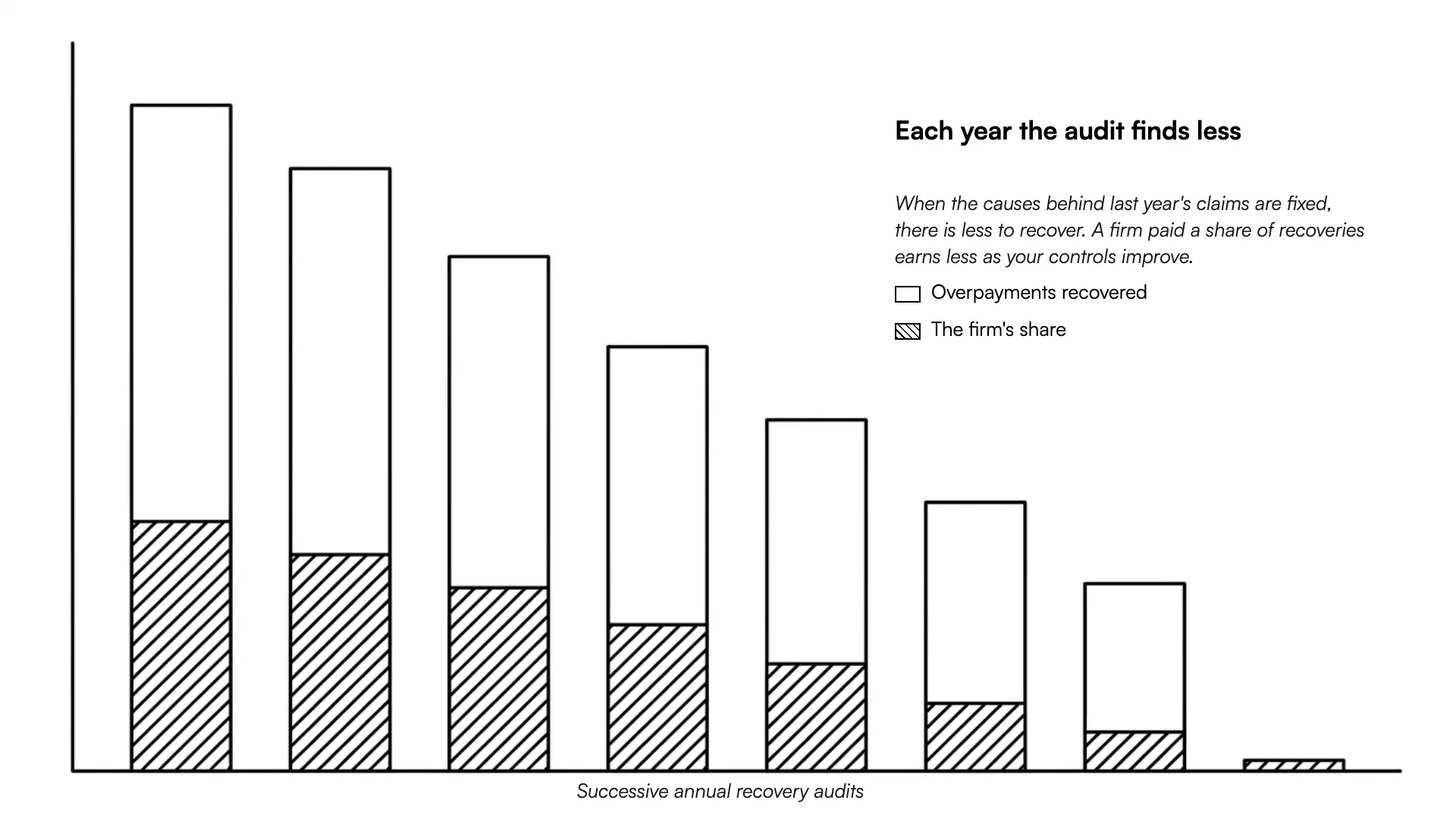
The fee rewards finding, not fixing. When a firm is paid on recoveries, its income depends on there being something to recover. When Texas agencies cut their error rate to about half of what auditors expect, the comptroller's 2023 letter passed on the firm's verdict that the work "was not profitable." Several firms now report root causes, but fixing them stays with your team.
Hot take: a recovery audit that finds the same kind of error every year is not a control. It is a fee on a leak you have agreed to keep. An audit should test whether your controls work. If this year's findings look like last year's, the causes were never fixed.
Fee models by firm
- PRGX: contingency, with a fixed-fee-plus-commission option.
- apexanalytix: contingency audit, plus prevention software sold on subscription.
- Transparent: contingency, with no fee unless money is recovered.
- Strategic Audit Solutions: contingency audit, or fixed-fee software.
- FlexTecs: contingency audit, plus prevention software.
- SC&H Group: recovery audit run by salaried auditors. Fee model not published.
- Tellius: priced by the supplier spend it manages. The twelve-month replay is a fixed price.
At $1 billion of supplier spend, those vendor figures mean $1 million to $3.5 million recovered and, at the 22.5 percent Texas paid, a fee of about $225,000 to $790,000.
Other recovery audit providers include GEP, which runs Cost Recovery & Invoice Auditing as a managed service within its procurement outsourcing. SC&H Group runs a recovery audit and AP audit practice for Fortune 500 companies, staffed by salaried auditors rather than commissioned ones.
AP recovery audit checklist for an internal P2P review
Your finance team can run most of these checks on its own ERP data before hiring anyone. Pull twelve to twenty-four months of paid invoices, the vendor master and the contracts behind your largest suppliers, and you will see where your controls leave gaps.
- [ ] Price each line against the contract term in force on the invoice date, not today's price file. Reviews that use the current file miss terms that have already changed.
- [ ] Test lines paid on either side of an amendment's effective date. An amendment loaded late can leave weeks of invoices at the old rate.
- [ ] Pull lines that matched only after someone edited the PO. The edit makes the three-way match pass without anyone opening the contract.
- [ ] Check rebate and volume thresholds against what was bought, and confirm a claim went out. No invoice is wrong, so nothing else flags a missed rebate.
- [ ] Match duplicates on normalized invoice numbers, not exact ones. ERP duplicate checks look for exact matches and miss a second copy keyed with a different prefix.
This checklist is what a recovery audit firm runs after payment, and its price and rebate checks are what Tellius runs before payment, beside the duplicate controls you already have.
Can Copilot, ChatGPT or Claude replace P2P audit software?
No, not for the payment run. A general assistant can explain a contract clause. It can draft the note that goes to a supplier. It cannot check every invoice line, every night, inside your ERP.
➔ They only see what you hand them. An export shows the price paid. It does not hold the amendment, the unit conversion or the FX clause.
➔ They can answer differently each time. A payment control must give the same answer to the same line every night.
➔ They don't remember last quarter. A rebate tier crossed months ago only shows up when purchase history is kept.
➔ They stop at the answer. There's no hold, no approver and no audit trail.
How should you test spend recovery and P2P audit vendors?
Test every vendor on a year you've already paid.
- Hand over twelve months of paid invoices and the contracts behind them. Pick the largest price variance. Ask which contract term governed it, and on what date.
- Load an amendment with a later effective date. Last month's line should not change.
- Give the tool a line billed by the case against a contract priced by the each. It should clear, with the reason written down.
- Ask which record was wrong: the contract, the PO or the invoice. Ask who approves the fix.
- Ask for the rebates that were owed and never claimed, with the clause attached.
- For an audit firm, ask for its recovered-to-found ratio on a reference client.
A tool that passes these tests gives your team findings it can act on without redoing the work.
Illustrative procurement demo: a recovery audit a year later, versus a quarterly check that corrects the record so the loss doesn't come back.
Tellius vs. Xelix for spend recovery
Xelix suits AP teams whose main risk is duplicates and statement gaps. Tellius answers a different question: was each line paid at the contract price, and were the rebates collected?
Xelix stays the duplicate and statement control. Tellius reads the contract behind each line and runs beside it.
Tellius vs. PRGX for spend recovery
PRGX suits teams that want a third party to review paid history and chase suppliers. Tellius moves the price check to before payment and reviews rebates every quarter, inside your own approval flow.
PRGX stays the outside audit. Tellius catches price errors before payment and claims rebates every quarter, so there is less left for the audit to find.
Tellius vs. Basware for spend recovery
Basware suits teams moving their invoice processing onto one suite. Tellius sits on top of whichever ERP and P2P systems you already run.
Basware stays the system that processes invoices. Tellius checks each line against its contract, whichever system holds it.
Spend recovery terms used in this guide
Do AI agents replace the AP team in a recovery audit?
Tellius prepares each fix and claim with its evidence, and a buyer or controller approves it depending on the amount, so the AP team decides instead of assembling each claim by hand. Recovery audit firms that use AI still review claims with you before they contact suppliers.
Disclosure: This comparison was researched and published by Tellius, and Tellius is one of the sixteen platforms in it. Ratings reflect public pages, filings and announcements reviewed in October 2026, including Tellius's own. No product was tested hands-on. "Not verified" means we found no public evidence, not that a product lacks the capability. If you represent a platform here and think we got something wrong, tell us and we will review it. Tellius app screens show sample data
Get release updates delivered straight to your inbox.
No spam—we hate it as much as you do!


Tellius is the best fit when losses come from prices above contract and rebates nobody claimed. It checks each line against its contract before payment and prepares each fix for approval. Recovery audit firms such as PRGX suit teams that want an outside review of paid history. AP control tools such as Xelix suit teams focused on duplicates.
Tellius checks each invoice line against the contract term in force on the invoice date, before payment. Several recovery audit firms test contract prices after payment. Most AP control software compares the invoice with the PO only.
Tellius's Value Recovery reads rebate and volume clauses every quarter and prepares a claim when a threshold was met. Recovery audit firms often include rebates in their audits. Most AP control software does not look at rebates, because no invoice is wrong when one goes unclaimed.
Tellius assigns each exception to one of twelve causes, in three groups, and prepares the fix for approval. Recovery audit firms and several AP tools report root causes with their findings. For the other tools, the material we reviewed doesn't describe a prepared fix to the record itself.
Not always. Tellius catches price errors before payment and claims rebates every quarter, so less is left for a firm to find. An outside audit can still test whether your controls work. Each claim arrives ready, with the clause and evidence attached, for your team to approve and send.
Tellius shows the contract term, the conversions and the record it says was wrong for every flagged line. With any tool, open the line to its contract term, check the date, units and currency, then rerun the check.
Tellius writes nothing back until a person approves it. Recovery audit firms usually review claims with you before contacting suppliers. Ask each vendor, in writing, what moves without a human.
Tellius gives each held line one owner. A stale contract master goes to your buyer. A supplier overcharge goes to the supplier as a debit note, once approved. A PO changed without approval goes to the buyer's manager, and spend with no contract goes to sourcing. When the evidence is not enough, a person rules.
Tellius is priced by the supplier spend it manages, not per line, seat or recovery. The twelve-month replay is a fixed price. A contingency audit takes a share of what it recovers, so its fee grows with the losses it finds.
Tellius offers a read-only replay of your last twelve months, at a fixed price, in thirty days. It shows how many variances were never real, what was paid wrong, and what was owed.
Tellius sits on the pre-payment side for price and rebate leakage, checking each line against its contract before payment and reviewing rebates every quarter. An AP recovery audit reviews payments already made, usually by an outside firm paid a share of what it recovers. A pre-payment audit runs checks before the pay run, usually as subscription software focused on duplicates and supplier statements.
A contingency firm keeps a share of each recovery, typically 10 to 40 percent across the industry, and the Texas comptroller paid 22.5 percent. You approve each claim before the firm contacts the supplier, and the firm is paid on what comes back. Before you sign, ask whether the fee also applies to credits the supplier takes against future invoices, and to errors your own team would have caught.
In the evidence we reviewed, neither PRGX nor apexanalytix checks each invoice line against its contract term before payment, which is the check Tellius runs. Both are post-payment contingency audit firms that also sell prevention software. The differences between them come down to audit scope and geographic coverage, so ask each for its recovered-to-found ratio on a reference client in your industry and region.
PRGX, apexanalytix, Transparent, Strategic Audit Solutions, FlexTecs and SpendMend all offer contingency recovery audits. PRGX also offers a fixed fee plus commission, and Strategic Audit Solutions sells fixed-fee software. Neither SC&H Group, which uses salaried auditors, nor GEP, which runs cost recovery as a managed service, publishes its fee model. Tellius is priced by the supplier spend it manages, with a fixed-price twelve-month replay.
Tellius and other pre-payment tools shrink what an annual audit can find, and whether they replace it depends on which losses the software covers. Xelix positions its software as a replacement for the historical recovery audit and is built mainly around duplicates and statements, so prices above contract and unclaimed rebates still need a check that reads the contract.
Tellius sits beside your ERP and P2P systems, reading SAP, Oracle, Coupa, Ariba and Ivalua plus your contract system. Coupa SpendGuard works inside Coupa, Basware AP Protect inside the Basware suite, and Concur Detect by Oversight through SAP Concur. Xelix, FISCAL Technologies and AppZen are separate products that connect to the ERP, and recovery audit firms work from extracts of paid history.
Tellius runs the price and rebate checks before payment, and a finance team can run the rest on its own ERP data. Start with the checks routine reviews miss: pricing against the contract term in force on the invoice date, lines on either side of an amendment's effective date, lines that passed only after a PO edit, rebate thresholds crossed with no claim, and duplicates matched on normalized invoice numbers.
Tellius works across industries, so for a sector-specific recovery audit look at SpendMend for healthcare systems and medical manufacturers, and at Cotiviti and FlexTecs for retail. Cotiviti centers on retail supplier deductions and merchandise payment arrangements. Ask each whether rebates and contract pricing are in scope, or only duplicates, statements and deductions.
Tellius uses AI to read contracts, amendments and rebate clauses, so the price and rebate checks a recovery audit runs a year later can run against each invoice line before payment. AppZen's agents and Xelix's screening apply AI to duplicate detection and PO matching. A person still approves each fix or claim, with the evidence attached.
Tellius was built around four checks to ask any vendor to show: the contract term behind each line, false variances cleared with the reason logged, the record that was wrong, and rebates claimed with the clause attached. Run them on twelve months you've already paid. For an audit firm, also ask for its recovered-to-found ratio on a reference client.

The Ultimate Guide to Supply Chain Analytics & Procurement Analysis

Learn how AI and augmented analytics are revolutionizing every part of supply chain management—from planning, to sourcing, to manufacturing, to logistics.