

Why Invoices Get Blocked in Three-Way Matching, and How to Resolve Them
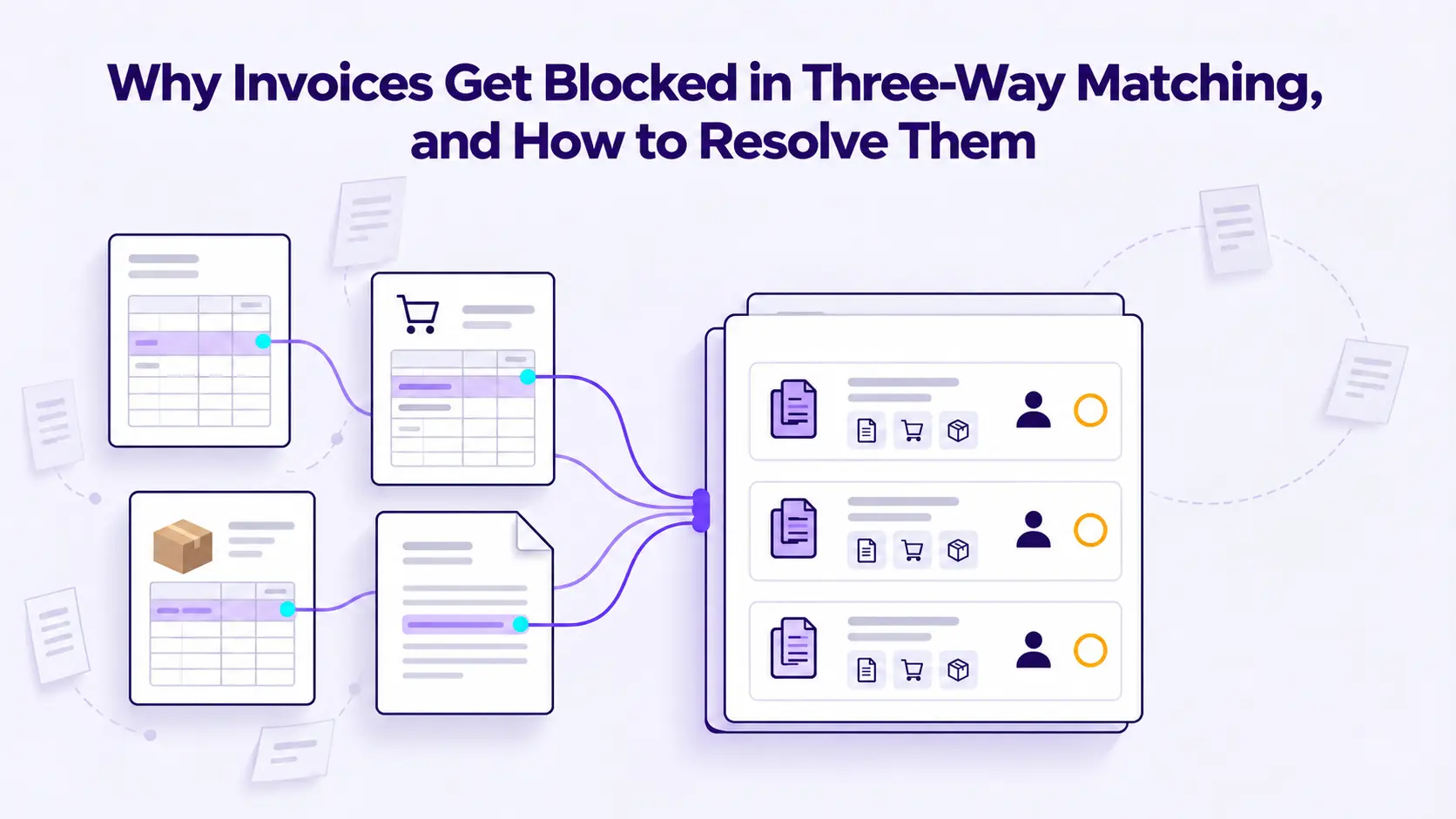

A three-way match (3-way match) compares an invoice with its purchase order and goods receipt before payment. An invoice becomes an exception when a required record is missing or price or quantity falls outside the configured tolerance. To resolve the queue, link the records at invoice-line level, identify each cause and its owner, then check the governing contract separately. An invoice and its PO can agree even when the PO price is above contract.
In SAP invoice verification, a line exceeding an upper tolerance can block the entire invoice for payment. A contract discrepancy is different: a standard three-way match does not independently establish whether the price loaded on the PO was correct.
Your AP team can spend close week chasing invoices whose records are scattered across systems. Some lack evidence; others have linked records that disagree. Above-contract PO prices can sit outside the queue entirely.
The linkage tax is the effort of assembling that evidence: chasing paperwork, reconciling payment forecasts and answering supplier calls.
Ardent Partners' 20th annual State of ePayables 2025 reports an average invoice exception rate of 18.4%. That is a benchmark for invoices requiring intervention, not the share with a price error or the size of a blocked-payment queue.
Consider an illustrative close week at a consumer goods company. AP reports 5,214 blocked invoices. At 08:47 the CFO asks how much invoice value is on hold and whether the company is paying above contract. The P2P controls lead needs invoices and receipts from the ERP, purchase orders from purchasing systems, and rates from the contract repository. Counting the queue and validating its commercial terms require different evidence.
Why the queue grows faster than anyone can work it
Three-way matching protects against paying for goods that were not ordered or received. Resolving an exception requires the desk that can establish the missing fact.
A missing receipt sends AP chasing the person who took delivery. An open GR/IR item can help locate the reconciliation problem, but it does not establish delivery or approve payment. Ardent's 2025 report puts supplier inquiries at 21.9% of AP staff time. That measures inquiries across AP, not time spent resolving this illustrative queue.
Compare new blocks with resolved blocks per payment cycle. More processors can clear today's backlog while the source creates tomorrow's.
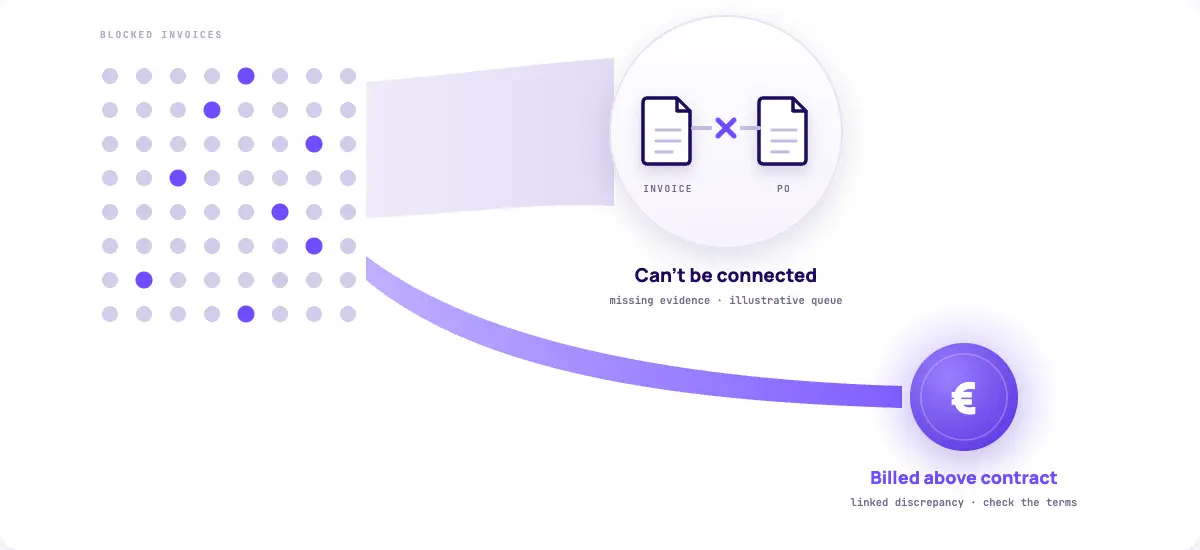
Illustrative queue composition. Missing evidence and a confirmed commercial discrepancy require different owners.
What the linkage tax actually costs
Held value is the invoice value on blocked records. It is not available cash or validated savings, and disputed amounts may need separate accounting treatment. Releasing an invoice generally creates a payment outflow.
Allow an assumed 20 minutes per invoice to find the PO, check the receipt and reach the owner. For this illustrative cohort of 5,214 invoices, that is 1,738 staff hours per cycle, about eleven 160-hour staff months. The 20 minutes is an assumption, not an industry benchmark.
Report held value per currency. This illustrative queue carries €38.4M, HUF 291.7M, PLN 11.2M and £7.6M. If treasury needs a consolidated figure, retain the FX rate, date and source alongside it.
The cost also shows up in the work that waits:
- Correction delays. A contract discrepancy waits behind invoices whose records have not been linked, while evidence ages and supplier discussions become harder.
- Discount windows. In this illustrative queue, 3,641 of 5,214 invoices, 69.8%, are more than 30 days overdue. Age alone does not prove a lost discount; check each invoice's terms.
- Forecast uncertainty. Finance must distinguish payable amounts, disputed amounts and expected credits under its accounting policy.
- Missing ownership. In this illustrative queue, 4,625 of 5,214 invoices, 88.7% by count, have no resolved PO or contract owner in the assembled data. That can reflect a source gap or wrong identifier as well as buying outside approved channels.
When the invoice matches the PO but the PO is wrong
A 14-line invoice for €212,540 is 33 days overdue in the illustrative scenario. Every invoice line agrees with its PO rate. Six lines use €121.40 per unit against a governing contract rate of €117.60. Another line bills 168 units against 165 received.
The three-way match passes the invoice-to-PO price check, while the quantity difference can still block the invoice; the above-contract price appears only in the separate PO-to-contract check.
The price difference is €3.80 per unit, or approximately 3.2% above €117.60. Assume, for this worked calculation, that the six affected lines total 1,000 comparable units. Their price exposure is €3,800. The three-unit receipt discrepancy is a separate quantity issue, with its own evidence and disposition. Do not add it to price exposure without checking the line and removing any overlap.
Sample resolution brief
Tellius provides AI workers for spend validation and investigation. The proposed output below uses the Spend Leakage Control naming on Tellius for procurement. It is an illustrative brief, not a product screenshot or a demonstrated customer deployment. Source mappings, contract rules, draft generation and owner assignments require configuration and validation.
The supplier billed the PO rate. That does not establish who is responsible for the contract discrepancy or whether a short-pay is permitted. Procurement must verify the terms before AP changes the payment.
Unit conventions can create a false variance. Cases and individual units must be converted before comparing rates. SAP distinguishes order price quantity variance, which involves the relationship between order-price and order units. A document mismatch is a reason to inspect those conventions, not proof of that particular SAP variance type.
The spend intelligence guide covers validation after workflow controls have run. This post focuses on the blocked-invoice resolution brief.
The data has to join before the queue can be judged
Answering the 08:47 question requires compatible line-level records.
Use stable supplier and line identifiers, approved mappings, comparable currencies and price units. Contract, direct-PO and indirect-PO resolution paths depend on the source systems and governing terms.
Preserve every line reason under the primary routing owner. Missing agreements, conversions or extracts leave the commercial finding unresolved.
Walkthrough: resolving a blocked-invoice queue in one close week
This text walkthrough uses synthetic data and describes a proposed configured workflow.
At 08:47, the controls lead freezes the payment-run cohort and records each source cutoff. The initial inventory contains 5,214 blocked invoices, with held value reconciled separately in EUR, HUF, PLN and GBP.
Invoice lines are linked to PO and receipt lines. Contract records are resolved separately using the applicable dates and pricing rules. The team assigns one primary routing cause per invoice and retains additional line reasons. Roughly 61% of this illustrative cohort has a missing PO or contract link; that describes the assembled evidence, not proven maverick spend.
The worked invoice passes its price comparison with the PO. Receiving investigates 168 billed versus 165 received. Procurement checks six above-contract lines, with €3,800 of illustrative price exposure under the stated 1,000-unit assumption.
The brief shows held value, findings, unresolved requests and owners. Correction drafts require review; nothing has been recovered.
How to resolve blocked invoices: five checks
Reconcile cohort → Link records → Classify causes → Check lines against contract → Route or draft corrections.
1. Reconcile the cohort
Freeze the payment run, source cutoff and invoice population. Deduplicate invoice identifiers at the agreed grain. The count and held value must reconcile with the AP export in each currency.
Reconciliation establishes coverage, not causal certainty. Every invoice remains visible, including invoices whose cause is unresolved. Keep an initial routing guess separate from a confirmed cause.
2. Link records at invoice-line level
Match invoice lines to PO and receipt lines across the systems involved. Normalize supplier identifiers, price units and currency before comparing quantities or rates.
Resolve the governing contract separately. Record the version, effective date and pricing basis that apply to each line. Missing or conflicting evidence stays open with a named evidence request.
3. Classify causes and assign the next owner
Assign one primary cause for routing while keeping each line-level reason attached.
In this illustrative cohort, about 61% has a missing PO or contract link. It is a queue-specific evidence gap, not a universal share of invoice exceptions or proof of a price problem.
4. Check lines against the governing contract
Compare the normalized rate with the governing term. Account for amendments, effective dates, volume tiers, freight and permitted index changes. A difference against a stale contract master can mean the master needs correction rather than the supplier.
Configured tolerances decide which invoice-to-PO discrepancies trigger a hold. A 3.2% invoice-to-PO variance exceeds a 3% limit, subject to the system's configured comparison and rounding rules. But the worked example has zero invoice-to-PO price variance: both use €121.40. Its gap is between the PO and contract.
Review tolerance design by supplier and category where the system supports it. SAP's cited invoice-verification tolerances are configured by company code; do not assume every ERP offers identical granularity. Extend the contract check to released invoices too, because a clean three-way match does not validate the PO's contract rate.
Before calling a finding recoverable, verify the governing terms and exclude unit, currency and extract artifacts. Detected exposure, an approved correction and collected value are different financial states.
5. Route evidence requests or draft corrections
Assign missing-evidence requests to the owner who can establish the next fact. Track age and response.
For supported variance, prepare the line comparison and proposed disposition. That might be a PO correction, supplier credit request or short-pay proposal if the contract and policy allow it. Procurement and finance approve the commercial treatment; AP holds or releases payment through its existing system.
Retain the source snapshot, rule version and approval record. A recurring view must show when its inputs refreshed and preserve historical cohorts. A new refresh does not silently rewrite last week's brief.
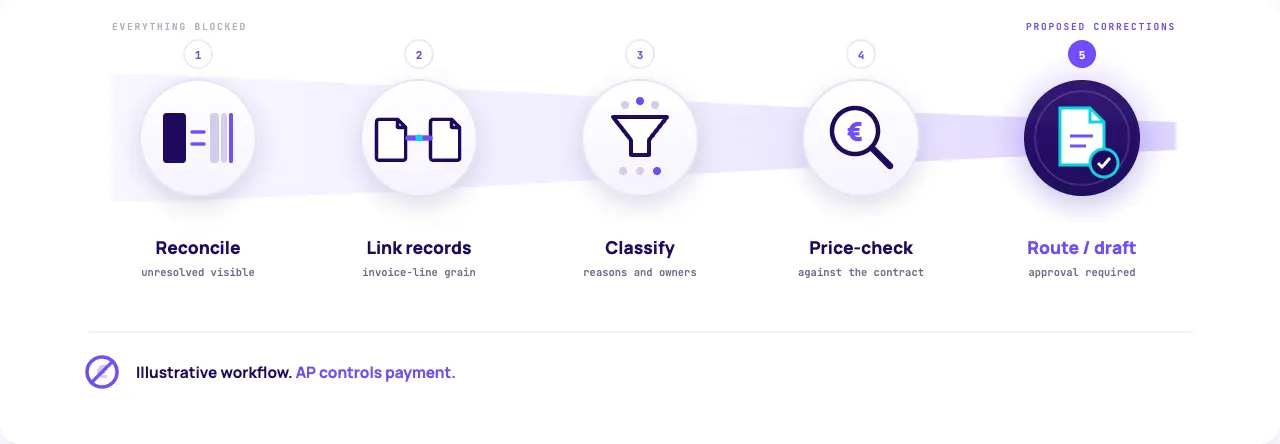
Reconcile and link before confirming causes. Unresolved evidence remains visible; corrections require approval.
Run this on one payment run
Export a blocked cohort with invoice identifiers, block reasons, PO references, receipt status, amounts and currencies. Assign a provisional routing cause and name the desk that can supply the next fact.
This is provisional triage from an export. Confirm causes after linking the supporting records.
Compute the linkage share by count and value per currency, the share of next evidence requests assigned outside finance, and the unresolved count. The output is a routing list. It is not authorization to pay, dispute or book savings.
Four accounts payable metrics that show whether the queue is improving
A shrinking queue can reflect better buying discipline or looser tolerances. Read these measures together.
Count a financial correction when the payable amount is reduced or the credit is recorded. A PO master fix alone is a source correction, not collected savings. Keep like currencies and cohorts together, exclude overlapping findings, and report undefined ratios when the denominator is zero. The manufacturing variance analysis article develops the broader denominator problem.
Where Tellius fits
Tellius is an AI analytics platform that gives procurement and finance teams AI workers for spend validation and investigation. Its procurement page calls the before-payment work Spend Leakage Control and the entitlement and recovery work Value Recovery.
For this proposed deployment, the worker would produce the resolution brief: held value per currency, linked evidence, contract comparisons, unresolved requests, owners and correction drafts. The ERP and AP system retain the buy-and-pay workflow.
The platform supports governed data preparation, analysis through Kaiya, and recurring work through Kaiya Missions. Prepare purchasing extracts, contract documents and pricing rules through supported sources. This does not imply native connectors to every purchasing system.
Configure and validate the line mappings, governing-term logic, draft templates, routing rules and source refresh for the deployment. Show the exact records behind each finding and test missing evidence before scheduling recurring delivery. An interactive App can expose the configured results, with source timestamps visible.
People approve the proposed corrections. The illustrative workflow does not establish automatic payment release, ERP writeback or a prebuilt procurement implementation.
Get release updates delivered straight to your inbox.
No spam—we hate it as much as you do!


Ardent's State of ePayables 2025 reports 11.1% for best-in-class teams and 20.9% for all others. Best-in-class means the top 20% on processing cost and cycle time. Compare definitions, invoice mix and controls before setting a target; a lower rate achieved by relaxing tolerances can hide exposure.
AI can help extract records, propose links and assemble evidence for review. For this workflow, the useful output is a reconciled brief with confirmed causes, unresolved requests and owners. Contract comparison requires approved governing-term logic in addition to the invoice-to-PO-and-receipt match. Test the configured workflow on known cases before trusting its findings.
There is no universal percentage. Use contractual terms, materiality, rounding and category risk to design supported controls. A tolerance governs the invoice-to-PO comparison; it cannot catch a PO price above contract when the invoice matches that PO exactly.
Fix the recurring source cause: PO references at ordering, timely receipts or service acceptance, consistent supplier identifiers, approved unit conversions and current PO rates. Assign those changes to the buyer, receiving team or data owner. Track new blocks per cycle as well as the backlog.
A standard three-way match compares invoice, PO and receipt. If the PO already carries the wrong rate and the supplier bills it, the price check can pass. A separate comparison with the governing contract is needed. Some procurement systems support additional contract controls; assess the configuration actually in use.
Test line-level linkage, governing dates, price-unit conversions, per-currency reconciliation, unresolved outcomes and traceable evidence. Ask whether it separates invoice-to-PO variance from PO-to-contract variance and preserves approval boundaries. The procurement software comparison covers the broader buying decision.
The linkage tax is the effort spent assembling the invoice, PO, receipt and governing terms before judging a payment. It is an editorial term, not an industry benchmark. Measure it through evidence-request time and repeat source failures in your own queue.
There is no reliable universal share. About 61% of this illustrative cohort lacks a resolved PO or contract link, which describes missing evidence rather than a verified commercial cause. Determine price findings after linking records and checking comparable rates.
Yes. A partial receipt and a price discrepancy can occur on different lines. Keep all line reasons even when one primary owner controls the next step. Report held invoice value once; do not sum it again for every reason.
Separate totals remain reconcilable to each source. A consolidated value needs the FX rate, date and method. Held value measures invoices awaiting disposition, not savings or recovered cash.
AI Agents for CPG: The 2026 Field Guide to Use Cases, Vendors, and What's Actually Real

AI agents are quickly moving from pilot projects to production deployments across consumer packaged goods organizations, but understanding where they create real business value versus where hype still dominates remains a challenge. This field guide explores the AI agent use cases that are actually being deployed across category management, revenue growth management, trade promotion optimization, demand forecasting, shopper insights, supply chain analytics, retail execution, and omnichannel commerce.