

Best AI Procurement Software in 2026: Spend Intelligence & Value Recovery Compared
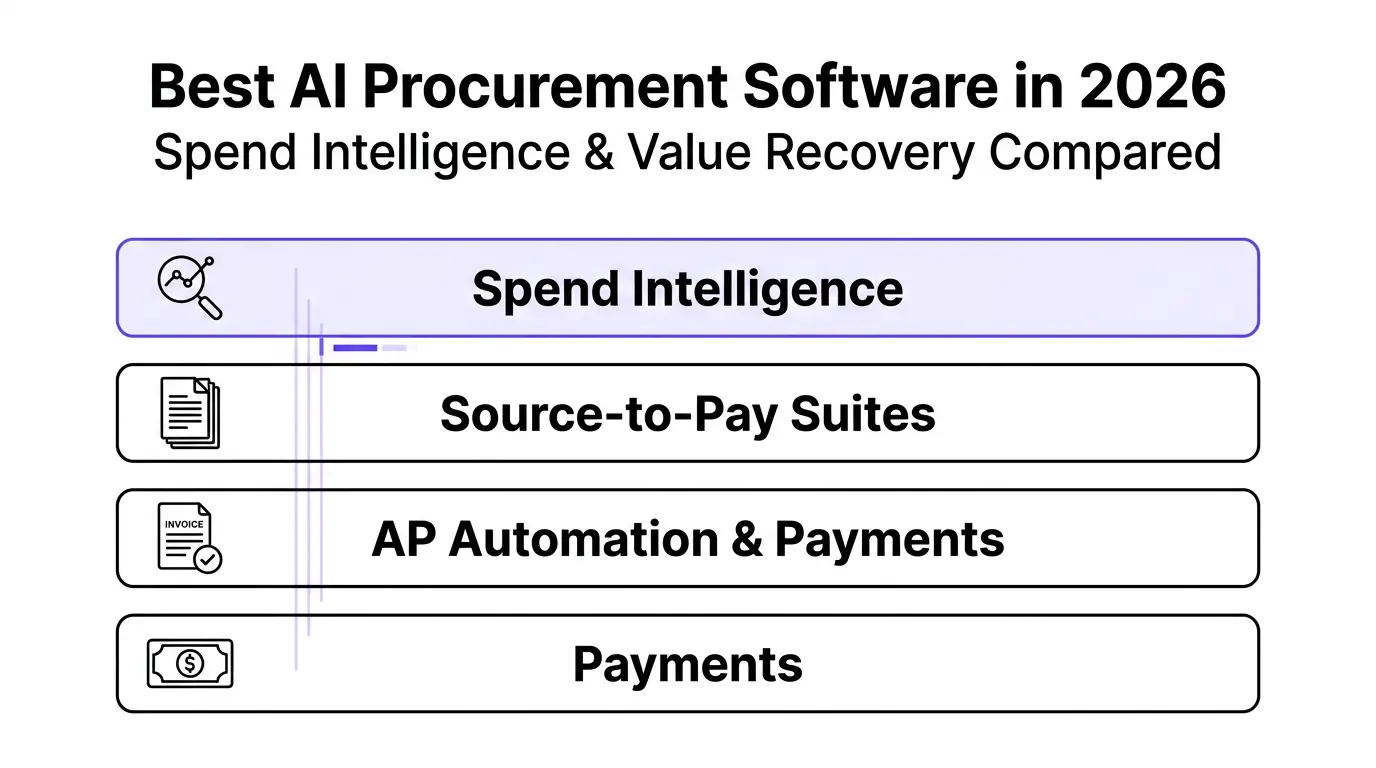

Comparing AI procurement software and spend-intelligence platforms against the source-to-pay (S2P) suites and procure-to-pay tools they sit on top of — and where each one catches, or misses, spend leakage.
Spend intelligence is the use of AI to validate every procurement transaction against its contract — testing each invoice line for overbilling, duplicate payments, off-contract spend, and unclaimed rebates — then recovering or preventing that loss before the payment window closes. AI-powered spend intelligence sits on top of the procure-to-pay workflow rather than running it: it reads the invoices, contracts, and payments your existing systems already produce and flags what shouldn't be paid. Tellius is the spend-intelligence platform in this guide built to validate, recover, and prevent leakage on top of any procurement stack — it does not issue purchase orders or move money.
Gartner forecasts that supply chain management software with agentic AI will grow from less than $2 billion in 2025 to $53 billion in spend by 2030 — a roughly 94% compound annual growth rate. Procurement sits squarely inside that wave; it's the category this guide is read against.
The Hackett Group's User Experience and Maverick Spend Study found that organizations lose up to 16% of negotiated savings to off-contract "maverick" spend — and the problem isn't shrinking. Recent research puts preventable post-signature leakage at roughly 11% of contract value, from maverick buying, missed rebates, and unclaimed volume discounts. On a multi-billion-dollar direct-materials base, that's millions a year walking out the door — recoverable only if you catch it before the supplier credit window closes. The reason it slips is the matching. Before payment, every invoice has to be checked against its purchase order and goods receipt, with the contract price, the currency, the unit of measure, and the tolerance band all lining up. That's manageable on one invoice, but a large manufacturer processes millions a year, with contract terms in one system and invoices in another and nothing reconciling the two. So matching happens by exception, against payment deadlines shorter than validation takes, which means invoices get paid first and checked later, if at all.
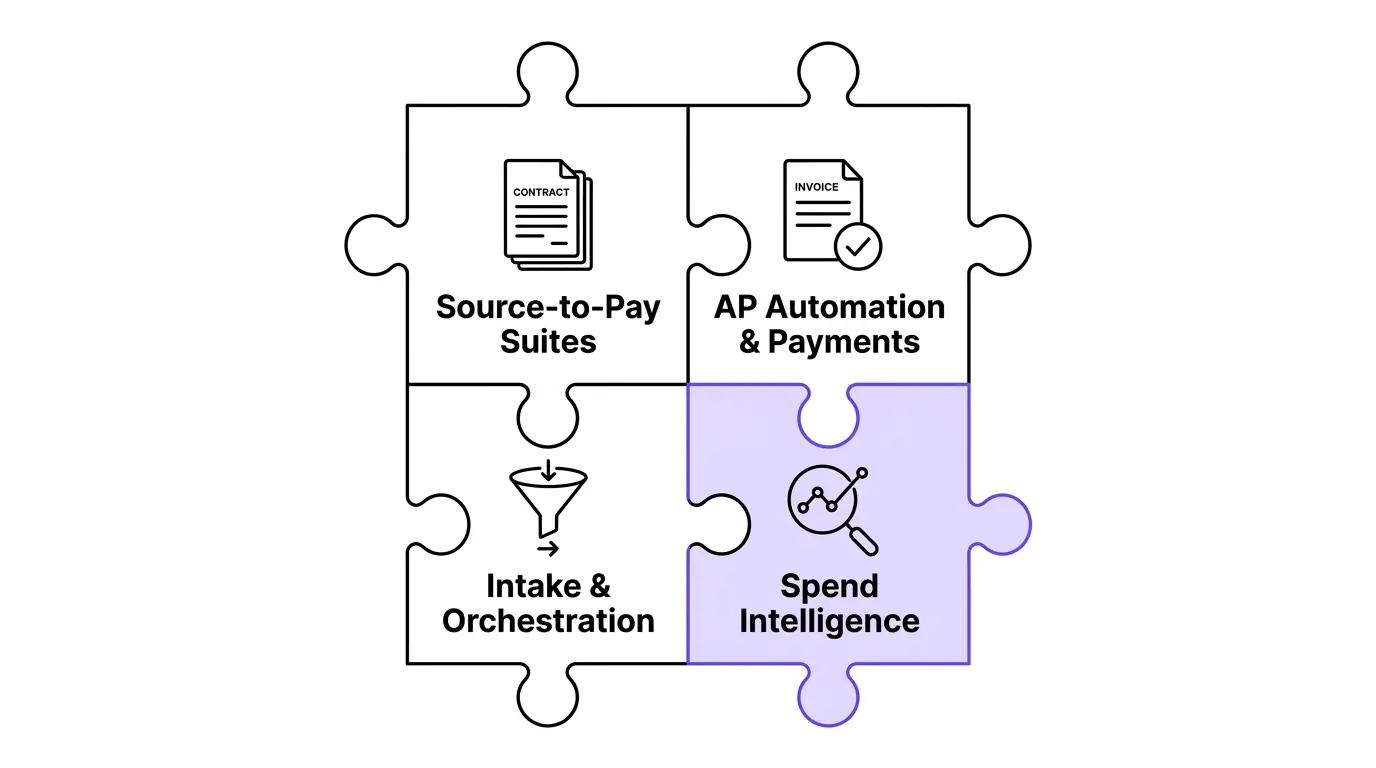
Almost no enterprise solves this with one product. The procurement-software market splits into four functional categories:
- Source-to-pay (S2P) suites run sourcing, contracts, procurement, and invoicing end to end.
- AP automation and payment platforms capture invoices, match them, and move the money.
- Spend-intelligence layers analyze what the workflow leaves behind.
- Intake and orchestration tools act as the request "front door" sitting on top of the ERP.
The first two categories are systems of record. They run the workflow and store the transaction, but neither was built to question it. Recording that a payment went out is not the same as knowing whether it should have. That is where the money leaks, and catching it is a different job than running the workflow.
This guide covers all four categories, ordered by the dimension we weight most heavily: how well a platform validates spend rather than just executing it. On that dimension, Tellius is the one platform here that checks every transaction against its contract, flags what's billed above terms before payment, and explains the cause — on top of whatever procurement system you already run. It validates, recovers, and prevents; it does not issue POs or pay invoices.
The Five Categories of Procurement Software
"Procurement software" gets used as if it's one thing to buy, but the market is really five different categories doing five different jobs. The confusion is costly: teams buy a source-to-pay suite expecting it to also catch pricing errors, or an AP tool expecting it to manage contracts, and find the gap only after rollout. Where a tool sits in the stack tells you more about whether you need it than any feature list does.
Four of these are software categories you'd choose between; the fifth, recovery-audit, is an adjacent service, included here because it's the status quo many teams are trying to replace. The first two are systems of record: they run the workflow and hold the transaction. Intake tools sit in front of them, shaping requests before they become POs. Recovery-audit firms come at the other end, usually once a year, to claw back overpayments by hand after the money's already gone.
Spend intelligence works differently. It doesn't run the workflow or store the transaction. It reads what the other tools produce — every invoice, every contract, every payment — and flags what shouldn't be there, continuously instead of in an annual sweep. That's the category Tellius sits in, and it's judged here on that one job, not on transactional breadth.
These categories complement each other rather than compete, which is why most enterprises run a combination: SAP Ariba or Coupa to run the buy-and-pay workflow, an AP-automation tool like Tipalti or Stampli to capture and pay invoices, and a spend-intelligence layer like Tellius on top to catch leakage and explain the why. The comparison that follows covers all five.
At-a-Glance Comparison
The table covers every vendor in this guide, ordered by market footprint within each category: the largest source-to-pay suites first, then AP and payments platforms, then spend intelligence, intake, and recovery audit.
No tool wins every column. The right shortlist depends on your real constraint, which is what the next section is about.
How We Evaluated
No platform tops every column, so the ranking depends on what you weight. We scored every platform on six criteria:
- Validate and recover (weighted highest). Can the platform check each transaction against its contract, across the full population rather than a sample, recover what's owed, and explain the root cause well enough to act on?
- Workflow execution breadth. How much of source-to-pay or AP the tool actually runs: sourcing, contracts, POs, matching, payments.
- Time to value. Weeks versus quarters to a working deployment and a first measurable result.
- System-of-record fit. How cleanly it sits with your ERP and existing procurement tools, and whether it assumes you'll rip and replace.
- Prevention, not just reporting. Does the platform flag an overcharge before payment — at the approval gate, while the credit window is still open — or only surface it after the money's gone? Does it act on what it finds, or hand a dashboard to someone else to interpret?
- Enterprise readiness. Security, scale, governance, and the multi-entity, multi-currency reality of global volume.
Because we weight validate-and-recover highest, a full source-to-pay suite that runs your entire procurement operation can score below a tool that does nothing but investigate spend — they're built for different jobs, so read the deep dives with your own constraint in mind.
How to Choose
The table tells you what each tool does. Picking one comes down to your real constraint: the ERP you run, the spend you're trying to protect, and who owns the result. A few decision rules:
- Anchor on your ERP first. If you run SAP, weigh SAP Ariba's native fit before anything else; if you run Oracle, start with Oracle Fusion. A suite that shares your ERP's data model saves months of integration work that an equally capable rival would cost you.
- Match the suite to your spend mix. Configurable, BOM-heavy direct procurement points toward Ivalua or JAGGAER; broad, ERP-agnostic total-spend management points toward Coupa.
- Separate "pay invoices" from "run procurement." If the gap you feel is in accounts payable rather than sourcing, an AP specialist like Tipalti or Stampli layered on your ERP solves it faster and cheaper than a full suite.
- Decide where the request should start. Teams whose leakage begins upstream, with off-process buying, get more from an intake tool like Zip than from another system of record.
- Treat leakage recovery as its own decision. The job of finding overbilling, duplicate payments, and unclaimed rebates across every transaction sits apart from running the workflow. That's the lane Tellius occupies, on top of whatever you already run.
- Weigh services against software. GEP pairs its suite with managed-services capacity; if you're short on procurement headcount, that bundle can matter more than a feature.
Map your constraint to the lane, shortlist two or three names from it, and take them into demos with the verification questions further down this guide.
Key Takeaways
One read on each platform, in the order they appear in the comparison table.
SAP Ariba — The default for SAP-centric global enterprises. Deep S/4HANA integration and the SAP Business Network give it supplier reach few can match. A 2026 Gartner Magic Quadrant Leader. Best for organizations standardizing source-to-pay inside an existing SAP estate.
Coupa — The strongest all-around enterprise total-spend platform, and ERP-agnostic, so it doesn't tie you to one back office. A 2026 Gartner Leader with the highest Ability to Execute in the S2P Magic Quadrant. Best for broad, unified spend management across a mixed system landscape.
Oracle Fusion — Source-to-settle and ERP on one data model. A 2026 Gartner Leader. Best for Oracle-ecosystem enterprises that want procurement and finance under one roof.
Ivalua — A single, highly configurable platform that bends to complex direct and indirect processes. A 2026 Gartner Leader. Best for teams with intricate requirements and the appetite to configure for them.
JAGGAER — Sourcing, SRM, and category depth aimed at supplier- and BOM-heavy industries. A 2026 Gartner Visionary. Best for complex direct procurement in manufacturing, higher education, and life sciences.
GEP SMART — A unified suite paired with GEP's managed-services capacity. A 2026 Gartner Leader. Best for Global 2000 procurement transformation where software and services are bought together.
Zycus — Broad source-to-pay with an aggressive push into autonomous agents, including tail-spend negotiation. Best for mid-to-large enterprises that want an AI-forward suite.
Tipalti — End-to-end global payables across many countries and currencies, with tax and compliance built in. Best for finance teams running high-volume, multi-entity payments.
Stampli — Invoice-centric AP automation that deploys fast on top of an existing ERP, with collaborative coding and an AP copilot. Best for teams fixing accounts payable without replacing procurement.
Medius — Strong invoice automation with spend controls and payment-fraud detection. Best for mid-market-to-enterprise AP teams worried about fraud as well as throughput.
BILL — Simple, affordable AP, AR, and payments. Best for SMB and mid-market finance teams on QuickBooks or Xero.
AvidXchange — AP automation with deep vertical networks. Best for mid-market buyers in real estate, HOA, and construction.
Ramp — Cards, spend, and AP in one modern interface with real-time controls and a free tier. Best for fast-moving finance teams that want spend management and AP together.
Tellius — The one platform here that validates every transaction against its contract to catch and recover leakage — price-variance overbilling, duplicate payments, under-claimed rebates, off-contract spend — and explains the why with quantified driver attribution, on top of whatever procurement system you run. It reads unstructured contracts alongside structured PO and invoice data in a single investigation, flags what's billed above terms before payment rather than after, and produces recovery-ready output rather than a dashboard to interpret. A multiple-time Gartner Magic Quadrant Visionary. Best for finance and procurement teams that want leakage caught, prevented, and recovered continuously, without ripping out the systems they already run.
Zip — Clean intake and fast approval routing as a front door on your existing ERP and procurement system. A 2026 Gartner Visionary. Best for controlling spend at the point of request.
Spendflo — Intake plus SaaS-spend visibility and negotiation-as-a-service. Best for teams getting a grip on software spend specifically.
apexanalytix — Supplier data, risk, and large-scale recovery-audit depth. Best for periodic, after-the-fact overpayment recovery and supplier-master hygiene.
Who Feels This Most
The leakage problem reads differently depending on whose number is on the line. A few of the people who run into it:
- VP of Procurement Operations. Owns negotiated savings on paper and watches them erode in practice. The frustration is structural: the overcharge is recoverable for a few weeks after payment, then it isn't, and a once-a-year audit arrives long after the window has closed.
- Director of Accounts Payable. Lives in the blocked-invoice queue, clearing exceptions against a payment clock. Throughput is the mandate, so invoices clear; whether each one matched its contract is a question nobody has time to ask at volume.
- FP&A / Finance business partner. Has to defend margin to the CFO and needs recovered or protected dollars tied cleanly back to the P&L, with a number that survives audit rather than an estimate from a spreadsheet.
- Category Manager. Negotiates the price, then loses a slice of it to off-contract buying and wrong prices loaded against the right contract. Wants to see which suppliers and which sites are drifting, before the quarter closes.
- Supplier Operations. Tracks rebate realization and on-time-in-full, and knows that earned rebates go uncollected when nobody reconciles entitlement against what actually shipped and billed.
- Analytics CoE lead. Fields the same "why did this spend move" question from four teams using three tools, and wants one governed source of spend truth instead of four reconciliations that disagree.
None of these roles is asking for another system to run the buy-and-pay workflow. They're asking a different question: of everything we already paid, what shouldn't we have, and can we get it back.
What Separates Spend Intelligence from Spend Reporting
Most platforms that touch procurement can show you spend. Far fewer can investigate it. The difference isn't cosmetic, and it decides whether a tool catches leakage or just charts it.
Reporting answers questions you already know to ask. You build a dashboard for price variance, you filter to a supplier, you read the number. It's retrospective and it's bounded by your hypotheses: you only find the problems you thought to chart. Spend reporting is genuinely useful, and every suite and BI tool does some version of it. But it waits for a human to point it at the right place.
Investigation runs the other direction. Instead of a person querying a slice, the system reads the full population of transactions, decides on its own which ones don't belong, and works out why. It validates each invoice line against the contract it was supposed to price to, normalizes currency and unit of measure so a price per pallet isn't compared to a price per case, applies the tolerance band, and then clusters what's left by supplier, site, and category to separate a one-off keying error from a systemic wrong price loaded across a whole portfolio. The output isn't a chart of variance. It's a ranked list of recoverable claims with the contract clause each one breached.
Two things make that possible, and most reporting tools have neither. The first is reading structured and unstructured data in one pass: the contract terms usually live in a PDF, the invoices in the ERP, and an investigation has to hold both at once. The second is autonomy: the analysis has to run without someone asking, because leakage you only find when you query for it is leakage you mostly don't find. The line between reporting and intelligence is the line between a tool that shows you what you asked about and one that tells you what you didn't.
Spend Intelligence vs. Process Mining
Process-mining platforms like Celonis and SAP Signavio answer a question that sounds adjacent but isn't: did the process run the way it was supposed to? They reconstruct the actual path each purchase order or invoice took through your systems — every step, handoff, and delay — and surface where it broke: a missing purchase order, a three-way match that failed, an approval that skipped a step, a payment that went out late. For the leakage that is process-shaped — the maverick buy that bypassed the workflow, the duplicate two systems both let through — they're strong, and many large enterprises run them.
Spend intelligence answers the other question: was the outcome correct? A purchase order can move through every step cleanly, clear a three-way match, and still be wrong, because the price on the invoice sits above the price in the contract — in tolerance, against the right PO. The process ran perfectly; the transaction was overbilled. A process map has no way to see that, because nothing in the process broke. Catching it means validating the invoice line against the contract clause it should have priced to — reading the unstructured contract terms alongside the structured invoice — which is contract-vs-line leakage, not process-shaped leakage.
The distinction is "did the process run right" versus "was the outcome correct," and the two are complementary. Process mining fixes the workflow; spend intelligence checks the result. A clean three-way match is exactly where an overcharge hides, and closing that gap — on top of whatever process-mining or procurement system you already run — is the job Tellius is built for.
The Spend-Intelligence Maturity Model
Organizations tend to sit at one of four levels in how they catch value leakage. Each is a legitimate operating point, and most enterprises run a mix across categories.
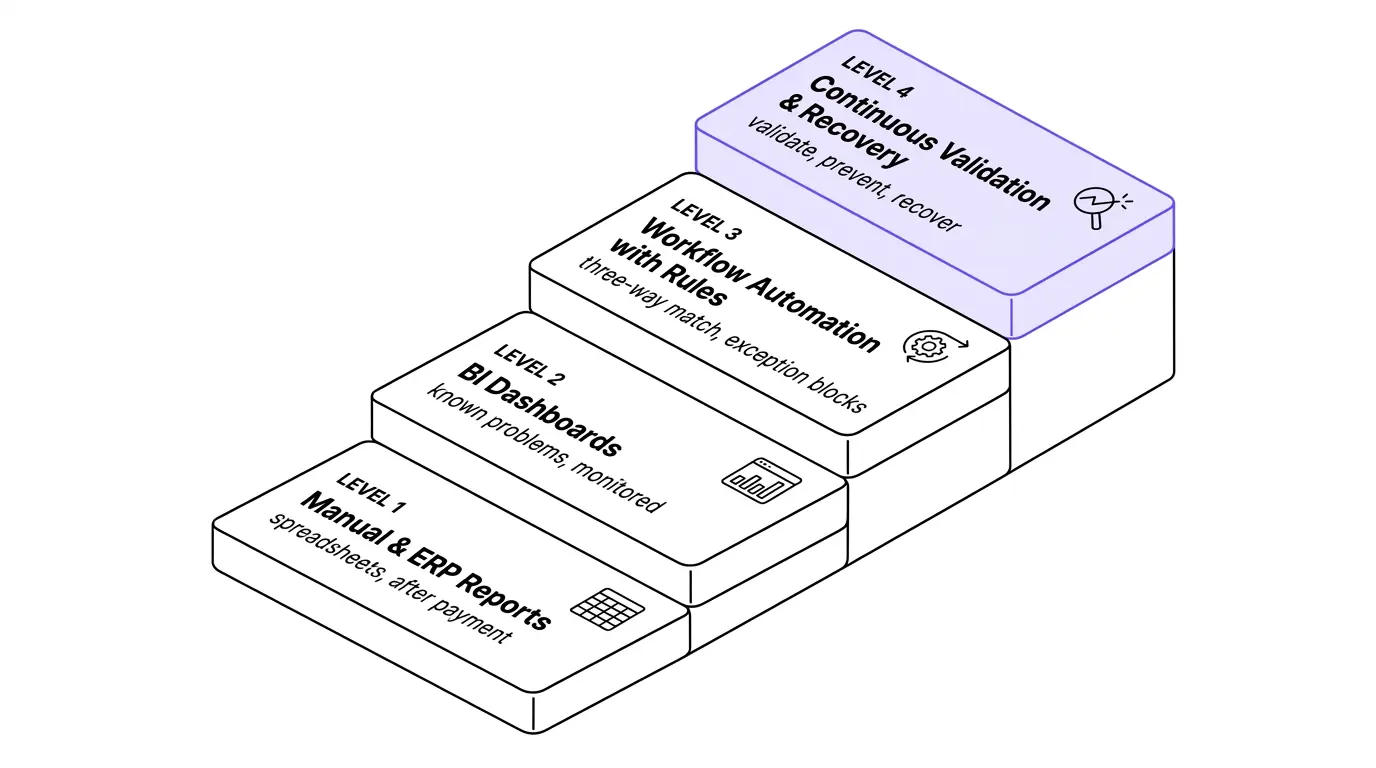
Level 1 — Manual and ERP reports. Validation happens in spreadsheets, after payment, on a sample. Standard ERP reports show what was paid, not whether it was right. This is where most direct-materials spend is still checked, and for low volumes it holds up.
Level 2 — BI dashboards on spend. A team stands up price-variance and compliance dashboards in a BI tool. Visibility improves, and known problems get monitored. The ceiling is the hypothesis: the dashboards surface the variances someone thought to chart, on the cadence someone refreshes them.
Level 3 — Workflow automation with rules. AP automation and suite controls enforce three-way matching and block exceptions over a threshold. This catches a lot, fast, and is a real step up. The limit is that rules catch the violations you encoded; a wrong price loaded against the correct contract, inside tolerance, sails through.
Level 4 — Continuous validation, prevention, and recovery. The system validates every transaction against its contract, flags what doesn't belong before payment rather than after, explains the root cause, and produces recovery-ready output continuously rather than in an annual sweep. Levels 1 through 3 run and record the workflow; Level 4 checks whether the result was correct. Tellius operates at Levels 3 to 4 of this curve, on top of the systems running the rest.
Tellius: The Intelligence Layer for Spend Recovery
Tellius is Decision AI for the enterprise: the intelligence layer connecting your data to your decisions. In procurement, that means it doesn't run the buy-and-pay workflow at all. It sits on top of the procurement system you already run and does the one job those systems weren't built for — validating every transaction against its contract to catch, prevent, and recover leakage, and explaining the why.
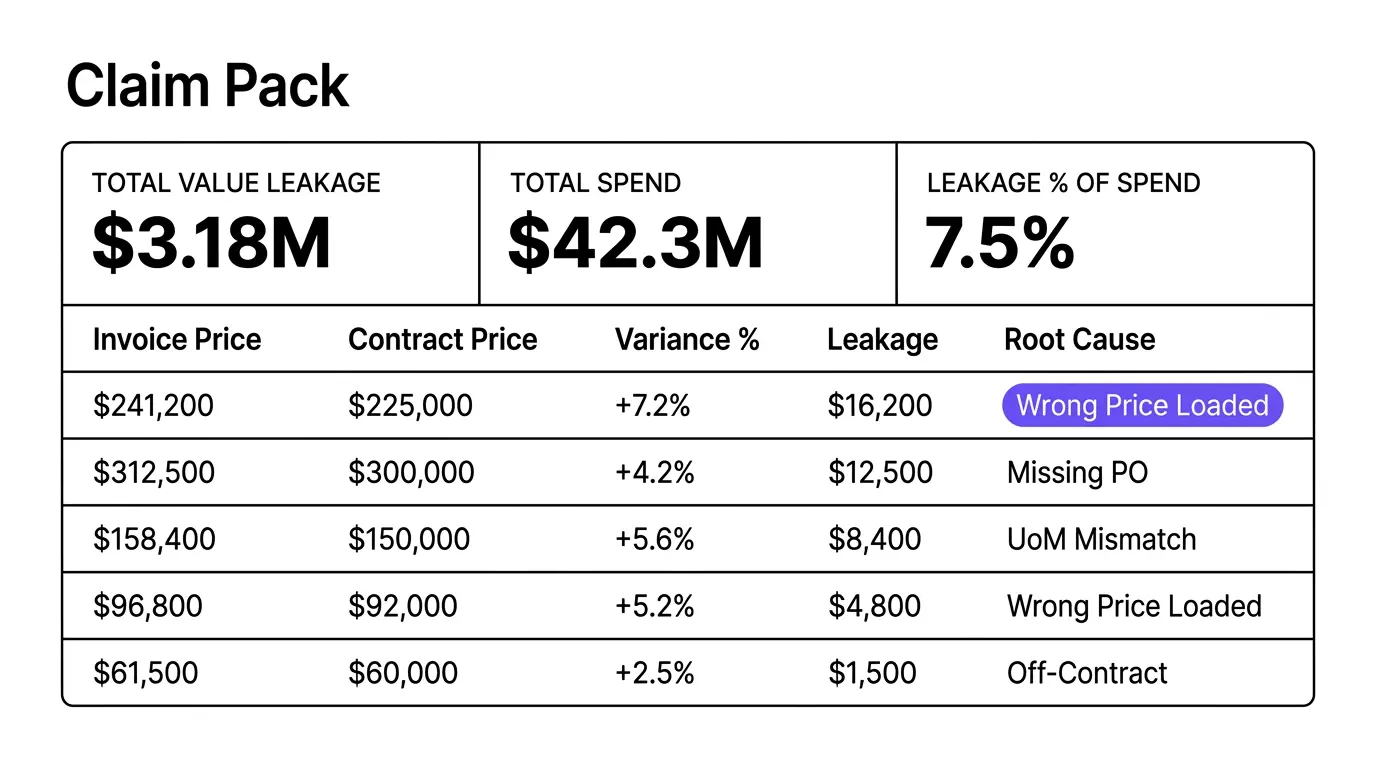
Here's the shape of the problem it's built for. Take a global manufacturer that buys billions in direct materials — packaging, chemicals, oils — each on a negotiated contract with its own price terms, currency, unit of measure, and tolerance band. The contract terms sit in one system, the invoices in another. Millions of invoice lines a year get matched and paid against payment deadlines shorter than any real validation takes. Some fraction is billed above contract. Under the status quo, that fraction is found, if at all, in a spreadsheet months later, by which point the credit window on the earliest overcharges has closed.
Tellius runs this as an agentic Mission: a multi-step investigation that pulls every invoice line with its matched contract price, normalizes currency and unit of measure into a common base, computes the variance against the tolerance band, and filters to what's genuinely claimable. It then clusters the claimable lines by supplier, country, and portfolio, and assigns each a root cause — a wrong price loaded against the right contract, a missing purchase order, a unit-of-measure mismatch — so a team sees not just that a variance exists but why. The result is an executive summary of total leakage, total spend, and leakage as a share of spend, plus a drill-down to the supplier-level claim pack, exportable as a finished document the recovery team can act on. This is the Reason · Run · Ship pattern: reason over the full transaction population, run the investigation end to end, and ship recovery-ready work rather than a dashboard someone still has to interpret.
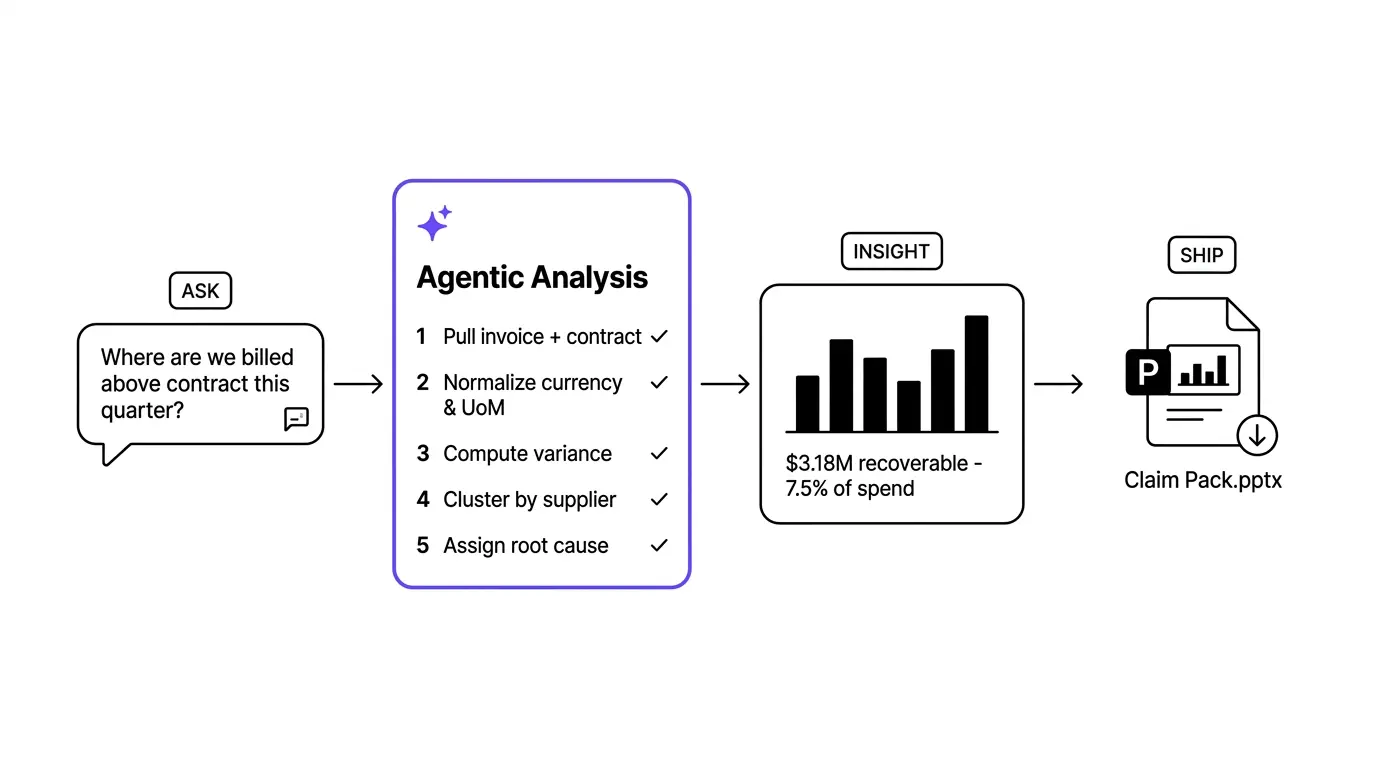
The higher-value move is catching the overcharge before the money leaves — block it, don't just report it. Run continuously against incoming invoices, the same validation that builds a recovery claim after payment can flag an above-contract line at the approval gate, while the invoice is still in the queue and the credit window hasn't opened yet. That's the line between this and the two status-quo alternatives: a recovery-audit firm finds the overcharge a year later, and a dashboard charts it for someone to notice. Prevention keeps the dollar in the first place; recovery gets it back when prevention wasn't in time. Tellius does both, and recovers what already slipped while preventing the next one.
The reason this lands as a finance story, not just a procurement one, is the P&L. Recovered overbilling and reclaimed rebates are margin, and they're the kind of margin a CFO can defend because every claim traces back to a specific invoice line and the contract clause it breached. Spend analysis of this kind typically surfaces recoverable value in the range of 5 to 15% of the spend analyzed, and on a large direct-materials base, the early read often runs into the millions before the full dataset is even in view. It's also governed: the same question produces the same answer, every claim is auditable, and there's a traceable path from finding to recovery — which matters to a buyer who now has an AI-governance line item.
Tellius reads unstructured contracts alongside structured PO and invoice data in a single investigation, monitors continuously instead of on a refresh schedule, and is a multiple-time Gartner Magic Quadrant Visionary for its analytics platform.
Where Tellius falls short. Tellius does not run the transactional workflow. It issues no purchase orders, pays no invoices, and is not a supplier network or a system of record. If you need software to operate procurement and accounts payable, you need one of the suites or AP platforms in this guide, not Tellius. The two fit together by design: you keep Coupa, you keep SAP Ariba, you keep your AP tool, and Tellius is the layer on top that catches what they can't and explains it. It's an addition to the stack, not a replacement for it.
Vendor Deep Dives
Profiles run in comparison-table order: source-to-pay suites first, then AP and payments, then intake, then recovery audit.
SAP Ariba
SAP Ariba is the source-to-pay benchmark for SAP-centric enterprises. Its advantage is integration: native data flow with S/4HANA and the SAP Business Network, one of the largest supplier networks in the market, connecting buyers to millions of suppliers for catalogs, POs, and invoicing. For a global enterprise already standardized on SAP, that fit removes integration work that any rival would charge you in months. A 2026 Gartner Magic Quadrant Leader for Source-to-Pay Suites.
The trade-offs are weight and lock-in. Ariba is a substantial implementation, and its value is highest inside an SAP estate; outside one, the calculus changes and lighter or more ERP-agnostic options compete well. Its native analytics describe spend more than they validate each transaction for leakage across it. Best for SAP-centric global enterprises standardizing procurement on their existing ERP.
Coupa
Coupa is the strongest all-around enterprise total-spend platform, and being ERP-agnostic, it doesn't bind you to a single back office. It unifies sourcing, procurement, invoicing, payments, and spend analysis, and layers community benchmarking on top — anonymized spend patterns drawn across its customer base. A 2026 Gartner Leader with the highest Ability to Execute in the Magic Quadrant.
Its limitations are price and analytical depth. Coupa sits at the premium end, and its spend analytics, while broad, describe and benchmark spend rather than validating each transaction against its contract for recoverable leakage and root cause. For organizations that want one platform across a mixed ERP landscape, those are acceptable trades. Best for enterprise-wide, ERP-agnostic total spend management.
Oracle Fusion
Oracle Fusion Cloud brings procurement, source-to-settle, and ERP onto one data model, with EPM in the same family. For an Oracle-ecosystem enterprise, that single-vendor coherence is the draw: procurement and finance share a backbone, and there's no seam to integrate between the suite and the ledger. A 2026 Gartner Leader.
As with the other ERP-aligned suites, its strongest case is inside its own ecosystem; evaluated standalone against best-of-breed procurement specialists, it's less differentiated. Best for Oracle-ecosystem enterprises wanting source-to-settle and ERP in one suite.
Ivalua
Ivalua runs the full source-to-pay process on a single, unusually configurable platform, which is its signature: it bends to complex, non-standard direct and indirect processes that make other suites strain. Breadth and depth on one codebase mean teams can model intricate category and supplier requirements without bolting on point tools. A 2026 Gartner Leader.
That configurability is also the cost: realizing it takes implementation time and skilled hands, so Ivalua rewards teams with complex needs and the appetite to configure for them, and over-serves teams that want something simple out of the box. Best for highly configurable, complex direct and indirect procurement.
JAGGAER
JAGGAER brings deep sourcing, supplier relationship management, and category capability aimed at industries where direct procurement and bills of materials dominate. Its strength is the upstream and supplier side, and it's well established in manufacturing, higher education, and life sciences. A 2026 Gartner Visionary.
User experience and cohesion across modules can trail the largest suites, and its brand reach is narrower than the megavendors'. For supplier- and BOM-heavy procurement, the sourcing depth outweighs that. Best for complex direct procurement in manufacturing, higher education, and life sciences.
GEP SMART
GEP SMART is a unified source-to-pay suite, and GEP's differentiator is that the software comes paired with substantial managed-services capacity. For a Global 2000 procurement transformation short on internal headcount, buying software and services together can matter more than any single feature. A 2026 Gartner Leader.
The flip side is that the model is services-led; evaluated as software alone, the suite is less distinct from its peers. Best for Global 2000 procurement transformation where software and services are bought together.
Zycus
Zycus offers a broad source-to-pay suite with an aggressive move into autonomous agents, including agents that handle tail-spend negotiation without manual intervention. For a mid-to-large enterprise that wants an AI-forward suite, that roadmap is the draw. A 2026 Gartner Leader.
Its brand and partner ecosystem are smaller than the megasuites', which matters for organizations that weight market presence and integrator availability heavily. Best for mid-to-large enterprises wanting AI-forward source-to-pay.
Tipalti
Tipalti runs end-to-end global payables: supplier onboarding, tax compliance, invoice processing, and mass payments across many countries and currencies. Its strength is the hard part of paying a global supplier base — regulatory, tax, and currency complexity — handled in one platform. For finance teams running high-volume, multi-entity payments, that breadth is hard to assemble otherwise.
Tipalti is payments-centric by design; it isn't a sourcing or contract-management suite, so it complements rather than replaces upstream procurement. Best for global mass payments and multi-entity payables.
Stampli
Stampli is invoice-centric AP automation that layers on top of your existing ERP rather than replacing it, which is why it deploys fast. Its hallmark is collaborative invoice coding — communication, approvals, and context attached to each invoice — plus an AP copilot that speeds exception handling. For a team fixing accounts payable without touching procurement, it's a quick win.
Its scope is AP; there's no upstream sourcing or contract management, so it sits alongside, not instead of, a procurement suite. Best for invoice-centric AP automation on an existing ERP.
Medius
Medius pairs strong invoice automation with spend controls and, notably, payment-fraud detection — a real concern as AP fraud rises. For mid-market-to-enterprise AP teams that care about fraud as much as throughput, that combination stands out.
Like other AP specialists, Medius is focused on the invoice-to-pay end and is light on sourcing. Best for mid-market-to-enterprise AP with spend and fraud controls.
BILL
BILL delivers simple, affordable AP, AR, and payments aimed at smaller organizations, with tight QuickBooks and Xero integration. Its strength is speed and accessibility for teams without a procurement function. Built for SMB and mid-market, it's deliberately light on enterprise depth and global complexity. Best for SMB and mid-market AP, AR, and payments.
AvidXchange
AvidXchange automates AP with deep networks in specific verticals — real estate, HOA, and construction — where its supplier connections and workflows are well tuned. That vertical focus is the strength and the boundary: it's a strong fit in its industries and less suited to global direct-materials buyers. Best for mid-market AP in real estate, HOA, and construction.
Ramp
Ramp combines corporate cards, spend management, and AP in one modern interface, with real-time controls, strong automation, and a free tier that's made it a fast-growing favorite among US finance teams. The experience and price are the draw.
Ramp is a finance and spend platform rather than a procurement suite, so it's thin on the contract- and PO-heavy reality of direct-materials buying. Best for fast-moving finance teams wanting cards, spend, and AP together.
Zip
Zip is an intake-to-procure orchestration layer — the front door for purchase requests on top of an existing ERP and procurement system. Its strength is a clean intake experience and fast approval routing across the tools beneath it, which controls spend at the point of request before it becomes off-process buying. A 2026 Gartner Visionary.
Zip orchestrates rather than executes; it depends on the systems underneath it and doesn't replace them. Best for intake-to-procure orchestration on an existing stack.
Spendflo
Spendflo combines intake with SaaS-spend visibility and negotiation-as-a-service, helping teams get a grip on software spend specifically. Its strength is the SaaS and indirect lane; it isn't built for broad direct-materials procurement. Best for SaaS procurement and intake with negotiation help.
apexanalytix
apexanalytix pairs large-scale supplier data and risk management with recovery-audit depth, clawing back overpayments after the fact. Its strength is supplier-master hygiene and the scale of its recovery operation. The model is periodic and post-payment by nature: it recovers what already leaked, rather than catching it before or at payment. Best for periodic, after-the-fact overpayment recovery and supplier-data management.
Buyer's Verification Checklist
The owned dimension is easy to claim and hard to fake. These are the questions to take into a demo to tell a platform that investigates spend from one that only charts it. Make the vendor show you, on data, not slides.
- Ask the vendor to show a single invoice flagged as billed above contract — and the specific contract clause it was matched against. If they can show the variance but not the clause, it's reporting, not investigation.
- Test whether it runs without being asked. Does it surface a duplicate payment or an overcharge before payment, or only when someone queries for it?
- Probe how it handles an unstructured contract PDF alongside structured PO and invoice data in one investigation. Reading both at once is the hard part; reading one isn't enough.
- Verify the root-cause output. Can it tell a one-off keying error from a wrong price loaded systemically across a portfolio, or does it just flag the threshold breach?
- Confirm currency and unit-of-measure normalization. Ask it to reconcile a price per pallet against a price per case in two currencies, and watch whether it does the conversion or expects you to.
- Request the recovery output. Is the result an exportable claim pack a recovery team can act on, or a dashboard someone still has to turn into a claim?
- Look at the audit trail. Does the same question produce the same answer every time, and can each finding be traced from claim back to source?
- Check what it leaves untouched. Confirm it sits on top of your existing procurement system rather than asking you to move the workflow into it.
Can't I Just Use ChatGPT or Claude on a Spend Spreadsheet?
It's a fair question, and the answer has two halves. For personal exploration, a general-purpose AI assistant is genuinely useful: upload a spend CSV, ask why a supplier's costs moved, and you'll get a plausible, readable narrative in seconds. For a one-off look at a static snapshot, that's a real productivity gain, and there's no reason to pretend otherwise.
It breaks down as a production answer for a few concrete reasons. There's no persistent connection to your ERP and procurement system, so every analysis is a manual export of a frozen snapshot rather than a live read of current spend. There's no semantic understanding of your contract structure — it doesn't know your tolerance bands, your units of measure, or which contract a given invoice should price to, unless you hand-feed all of it. There's no audit trail, and the same prompt can produce different answers on different days, which is disqualifying for anything that has to survive a finance review. And there's no monitoring: it answers when you ask and watches nothing in between, so leakage you didn't think to query for stays invisible. General-purpose assistants are good personal tools for static questions. Governed, repeatable, auditable spend recovery at scale is a different job.
Where Procurement Evaluation Is Heading
For most of the last decade, procurement software was judged on workflow: how much of source-to-pay it ran, how deep its supplier network reached, how cleanly it automated three-way matching. Those criteria still matter, but the ground is shifting, and the next two to three years of evaluation will weight something the old criteria barely scored — whether a platform can investigate spend on its own, not just process it.
The shift has two drivers. The first is that rules-based AP automation is hitting its ceiling. Encoding three-way-match rules and exception thresholds caught the obvious violations, and most enterprises have already captured that gain; what's left is the leakage that passes the rules — a wrong price loaded against the correct contract, an unclaimed rebate, off-contract spend that never tripped a threshold. Catching that requires investigation, not another rule. The second is the arrival of agentic AI in procurement. Vendors across the category are adding autonomous agents, and as that capability becomes table stakes, buyers will stop asking whether a platform has dashboards and start asking whether it acts: does it find the problem and produce the recovery, or does it wait to be queried.
The buyer is changing too. As recovered and protected spend becomes a defensible margin line, Finance moves from validator to co-evaluator, and Finance asks different questions than Procurement Ops — about traceability, auditability, and dollars that hold up under review. The evaluation criteria that follow from that buyer favor platforms that explain the why and produce governed, recovery-ready output. That's the direction of travel, independent of any one vendor.
Head-to-Head Comparisons
Tellius vs. Coupa (for spend analytics)
This is a comparison people reach for, and it's worth being precise, because the two aren't substitutes. Coupa is a full source-to-pay suite that runs procurement, invoicing, and payments and includes broad spend analytics with community benchmarking. Tellius runs none of that workflow; it's the intelligence layer on top.
On their shared edge — analyzing spend — the difference is reporting versus investigation. Coupa's analytics describe and benchmark spend well: where it goes, how it trends, how it compares to anonymized peers. That's valuable, and for many teams it's enough. Tellius does the narrower, deeper job of validating every invoice line against its contract, finding what's recoverable, explaining the root cause, and producing a claim pack — reading the unstructured contract alongside the structured invoice in one pass, continuously rather than on a dashboard refresh.
In practice, the two coexist. A Coupa customer keeps Coupa to run the buy-and-pay workflow and adds Tellius on top to catch and recover the leakage the suite's native analytics describe but don't hunt down. Neither displaces the other; they answer different questions about the same spend.
Tellius vs. recovery-audit firms (PRGX, apexanalytix)
The real incumbent for spend leakage isn't a procurement suite — it's the contingency-fee recovery-audit firm. Firms like PRGX and apexanalytix recover real money, and they've done it for decades. The comparison isn't capability for capability; it's continuous AI versus an annual contingency audit. A recovery audit is periodic and after the fact: a firm comes in, often once a year, manually reviews historical payments, and claws back a share of what already leaked — taking a percentage of recoveries as its fee, and typically recovering on the order of 0.1% of total spend at strong ROI.
Tellius changes when the catch happens. Instead of an annual look back by a third party, it validates every transaction continuously and surfaces an overcharge or duplicate before or at the point of payment, while the credit window is still open and the money hasn't left — prevention, not just post-payment recovery. It also explains the root cause, so the same wrong price loaded doesn't recur next quarter, which a periodic audit can't prevent. And the dollars stay yours: no contingency fee on what continuous validation catches up front.
The two coexist cleanly. A recovery audit is a safety net for what slips past; continuous validation shrinks how much reaches the net in the first place. Teams serious about value recovery increasingly run both, with the audit catching the residue rather than the bulk.
A Note on This Guide
Tellius published this guide, and we positioned ourselves in it — narrowly, on the one dimension we're built for: validating, recovering, and preventing spend leakage and explaining the why, on top of the systems you already run. We didn't claim to be a procure-to-pay suite, because we aren't one, and the comparison marks reflect that, including where Tellius can't do what a suite does.
We worked to get the competitors right, because a guide that misrepresents them isn't useful to you and doesn't reflect well on us. Vendor placements draw on the 2026 Gartner Magic Quadrant for Source-to-Pay Suites and other independent sources, and the leakage statistics are cited as ranges with named bodies behind them. If you find something inaccurate — a capability we got wrong, a strength we undersold — tell us and we'll correct it.
See It on Your Own Spend
The quickest way to judge any of this is on your own data. Bring one quarter of invoices and the contracts behind them, and watch Tellius validate each line, flag what's billed above terms, assign a root cause, and hand back a recovery-ready claim pack — on top of the procurement system you already run.
Get release updates delivered straight to your inbox.
No spam—we hate it as much as you do!


It depends on the job you're buying for. For validating, recovering, and preventing spend leakage on top of any procurement stack, Tellius — it checks every transaction against its contract and flags what's billed above terms before payment. For running the buy-and-pay workflow with AI layered in, the source-to-pay suites (Coupa, SAP Ariba, Oracle Fusion, Ivalua) and AP-automation platforms (Tipalti, Stampli) each fit a different constraint, covered above. "Best" tracks the outcome you're protecting, not a single leaderboard.
Spend intelligence is the use of AI to validate every procurement transaction against its contract — testing each invoice line for overbilling, duplicate payments, off-contract spend, and unclaimed rebates — and to recover or prevent that loss before the payment window closes. It sits on top of the procure-to-pay workflow rather than running it. Tellius is the spend-intelligence platform in this guide.
Yes — finding spend leakage is the core of what spend intelligence does, and Tellius is the platform in this guide built for it. AI reads the full population of invoices, POs, and contracts, validates each line against the terms it should have priced to, normalizes currency and unit of measure, and flags overbilling, duplicates, off-contract spend, and unclaimed rebates — continuously, not in an annual sample. The hard part is reading the unstructured contract alongside the structured invoice in one pass, which is what separates catching real contract-vs-line leakage from charting variance.
Yes. A spend-intelligence layer like Tellius reads the structured invoice and PO data from your ERP or procurement system plus the contract terms it should price against, without replacing any of it — that's the point of a layer that sits on top. Suites and AP tools integrate too, but more invasively, since they run the workflow rather than reading what it produces.
Start with the outcome you're protecting. Traditional suites and AP tools run and record the workflow; AI-enhanced spend intelligence like Tellius validates whether each recorded transaction was actually correct and recovers what wasn't. They're complementary, not either-or: keep the system that runs procurement, and add the layer that checks the result. If your gap is leakage that passes a clean three-way match, weight validation-and-recovery the highest.
Process mining (Celonis, SAP Signavio) asks whether the process ran the way it should — where a PO stalled, a match failed, a payment ran late. Spend intelligence asks whether the outcome was correct — whether the invoice was billed above its contract even when every process step ran cleanly. A clean three-way match is exactly where an overcharge hides, invisible to a process map; Tellius validates the invoice line against the contract clause to catch it. The two are complementary.
Estimates vary by source and category, so treat these as ranges. The Hackett Group has found up to 16% of negotiated savings lost to off-contract spend; duplicate or erroneous payments run around 0.8% of disbursements even at best-in-class performers (APQC); and industry estimates put uncollected rebates at roughly 15 to 25% of those earned. Spend analysis typically surfaces recoverable value of 5 to 15% of the spend analyzed.
Because a lot of comparison content is vendor-self-published, and a vendor ranking itself #1 isn't an independent signal. We've leaned on independent sources where they exist — the 2026 Gartner Magic Quadrant for Source-to-Pay Suites, G2 ratings with review counts, and benchmark bodies like APQC, The Hackett Group, and Ardent Partners — and named where a claim traces back to an interested party.
Tellius is the intelligence layer; Coupa is the suite. Coupa runs the buy-and-pay workflow and reports on spend; Tellius investigates every transaction for recoverable leakage and explains the root cause, on top of Coupa. They coexist: keep Coupa, add Tellius to catch what its native analytics describe but don't hunt down.
The same way. Ariba runs source-to-pay inside your SAP estate; Tellius reads the invoices, contracts, and payments it produces and flags what's billed above terms, with the breached clause. Tellius doesn't touch the Ariba workflow; it adds a recovery layer on top.
Timing and model. A recovery audit is periodic and after the fact, recovering a share of what already leaked. Tellius investigates continuously and surfaces overcharges before or at payment, while the credit window is open — and explains root cause so the same error doesn't recur. Many teams run both.
Both are 2026 Gartner Leaders. Ariba is the stronger fit for SAP-centric enterprises that want native S/4HANA integration and supplier-network reach; Coupa is the stronger fit for ERP-agnostic total-spend management across a mixed landscape, with the highest Ability to Execute in the Magic Quadrant.
Both are AP specialists that layer on your ERP. Tipalti is built for global mass payments across many countries and currencies; Stampli is built for invoice-centric AP automation with collaborative coding. Choose Tipalti for cross-border payables complexity, Stampli for fast AP automation on an existing ERP.
No, and it isn't meant to. A spend-intelligence layer like Tellius sits on top of whatever you run and validates the spend that flows through it. The point is to add recovery and prevention without disrupting the workflow.
Because it reads data your systems already produce rather than replacing them, the path to a first result is short: point it at a slice of invoices and contracts and it can surface recoverable leakage on that sample without a full deployment.
Usually both. Procurement Operations runs the recovery, and Finance validates the recovered or protected dollars to the P&L. The dual ownership is a feature: Procurement acts, Finance defends the number.
Yes, and for this buyer that matters. Each finding traces from claim back to the source invoice and the contract clause it breached, and the same question returns the same answer, which is what lets recovered spend survive a finance review.
At minimum, the structured invoice and PO data from your ERP or procurement system and the contract terms it should price against — including the unstructured contract documents, which it reads alongside the structured data in one investigation.

Best Revenue Intelligence Platforms in 2026: Clari, Gong, Tellius & 7 More Compared

This post compares 10 revenue intelligence platforms for 2026 and explains the “Revenue Root Cause Gap”—why most tools show what happened in pipeline and forecasts, but can’t investigate why across CRM, conversations, and documents. It evaluates each platform on pipeline analytics, root-cause depth, data sources, proactive monitoring, conversational analytics, and total cost of ownership, with clear “best for” recommendations.