

Best Revenue Intelligence Platforms in 2026: Clari, Gong, Tellius & 7 More Compared


A revenue intelligence platform uses artificial intelligence to analyze pipeline metrics, CRM records, conversation transcripts, deal signals, and forecast inputs — helping revenue teams understand why deals win or lose, why forecasts miss, and where pipeline is leaking. Unlike traditional revenue dashboards that visualize pipeline data for human interpretation, advanced revenue intelligence platforms perform the investigation themselves: connecting pipeline data with conversation and document evidence, decomposing metric changes into ranked contributing factors, and delivering finished explanations. The category ranges from conversation intelligence tools that transcribe sales calls, to forecasting engines that predict pipeline outcomes, to fully integrated platforms that autonomously investigate revenue performance changes and deliver finished insights.
The category is consolidating fast. Gartner published its first-ever Magic Quadrant for Revenue Action Orchestration in December 2025, formally recognizing the convergence of previously separate sales engagement, conversation intelligence, and revenue intelligence categories. The Clari–Salesloft merger closed in December 2025, combining ~$450M in ARR. Highspot and Seismic announced their intent to merge in February 2026. But amid the consolidation, one gap persists — what we call the Revenue Root Cause Gap: most revenue intelligence platforms can tell you what happened to your pipeline. Almost none can tell you why — and none unify pipeline data with conversation and document evidence to deliver autonomous investigation and finished explanations.
This guide evaluates 10 platforms across what actually separates useful revenue intelligence from marketing claims: pipeline visibility, revenue root cause investigation, data source breadth, proactive intelligence, conversational analytics, and total cost of ownership. We tested, researched, and compared each platform against a consistent framework — and we're transparent about our methodology and our biases (see Methodology and Disclosure).
Quick Comparison: 10 Revenue Intelligence Platforms at a Glance
Key Takeaways
Clari is best for enterprise revenue leaders who need mature pipeline visualization, forecasting accuracy, and deal management — and are comfortable investigating root causes manually.
Gong is best for sales leaders who prioritize conversation intelligence and coaching — and want expanding revenue intelligence capabilities from a platform trained on 3.5B+ sales interactions.
Tellius is best for RevOps leaders drowning in the "why did we miss?" fire drill — teams spending 3-5 days after every quarter close pulling CRM data, cross-referencing call recordings, arguing about definitions, and assembling narratives that are already stale by the time they're delivered. Tellius connects all revenue data sources (CRM, conversations, documents, financial systems) into a single governed model, monitors proactively with AI agents that investigate anomalies automatically, and lets any revenue leader ask complex questions conversationally and get instant, auditable answers with citations. The only platform in this comparison that delivers automated root cause investigation across both pipeline data and conversation/document evidence.
Aviso is best for organizations that need AI-native forecasting with claimed 98% accuracy, particularly for complex consumption-based and multi-CRM environments.
Salesforce Revenue Cloud is best for organizations deeply invested in Salesforce that want end-to-end quote-to-cash with emerging AI capabilities, and are willing to pay premium pricing for ecosystem consolidation.
What Separates a Revenue Intelligence Platform from a Revenue Dashboard
Most platforms marketed as "revenue intelligence" deliver one thing well: pipeline visibility — connecting to CRM data, displaying deal progression, and projecting forecast outcomes. This is genuinely valuable. Clari's Waterfall analytics and Gong's Revenue Graph both do this well.
But pipeline visibility alone means every investigation starts from zero. A VP of Revenue Operations sees that pipeline dropped 18% week-over-week. The dashboard shows the drop. Now what? Someone has to pull Salesforce reports, cross-reference Gong call recordings, check Slack threads, read deal notes, and spend two days assembling a narrative for the CRO. The dashboard answered the what. The why — the analytical labor — is still manual.
The platforms that deliver genuine revenue intelligence build on top of pipeline visibility with three additional capabilities:
Multi-source data unification. The system connects pipeline data (CRM records, forecast submissions, bookings, activity metrics) with conversation data (call recordings, email threads) and deal documents (contracts, competitive intelligence, policy documents) in a single analytical model. When a RevOps leader asks "why did we lose more deals to Competitor A this quarter?", the platform should investigate both the pipeline metrics and the conversation patterns and the competitive intelligence documents — not require toggling between Clari for the numbers, Gong for the call themes, and Google Drive for the competitive brief.
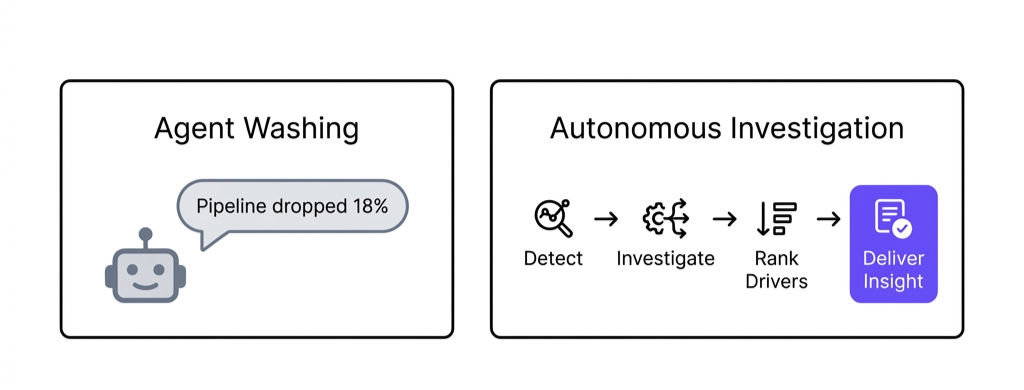
Proactive intelligence. The system continuously watches pipeline health, deal progression, and conversion rates — and investigates anomalies before anyone opens a dashboard. When expansion revenue in mid-market drops below trend, the platform doesn't wait for a human to notice during the weekly forecast call. It detects the change, investigates the drivers across all connected data sources, and delivers the explanation to the right stakeholder. The critical word is investigates — not just alerts. An alert that says "pipeline dropped 18%" without explaining why is just a faster notification of the same manual investigation.
Conversational analytics. Any revenue leader can ask complex questions in plain English — "why is the EMEA forecast trending below target?" — and get an instant, governed answer that decomposes the change into ranked contributing factors with citations. Same question, same answer, regardless of who asks. No SQL, no analyst request, no waiting. The governed consistency is what makes this work at enterprise scale — if sales and finance get different answers to the same question, the tool is creating problems, not solving them.
The simplest way to evaluate any revenue intelligence platform: Can the team see what's happening in the pipeline? Then the harder question: when the pipeline changes, can the platform autonomously investigate why — across your CRM data, your conversations, and your documents — and deliver a finished explanation? Or does your team still spend days doing that investigation manually?
The Revenue Root Cause Gap: The Category's Defining Differentiator
If there is one capability that separates revenue intelligence platforms from revenue dashboards, it's the ability to not just show you what changed in the pipeline, but autonomously investigate why, rank the contributing factors across pipeline data and conversation evidence, and deliver finished explanations with actionable recommendations. We call this the Revenue Root Cause Gap — the distance between knowing that pipeline dropped and understanding why. When pipeline drops, deals slip, or forecasts miss, can the platform deliver a complete analytical narrative — without a human analyst spending days assembling the story manually?
Of the 10 platforms evaluated, only Tellius offers full automated root cause investigation: driver ranking with quantified impact, pipeline-to-conversation data synthesis, executive summaries, and actionable recommendations — all generated from a single question or proactive alert. Every other platform shows you what changed and relies on humans to figure out why.
This isn't a minor feature gap. Consider the math: 78% of RevOps and sales leaders say they lack correct data to forecast accurately. 67% of sales operations leaders agree forecasting is harder than three years ago. 75% of RevOps professionals cite data inconsistencies as their biggest challenge. The bottleneck isn't seeing the pipeline — it's understanding why the pipeline is behaving the way it is.
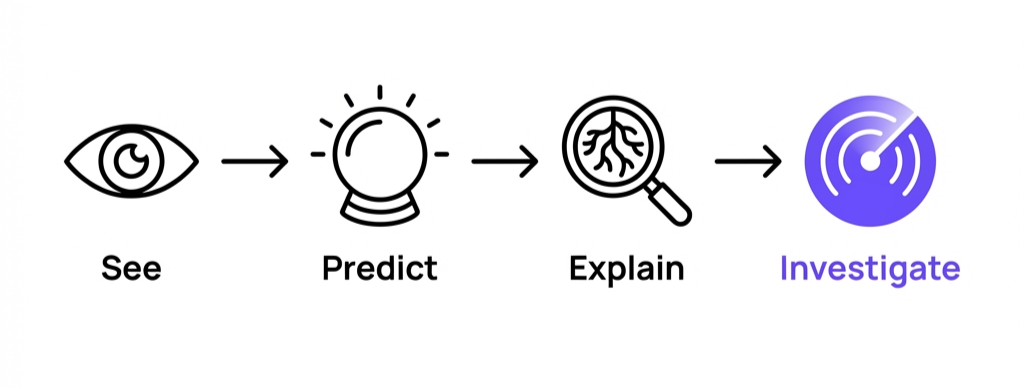
Four levels of revenue intelligence maturity:
Level 1: See what's in the pipeline. CRM dashboards and basic reporting — the team can see deals, stages, and totals. This is table stakes and where Salesforce, HubSpot, and most CRM-native tools operate.
Level 2: Predict what will happen. AI-driven forecasting — ML models score deals, predict close rates, and project pipeline outcomes. Clari, Gong, and Aviso all perform well here. The team knows what's likely to happen but not why.
Level 3: Explain why it happened — across all your revenue data. Automated investigation into ranked drivers with quantified impact, connecting pipeline metrics with conversation signals and document evidence. The platform tells you that mid-market expansion is down because Stage 2 conversion dropped 22%, driven by competitive displacement (appearing in 3x more calls), rep capacity constraints (47% of mid-market AEs at >120% quota capacity), and pricing sensitivity (concentrated in deals over $100K) — and delivers a finished narrative with next steps.
Level 4: Investigate before you ask — connecting your numbers with your conversations. 24/7 monitoring → anomaly detection → root cause investigation → insight delivery — analyzing both pipeline data and conversation/document data simultaneously. The platform detects that EMEA forecast is trending 15% below target, investigates by connecting CRM pipeline data with call transcript analysis showing increased competitor mentions and procurement delay signals, and delivers the complete explanation before the weekly forecast call.
How We Evaluated These Platforms
Every platform in this guide was evaluated against seven dimensions that reflect what actually matters when revenue intelligence moves from a demo to daily use:
1. Pipeline Analytics. Can the platform provide deep, governed visibility into pipeline health — not just current state, but flow analysis, conversion trends, velocity metrics, and deal progression patterns? Does it connect to CRM data natively and maintain consistency across views?
2. Revenue Root Cause. Can the platform autonomously investigate a pipeline change, forecast miss, or conversion drop — decomposing it into ranked contributing factors — or does it just show you the trend and leave investigation to humans? This is the single most important differentiator in the category, and most platforms fail here entirely.
3. Data Sources. Can the platform investigate across CRM records, call recordings, email threads, deal documents, contracts, and competitive intelligence — or is it limited to one data type? Revenue lives in both structured and unstructured data — tools that only see one are working with half the picture.
4. Proactive Intelligence. Does the platform continuously watch pipeline health and conversion rates — and investigate when something meaningful changes? Or does it only work when someone asks? The distinction between "alert" and "investigation" matters: an alert that says "pipeline dropped" without explaining why is just a faster notification of the same manual work.
5. Conversational Analytics. Can any revenue leader ask complex questions in plain English and get instant, governed, auditable answers — or does the platform require dashboard navigation, predefined reports, and technical skills? Governed consistency (same question = same answer) is the difference between a chatbot and enterprise-grade intelligence.
6. Industry and Domain Specificity. Does the platform understand RevOps workflows natively — pipeline stages, win/loss analysis, territory structures, forecast hierarchies, quota attainment? Or is it a general-purpose tool that requires months of configuration?
7. Total Cost of Ownership. What does the full revenue intelligence stack actually cost — including the reality that most enterprises layer multiple tools (Gong + Clari + Salesforce) at $7,000-10,000 per user per year?
Platform Deep Dives
1. Tellius — Proactive Revenue Intelligence Across CRM, Conversations & Documents
Tellius is a revenue intelligence platform that connects CRM pipeline data, conversation transcripts, and deal documents into a single governed analytical model — then investigates revenue performance changes autonomously. It combines conversational analytics, where any revenue leader asks complex questions in plain English and gets instant, auditable answers with document-level citations, with agentic intelligence, where AI agents monitor pipeline health 24/7, detect anomalies, and deliver finished root cause explanations. Unlike pipeline tools that show what changed or conversation tools that capture what was said, Tellius investigates why revenue metrics moved — connecting CRM records, call transcripts, and competitive intelligence in a single analysis.Every other tool in this comparison sees one slice of your revenue data. Clari sees your pipeline. Gong sees your conversations. Salesforce sees your CRM records. Revenue performance isn’t driven by any single source — it’s driven by the interplay between all of them. Tellius connects all of it — CRM pipeline data from Salesforce or HubSpot, conversation signals from Gong or Chorus, deal documents from Google Drive or SharePoint, financial data from Snowflake or Databricks, and 30+ additional sources — into a single governed model. Then it does two things no other platform here does: monitors that unified data around the clock with AI agents that detect and investigate anomalies proactively, and gives every revenue leader a conversational interface to get instant, governed answers with document-level citations.
The result: when pipeline drops 18%, your team isn’t spending 3–5 days pulling data from four systems. Tellius delivers the finished root cause explanation — ranked drivers, quantified impact, cited evidence — before the weekly forecast call.
Key capabilities:
- Governed conversational interface — ask "Why did we lose more deals in mid-market this quarter?" in plain English and get consistent, auditable answers across pipeline data, conversation transcripts, and deal documents
- Automated root cause investigation with ranked contributing factors, quantified impact (Impact Scores), and executive summaries connecting CRM metrics with conversation signals and document evidence
- 24/7 pipeline and KPI monitoring — not just alerts, but alerts with the root cause investigation already completed
- Multi-source data unification: AI agents investigate across CRM data, call transcripts, contracts, competitive intelligence, and deal notes — with document-level citations on every answer
- Pre-built connectors for Salesforce, HubSpot, Gong, Snowflake, Databricks, BigQuery, Google Drive, and 30+ additional sources
- Finished artifact delivery: PowerPoint, Excel, PDF generated automatically for stakeholder reporting
How it works under the hood:
Tellius operates as connected analytical pipelines — not isolated queries against a CRM. A governed knowledge layer maintains consistent definitions for every revenue metric (pipeline coverage ratios, stage conversion benchmarks, weighted pipeline calculations) so every answer uses your RevOps team's methodology, not generic AI assumptions. Same question = same answer, regardless of who asks.
Proactive intelligence workflows chain analytical steps into repeatable, schedulable pipelines — pull CRM data, cross-reference conversation transcripts for objection patterns, run root cause investigation on conversion changes, generate a narrative, and deliver a finished PDF to the CRO. Triggered weekly or on anomaly detection. These are governed analytical processes with defined inputs, steps, and outputs — not prompt chains.
Orchestration coordinates multiple agents in concert. A monitoring agent detects that Stage 2-to-3 conversion dropped in enterprise. An investigation agent analyzes deal timing, competitive signals from call transcripts, and pricing objection frequency. A document analysis agent reviews competitive intelligence files. A narrative agent produces a stakeholder-ready summary — with citations to specific calls, documents, and data points. The entire pipeline runs without human intervention, and every step is auditable.
Native integration with your existing revenue stack — Tellius ingests Gong transcripts, Salesforce/HubSpot deal data, Google Drive/SharePoint documents, and Snowflake/Databricks warehouse data as a single connected dataset. When a root cause investigation finds competitive displacement driving pipeline decline, Tellius cites the specific Gong calls, the CRM records showing deal regression, and the competitive intelligence documents — all in one analysis. This isn't a bolt-on integration. It's unified investigation where every data source contributes evidence.
What this looks like in practice:
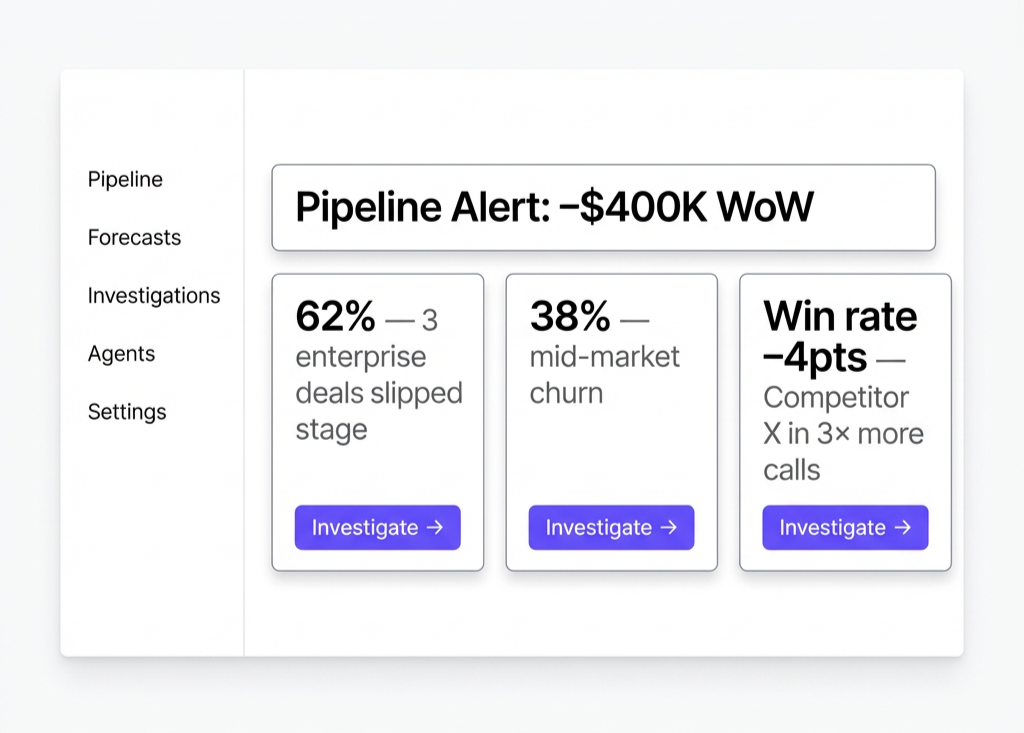
Monday 8 AM. You open Tellius. Instead of dashboards, you see: Pipeline is down $400K WoW — 62% from 3 enterprise deals that slipped stage, 38% from mid-market churn. Win rate dropped 4 points — driven by deals where Competitor X appeared in 3x more Gong calls. Forecast confidence is 74%, down from 81%, with 2 territories flagged. Each finding is clickable — ask "why did enterprise deals slip?" and get the full root cause tree in seconds, with citations from Salesforce records, Gong calls, and Google Drive documents. No analyst request. No spreadsheet. No waiting.
Where Tellius excels: The combination of multi-source data unification, proactive intelligence, and conversational analytics creates the most distance from dedicated RevOps tools. The same engine delivers 12x faster root cause investigation for PepsiCo and 88% time savings for Novo Nordisk — applied to revenue data. When pipeline drops 18%, Tellius generates a complete investigation ranking contributing factors (e.g., "Mid-market contributed 58% of the decline — competitive displacement in 3x more calls, rep capacity at 120% quota coverage, pricing objections in deals >$100K"), connecting CRM data with conversation evidence, and delivering the explanation with citations before the forecast call. No other platform performs this level of autonomous investigation across both pipeline metrics and deal evidence.
Gartner Magic Quadrant Visionary five consecutive years (2022–2026). 4.8/5.0 on Gartner Peer Insights — the highest-rated in its category. Trusted by PepsiCo, eBay, and 8 of the top 10 pharmaceutical companies including Novo Nordisk, AbbVie, and Bristol Myers Squibb.
Where Tellius falls short: Tellius didn't originate as a dedicated RevOps tool — its deepest pre-built intelligence is in pharma, CPG, and finance, now extending into RevOps. Teams used to Clari's pipeline UX or Gong's coaching workflows won't find identical experiences — Tellius's interface is built for investigation, not deal management or call coaching. No native CRM workflow automation (sequences, cadences, live coaching) — pair with dedicated engagement tools. No free tier or self-serve signup.
Pricing: Two tiers, both with no per-user fees. Pro — governed conversational analytics and automated root cause investigation with streamlined deployment. Enterprise — adds proactive workflows, orchestration, SSO/RLS, and dedicated support. Custom pricing on both. Request a demo.
Ideal for: RevOps leaders drowning in manual investigation — spending days assembling forecast narratives, investigating deal slippage across CRM and call data, and running post-mortems — who need intelligence that connects, monitors, and explains automatically.
2. Clari — Best for Enterprise Pipeline Management & Forecasting
Clari is the enterprise standard for revenue forecasting and pipeline visualization, now expanding into a full "revenue orchestration" platform following its merger with Salesloft (closed December 2025, combined ARR ~$450M). Built on RevDB — a time-series revenue data model — Clari captures activity signals across the GTM stack and provides mature pipeline analytics through Waterfall, Flow, Trend, and Pulse views. The Salesloft merger adds sales engagement (sequences, cadences, dialer) to create a combined forecasting + engagement platform under new CEO Steve Cox.
Key capabilities:
- RevDB time-series data model capturing activity signals across the GTM stack
- Mature pipeline analytics: Waterfall (pipeline movement tracking), Flow (deal progression), Trend (historical patterns), Pulse (real-time signals)
- AI-driven forecasting with claimed 96-98% accuracy
- Clari Copilot (via Wingman acquisition): call recording, transcription, real-time coaching
- Salesloft integration: sales engagement, cadences, and dialer
- AI Advanced Opportunity Scores for deal health assessment
- Deal Inspection Agent and Trend Analysis Agent (both Early Access as of late 2025)
Where Clari excels: Pipeline visualization and forecasting maturity. Clari's Waterfall analytics — showing pipeline movement as new deals, slippage, pull-ins, and push-outs — is the gold standard for revenue leadership. The forecasting engine, trained on years of CRM data, consistently delivers strong accuracy for organizations with clean pipeline data. One customer reports consistently landing within 3-4% every quarter. Clari was named a Leader in the inaugural Gartner Magic Quadrant for Revenue Action Orchestration (December 2025) and holds a 4.6/5 on G2.
Where Clari falls short: Clari excels at showing what changed in the pipeline but does not explain why. Waterfall analytics shows that $2M slipped from commit to best case — but the investigation into why those deals slipped is still manual. Deal health scores flag at-risk deals without decomposing the contributing factors. The Wingman integration (now Clari Copilot) adds conversation data, but it remains modularly integrated — conversation signals feed into deal scores, but there is no unified investigation connecting call patterns to pipeline trends. There are no conversational analytics — you navigate dashboards, you don't ask questions. A Gartner reviewer explicitly noted that Clari needs to "migrate to more of an AI-centered forecast" that incorporates "external sources of data." Post-merger integration with Salesloft introduces uncertainty; Forrester described the merger as "a bold, high-risk, high-reward gambit" and warned of significant product overlap.
Pricing: Custom enterprise pricing, not published. Estimated: Core Forecasting ~$100-125/user/month, Copilot ~$90-110/user/month, combined stack $200-400+/user/month. Implementation: $15K-$75K, 8-16 week timeline.
Ideal for: Enterprise revenue leadership (CRO, VP Sales) that needs best-in-class pipeline visualization and forecasting accuracy — and has the analyst capacity to investigate root causes when the forecast shows problems.
3. Gong — Best for Sales Conversation Intelligence & Coaching
Gong is the category leader in conversation intelligence, now positioning as the "Revenue AI Operating System" built on its Revenue Graph — a network of revenue data capturing every interaction across 70+ languages, trained on 3.5B+ sales interactions. Gong surpassed $300M ARR in January 2025 (28% YoY growth) and was named a Leader in the 2025 Gartner Magic Quadrant for Revenue Action Orchestration — placed highest on both axes.
Key capabilities:
- Industry-leading conversation intelligence: call recording, transcription, and analysis in 70+ languages
- Revenue Graph connecting interaction data across the GTM stack
- Gong Engage (sales engagement, launched June 2023)
- Gong Forecast (revenue forecasting)
- Gong Orchestrate (workflow automation, October 2025 — initially waitlist)
- Agent Studio for custom agent configuration
- Ask Anything for natural language queries across conversation data
Where Gong excels: Conversation data depth. No other platform has Gong's breadth of analyzed sales interactions or the quality of its conversation intelligence. The AI Briefer reportedly drives a 19% increase in win rates. Ask Anything (400% YoY growth) lets users query conversation patterns across all deals. The new AI Deep Researcher (October 2025) handles complex business questions requiring multi-step analysis. Gong captures what's happening in customer conversations at scale — coaching patterns, competitive mentions, objection trends, buying signals — and that data is irreplaceable.
Where Gong falls short: Gong's DNA is unstructured data — calls, emails, meetings — and its expansion into structured pipeline analytics is still maturing. Forecasting capability has been informally rated "4/10" by some revenue leaders compared to dedicated forecasting tools. Only 25% of Gong customers buy multiple products, suggesting the full-platform story hasn't landed yet. Gong's own pipeline investigation documentation describes a manual three-step process: find blips in Analytics trends, filter in Changes report, then triage individual deals. Ask Anything queries conversation data but doesn't investigate across CRM metrics and documents to explain pipeline-level changes. Gong does not analyze documents — contracts, competitive intelligence files, policy documents, or research reports are outside its data model. Pricing is aggressive: per-user plus mandatory platform fee, with multi-year contracts and no mid-contract seat reductions.
Pricing: Custom, per-user + mandatory platform fee. Platform fee: $5,000-$50,000/year. Per-user: $1,200-$1,600/year (~$100-134/month). Bundled pricing (Foundation + Engage + Forecast) pushing ~$250/user/month. Onboarding: $7,500+. For 100 users: ~$170,000-$330,000/year.
Ideal for: Sales leadership that prioritizes conversation intelligence and coaching, and wants a single platform expanding into pipeline management and forecasting — with the understanding that cross-source investigation and conversational analytics across all revenue data are still maturing.
4. Aviso — Best for AI-Native Forecasting with Complex Revenue Models
Aviso is the AI-native dark horse built on machine learning from inception (founded 2012). Its core differentiator is forecasting accuracy — claiming 98% accuracy validated at New Relic for consumption-based forecasting — using RNNs, LSTMs, Gradient Boosted Methods, and Bayesian models. Aviso's time-series database (Aviso Replay) continuously monitors every change, and its MIKI "AI Chief of Staff" orchestrates 30+ GTM workflows with 50+ task-specific agents.
Key capabilities:
- AI-native forecasting with claimed 98% accuracy across opportunity-based and consumption-based models
- Aviso Replay: time-series database monitoring every pipeline change
- MIKI AI Chief of Staff with RAG architecture
- AI Avatars: virtual BDRs, Sales Engineers, and Customer Success reps
- Multi-CRM support: Salesforce, Dynamics, SAP, Oracle, HubSpot, Veeva, Snowflake
- 30+ workflows with 50+ task-specific agents
- WinScore with explainable deal-level predictions
Where Aviso excels: Forecasting depth and flexibility. Aviso was the first platform to deploy billion-dollar scale consumption forecasting (for Snowflake customers) and supports both opportunity-based and consumption-based models natively. Multi-CRM support is a genuine differentiator — organizations running multiple Salesforce instances, Dynamics, and SAP can consolidate forecasting in a single platform. WinScore incorporates CRM data, multi-channel engagement, conversations, and historical trends with explainable deal-level predictions.
Where Aviso falls short: Multiple reviewers report bugs and slow performance. Dashboard customization reverts unexpectedly. Deal scoring lacks transparency. Separate login from Salesforce creates workflow friction. Despite ambitious agent claims, the platform's investigation remains deal-level explanation rather than portfolio-level root cause investigation connecting pipeline data with conversation and document evidence. No conversational analytics across all revenue data. Smaller brand recognition means fewer integrations and a smaller partner ecosystem than Clari or Gong.
Pricing: Custom enterprise pricing. Annual/multi-year contracts. White-glove onboarding and free migration included.
Ideal for: Revenue operations teams in complex environments — multi-CRM, consumption-based pricing models, or hybrid SaaS + usage models — that need AI-native forecasting accuracy above all else.
5. BoostUp / Terret — Best for Mid-Market Forecasting at Accessible Pricing
BoostUp rebranded as Terret in September 2025 and launched the Virtual Revenue Fleet — a suite of interconnected AI agents. Under CEO Justin Shriber (ex-LinkedIn, Oracle), the platform is repositioning from "forecasting tool" to "full-stack AI revenue system." BoostUp's key differentiator is multi-dimensional forecasting supporting SaaS subscriptions, consumption/usage, PLG motions, renewals, and expansions — at a price point significantly below Clari or Gong.
Key capabilities:
- Multi-dimensional forecasting: SaaS, consumption, PLG, renewals, and expansions
- RevBI module for self-service revenue analytics
- Native conversation intelligence (or integrates with existing Gong/Chorus via APIs)
- Virtual Revenue Fleet: Pipeline Builder, Sales Process Agent, Mutual Action Planner, Terret GPT
- Claims 95% forecast accuracy within 4 weeks of quarter
Where BoostUp/Terret excels: Flexibility and value. Unlike Clari and Gong which push rip-and-replace, Terret integrates with existing conversation intelligence tools via APIs — teams already using Gong can add Terret for forecasting without abandoning their CI investment. RevBI enables self-service revenue analytics without requiring a central data team. Named a 2025 G2 Momentum Leader with 11 Enterprise awards. Starting at ~$79/user/month, it's the most affordable dedicated RevOps platform.
Where BoostUp/Terret falls short: Only 57 employees — scale and long-term viability are real concerns. The rebrand from BoostUp to Terret creates market confusion. Virtual Revenue Fleet agents are ambitious but early-stage. No root cause investigation beyond deal-level scoring. No document analysis capability. Limited analyst coverage compared to Clari and Gong. No conversational analytics across revenue data.
Pricing: Starting ~$79/user/month. Free trial available.
Ideal for: Mid-market and growth-stage companies that need dedicated forecasting and pipeline analytics at an accessible price point without the $250+/user enterprise pricing of Clari or Gong.
6. Salesforce Revenue Cloud + Einstein + Agentforce — Best for Salesforce Ecosystem Consolidation
Salesforce Revenue Cloud (renamed Agentforce Revenue Management at Dreamforce 2025) is an end-to-end quote-to-cash platform with 8 modules. Einstein AI adds lead/opportunity scoring, predictive forecasting, and Einstein Conversation Insights for call transcription. Agentforce introduces AI agents for lead nurturing, deal insights, quoting, and sales coaching. Together, they represent the broadest — and most expensive — option for Salesforce-native organizations.
Key capabilities:
- Revenue Cloud: Product Catalog, Advanced Configurator, Price Management, CPQ, Contract Lifecycle, Order Orchestration, Billing, Revenue Analytics
- Einstein AI: lead/opportunity scoring, predictive forecasting, activity capture, Einstein Conversation Insights
- Agentforce agents: Lead Nurturing, Deal Insights, Quoting, Sales Coach, SDR Agent
- Revenue Intelligence add-on ($220/user/month) for advanced pipeline analytics
- Deep Data Cloud integration
Where Salesforce excels: Platform breadth. No other vendor offers the combination of CRM, CPQ, billing, engagement, and AI in a single ecosystem. For organizations already deeply invested in Salesforce, consolidation reduces integration complexity. Einstein Discovery can build custom predictive models. The Agentforce agent marketplace is growing rapidly.
Where Salesforce falls short: The full AI sales stack costs $500-650/user/month — a 50-person team faces $336,000+ annually in licensing alone. Einstein Conversation Insights provides baseline call analysis but is less mature than Gong by a wide margin. Agentforce agents are primarily focused on B2C and customer service rather than complex B2B revenue investigation. No automated root cause investigation. No conversational analytics that can query across CRM and conversation data simultaneously. Multiple G2 reviews flag adoption challenges and unclear pricing for Agentforce.
Pricing: Full AI stack: Enterprise ($165/user/mo) + Agentforce ($125-150) + Einstein Conversation Insights ($50) + Revenue Intelligence ($220) = $500-650/user/month. A 6% price increase took effect August 2025.
Ideal for: Large enterprises deeply invested in Salesforce that want end-to-end consolidation from CRM to billing — and can absorb premium pricing for ecosystem simplicity.
7. People.ai — Best for CRM Activity Data Capture & Enrichment
People.ai is the activity data infrastructure play — automatically capturing emails, calls, and meetings and mapping them to deals and accounts in Salesforce. Valued at $1.1B, recognized as a Visionary in the 2025 Gartner MQ for Revenue Action Orchestration, People.ai's core differentiation is its data layer — it integrates with other sales tools rather than replacing them.
Key capabilities:
- Patented activity capture technology: automatically maps emails, calls, meetings to CRM records
- Trained on $239B+ in closed/won deals and 1.1B+ unique sales activities
- AI-native forecasting (GA 2025) with bottoms-up approach and 360-degree deal view
- "Top Stories" feature aggregating pipeline risks
- Deep Salesforce integration
Where People.ai excels: Data quality. People.ai solves the foundational problem that undermines every other RevOps tool: bad CRM data. By automatically capturing and mapping activities, it creates the activity data foundation that forecasting and pipeline analytics depend on. Unlike Gong (call-centric) or Clari (forecast-centric), People.ai plays well with both.
Where People.ai falls short: Call data can take a day or two to appear. Less robust native conversation intelligence than Gong. "Time Spent" attribution is imprecise. Primarily Salesforce-focused. AI forecasting is newer and less battle-tested than Clari or Aviso. No root cause investigation. No document analysis. No conversational analytics beyond basic reporting. The platform is a data infrastructure layer, not an intelligence layer — it improves the data that feeds other tools rather than performing the investigation itself.
Pricing: Custom enterprise pricing. Estimated $50-100/user/month.
Ideal for: Revenue operations teams that recognize bad CRM data as their primary problem and want an activity data layer that enriches their existing stack (Clari, Gong, or Salesforce native).
8. HubSpot Operations Hub + Breeze AI — Best for SMB/Mid-Market All-in-One
HubSpot Operations Hub (rebranded to Data Hub at INBOUND 2025) combined with Breeze AI provides an accessible, integrated RevOps environment for companies that want CRM, marketing automation, and revenue analytics in a single platform. Breeze AI adds 15+ agents across marketing, sales, and service — including a Prospecting Agent that saw 94% quarter-over-quarter adoption growth in Q3 2025.
Key capabilities:
- Integrated CRM + marketing automation + service in a single platform
- Breeze AI: Assistant (copilot), Agents (15+), Intelligence (data enrichment)
- Predictive forecasting in Sales Hub
- Data Hub (formerly Operations Hub) for data sync, quality, and automation
- Breeze Prospecting Agent for automated outreach
Where HubSpot excels: Simplicity and integration. For companies with 10-500 employees, HubSpot eliminates the multi-tool complexity that plagues larger RevOps stacks. Everything lives in one system — no integration headaches between CRM, engagement, and analytics. Pricing is dramatically more accessible than enterprise alternatives.
Where HubSpot falls short: No root cause investigation. No native call recording platform comparable to Gong. Forecasting can't handle complex multi-hierarchy environments. Breeze only works within HubSpot's ecosystem — external data is invisible. Pipeline analytics are basic compared to Clari or Gong. Conversational analytics limited to HubSpot data only. Not suitable for enterprises with complex forecasting, multi-entity structures, or heavy compliance requirements.
Pricing: Data Hub Professional $800/month + $50/additional seat. Sales Hub Professional $100/seat/month. Combined: $100-250/user/month depending on hub configuration.
Ideal for: SMBs and mid-market companies (10-500 employees) that want all-in-one simplicity — CRM, engagement, and basic revenue analytics in a single platform — without building a multi-vendor stack.
9. Microsoft Dynamics 365 + Copilot for Sales — Best Value Enterprise RevOps Stack
Microsoft Dynamics 365 Sales Premium ($150/user/month) combined with Microsoft 365 Copilot ($30/user/month) delivers the best price-to-capability ratio in the market. Copilot for Sales was folded into the standard M365 Copilot license at no extra cost (October 2025), providing unlimited conversation intelligence in Teams, CRM management from Outlook, real-time tips during calls, and natural language CRM queries. It works with both Dynamics 365 and Salesforce as CRM backend.
Key capabilities:
- Sales Premium: advanced relationship analytics, predictive scoring, pipeline intelligence
- Copilot for Sales: conversation intelligence in Teams, CRM record management, real-time tips
- Natural language CRM queries
- Sales Qualification Agent (2025 Wave 2 release)
- Works with Dynamics 365 AND Salesforce
Where Microsoft excels: Value. At $180/user/month total, it's less than half the cost of Salesforce's full AI stack and significantly cheaper than Gong or Clari. For organizations already on Microsoft 365 and Teams, the integration is seamless — no additional tool adoption required. 2.1M+ monthly Copilot users as of March 2025 suggest real traction.
Where Microsoft falls short: Conversation intelligence is less mature than Gong. Forecasting is less specialized than Clari. No automated root cause investigation. No document analysis for revenue intelligence. Conversational analytics limited to CRM data queries. Smaller CRM market share means a smaller partner ecosystem. No CPQ or billing comparable to Salesforce Revenue Cloud.
Pricing: Dynamics 365 Sales Premium ($150/user/mo) + M365 Copilot ($30/user/mo) = ~$180/user/month.
Ideal for: Organizations already on Microsoft 365 and Teams that want solid RevOps capabilities at the best price point in the market — and where the primary goal is value rather than best-in-class depth in any single capability.
10. 6sense — Best for Intent Data & Top-of-Funnel Pipeline Creation
6sense is the intent data and account-based marketing leader, recently repositioning as an "agent-powered Revenue Intelligence platform." Its Signalverse captures trillions of buyer signals to identify accounts showing purchase intent before they enter the pipeline. RevvyAI (November 2025) adds a conversational AI command center. Named a Leader in the 2025 Gartner MQ for ABM Platforms.
Where 6sense fits in the revenue intelligence stack: 6sense operates before and around the pipeline, not inside it. It's a pipeline creation tool — generating qualified opportunities from intent signals — not a pipeline investigation tool. There is no pipeline analytics, no deal-level forecasting, no post-pipeline root cause investigation, and no conversation intelligence. For RevOps teams, 6sense is complementary to (not competitive with) the pipeline intelligence platforms in this comparison. Customers report 2x deal sizes and 4x higher win rates from intent-driven targeting. Pricing: $60,000-$300,000/year depending on data volume and features.
Ideal for: B2B marketing and demand gen teams that need intent-driven pipeline creation — as a complement to pipeline analytics and conversation intelligence tools.
How Tellius Works With Your Existing Revenue Stack
Tellius is not a rip-and-replace for any tool in this comparison. It's the intelligence layer that sits on top of your existing stack and adds the investigation capability that none of these tools provide on their own. After reviewing all 10 platforms, Tellius is the only one that delivers proactive revenue intelligence across CRM, conversations, and documents — connecting all revenue data sources into a single governed model, monitoring 24/7 with AI agents that investigate anomalies autonomously, and enabling any revenue leader to ask complex questions conversationally and get instant, governed answers with document-level citations.
Tellius + Gong. Gong captures what's happening in every customer conversation — competitive mentions, objection patterns, buying signals, sentiment shifts. That data is irreplaceable. Tellius ingests Gong call transcripts as a native data source and connects those conversation signals to pipeline data and deal documents, investigating the relationship across all of it. A concrete example: Tellius detects that enterprise win rates dropped 8 points. Its investigation pulls Salesforce pipeline data showing which deal stages are leaking, Gong call data showing a 3x increase in Competitor X mentions in lost deals, and competitive intelligence documents from Google Drive showing Competitor X launched aggressive displacement pricing. The finished insight ranks each factor's contribution, cites the specific calls and documents, and delivers an executive summary. Gong provided the conversation intelligence. Tellius provided the investigation connecting it to everything else.
Tellius + Clari. Clari provides pipeline visualization and forecasting — Waterfall analytics and deal health scoring are best-in-class. Tellius provides the investigation that explains why the pipeline looks the way it does. Both connect to Salesforce as the underlying data source. The combination gives revenue leadership Clari's Waterfall view of what moved — and Tellius's investigation of why it moved. The question isn't Tellius or Clari — it's whether your bottleneck is pipeline visibility (keep Clari) or the 3-5 day investigation after the forecast shows a problem (add Tellius).
Tellius + Salesforce. Tellius connects natively to Salesforce and investigates pipeline data, opportunity history, activity logs, and forecast submissions. RevOps teams keep Salesforce as their CRM and system of record. Tellius adds the intelligence layer: root cause investigation on forecast variances, proactive monitoring on pipeline health, and conversational analytics connecting Salesforce data with conversation and document evidence.
Tellius + HubSpot, Snowflake, Google Drive, and 30+ sources. Tellius's connector library includes CRM systems, data warehouses, cloud storage, and collaboration tools. For RevOps teams working across multiple data sources — pipeline data in Salesforce, call recordings in Gong, competitive intelligence in Google Drive, financial data in Snowflake — Tellius provides the single intelligence layer that investigates across all of them.
The pricing model supports this complementary positioning: no per-user fees means Tellius adds an intelligence layer to the stack without multiplying per-seat costs across the entire sales organization. For a 100-person sales org already spending $700K+ on tools, Tellius adds the investigation capability the entire stack is missing — without adding another $100-250/user/month to the pile.
.png)
What "Agentic RevOps" Actually Means (And Who's Faking It)
The term "agentic" has become the most overused label in the revenue technology category. Clari claims an "Autonomous Revenue System," Gong launched 12+ "AI agents," Aviso offers 50+ "task-specific agents," BoostUp/Terret introduced a "Virtual Revenue Fleet," and 6sense rebranded as "agent-powered Revenue Intelligence." But there is a material difference between platforms where AI autonomously performs revenue investigation and platforms that rebranded existing features with the word "agent."
Gartner has been direct about this problem. In June 2025, Gartner estimated that only about 130 of the thousands of agentic AI vendors are real. Gartner's Anushree Verma stated that most agentic AI propositions lack significant value or ROI because current models lack the maturity to autonomously achieve complex business goals.
A useful litmus test: Can the platform detect a pipeline anomaly, autonomously investigate why it happened across both CRM data and conversation/document data, and deliver a finished explanation — without a human directing each step?
By that standard, Tellius qualifies — its agents autonomously monitor pipeline metrics, detect anomalies, investigate root causes across all connected data sources, chain analytical steps through orchestrated workflows, and deliver finished insights with quantified drivers and document-level citations. Gong's 12+ agents automate specific tasks within defined workflows (transcription, scoring, data extraction) but require human prompting and don't perform autonomous multi-source investigation — Gong's CEO has explicitly positioned them as "augmenting human beings, not replacing them." Clari's Deal Inspection Agent and Trend Analysis Agent are in Early Access and represent early moves toward autonomous analysis but remain nascent. Aviso's MIKI framework offers the most ambitious architecture among dedicated RevOps tools but lacks the investigation depth of connecting pipeline data with deal evidence at a root cause level. Salesforce Agentforce agents focus primarily on B2C and customer service use cases.
The distinction matters because choosing a platform based on its "agentic" marketing rather than its actual autonomous investigation capabilities will leave your RevOps team doing the same manual work — just with a nicer interface layered on top.
Tellius vs Clari: Investigation vs Pipeline Visualization
Tellius and Clari both serve revenue leadership — but they solve fundamentally different problems. Clari is the gold standard for pipeline visualization and revenue forecasting: Waterfall analytics, deal health scoring, and ML-driven forecast projections. Tellius is built for investigation: automated root cause analysis, proactive monitoring, and the ability to connect pipeline metrics with conversation and document evidence in a single analysis — all queryable through conversational analytics.
The question isn't "Tellius or Clari?" — it's "do you need to see what happened, or understand why it happened?" When pipeline drops 18%, Clari shows you the Waterfall — $2M moved from commit to best case, $800K pushed to next quarter. Tellius tells you why: mid-market rep capacity drove 58% of the slippage (three AEs at >120% quota capacity couldn't advance Stage 2 deals), competitive displacement drove 27% (Competitor X mentioned in 3x more calls than last quarter, concentrated in financial services), and pricing objections drove 15% (concentrated in deals >$100K where new procurement policies created friction).
Clari does not offer automated root cause investigation, conversational analytics across revenue data, or proactive monitoring with root cause explanations. Tellius does not offer native CRM workflow automation, sales engagement sequences, or live call coaching.
Choose Clari if your bottleneck is pipeline visibility and forecasting accuracy — and you have the analyst capacity to investigate root causes manually. Choose Tellius if your bottleneck is the 3-5 day investigation that happens after the forecast shows a problem. Consider both if you need Clari's deal management with Tellius's intelligence layer on top — the strongest configuration for revenue leadership that needs both visibility and explanation.
Tellius vs Gong: Revenue Investigation vs Conversation Intelligence
Gong and Tellius approach revenue intelligence from opposite directions. Gong starts from conversation data — 3.5B+ sales interactions — and is expanding into pipeline analytics. Tellius starts from deep investigation capabilities — root cause decomposition, proactive monitoring, conversational analytics — and connects to both pipeline data and conversation data including Gong.
Gong captures what's happening in conversations. Tellius connects those signals to pipeline metrics and documents and investigates the relationship.
Where Gong is unmatched: conversation intelligence depth. No platform has Gong's breadth of analyzed interactions or the quality of its call analysis. For understanding what's happening in customer conversations at scale, Gong is the category leader.
Where Tellius is unmatched: cross-source investigation. When a RevOps leader asks "why is the forecast for EMEA 15% below target?", Gong surfaces call themes and deal signals related to the shortfall. Tellius autonomously investigates across pipeline metrics, conversation signals, and document evidence — delivering a finished executive summary with citations. Gong tells you that competitors are being mentioned 3x more. Tellius tells you that those mentions are driving 27% of your pipeline decline in the enterprise segment, concentrated in financial services deals over $100K, connected to a pricing change documented in your competitive intelligence files.
Gong does not perform automated root cause investigation on pipeline data, does not analyze documents, and does not deliver proactive monitoring with root cause explanations. Tellius does not record calls, provide real-time coaching, or match Gong's conversation intelligence depth.
The "better together" case: When Tellius ingests Gong as a data source, the combination is more powerful than either alone. Gong captures every conversation. Tellius connects those conversations to pipeline metrics and documents and investigates the relationship across all of it — delivering finished explanations with citations from CRM records, Gong calls, and deal documents. This is the configuration that delivers the deepest revenue intelligence available today.
Choose Gong if conversation intelligence and sales coaching are your primary needs. Choose Tellius if automated investigation — connecting pipeline metrics with conversation signals and deal documents — is your primary need. Choose both if you want Gong's unmatched conversation intelligence feeding directly into Tellius's investigation engine.
The Real Cost of a Revenue Intelligence Stack in 2026
Most enterprises don't buy one revenue intelligence tool — they layer multiple platforms, creating what industry observers call the "Frankenstack." The total cost is significantly higher than any individual vendor's pricing page suggests:
For a 100-person sales organization, that's $696,000-$1,026,000/year in tool spending — before implementation, training, and maintenance. And the investigation work — understanding why pipeline dropped, why deals slipped, why the forecast missed — is still manual. The stack provides data and visibility. The root cause investigation is done in spreadsheets.
Tellius's pricing model is designed for exactly this problem. No per-user fees means you're adding an intelligence layer to your stack — not multiplying per-seat costs across 100 sellers who may never log in. The investigation engine, proactive monitoring, and conversational analytics are priced by deployment scope and data volume, not headcount. For a 100-person sales org already spending $700K+ on tools, Tellius adds the investigation capability the entire stack is missing — without adding another $100-250/user/month to the pile.
.png)
Frequently Asked Questions
Part 1: Understanding Revenue Intelligence
What is a revenue intelligence platform?
A revenue intelligence platform uses AI to analyze pipeline metrics, CRM records, conversation transcripts, and deal signals — helping revenue teams understand why deals win or lose and why forecasts miss. The category ranges from conversation intelligence tools (Gong) to forecasting engines (Clari, Aviso) to platforms like Tellius that autonomously investigate root causes across multiple data sources and deliver finished explanations.
What is the difference between revenue intelligence and a CRM dashboard?
Revenue intelligence captures sales activity data, analyzes pipeline health, and provides visibility into deal progression. CRM dashboards display pipeline data for human interpretation. The key distinction: revenue intelligence platforms can predict outcomes, detect anomalies, and — in the case of Tellius — autonomously investigate why pipeline metrics changed and deliver finished explanations.
What is the Revenue Root Cause Gap?
The Revenue Root Cause Gap is the distance between knowing that pipeline changed and understanding why. Every platform in this comparison can show you pipeline movement. Only Tellius autonomously investigates the contributing factors — connecting CRM data with conversation signals and document evidence — and delivers finished explanations with actionable recommendations.
What is conversational analytics for revenue teams?
Conversational analytics enables revenue leaders to ask complex business questions in plain English — "why did we lose more enterprise deals this quarter?" — and receive instant, governed, auditable answers. Unlike dashboards that require navigation and technical skills, conversational analytics lets any team member query revenue data naturally. Governed consistency (same question, same answer regardless of who asks) is what differentiates enterprise-grade conversational analytics from basic chatbot interfaces.
Part 2: Evaluating and Comparing Platforms
How does Tellius compare to Clari?
Clari excels at pipeline visualization and forecasting — Waterfall analytics and deal health scoring are best-in-class. Tellius excels at explaining why pipeline is behaving the way it is, with automated root cause investigation connecting pipeline data with conversation and document evidence, plus conversational analytics where anyone can ask questions and get governed answers. The platforms are complementary: Clari shows what changed, Tellius investigates why.
How does Tellius compare to Gong?
Gong is the conversation intelligence leader — unmatched across 3.5B+ interactions. Tellius is the only platform here that performs automated root cause investigation across all revenue data sources and provides conversational analytics that query across CRM, conversations, and documents simultaneously. The strongest configuration uses both: Gong for conversation intelligence feeding into Tellius for cross-source investigation. Tellius connects to Gong natively.
What is the best alternative to Clari for revenue intelligence?
The best complement (rather than replacement) depends on your gap. If you need deeper conversation intelligence, add Gong. If you need to understand why pipeline is changing — with automated investigation across CRM data, conversation signals, and deal documents — add Tellius. If you need better activity data capture, add People.ai. Tellius is the only option that adds root cause investigation, proactive intelligence, and conversational analytics to Clari's pipeline management.
What RevOps tools work with Gong?
Tellius, Clari, Salesforce, HubSpot, and most major RevOps platforms integrate with Gong. Tellius provides the deepest analytical integration — ingesting Gong call transcripts as a native data source and including conversation signals directly in root cause investigations alongside CRM data and document evidence. When pipeline drops, Tellius's finished insight cites specific Gong calls, CRM records, and competitive intelligence documents in a single analysis with ranked driver attribution.
How do I automate revenue root cause analysis?
Automated revenue root cause analysis requires three capabilities working together: multi-source data unification (connecting CRM, conversation, and document data), proactive monitoring (detecting when metrics change), and analytical investigation (decomposing changes into ranked contributing factors). Tellius is the only platform in this comparison that delivers all three — autonomously investigating why pipeline metrics changed and delivering finished explanations with document-level citations.
How do I explain a revenue miss to my board?
Most RevOps teams spend 3-5 days manually assembling post-quarter narratives — pulling CRM data, cross-referencing call recordings, and building slides. Tellius automates this: ask "why did we miss target in Q4?" and receive a finished root cause investigation that ranks contributing factors (e.g., "42% from enterprise churn, 30% from deal slippage, 28% from pricing compression"), cites evidence from CRM records and call transcripts, and can be exported directly to PowerPoint, PDF, or Excel for board presentation.
Can we use Tellius with our existing RevOps tools?
Yes — this is the recommended approach. Tellius connects natively to Salesforce, HubSpot, Gong, Snowflake, and 30+ sources. Keep your existing tools for what they do best. Add Tellius for root cause investigation, proactive intelligence, and conversational analytics. No per-user pricing means you're adding an intelligence layer, not multiplying per-seat costs.
Do we still need Clari or Gong if we have Tellius?
It depends on where your bottleneck is. If the problem is understanding why pipeline is changing, Tellius addresses that directly — with the investigation, proactive intelligence, and conversational analytics that neither Clari nor Gong offer. If the problem is pipeline visibility and forecasting, keep Clari. If it's conversation intelligence and coaching, keep Gong. Tellius provides the intelligence layer that completes what neither offers.
What is the best revenue intelligence platform for B2B RevOps teams?
Tellius is the only platform in this comparison delivering automated root cause investigation across CRM data, conversation evidence, and deal documents, with governed conversational analytics and proactive monitoring. For teams drowning in manual investigation — assembling forecast narratives, investigating deal slippage, running post-mortems — Tellius replaces the investigative labor with intelligence that connects, monitors, and explains automatically.
Part 3: Pricing, Deployment, and ROI
How much does a revenue intelligence stack cost in 2026?
The typical enterprise stack costs $7,000-$10,000 per user per year layering CRM, conversation intelligence, revenue intelligence, and engagement tools. Individual platforms range from BoostUp/Terret (~$79/user/month) to Salesforce's full AI stack ($500-650/user/month). Tellius offers Pro and Enterprise tiers with custom pricing and no per-user fees — adding an intelligence layer without multiplying per-seat costs.
How does Tellius pricing work?
Tellius offers two tiers, both with no per-user fees. Pro is for mid-size teams needing governed conversational analytics and automated root cause investigation with streamlined deployment. Enterprise adds proactive intelligence workflows, orchestration, SSO/RLS, and dedicated support. Pricing is custom based on deployment scope and data volume. Request pricing.
Can we run a pilot before full deployment?
Yes. Tellius engages through a consultative sales process that includes a demo tailored to your data environment and use cases. Enterprise evaluations typically include a proof-of-value phase connecting to your actual data sources — so you see root cause investigation on your pipeline data before committing.
How long does it take to deploy revenue intelligence?
CRM-native tools activate in days. Dedicated platforms (Clari, Gong) deploy in 8-16 weeks. Tellius Pro deploys in 4-6 weeks; Tellius Enterprise in 6-10 weeks depending on data environment complexity. Time-to-value is accelerated by pre-built connectors for Salesforce, Gong, HubSpot, and 30+ sources.
What ROI should RevOps teams expect from automated root cause investigation?
Speed: root cause investigation drops from 3-5 days to seconds (PepsiCo reports 12x faster). Capacity: analysts reclaim 20+ hours/month (Novo Nordisk reports 88% time savings). Business impact: proactive detection catches pipeline issues weeks earlier. Typical payback: 6-9 months, with $50,000/year in value per automated workflow.
Disclosure
This article is published by Tellius. We are a vendor in this category, and we've positioned ourselves favorably — as every vendor comparison guide does. The difference: we've been transparent about our limitations (not a native CRM workflow or deal management tool, no free tier, no self-serve trial, deepest domain intelligence is in pharma/CPG/FP&A with RevOps extending, upfront semantic layer configuration required), applied the same evaluation template to every platform, and cited third-party sources where available. We've given Clari genuine credit for pipeline visualization excellence, Gong genuine credit for conversation intelligence leadership, and Aviso genuine credit for forecasting innovation — because they've earned it. If you believe we've misrepresented any competitor's capabilities, contact us and we'll update the article.
Get release updates delivered straight to your inbox.
No spam—we hate it as much as you do!

