

ThoughtSpot alternative: migrating from ThoughtSpot to Tellius (2026 guide)

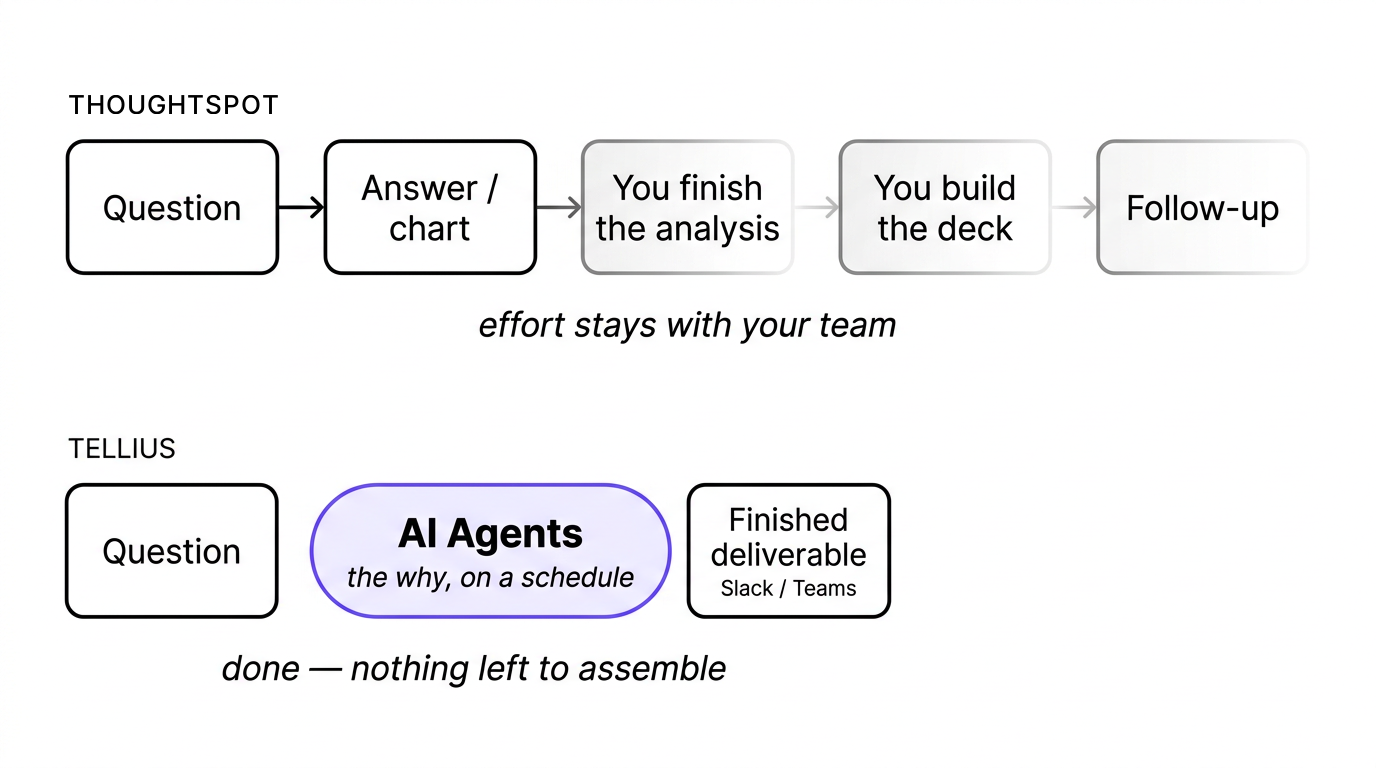
Tellius gives everyone on your team an AI worker that shows up with the work done, not just an answer. ThoughtSpot Spotter uses AI to hand back answers: charts, Liveboards, numbers with traces — still leaving the investigation, the deck, and next month's re-run for your team to do. The Tellius AI worker reasons over your governed data, diagnoses why the number moved, and delivers finished work — the brief, the deck, the recommended play — on a schedule built for pharma and CPG commercial teams. This guide covers why teams move off ThoughtSpot, what they get with Tellius, and how to migrate in days, not months.
Agents are arriving in the analytics stack either way. Gartner expects 40% of enterprise applications to include task-specific AI agents by the end of 2026, up from under 5% in 2025. For a team already running ThoughtSpot, the question is whether the agent that shows up hands you an answer or hands you the work.
ThoughtSpot outgrew search. The work after the answer still lands on your team.
ThoughtSpot is built around Spotter, a conversational agent that plans multi-step analysis and shows its work, joined this year by a suite of build agents — SpotterModel drafts governed semantic models, SpotterViz assembles dashboards, SpotterCode writes embedding code, and Spotter 3 reads unstructured sources alongside the warehouse.
Spotter answers the questions you ask and makes it faster for analytics teams to stand up models, dashboards, and embedded apps. But it still requires someone to decompose the number, chase the why across IQVIA extracts and Veeva call notes, builds the deck, and re-runs the whole exercise next month. The Tellius AI worker runs the job itself: it diagnoses why the number moved, produces the brief or the deck, and repeats on a schedule with an audit trail.
If ThoughtSpot is the incumbent, these five questions locate where the tool stops and whether that costs you anything:
- When the chart comes back, is the job done or just starting?
- Can it say why the number moved, with lineage that survives an MLR review?
- Do the VP and the analyst get the same number, or two exports that disagree?
- Is month 18 smarter and cheaper than month 1, or identical to it?
- Does it know what NBRx means on day one, or after a configuration project?
ThoughtSpot, agents included, lands on the first half of each. Answering and building is what the platform is for.
What you get with Tellius that ThoughtSpot doesn't hand you
Day-one depth is the part that can't be retrofitted. TRx and NBRx hierarchies, payer rollups, gross-to-net, territory dynamics, market access, RGM — the vocabulary and the methods ship with the platform, in production at 8 of the top 10 pharma companies. Tellius reads IQVIA and Symphony data, MMIT formulary feeds, and Veeva CRM (including the call notes, where the why usually lives) without anyone spending a configuration project teaching it what NBRx means. ThoughtSpot's move in this direction is Spotter for Industries, vertical packs launched in March 2026 spanning financial services through supply chain in one release. A pack that new and that broad is a starting point your team still finishes. The Tellius domain model has been running in production, in this vertical, for years.
On that foundation, the output changes shape. You get the access brief, the pull-through play, the Monday morning brief — not a chart to export and rebuild by hand. Tellius delivers into Veeva pre-call notes, Teams, Slack, email, and your own agents over MCP or API, human-gated where you want a reviewer, with an audit trail behind every artifact. The work that used to take a consulting cycle arrives already done.
And the longer it runs, the more it's worth. Business Memory keeps what your team teaches it — corrected definitions, resolved context, the grounding behind past answers — as governed, human-approved rules scoped per user until an admin promotes them wider. Correct a metric once and every future run inherits the fix. Grounding gets reused instead of re-derived, so each answer costs less than the one before it. On ThoughtSpot, that knowledge lives in model instructions someone maintains by hand and in the analyst who did the work, and it walks out the door when that person changes roles.
Diagnosis in Tellius vs ThoughtSpot
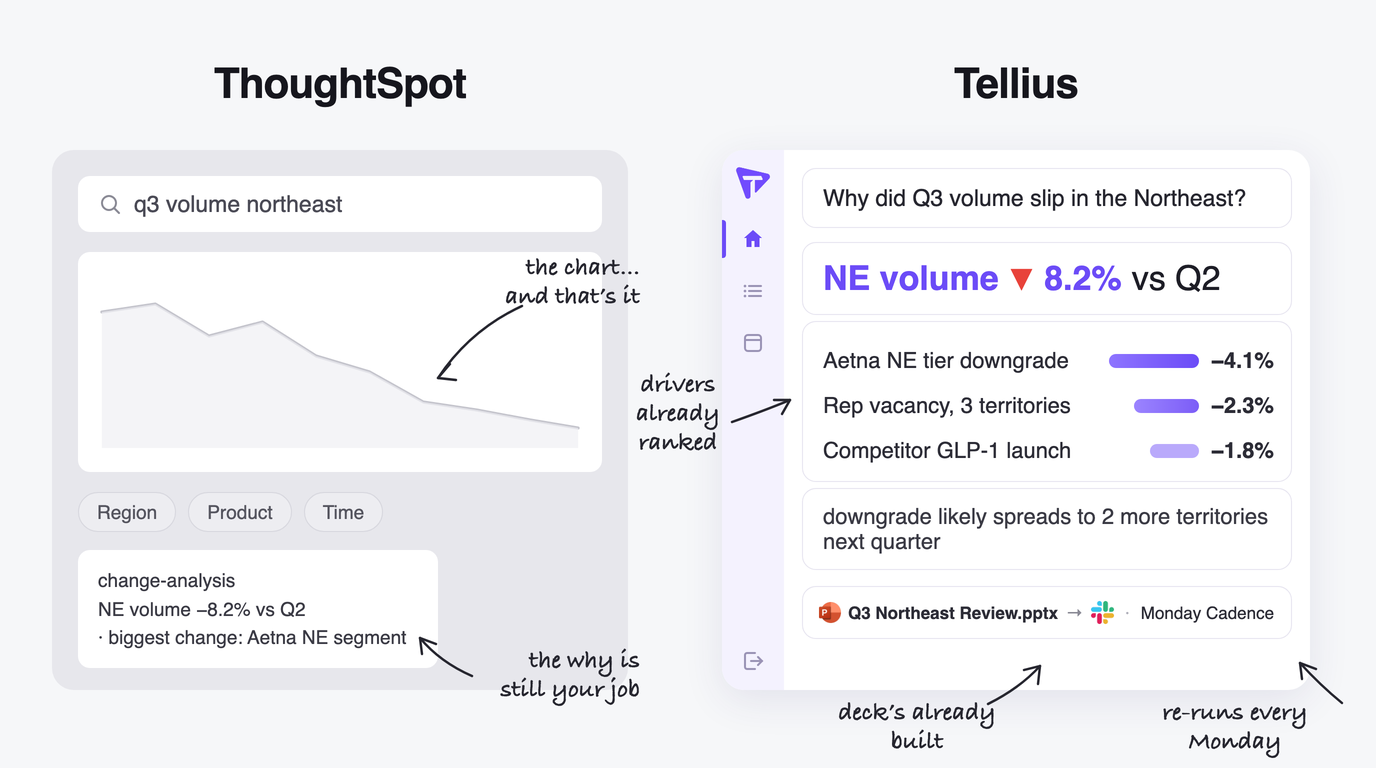
Ask both platforms the same question — "Why did Q3 volume slip in the Northeast?" — and you see key differences. ThoughtSpot answers inside its scope, and the answer is real: the volume trend, sliceable by region, product, and time, with SpotIQ's change analysis flagging which segments moved most and Spotter's trace showing how it got there. The why behind the Aetna segment, and the deck for Friday's review, stay with your team.
Tellius returns the finished investigation. In one deployment-style example (numbers illustrative): Northeast volume down 8.2% versus Q2, with three ranked drivers — a formulary tier downgrade at Aetna NE (−4.1%), rep vacancy across three territories (−2.3%), and a competitor GLP-1 launch (−1.8%). Alongside the drivers: the exposed accounts, an insight that the Aetna downgrade spreads to two more territories next quarter, and a generated Q3 Northeast Review deck — pushed to Slack as a Mission that re-runs every Monday.
What this looks like in practice
Two Missions our pharma customers run give a feel for the day-to-day. The per-rep morning brief lands in each rep's Veeva pre-call view: the per-HCP why behind the week's changes and the next best play, before the first call of the day. The declining-writer save list diagnoses why each slipping HCP is writing less, ranks them by recoverable value, and writes the save list straight into Veeva call plans. Neither one is a dashboard someone has to remember to check — the work shows up done.
How it works, briefly
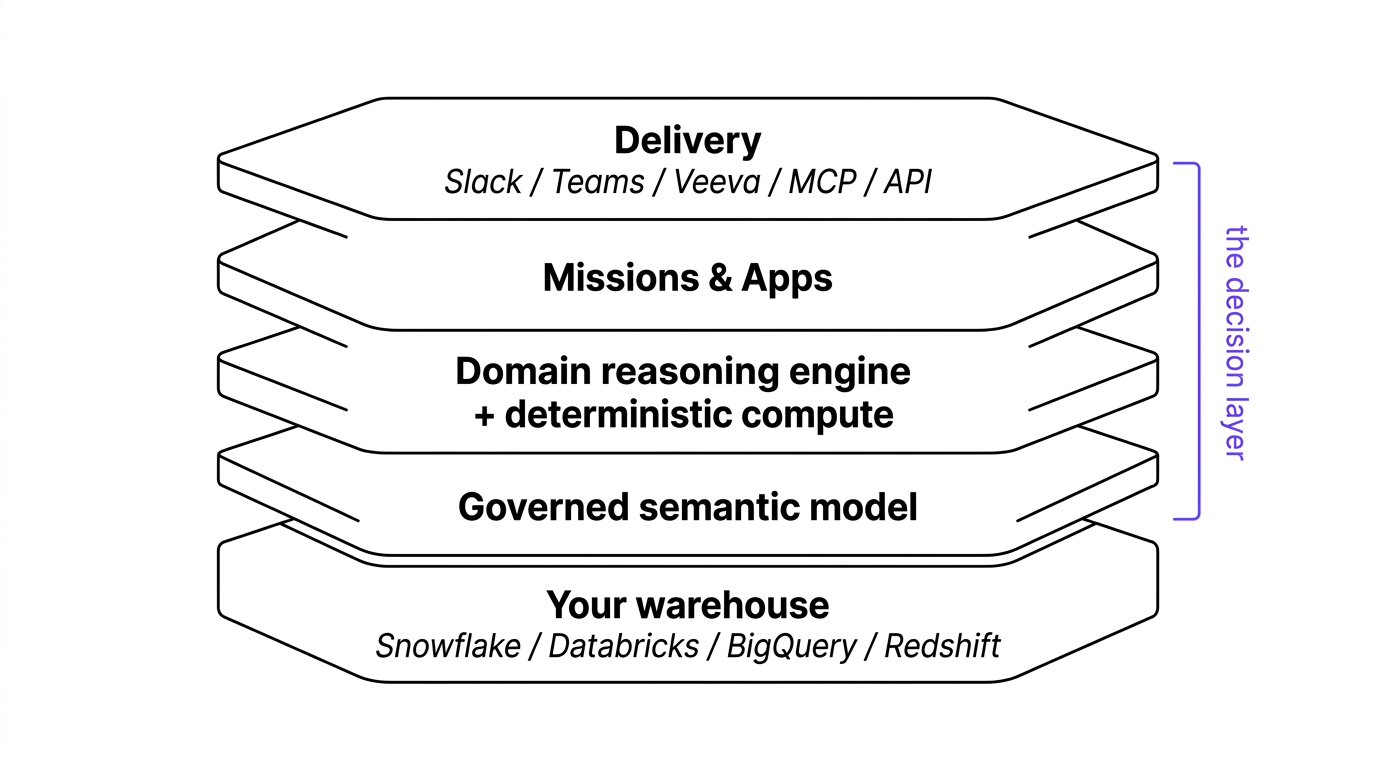
Under the surfaces, five layers do the work: a governed semantic model that fixes what your metrics mean, a domain reasoning engine that knows how pharma and CPG investigations decompose, deterministic compute for the math, Missions and Apps that run the recurring jobs, and delivery surfaces that put the output where your team lives. All of it runs warehouse-native on Snowflake or Databricks — your data doesn't move, the reasoning comes to it.
What switching is worth
ThoughtSpot changed how fast you get an answer. It didn't change who does the work after. Tellius replaces the labor line behind recurring analysis — analyst hours, services fees, and the decisions that never happened because the question went unasked. The unit of value isn't a query; it's work done.
The numbers below come from customer deployments and are illustrative — data, scale, and scope move them in both directions:
- ~40% lower LLM and token cost. Routing sends each task to the cheapest capable model, and grounding is reused across runs, so cost per decision falls the longer it runs.
- Hours of recurring analysis, automated. The work your team runs in Excel every week — or pays a firm for — becomes a Mission that returns the same governed answer every run.
- ~$6K for a ~$200K deliverable. An analysis that runs six figures built the traditional way, internal team or consultancy, delivered at software cost.
- $7M in leakage surfaced in one quarter. The kind of find a single search query never goes looking for. Capturing part of it clears the business case on its own.
Cost per decision falls with reuse while the consulting line stays flat, which is the part of the business case that gets stronger every quarter instead of renegotiated.
How to migrate from ThoughtSpot to Tellius
You can move in days, not months, with no data migration. Tellius runs on the same warehouse ThoughtSpot reads — Snowflake, Databricks, BigQuery, Redshift — so the move is a connection and a model conversion, not a re-platform.
Step 1 — Connect. Point Tellius at your warehouse. No data movement, no new pipeline, nothing to re-platform. The connection is a same-day task for whoever owns your warehouse access.
Step 2 — Convert. Automated conversion is rolling out: it discovers your existing ThoughtSpot models, Liveboards, and formulas and translates them across, and our migration team white-gloves the move today, so in most cases you inherit what you've already defined rather than rebuilding it. Where a model needs to be stood up or enriched, Kaiya Architect — Tellius's model-building agent — rebuilds the governed semantic layer for you: auto-profiling the data, inferring joins, and drafting metric definitions for your team to approve, parity-checked against your warehouse. Rebuild is the fallback, and it's automated.
Step 3 — Go live side-by-side. Run Tellius next to ThoughtSpot on questions you already know the answers to. Judge the why, the repeatability, and the finished output against what your team produces by hand today. Cut over when you're convinced. The whole arrangement is reversible until then.
No data migration · Compatible with your existing models · Days, not months · Reversible.

Tellius vs ThoughtSpot
A feature checklist won't settle this one. Both platforms have agents, both run on your warehouse, both lead with trust. What separates them is where each one stops in the same job.
If fast answers on governed data are all your team needs, ThoughtSpot does that well, and its agents keep making it faster. The rows that decide a switch are the middle ones — who does the work after the answer arrives, and what the platform keeps from everything your team teaches it.
Why act now
The switch offer is time-boxed: for a limited time, we'll stand up your governed model and prove the why on your own data as part of a migration chat, before you commit to anything. The quieter cost of waiting compounds on its own — every quarter of hand-built analysis is another quarter of questions your team never asked because nobody had the hours, and another quarter of context nobody captured. The migration takes days. The memory you're not building takes quarters to rebuild.
Key terms
- AI worker — an AI that delivers finished work (briefs, decks, recommended plays) rather than answers, grounded in governed data with an audit trail. Tellius scopes one to each person's role.
- Agentic analytics — ThoughtSpot's current category: a conversational agent (Spotter) plus build agents (SpotterModel, SpotterViz, SpotterCode) that answer questions and speed up building models, dashboards, and embedded apps.
- Semantic layer — the governed definition of what your metrics and entities mean, so every question resolves against the same logic.
- Mission — a Tellius agent job that runs an investigation on a schedule or trigger and delivers the finished output to a person or channel.
- Business Memory — Tellius's governed store of definitions, corrections, and reusable grounding; human-approved, scoped by user, team, or organization, and inherited by every future run.
- Domain Reasoning Engine — the layer that knows how pharma and CPG investigations decompose, so diagnosis follows your industry's methods rather than generic statistics.
- TRx / NBRx — total and new-to-brand prescriptions, the core pharma volume metrics.
- Pull-through — converting formulary access into actual prescriptions in the field.
- Payer mix — the distribution of a brand's volume across insurance plans and channels.
- Gross-to-net — the bridge from list price to net revenue after rebates, discounts, and fees.
- MLR review — pharma's medical-legal-regulatory review; any number you cite externally has to survive it.
Get release updates delivered straight to your inbox.
No spam—we hate it as much as you do!


The agents do different jobs. ThoughtSpot's agents answer questions and speed up building — Spotter for conversational analysis, SpotterModel for semantic models, SpotterViz for dashboards, SpotterCode for embedded apps. What lands with your team is still an answer or an asset, and the decomposition, the narrative, and the deck stay on their plate. The Tellius AI worker delivers the completed work: it diagnoses why the number moved, generates the deliverable, and re-runs the analysis on a schedule with an audit trail.
Both, in practice. Teams shortlist Tellius when they're evaluating ThoughtSpot alternatives, but what they buy is a different unit of output — finished work rather than answers. You keep the ability to ask questions in plain English and gain everything that used to happen manually after the answer came back.
No. Tellius runs on the same warehouse ThoughtSpot reads — Snowflake, Databricks, BigQuery, or Redshift. Migration means connecting to the warehouse and converting your models, not moving data or standing up a new pipeline.
In most cases, yes. Automated conversion (rolling out now, with white-glove migration in the meantime) discovers your existing models, Liveboards, and formulas and translates them across. Where something needs to be rebuilt or enriched, Kaiya Architect drafts the governed semantic layer — profiling the data, inferring joins, proposing metric definitions — and your team approves the result, parity-checked against your warehouse.
Days to a few weeks, depending on how many models you bring across. The warehouse connection is a same-day task, model conversion is automated, and most of the calendar time goes where it should — validating answers side-by-side against numbers you already trust.
Yes, and it's the recommended path. Run both on questions you already know the answers to, judge the why and the finished output, and cut over when you're convinced. Nothing about the setup locks you in before that point.
Tellius. It ships with pharma and CPG commercial depth rather than a blank semantic model to configure, every answer carries lineage you can defend in an audit or compliance review, and it runs on the warehouse you already have. Fortune 500 teams run it in production across pharma, CPG, and tech.
It depends on what you've outgrown. If you want faster or cheaper natural-language answers on governed data, several BI platforms compete on that, ThoughtSpot among the best of them. If the gap is everything after the answer — the why, the deliverable, the re-run — that's the job Tellius is built for, with the deepest coverage in pharma and CPG.
.webp)
Tellius Kaiya vs. Glean, Hebbia, Snowflake Cortex, and DIY RAG: A Buyer's Guide to Agentic Analytics Across Structured and Unstructured Data

This buyer's guide compares Tellius Kaiya, Glean, Hebbia, Snowflake Cortex, and DIY RAG approaches across structured analytics, unstructured document intelligence, agent orchestration, governance, semantic understanding, explainability, and total cost of ownership. Learn where enterprise search tools excel, where warehouse-native AI fits, where custom RAG stacks create maintenance challenges, and why a dedicated agentic analytics platform may be the best choice for organizations looking to automate investigation, root-cause analysis, and decision-making across both structured and unstructured data.