

Kaiya Everywhere: Intelligence That Knows Your Business, Now Wherever You Work
.webp)

Today we're shipping Tellius 6.3 with Kaiya Everywhere. Our agentic coworker is now available wherever your team actually works: overlaid on any web page in your browser, inside Slack and Teams, and through MCP in the agents your team already runs.
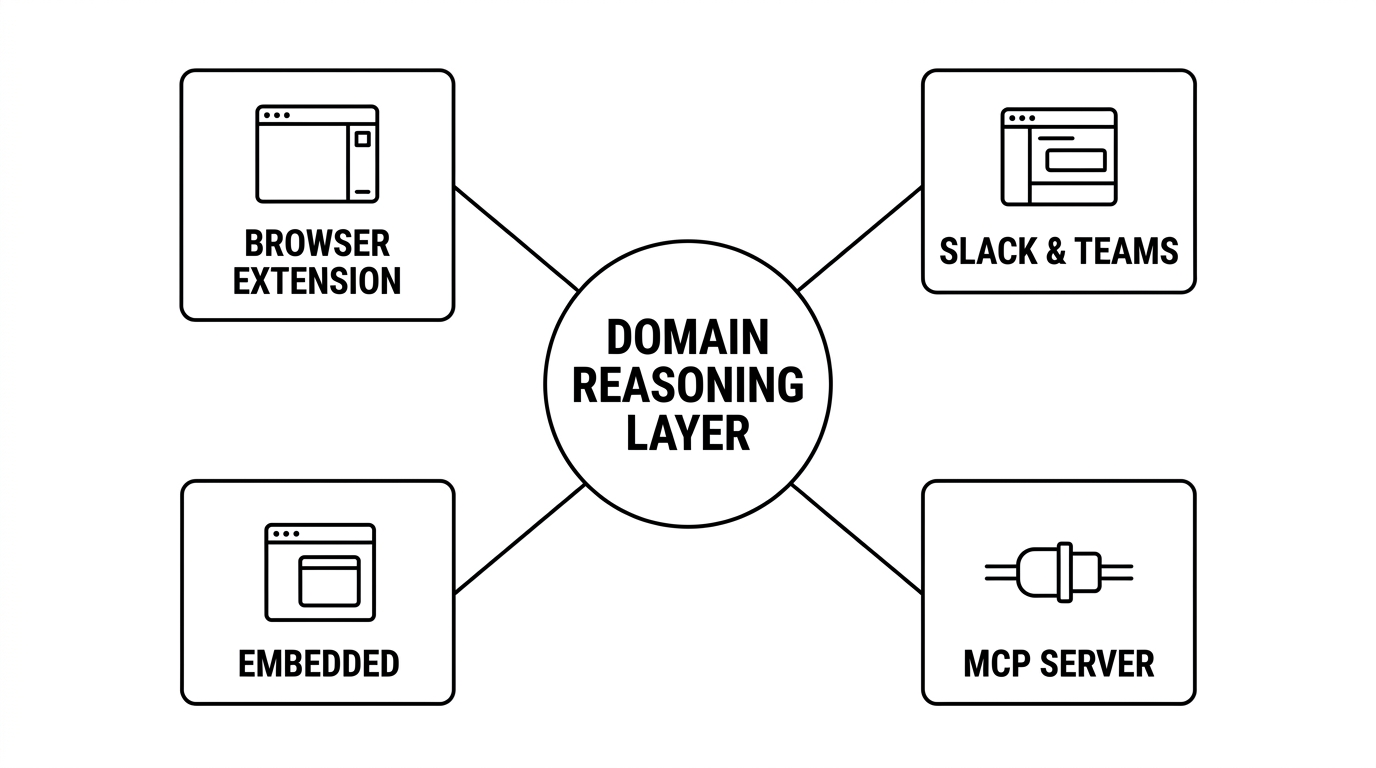
Kaiya Everywhere is the delivery of governed, agentic analytics into the tools where decisions actually get made: a browser extension, Slack and Teams bots, and an MCP server, all backed by the same domain reasoning layer that understands your definitions, your hierarchies, and your business logic. Unlike a stateless copilot bolted onto a warehouse, Kaiya carries your governed context everywhere it goes, so every answer traces back to the exact query that produced it.
An agent that follows you everywhere only matters if it knows your business. That starts with the layer underneath.
The wall everyone hits
Enterprises everywhere are racing to put AI on top of their data. Vertical agents, custom agents, all-purpose tools like ChatGPT and Claude. All of them try to connect to the systems where the data actually lives, and almost all of them hit the same wall: the model doesn't know what your data means. It doesn't know your definitions, your hierarchies, or which source to trust when two of them disagree.
So it guesses. Fragmented context produces conflicting definitions across your BI tools, your SQL, and your prompts. Conflicting definitions produce wrong answers. Agents relying on those answers fabricate plausible-sounding ones, the thing everyone now calls hallucinations. And as you lean on agents more, those errors compound into cascading wrong decisions, ending in the one thing the enterprise can't afford: lost trust in the whole AI effort.
What the wall looks like in practice:
- Pharma: A brand team asks why TRx dipped in a region. The model doesn't know IQVIA data lags two weeks, that the territory hierarchy changed last quarter, or that "NBRx" and "new starts" aren't the same thing, so it confidently returns a number the field knows is wrong, and the QBR runs on it anyway.
- CPG: A revenue growth manager asks whether a promotion worked. The model can't tell volume lift from pantry loading because nobody encoded the difference, so it reports "success" on an event that just pulled demand forward, and the next cycle's plan inherits the mistake.
- RevOps: A leader asks why net revenue retention fell. The model doesn't know which fiscal calendar applies, which CRM stages count as churn, or what the asker is allowed to see, so it stitches the wrong sources together and the forecast quietly drifts off true.
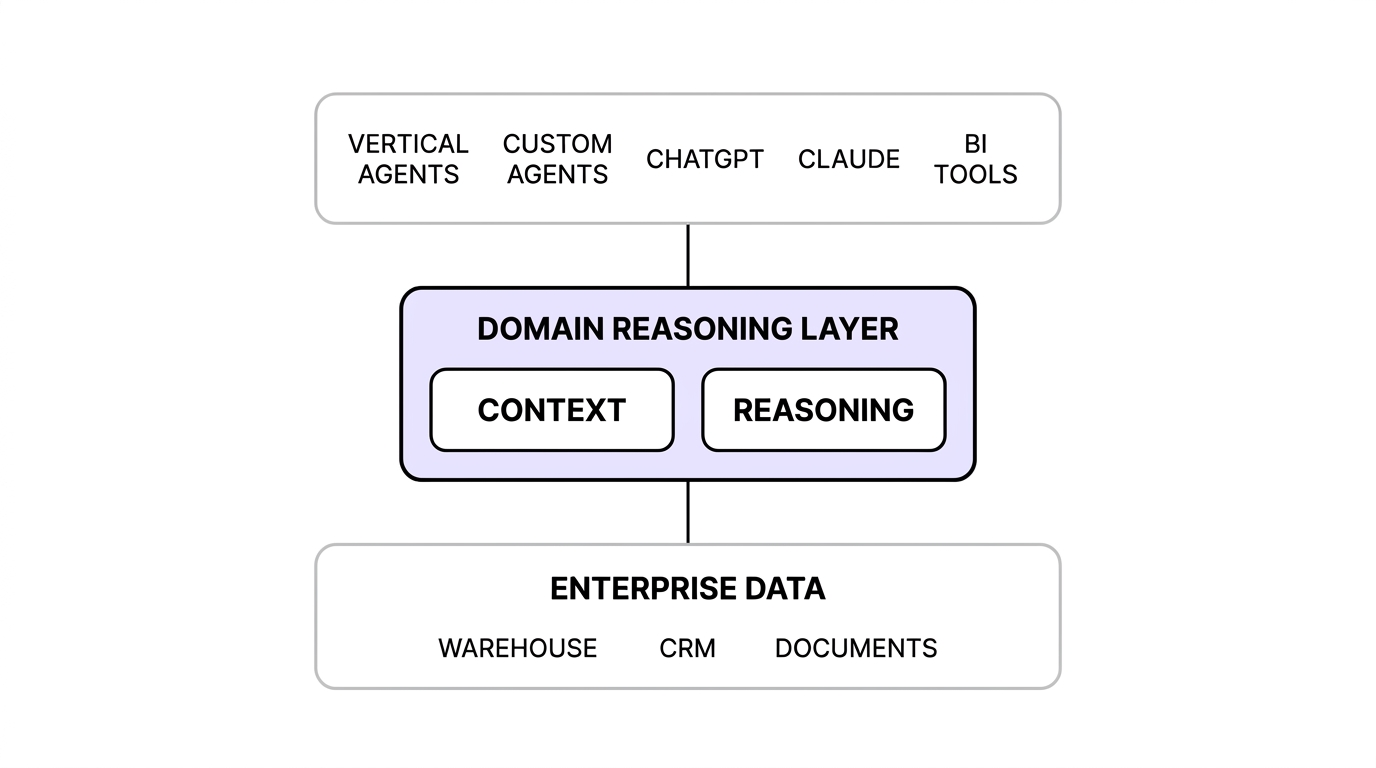
Smart models alone don't get you out of this. What's missing is a layer in the middle: one that every agent, every app, and every tool can hit to get the same governed definition of the business, where reasoning happens in a way you can reproduce and trace.
The piece everyone forgets
Most "agentic analytics" today is one move: wire a language model to a few data sources and let it write queries. That part is becoming table stakes, and plenty of teams are building it now with Snowflake, dbt, or a semantic layer. It's the context layer: what your metrics mean, how your data is modeled, the relationships and business logic underneath. It's necessary, but it isn't the hard part.
The piece everyone forgets is the reasoning. Context tells you what your data is. Reasoning is what your best analyst actually does with it: plans the analysis, decomposes the drivers, ranks what matters, stitches across sources, checks its own work, and tells you what to do next. Context without reasoning is just a well-organized pile of data. The reasoning on top turns it into an answer you can act on, and it's the part you can't fake by pointing a model at a warehouse.
Take a real question: why did net revenue retention fall? Before there's a credible answer, the system has to know who's asking (probably RevOps), what NRR means to you, which fiscal calendar applies, which data the asker can and can't see, the hierarchies in your CRM, and when this was last analyzed. That's context. Then it has to plan the work, decide what to join, decompose and rank the drivers across every source, and validate its own reasoning before it answers. That's reasoning. Skip any of those steps and you get half-baked AI slop. Run all of them and you get a finished, defensible deliverable with a next action attached.
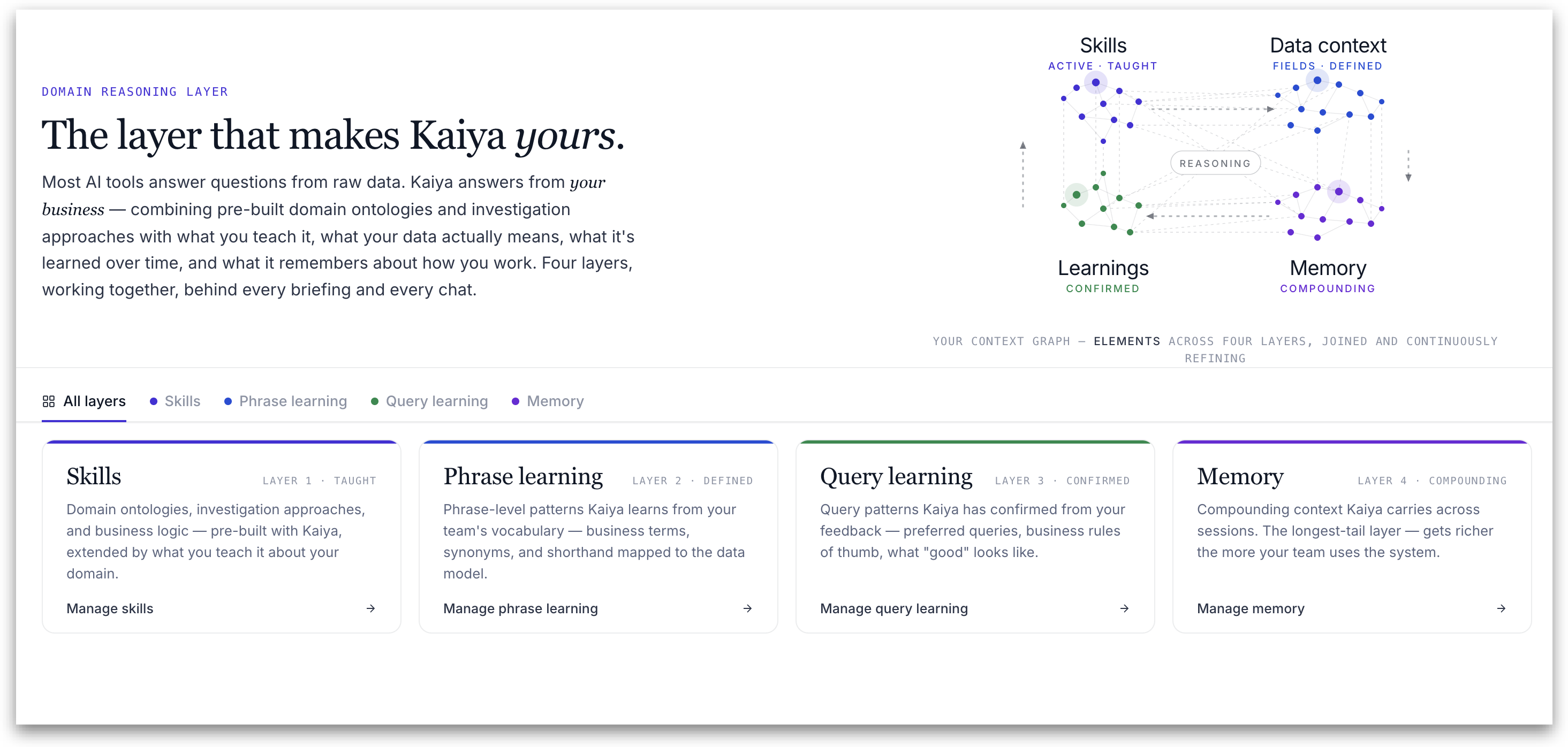
In 6.3, the context layer is no longer something our SEs hand-assemble through hacky system-prompt edits. It's built into the product as distinct, editable layers: dataset and Business View context, domain skills, custom skills, and memory, all in one place.
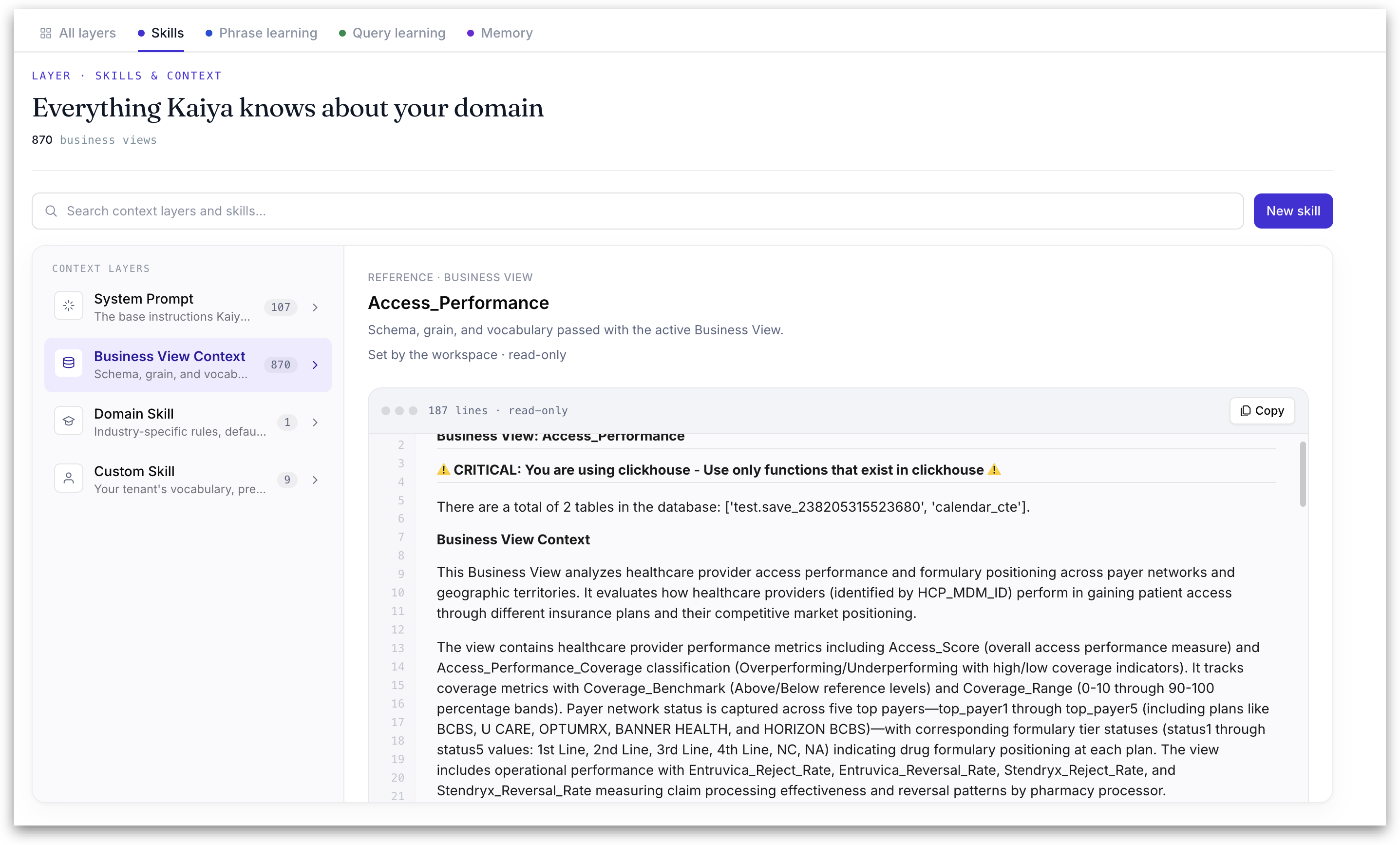
This is also where a decade of work shows up. We've distilled how pharma and CPG actually operate (vocabulary, metric definitions, the methodology a regional director follows when a territory plan changes) and baked it into those layers, so the platform is useful out of the box for a vertical. Skills let you push it the rest of the way: encode the specific procedures and rules your team uses, without touching core prompts. The goal isn't 100% out of the box. It's getting you about 90% there fast, then closing the last 10% with custom skills tuned to how your teams work.
Reliable numbers, and the honest version of that claim
Trust is everything in the enterprise, so the math is handled deterministically. The language model handles the language; a separate engine handles the numbers, against your schema and definitions. Every result traces back to the exact query that produced it, so you can see how the math was done and verify it yourself.
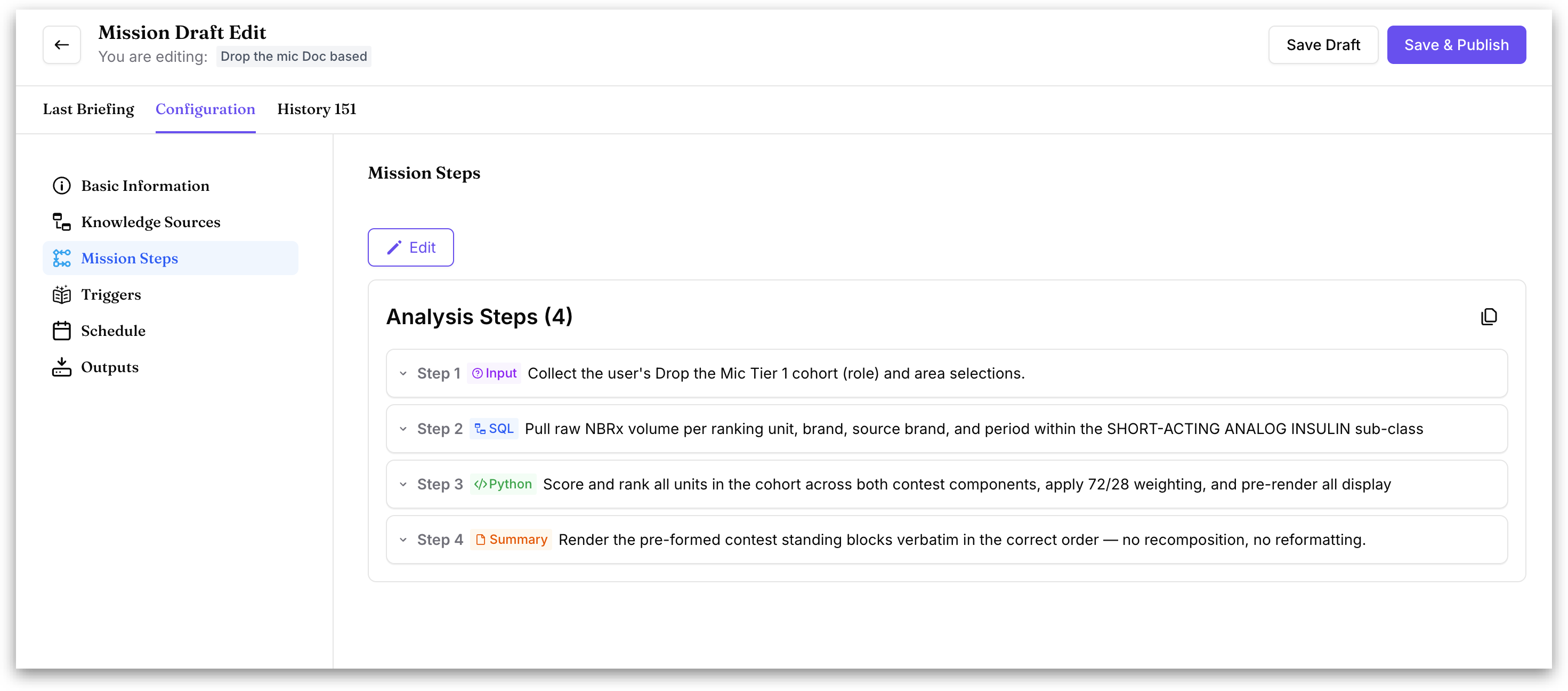
Now the honest version, because our field team asked for it directly: we don't claim Kaiya never hallucinates. That's the nature of LLMs, and a vendor who promises zero is overselling. What we do is control it. Where you need the same question to return the same answer every time, you build a Mission: ambiguities get resolved up front, at authoring time, so the model isn't making fresh assumptions on every run. The creator validates the plan once and it executes consistently after that. Ad hoc questions stay flexible and exploratory; Missions are how you lock in reproducibility. That's what "deterministic" means here: consistency you can verify, not magic.
And in 6.3 you build those Missions conversationally: describe the outcome you want in chat, and Kaiya assembles the steps.
An AI coworker that knows the business
When context and reasoning come together, the result behaves less like a chatbot and more like a coworker who already knows the business.
It knows what promo lift, gross-to-net, or pipeline coverage mean to you. It reasons across your structured and unstructured data as if they were one source, because the "why" rarely lives in one place: your warehouse has the number, while your call notes, contracts, and scorecards hold the reason it moved. And the expertise that used to live in one analyst's head gets taught once and applied for everyone, in every conversation. The knowledge stops walking out the door when your best analyst takes PTO.
This augments people rather than replacing them. Think of it as an Iron Man suit for your analysts and business teams: the human stays in command, reviews, and decides, while the AI agents do the legwork that scales, pulling the data together, decomposing the variance, and drafting the brief. And it hands back finished work rather than a chart to decode: a board-ready brief, a deck, or a Slack summary, formatted in your template and delivered to the right person before they ask.
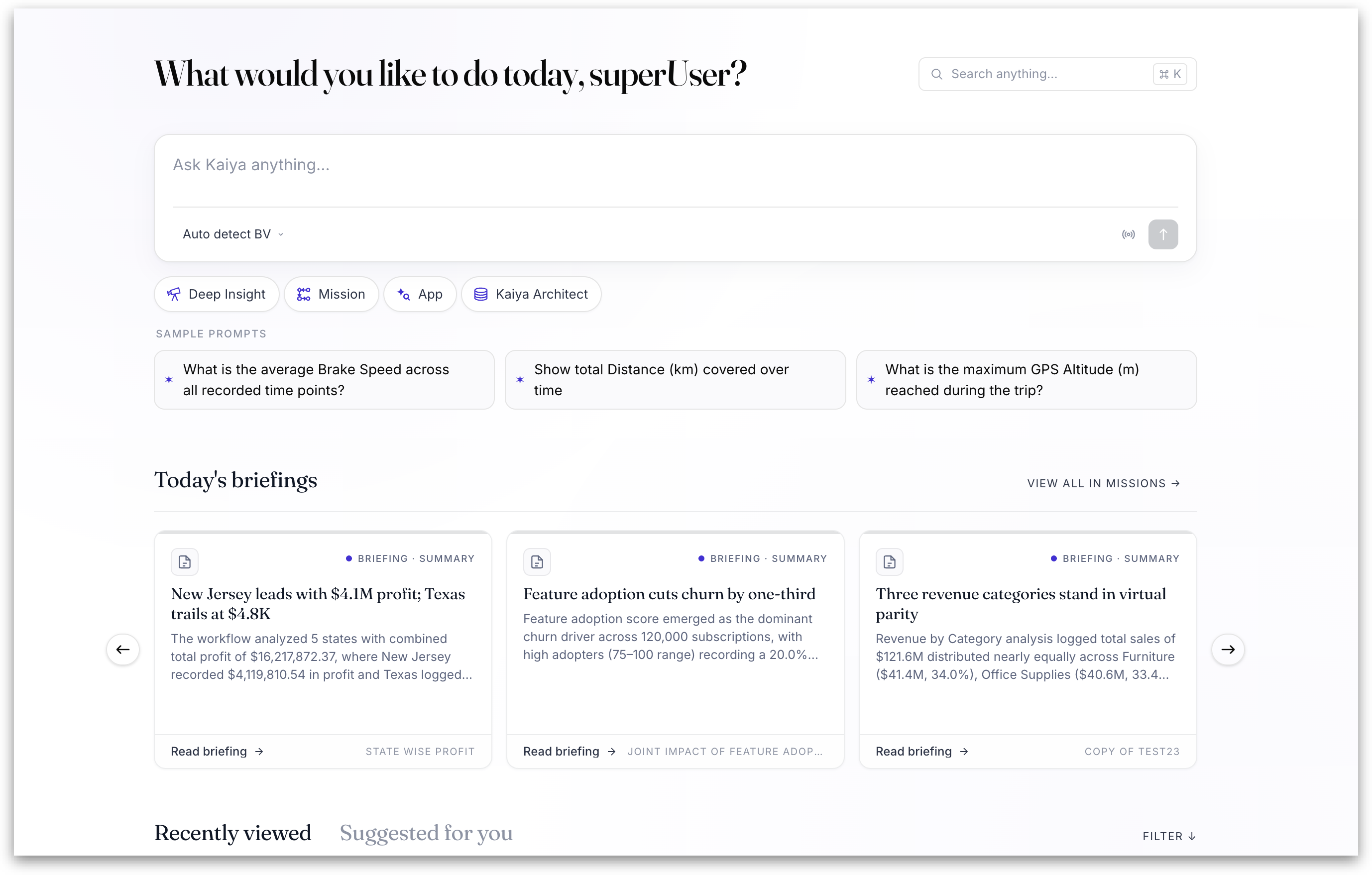
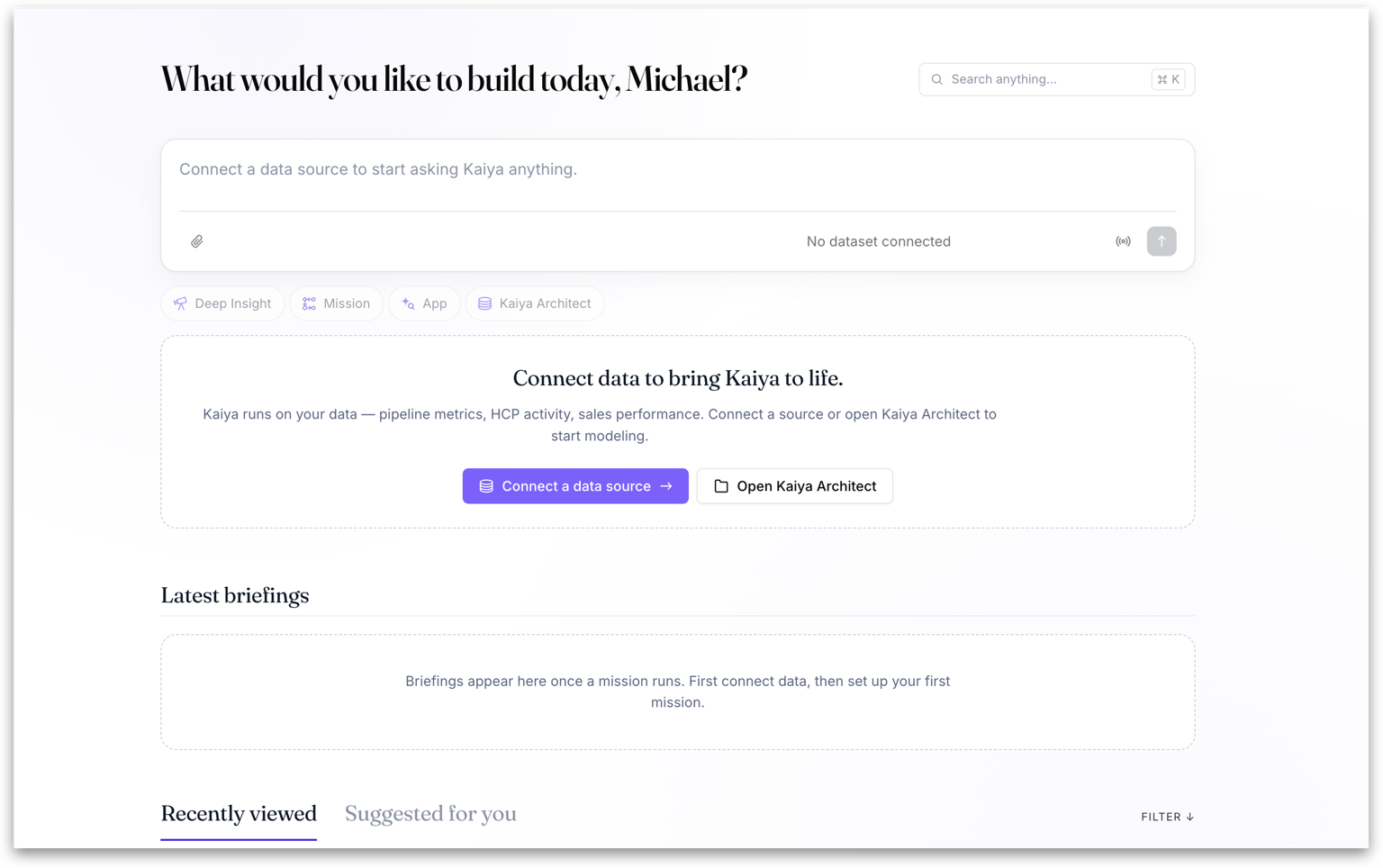
And getting started is faster: new users in 6.3 can go from connecting a data source to their first App in about ten minutes, guided by Kaiya Architect.
Everywhere the decision gets made
The same governed intelligence now shows up where the work already happens. You don't have to come to a tool to get it.
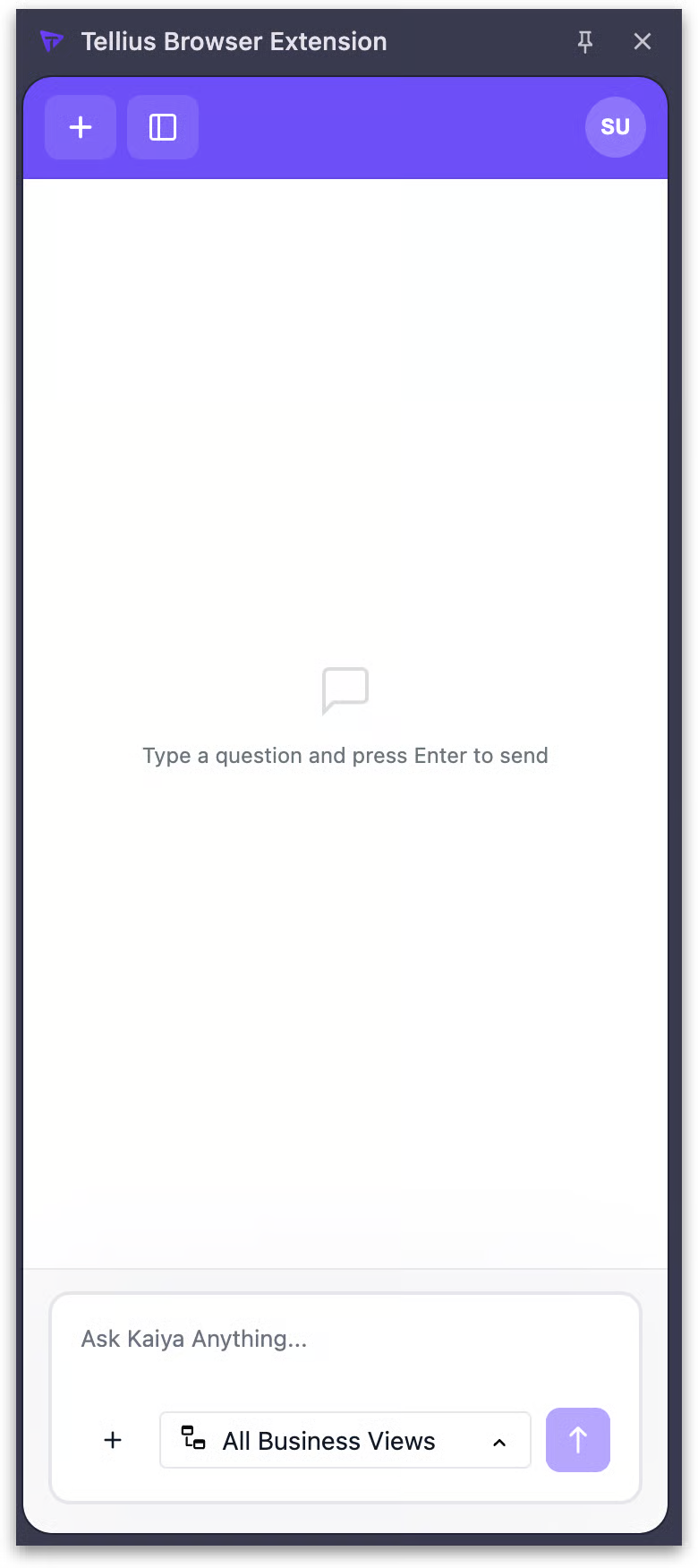
Browser extension. Click Kaiya open as a side panel on any web page, and it reads what you're looking at. Open a Power BI or Qlik dashboard that shows TRx declining but won't tell you why, or a static PowerPoint full of charts, and Kaiya maps what's on screen back to your Business Views to answer the question the dashboard can't. You're not ripping anyone out of the tools they already use, you're making those tools smarter.
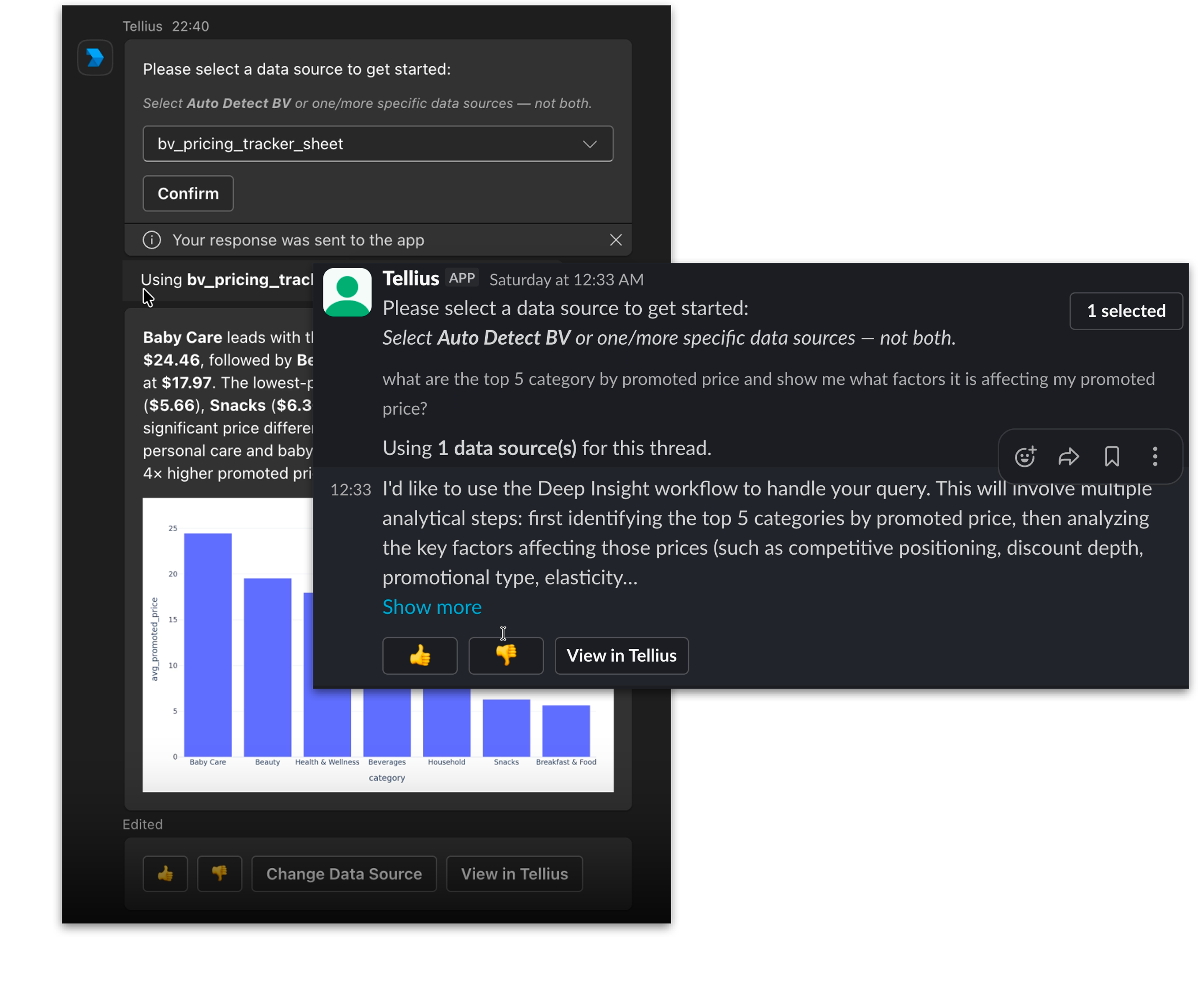
Slack and Teams. Your team lives in Slack and Teams; making them switch apps to ask a question is friction. Now you can @Kaiya in the channel and get governed answers on your Business Views without leaving the conversation. (Coming in a follow-on minor release: a Mission's output, such as the Monday-morning briefing deck or PDF, delivered straight to a channel or DM, plus building Missions and apps from Slack.)
MCP. We've opened Tellius and Kaiya as an MCP server. If your team lives in Claude, ChatGPT, or Cursor, install the integration and pull governed Tellius insights directly into those tools. This is also the cleanest answer to "build vs. buy." Want to build the experience yourself, the apps and workflows and the fun part? Go for it, and let Tellius handle the boring part underneath: getting the semantic layer right, the analysis right, and the numbers right, governed and traceable. Your agent orchestrates, and Tellius returns the truth it builds on.
Embedding. Embedding isn't new, but it belongs in this list. Tellius can run fully headless, so Kaiya doesn't need its own UI to show up wherever your decisions get made.
The flywheel: it gets sharper the longer you use it
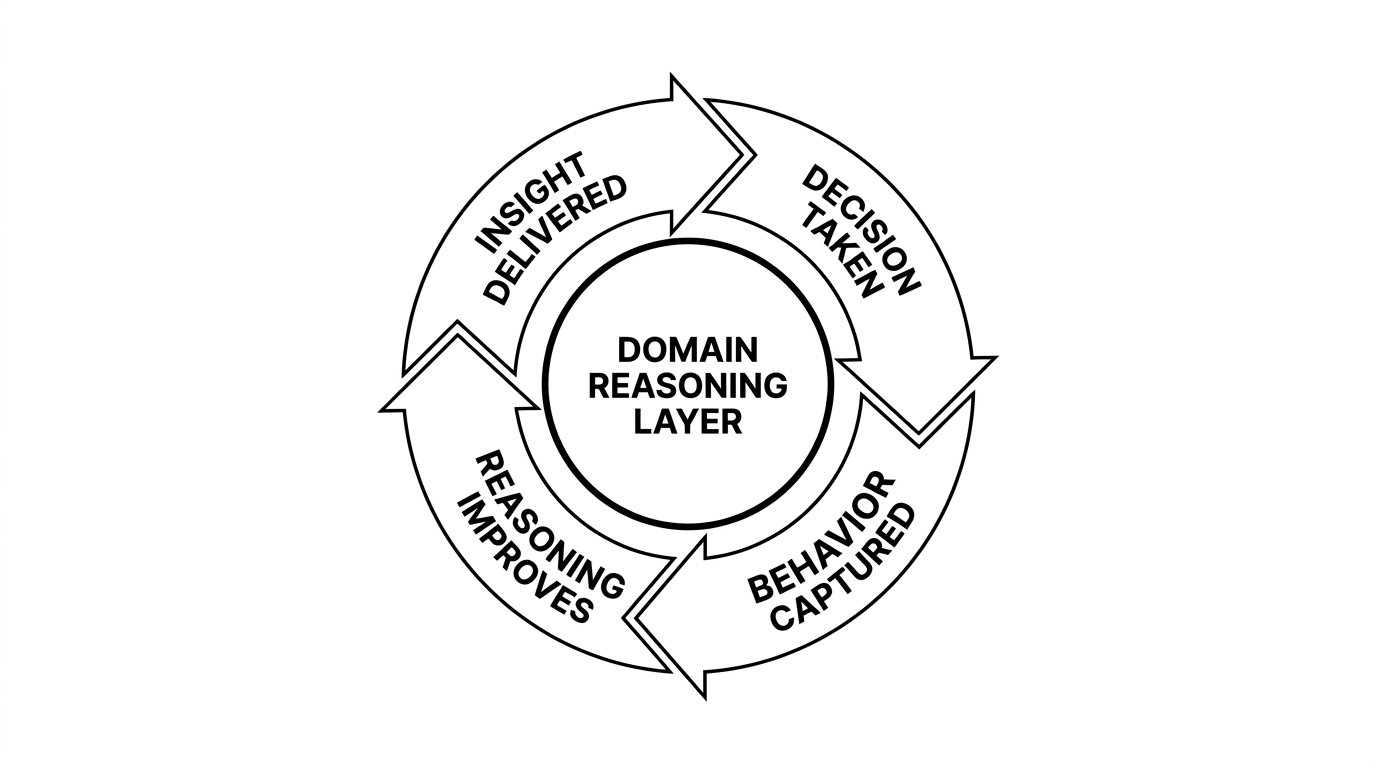
A stateless copilot at month eighteen is identical to the one you turned on day one. Tellius is built to compound. Today that means memory, phrase and query learning, and the context you've encoded. Next, we're capturing the behavioral layer: what your users view, what they prefer, and most valuably what decisions they make with the insights we surface. That loop feeds back into the reasoning engine, so the platform gets better not just at your industry but at your company, your teams, and your individual users.
We're also packaging this for speed. Industry Packs (rolling out across the 6.3 line) bundle a vertical's domain reasoning layer, default Kaiya Apps, default Missions, and starter conversations, so a customer can be live and getting value in roughly one to two weeks instead of months.
Where this is headed
We think analytics is about to fade into the work itself. For decades it's been a destination: you stop what you're doing, go to the tool, build the answer, and bring it back. The future runs the other way, toward intelligence that's always on, always in context, and already there when you need it. The question stops being "did we analyze this?" and becomes "of course we ran the numbers."
The models will keep improving for everyone. The advantage that compounds is the layer that learns your business: your vocabulary, your definitions, the patterns that mattered last quarter, and the decisions you actually made. That knowledge accumulates across sessions instead of resetting. We made the AI-first bet in 2017 and built the hard parts (semantic understanding, deterministic reasoning, and compounding memory) into the foundation. With Kaiya Everywhere, that intelligence now runs wherever your team already is.
Next Steps
If your team is already experimenting with ChatGPT or Claude on top of your data and hitting the wall where you don't quite trust the answers, 6.3 is worth an afternoon. Start where you already work: install the browser extension on a dashboard you live in, or add the MCP server to the agent your team already runs, and ask the "why" question your current tools can't answer.
Get release updates delivered straight to your inbox.
No spam—we hate it as much as you do!


Kaiya Everywhere is the set of capabilities in Tellius 6.3 that delivers governed, agentic analytics into the tools where decisions get made: a browser extension, Slack and Teams integrations, an MCP server, and embedding. Each is a window onto the same domain reasoning layer, so every answer uses your definitions and traces back to the query that produced it.
The domain reasoning layer is Tellius's combination of a context engine (what your metrics mean, how your data is modeled, your hierarchies and business logic) and a reasoning engine (how your best analyst plans, decomposes, ranks, and validates an analysis). Context tells the system what your data is; reasoning is what it does with it. Together they produce answers you can act on and audit.
A dashboard's built-in AI is scoped to that dashboard's data model. The Kaiya browser extension reads whatever is on your screen (a Power BI or Qlik dashboard, a PowerPoint, a web page) and maps it back to your governed Business Views to answer the question the dashboard can't. It adds reasoning on top of tools you already use, rather than replacing them.
The Tellius MCP (Model Context Protocol) server exposes Kaiya and the domain reasoning layer as a governed source that MCP clients (Claude, ChatGPT, Cursor, and other agents) can call. Your agent orchestrates and consumes its own tokens; Tellius runs the analysis against your governed definitions and returns traceable insights. It's how you get correct, reasoned answers inside the tools your team already runs.
No, it isn't 2x. Your client (Claude or ChatGPT, for example) consumes its own tokens to interpret the request and call the server, typically within your existing per-seat plan, and Tellius consumes its own tokens to run the actual analysis. They run on separate accounts, so it's more usage than a single tool, but not a doubling.
The language model handles language; a separate engine handles the math against your schema, so numbers are consistent and every result traces to its query. For repeatable workflows, Missions resolve ambiguities at authoring time so the same plan executes the same way every run. Tellius controls hallucination through governance and validation. It doesn't claim to eliminate it, which would oversell the nature of LLMs.
Skills let you encode the specific procedures and rules your team uses for analysis, without editing core system prompts. Domain skills come pre-built for verticals like pharma and CPG; custom skills let you tune the last 10% to how your organization actually works. They live in the unified Context tab alongside phrase learning, query learning, and memory.
Yes. In 6.3 you can @Kaiya directly in a Slack or Teams channel and get governed answers on your Business Views without opening the Tellius app. A follow-on minor release adds delivering Mission outputs (briefing decks, PDFs) to a channel or DM and building Missions and apps from Slack.
Pointing a general-purpose model at a warehouse gives you query generation without your business context. It doesn't know your definitions, your hierarchies, or which source to trust, so it guesses. Tellius supplies the governed context and the reasoning layer that decides how the analysis should be done, then returns a traceable answer. The MCP server lets you keep working in Claude or ChatGPT while Tellius supplies the truth underneath.
No. Tellius connects to Snowflake, Databricks, BigQuery, and Redshift without migration, and the browser extension makes your existing Power BI, Qlik, and Tableau dashboards smarter rather than replacing them. Kaiya can also run fully headless and embedded, so it shows up where your teams already work.
An Industry Pack bundles a vertical's domain reasoning layer with default Kaiya Apps, Missions, and starter conversations, so a customer can be live and getting value in roughly one to two weeks. Packs roll out across the 6.3 line and inform packaging and pricing.
Tellius compounds through memory, phrase and query learning, and the context you encode, plus a behavioral layer on the roadmap that captures what users view, prefer, and decide. That loop feeds the reasoning engine, so a deployment at month eighteen reflects eighteen months of your business, not the generic system you turned on day one.
Centralized analytics, IT, and data platform owners should focus on the missing context-and-reasoning layer and its manifestations in Missions, chat, and Apps. Business users should start with Kaiya Everywhere, since the browser extension is a lightweight way in. The fastest first step is a recurring deliverable you already rebuild by hand, like a QBR prep or a variance explanation, and letting Kaiya generate it on your governed data.
Start with the Mission

This blog argues that successful analytics and AI initiatives don’t start with tools or dashboards—they start with a clear mission tied to real business outcomes. It highlights how organizations often get stuck in cycles of data exploration without direction, leading to wasted time and low impact. Instead, leaders should define the decisions they want to improve, align analytics efforts to those goals, and build workflows that move from insight to action. By grounding analytics in mission-driven use cases, companies can reduce manual effort, accelerate decision-making, and unlock the full value of AI-powered insights.
Your Data Is In The Warehouse. The Model That Makes It Useful Isn’t. Introducing Kaiya Architect.
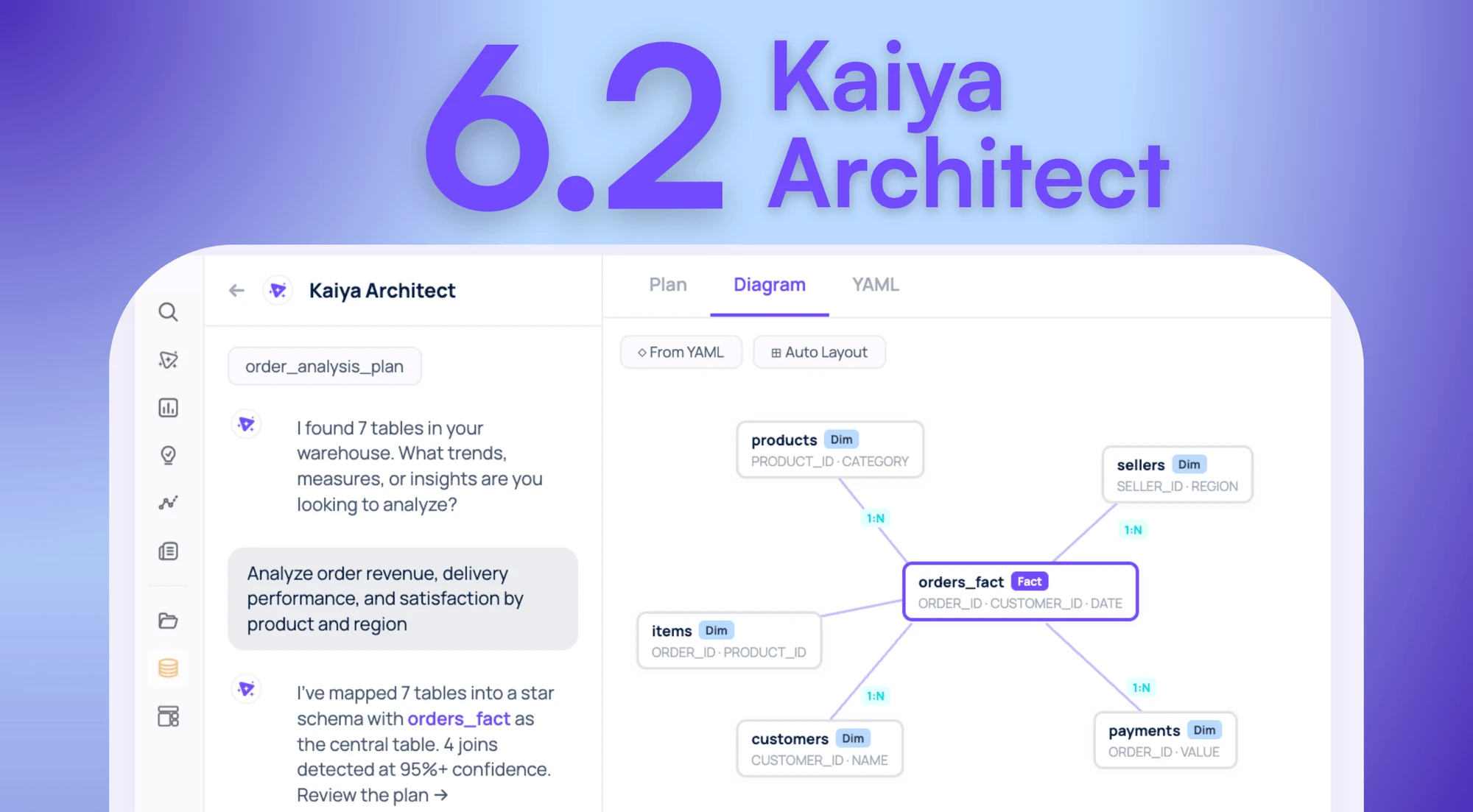
Tellius introduces Kaiya Architect, an AI data modeling agent that builds governed semantic layers from raw warehouse data through a single conversation — eliminating the multi-week engineering bottleneck between business need and analysis.