

Why Does Published Payer Coverage Differ From Actual Patient Access?
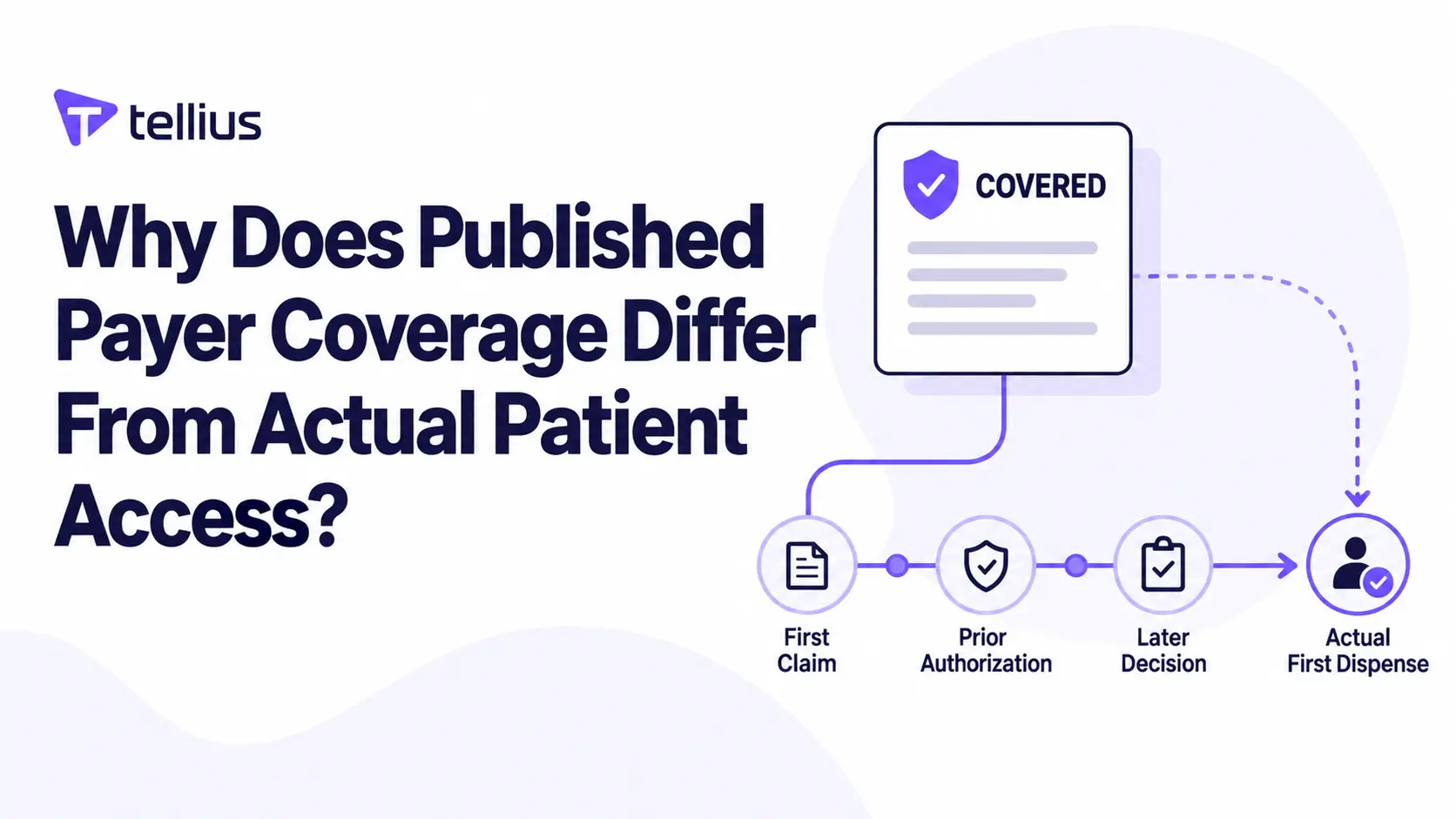

Published payer coverage can differ from actual patient access because coverage is only one part of the patient journey. Prior authorization, claim rejection, specialty pharmacy routing, patient cost, plan mapping, timing, and incomplete downstream data can prevent or obscure a patient start. Coverage describes what a plan says it will allow, while access depends on what happened to the patient after that policy decision.
A payer can list a drug as covered while patients still fail to start therapy. Market access can report a coverage win, watch new-to-brand prescriptions lag, and still lack the evidence to say whether the payer, the prior authorization process, patient cost, or a pharmacy handoff is responsible. The wrong diagnosis sends the account team into the wrong conversation while patients wait. Even a correct diagnosis can die in a slide deck if nobody turns it into a payer discussion, a patient-services intervention, or a repaired data feed.
The coverage-to-access gap is the distance between a payer's published coverage position and what patients experience when they try to start treatment. It can persist even when the policy record is current and accurately reflects the payer's documents. In an April 2026 IQVIA analysis sponsored by PhRMA, 70% of commercially insured attempts to fill a new branded medicine were initially rejected in 2025. After 30 days, 32% remained rejected. That is a specific national cohort, not a benchmark for a given brand. It illustrates how much the conclusion can change when the patient path is followed beyond the first claim.
5 reasons covered does not always mean accessible
What data do you need to explain a coverage-to-access gap?
The investigation may span MMIT formulary and policy data, claims, hub data, specialty pharmacy feeds, and CRM or account information. Those records were created for different jobs and rarely agree on the exact plan, benefit, patient status, or date without work from the access analytics team. MMIT distinguishes policy and restriction data from claims outcomes, and IQVIA documents variation across a payer's books of business. A "covered" policy joined to a claim from the wrong employer book or benefit can manufacture an apparent access failure. The work starts by determining which records describe the same access promise.
An adjudication response and a prior authorization decision may live in separate records. NCPDP notes that the claim response may not be linked to the PA decision. A paid claim can subsequently be reversed, and IQVIA treats paid, rejected, and reversed claims as separate events. The access question therefore crosses records with different identifiers and different units of analysis: a policy applies to a plan and benefit, a claim describes an attempt, a hub tracks a case, and a dispense or administration confirms a patient event. The join rules can change the conclusion as much as the underlying data.
An approved patient may move to a required specialty pharmacy or receive bridge or free-goods supply outside the paid-claims extract. IQVIA describes bridge support as one route to treatment initiation. Patient cost and accumulator or maximizer design can also change the outcome after coverage approval. For an infused drug, the confirming event may be administration under the medical benefit rather than pharmacy dispense, as CMS describes in its guidance on HCPCS drug billing. Each handoff is also a point where the explanation can detach from the team able to act on it.
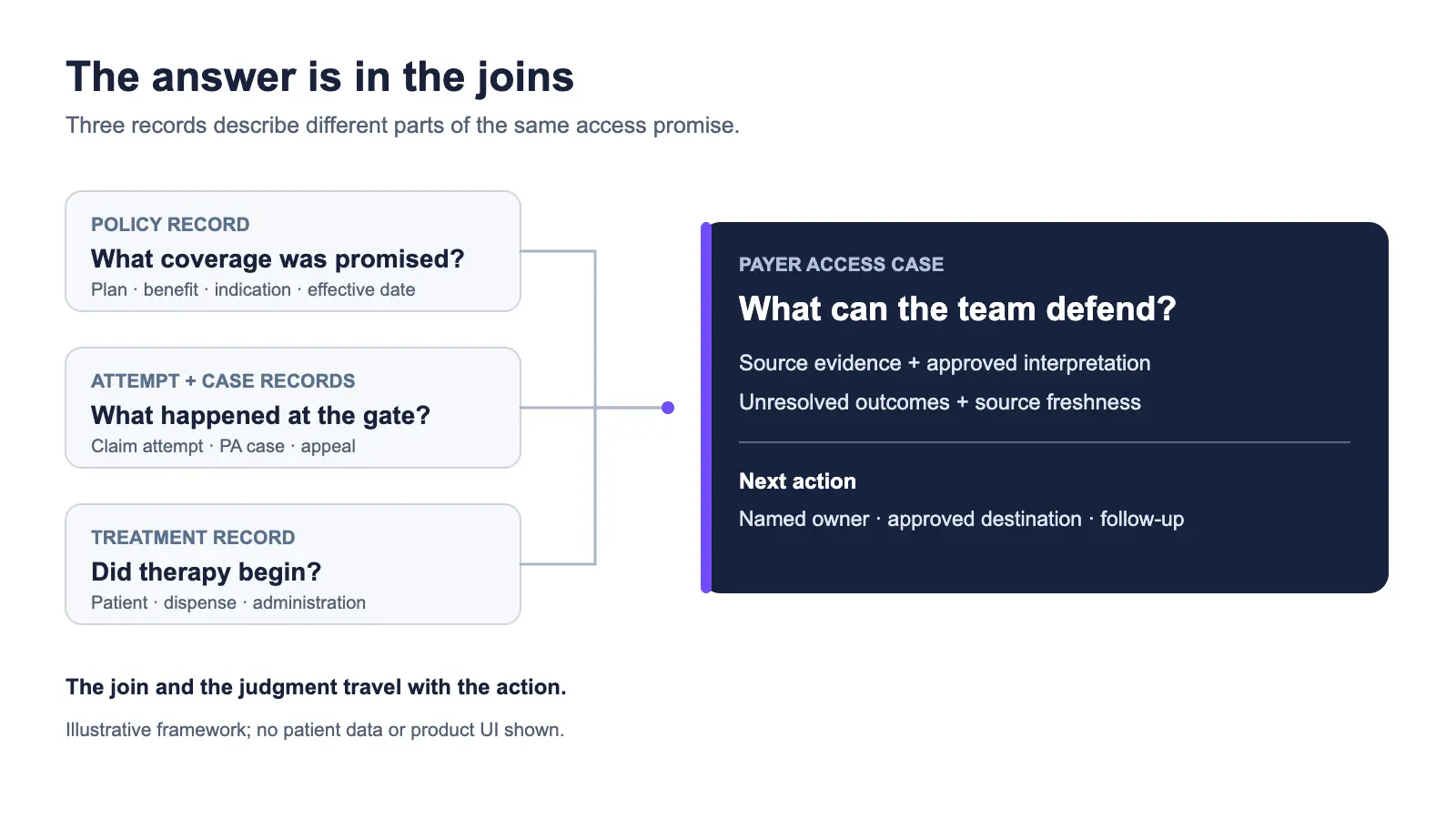
The work is to connect policy, attempts, cases, and patient starts before assigning a payer action.
Why data definitions and business rules change the access answer
A plan comparison can look precise and still be wrong. New-to-brand patients include people switching after a preferred therapy fails and people with no prior treatment, but a step edit affects those groups differently. The same patient may generate several claim attempts. A cohort assembled from attempts, then compared with patient-level starts, can make the rejection burden look larger than it is. An experienced analyst knows which source to trust when the policy file and claims disagree, which employer books belong in an account review, and which bridge fills are invisible to a vendor extract. Those choices are often buried in SQL, spreadsheets, and people's heads.
Time changes the picture as well. A recent attempt may not yet have a full follow-up window, so its start time is right-censored. A mature case can remain unresolved because the appeal, hub, or specialty pharmacy feed is missing. Those are different reasons for uncertainty. A brand with better specialty pharmacy capture can appear to have better access than another brand or plan with the same underlying patient experience. When these distinctions live only in the analyst's explanation, the next refresh or account-team handoff can quietly erase them.
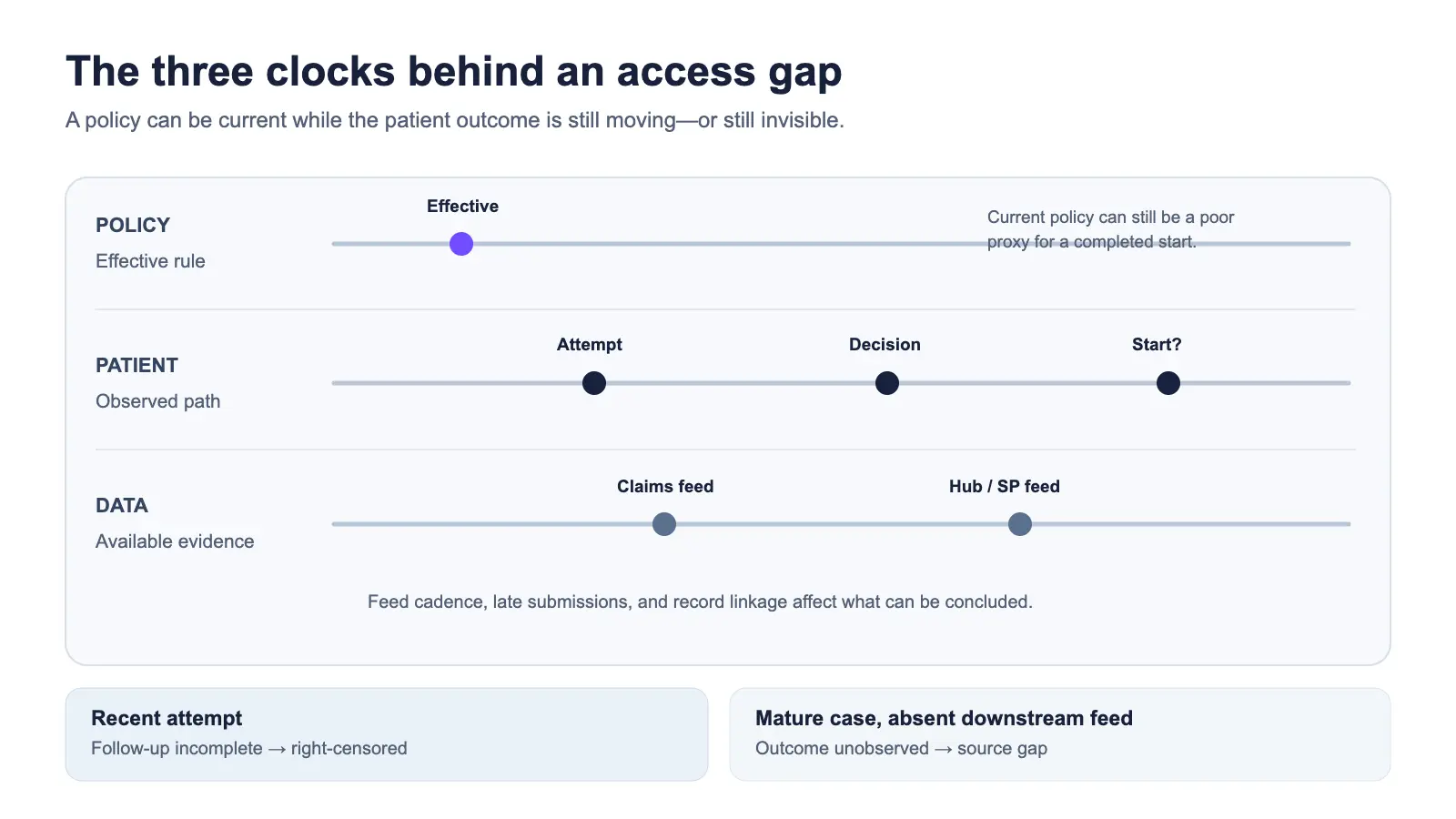
A missing start in a recent cohort and a missing start caused by an absent feed require different conclusions.
That is the operational cost of undocumented context. The team rechecks the same joins, debates the same definitions, and asks the same expert to reconstruct why an earlier decision was made. The access readout may be accurate on the day it is presented yet difficult to reproduce, refresh, or move into the account workflow. The missing information belongs in the conclusion because it may change which team acts.
How do market access teams close the coverage-to-access gap?
Market access teams close the gap by connecting published coverage, patient outcomes, approved business rules, and the action, owner, and result.
The unit of work is a payer access case
A payer access case is a living record of the published policy, the observed patient path, unresolved evidence, the team's interpretation, and the next action. It carries a defensible finding into the workflow that can change the outcome, then records whether that action worked.
Consider a plan whose policy lists the drug as covered while first-attempt rejections rise. The immediate explanation could be a new restriction. It could also be an employer-book mapping error, incomplete PA submissions, or claims that have not yet been linked to overturned appeals. If approvals are visible but starts lag, specialty pharmacy routing, patient liability, reversals, or bridge supply may change the answer again. A case captures which hypothesis was tested, which evidence supported it, and what would change the conclusion. That history matters when a new policy file or claims refresh arrives.
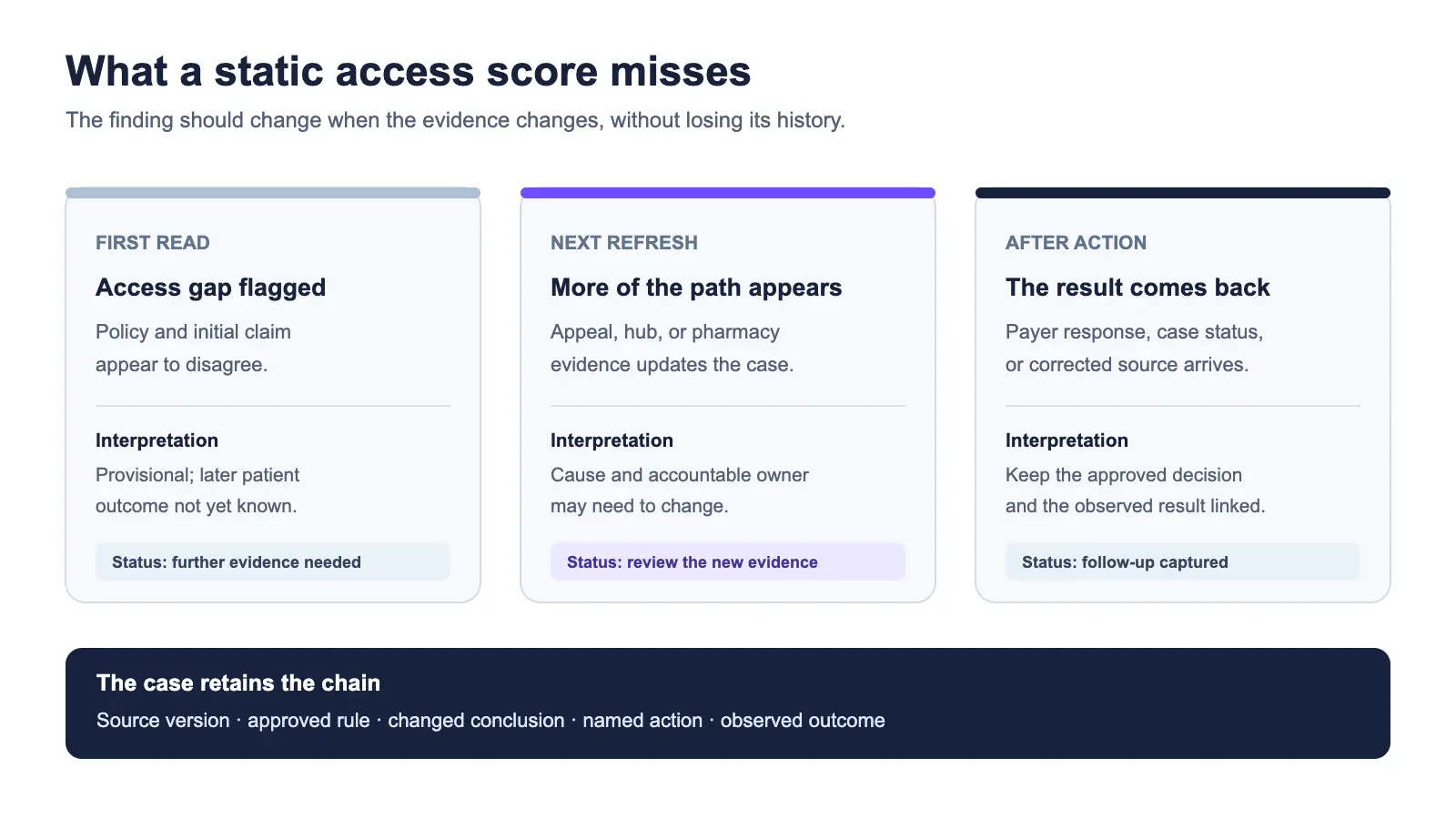
The case remains usable when the next feed changes the story. A static score cannot show that history.
The case should travel with its evidence: the policy passage and effective date, the matched plan and cohort, the observed sequence, the unresolved records, and the owner of the next check. The access lead still decides whether the finding warrants a payer escalation. The case keeps the reasoning attached so other teams can act without repeating the investigation.
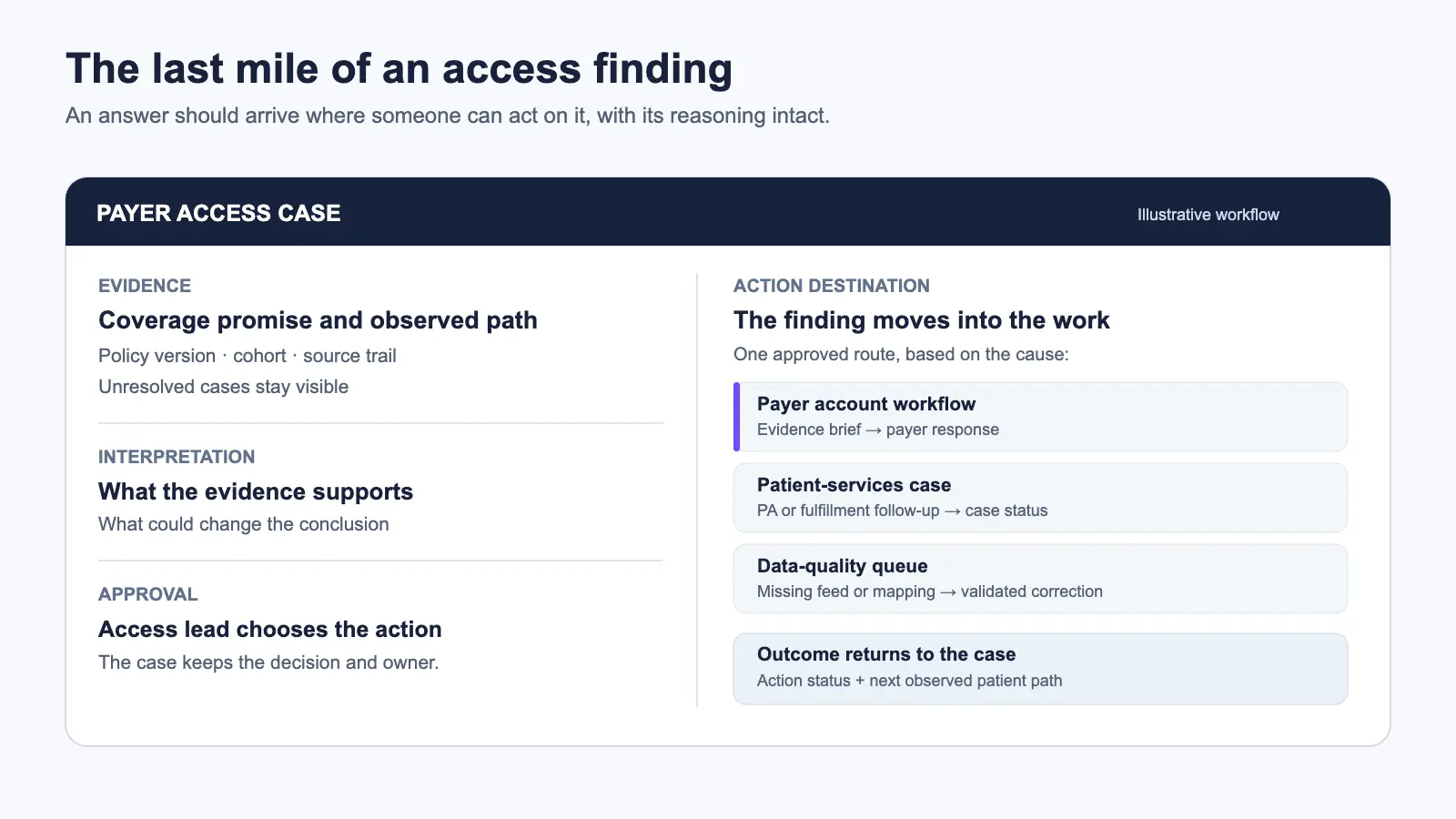
The output is an action-ready case with its reasoning and follow-up attached.
What should the team do after identifying the cause?
Suppose the investigation finds a payer restriction applied differently from the published policy. The work still includes assembling the policy clause and affected cohort, getting the access lead's judgment, preparing an account brief, recording the payer response in the account workflow, and checking subsequent adjudications. If the root cause is incomplete PA documentation, the next step belongs with field reimbursement or patient services and their case system. If a specialty pharmacy transfer is the barrier, a patient-services handoff and fulfillment status matter. If the gap is a missing feed, the task goes to the data owner before anyone claims an access loss.
How Tellius approaches the coverage-to-access gap
Tellius gives the team an AI worker that runs the recurring investigation through a configured Kaiya Mission. The Mission applies approved plan mappings and cohort definitions, refreshes the case as source systems change, and delivers an evidence-backed briefing with the next step prepared for review. People still own the judgment and approve any outward action. Tellius's market access overview describes the broader payer workflow.
Without that workflow, the handoff often turns insight back into manual work. An analyst exports evidence, an account lead rewrites it for a payer, and a service team re-enters a task. The result rarely makes it back to the original analysis. The system of record should hold the action and its status, while the access case retains the link to it. This describes a workflow design, not a claim that Tellius already writes to every account, hub, or pharmacy system.
Related market access questions
Payer-change monitoring focuses on what changed and how quickly the team can detect it. The structured coverage record itself is the subject of payer policy validation, which checks it against the source document. Payer contract analytics evaluates whether an access trade justified its economics. This article follows the patient-start gap after the policy is established, through a named action and an observed result.
Questions market access teams ask next
What would make a coverage gap worth raising with a payer?
An account team needs a pattern tied to the correct plan, benefit, policy period, and affected cohort, with downstream outcomes checked where available. The useful deliverable is a concise claim supported by source records and clear about what remains unresolved. A first-reject trend by itself is a signal to investigate, not the payer conversation.
What if the evidence points away from the payer?
The case should move to the team that can change the result. Incomplete PA submissions may call for field reimbursement or patient-services work. A specialty pharmacy handoff may need fulfillment follow-up, while a missing appeal feed needs a data owner. Preserve the account finding and link the task outcome back to it so the same pattern is not rediscovered next month.
Why can an access answer be right but still fail to change access?
The answer may arrive without the policy clause, cohort logic, accountable owner, or place to record the next step. An account lead then reconstructs the analysis, a service team opens a separate case, and the next refresh loses the disposition. Carrying the evidence and decision into the operational workflow is part of the access job.
What should an AI worker remember from one payer review to the next?
The approved plan hierarchy, cohort definitions, source priorities, policy interpretation, and corrections to earlier joins should persist as governed context. The worker should also carry the case status and source freshness into the next refresh. A human approves changes to the interpretation and any outward action.
Start with one payer
Choose a payer where the published position looks stronger than observed starts. The first useful deliverable is a case the access lead can defend: what the policy said, what happened to the patient cohort, what remains unknown, and who owns the next action.
Get release updates delivered straight to your inbox.
No spam—we hate it as much as you do!



Market Access Analytics for Pharma: Detect Payer Changes Before TRx Falls

This blog explains how AI-powered market access analytics helps pharma teams spot payer policy changes—formulary shifts, new PA requirements, and tier moves—within days instead of waiting 60–90 days for claims reports. By combining a pharma-native semantic layer, data federation across formulary, claims, hub, and specialty pharmacy sources, and agentic analytics, the platform automatically investigates access issues, quantifies TRx impact, and delivers finished decks and models. The result is earlier detection, faster performance diagnosis, and field activation while there’s still time to protect scripts and pull through new access wins.
.webp)
Payer contract analytics: how to size a formulary deal and prove pull-through
Winning favorable formulary access is only the first step in a successful payer strategy. The real challenge is determining whether a contract will generate profitable prescription growth—and proving that improved access translates into measurable pull-through. This guide explains how payer contract analytics enables market access, finance, and commercial teams to model the financial impact of formulary agreements before they're signed and continuously measure performance after launch. Learn how leading organizations combine formulary intelligence, claims, hub services, specialty pharmacy data, and field execution metrics to evaluate rebate effectiveness, forecast contract ROI, monitor payer performance, and identify opportunities to improve pull-through.
.webp)
Payer Policy Validation: How to Publish an Access Number That Survives a Challenge
A market access number is only useful if teams can explain exactly where it came from. This guide explores how pharma organizations can build a rigorous payer policy validation process for formulary access metrics that need to withstand scrutiny from market access, brand, finance, field, and leadership teams.