

Tellius AI teammates: enterprise AI agents that take recurring work off your team

TL:DR
- Tellius launches enterprise-grade AI teammates customized for specific areas of work
- Instead of driving prompt by prompt, AI teammates work towards your goals and coordinate across people and AI agents
- Guardrails, business/domain context, repeatable workflows, and built-in skills are now reachable in your everyday tools for rapid value
Today, I'm excited to announce Tellius is launching AI teammates — enterprise-hardened, goal-oriented AI agents that take on business work across your data, systems and people. Unlike chat AI that you must drive one prompt at a time, AI teammates automatically gather context, work across people and AI agents, check numbers, and produce polished deliverables and action recommendations for you to approve.
Domain know-how is built in, semantics and enterprise guardrails and security are baked in, it runs on tools you already leverage. But what's truly exciting, based on early adopters and our own internal usage of it is how intuitive it feels and the massive leverage we're seeing. Simply put it's changing the way businesses get work done across human and agent teams.
Why recurring work still piles up on teams with good AI tools
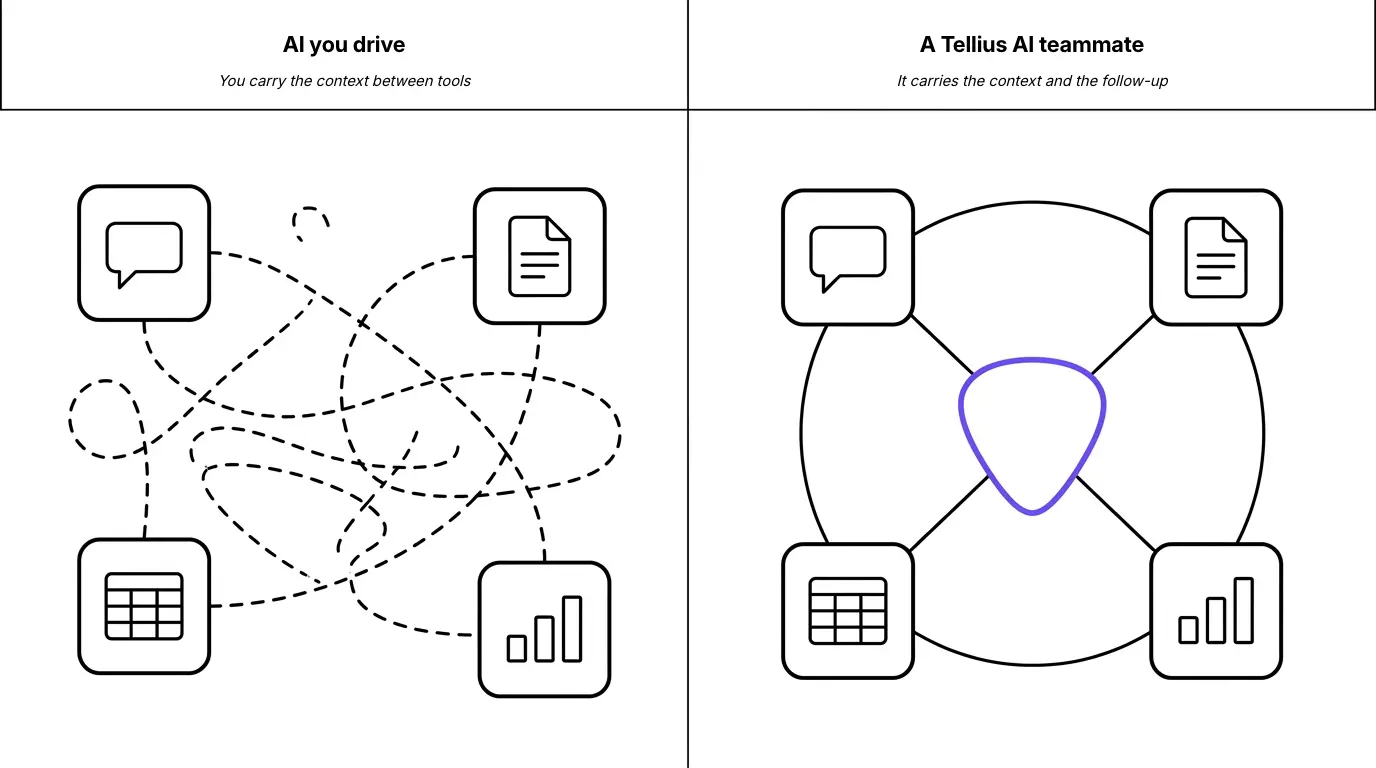
Most teams now use ChatGPT or Claude, a copilot in their documents and AI features inside the apps they already run. Each is good at the step in front of it, whether that's answering a question, drafting a summary or running a task when someone asks.
But the recurring work around those steps still moves at the speed of people. Someone has to remember to start the weekly field review, pull last week's numbers, apply rules that live in a few people's heads, chase three owners for their inputs and get the draft signed off. The number moves on Tuesday, someone notices on Friday, and the analysis lands after the window has closed. Little carries over to the next cycle, so the effort repeats.
That's why field reviews, payer QBRs and month-end commentary still depend on manual stitchwork and a lot of chasing down people, even on teams with good AI tools. Most of the elapsed time sits in the hand-offs.
What a Tellius AI teammate does
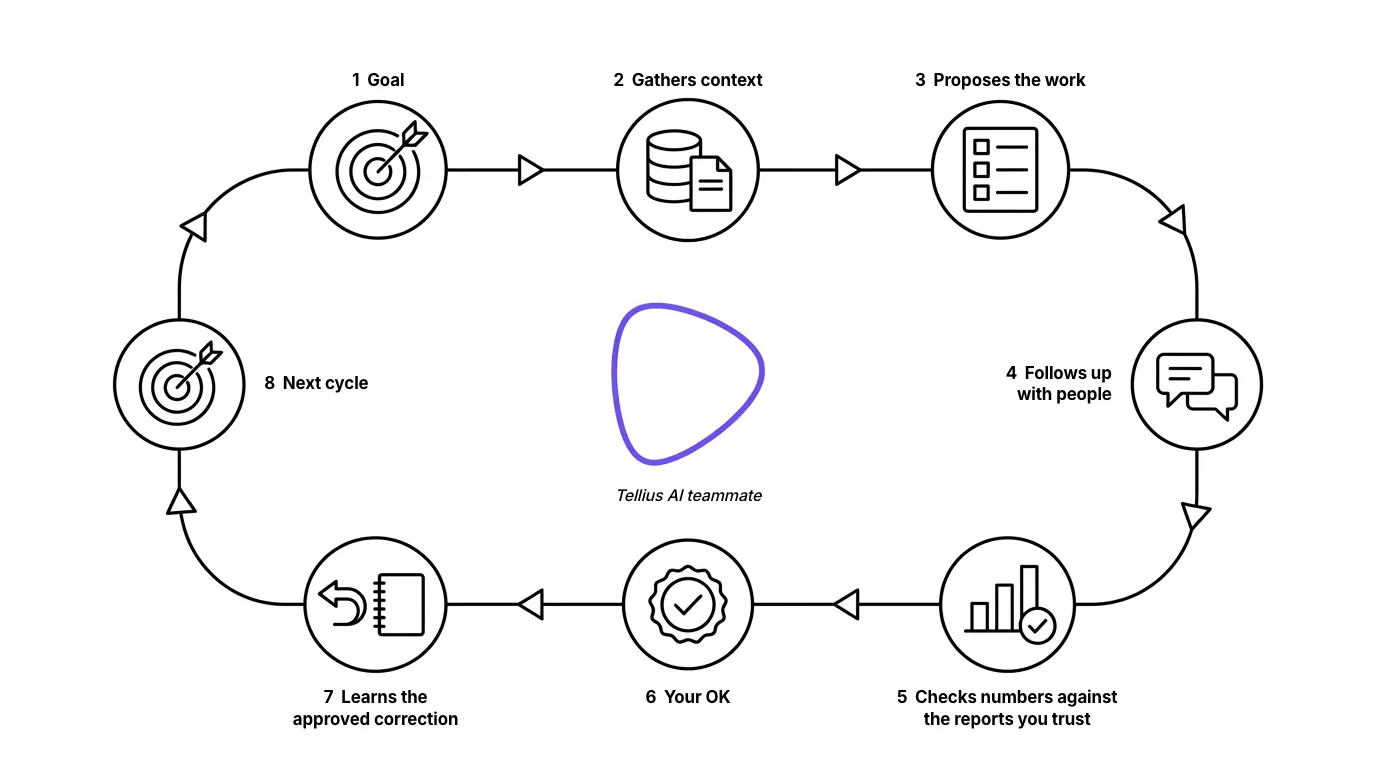
You give an AI teammate a goal, and it does the collating, chasing and analysis across the tools and data your team already uses. It keeps going while you're offline and comes back with a recommendation and the decisions that need you. Here is one illustrative run for a commercial finance lead whose goal is "Keep Q4 net revenue on plan."
- You give it a function or a goal. It works with ready-made worker AI agents, such as Month-End Variance or Payer Policy, or ones your team creates.
- It gathers the context on its own: your data, metric definitions, team structure and policies. Overnight it sees Northeast sales running an illustrative 8% under plan.
- It proposes the work. It traces most of the gap to two accounts and a stockout, flags a payer coverage change for the market access team and lays out what it can take on, and you choose what it does next.
- It coordinates and follows up. It asks the account owners and the supply lead for what it needs in Slack or Teams, drafts the follow-ups for your OK and hands the modeling to worker AI agents. Kaiya, your chief of staff and 24/7 AI orchestrator, coordinates them.
- You make the calls. Before Elena's forecast call, the revenue bridge and talking points are waiting for her OK, tied out to the reports her team already trusts. She corrects one line, and the AI teammate applies that rule from the next cycle on.
Polished deliverables, functional apps and repeatable multi-step workflows are a few of many outputs.
AI teammates for pharma, FP&A and RevOps: four recurring jobs
Most AI tools can run on a schedule now, so the schedule isn't what sets an AI teammate apart. The gap shows up in the people part of the job: gathering inputs, getting approvals and closing the loop. Here is how that plays out in four recurring jobs, with illustrative times and numbers.
In the pharma jobs, drafts to reps wait for the manager's OK, and nothing goes to doctors or their offices, since that runs through medical, legal and regulatory review.
How AI teammates learn your business context
You give ChatGPT or Claude the context in every session. An AI teammate gathers it on its own. It comes with curated domain skills and industry-specific metrics for pharma commercial, market access, FP&A and procurement, then learns your data models, definitions, rules and approvers on top.
Before an AI teammate reports an NBRx dip, for example, it applies the access team's payer-first check and excludes 340B volume from net, because those are the rules the team approved. (The example is illustrative.)
When someone fixes a definition, the rule's owner approves the change, and from then on it applies across the whole team. A new case gets one question, and the approved answer is reused after that, so the know-how stays with the company when people change roles.
How AI teammates work with your team in Slack, Teams and email
We call this multiplayer AI: your team, business unit and organization move at the speed of AI, instead of only the few people who have learned to prompt well. Most of a recurring job's elapsed time goes to waiting for an input or a sign-off, so that's the work an AI teammate takes on. It sends each person one short message with the context and one question, follows up when someone goes quiet and drafts what goes out for your OK.
Each job has one AI teammate that owns it and hands pieces to worker AI agents, so nobody on your team has to supervise a roster of agents.
How AI teammates stay governed: nothing goes out without your OK
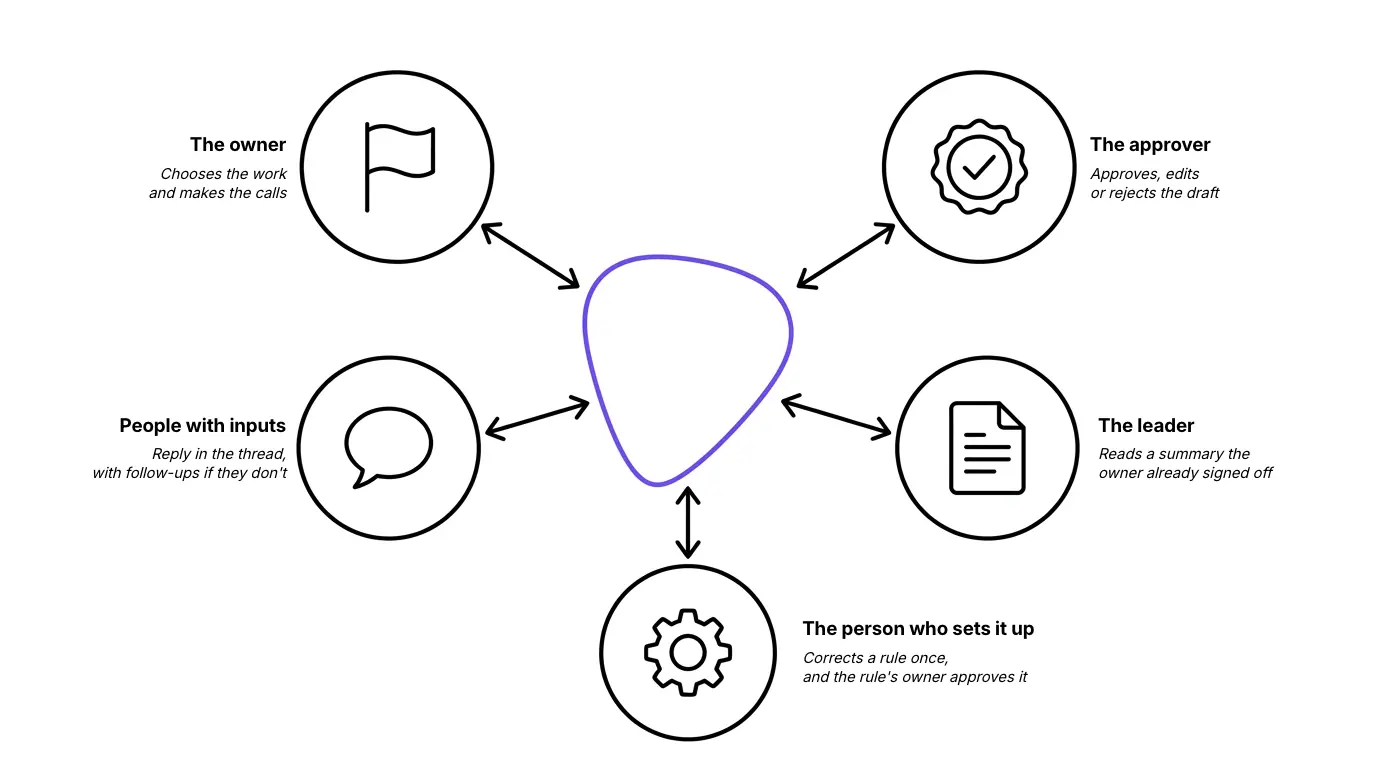
Numbers are checked against the reports you already trust. The AI teammate follows who can see what and who approves what, every action is logged, and nothing goes out without your OK. Patient-level data stays with patient services, for example, and nothing goes to a payer until a person on the access team approves it.
No AI gets every number right, and we won't claim ours does. What we can do is make a wrong number easy to catch before it travels: each figure links to the query and source behind it, and a person reviews anything that leaves the team.
What's available in Tellius 7.0
AI teammates are a layer on the Tellius product you already run, not a separate product or a separate price. They work through the agents, Apps and chat your team uses today.
- Generally available in Tellius: agents on a schedule, threshold alerts, data models, Skills and Memory, chat, Slack and Teams delivery, email delivery, plan approval, role-based access, the audit log, citations on figures and number checking.
- In preview with Tellius 7.0: AI teammates, ready-made worker AI agents, goals and plans, follow-ups with people, message triggers, learning from approved corrections, connectors to your apps, action approvals and work history.
- Shown in demos, not yet available: routing an approval to a designated approver in another role.
The AI Workers introduced in October are now ready-made worker AI agents, named for the job. The Month-End Variance Worker, for example, is now the Month-End Variance agent, and an AI teammate can hand it work.
Start with one job your team repeats
Tellius already runs at 8 of the top 10 pharma companies. Bring the job your team rebuilds every week or every close, such as last week's field review or last month's variance pack. We'll run it with an AI teammate on your last completed cycle and test it against five proof tests: accuracy, consistency, trace, change and field-ready. The usual rollout pattern puts the first job live in four weeks.
Questions about AI teammates
An AI teammate is an AI agent that takes on a recurring goal for a team instead of a single prompt for one person. It keeps context between runs, starts work on a schedule or a trigger, gathers inputs from the people involved and asks a person to approve anything consequential. Tellius AI teammates add built-in domain know-how and your governed business context.
How is an AI teammate different from ChatGPT, Claude or a copilot?
ChatGPT, Claude and copilots are strong at a task someone asks for, and several can now run scheduled work. An AI teammate owns a recurring goal. A Tellius AI teammate gathers the business context itself, follows up with the people involved and brings back finished work for your OK.
How is it different from a personal AI agent?
Personal agents work for one person and start from a blank page. Tellius AI teammates work for you and the team, come with your business built in and check the numbers before anything goes out.
What does a Tellius AI teammate know on day one?
It starts with domain know-how for pharma commercial, market access, FP&A and procurement. It then gathers your data models, metric definitions, team structure and policies, and learns your team's rules from approved corrections.
Does an AI teammate act without approval?
No. A Tellius AI teammate does the gathering, analysis and drafting on its own, and nothing goes out without your OK. It sees only what your role allows, and every action is logged.
Where does a Tellius AI teammate work?
A Tellius AI teammate works in Slack, Teams and email, and in the Tellius platform. It connects to the tools your team already uses, so nobody has another place to check.
Which jobs are a good first fit?
Recurring work that crosses data, systems and people, such as a weekly field performance review, month-end variance commentary, payer policy changes, off-contract spend or a weekly forecast. Tellius AI teammates fit best on a job your team repeats on a cadence that needs inputs from more than one person. For finance, see which FP&A jobs to start an AI agent on.
How long until the first job is live?
The usual rollout pattern puts the first job live in four weeks: align in week one and build in weeks two to four. Tellius AI teammates start with the function's know-how built in, so the first work arrives without months of onboarding.
What happened to Tellius AI Workers?
They're now ready-made worker AI agents, named for the job, such as the Month-End Variance agent. A Tellius AI teammate hands work to them.
How do I get Tellius AI teammates?
AI teammates are rolling out to Tellius customers in preview with Tellius 7.0, at no separate price. To start, bring one recurring job and test it on your last completed cycle.
Get release updates delivered straight to your inbox.
No spam—we hate it as much as you do!

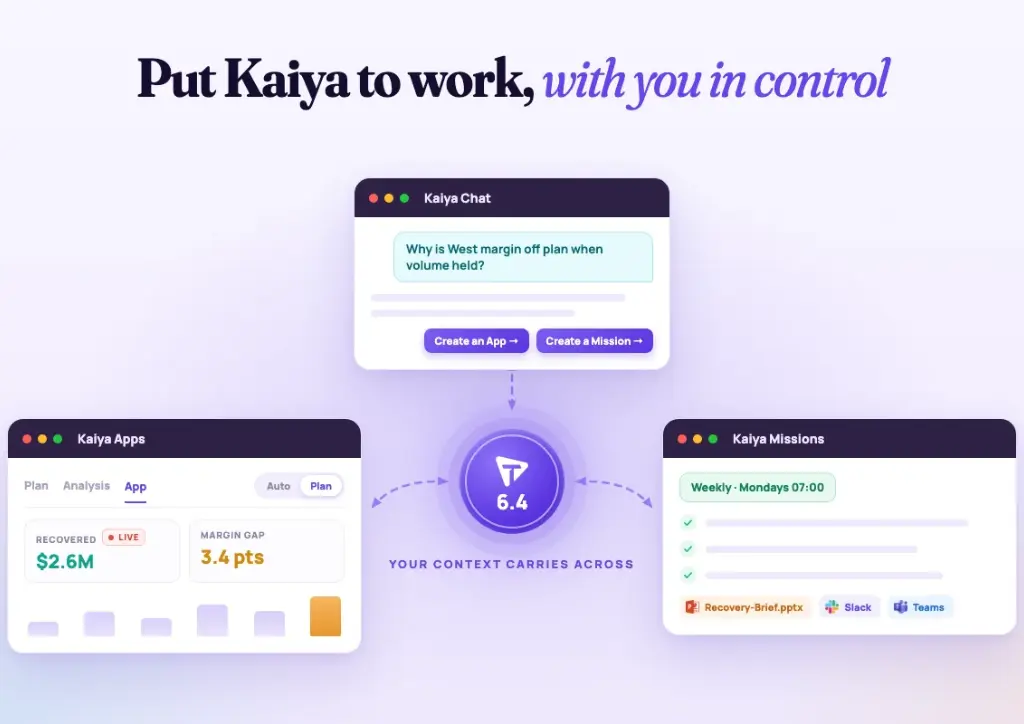
Tellius 6.4: Put Kaiya to Work, With You in Control

Kaiya now carries a question all the way to finished work: an App the team opens, a Mission that runs every Monday, and a reviewed action in the system where the work happens. You shape the plan before it builds, trace every number, and approve every write.