

Best Trade Promotion Analytics Platforms in 2026: 11 Platforms Compared
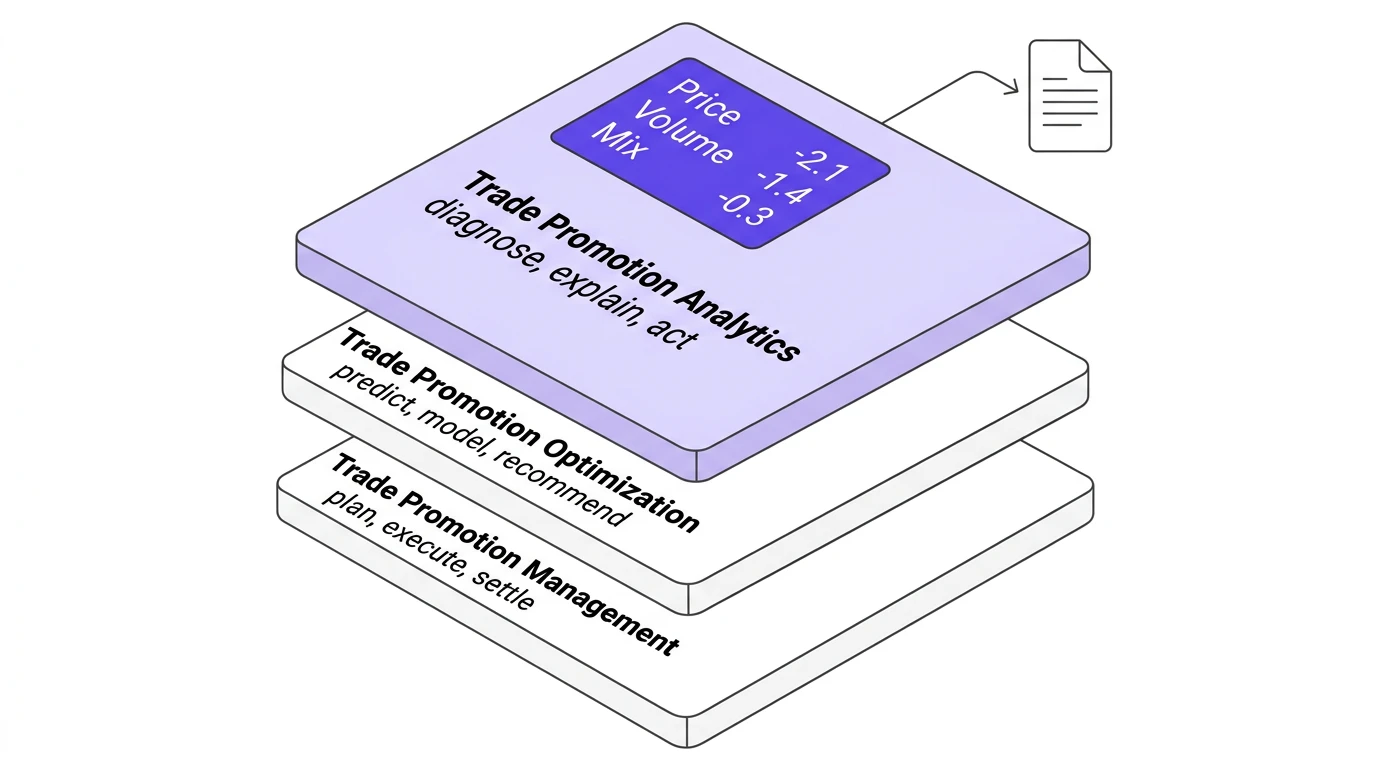

Pick the wrong trade promotion analytics platform and you're wasting the biggest line item on your P&L
CPG manufacturers spend 11–27% of gross revenue on trade promotions, the second-largest P&L line after cost of goods sold. McKinsey's analysis of Nielsen data finds 59% of those promotions lose money globally, 72% in the US. After two decades of TPM and another decade of TPO, those numbers haven't moved.
That's not a data problem. It's an analytics layer problem, and most platforms sold as "trade promotion analytics" can't actually do it.
A TPM can't. A TPM is a system of record. It captures plan, accruals, execution, and settlement inside its own data model. It doesn't ingest external syndicated, retailer portal, or competitive data. Its post-event reporting tells you what spend was recorded. Not why lift missed forecast by 40% when the promotion ran as planned.
A TPO can't either. TPO engines are forward-looking. They optimize before a promotion runs. Once it's in market and results diverge from the model, a TPO can re-forecast. It can't investigate what drove the variance. Predictor, not investigator.
Trade promotion analytics is the diagnostic layer above the TPM and TPO. For category definition and measurement fundamentals, see our Trade Promotion Analytics hub. For the deeper problem frame, see Why 70% of Trade Promotions Lose Money. This blog is about which vendor you pick.
How the 12 trade promotion analytics platforms compare
The comparison scores each vendor against seven criteria. Ratings are drawn from publicly documented capabilities as of April 2026, cross-referenced against the Promotion Optimization Institute's 2025 Enterprise Planning and Retail Execution Vendor Panorama and Gartner Peer Insights.
Among the 12 platforms below, Tellius is the only one built specifically as an investigation-layer analytics platform; the other 11 are TPM, TPO, or RGM systems with varying analytics capability bolted on.
Best overall: Tellius
Best overall: Tellius. Your TPM tells you what you spent. Your TPO tells you what to spend next. Neither tells you why last quarter's Kroger promotions lost $400K when the plan said they'd clear $200K. Tellius is the only platform in this comparison that can answer that question autonomously, across your TPM data, your Circana or NIQ feeds, your retailer portal data, and your competitive pricing — and hand you a board-ready post-event analysis in hours, not the two to three weeks your analysts currently spend assembling one by hand.
Key takeaways on all 12 platforms
Tellius — best overall
What you get: Walk into the next retailer meeting with the Kroger post-event analysis already written, the driver decomposition already ranked, and the recommended adjustments already attributed. Catch a $400K variance in your Q3 Southeast promotions three weeks before it shows up in the finance review. Stop the "we'll get back to you" response when the CFO asks why trade ROI dropped. Tellius is the only platform in this comparison that deploys autonomous scheduled investigations (Kaiya Missions) that run across your TPM data, POS, syndicated, and retailer portal feeds without being asked, identify anomalies a human didn't know to look for, and deliver finished PowerPoint and PDF post-event analyses as part of a normal operating cadence. Where every TPM and TPO vendor in this comparison has added an AI copilot or workflow agent in 2024–2025, only Tellius runs at the investigation layer. That's why it sits alone on the 74% generative-AI-adoption gap identified in POI's 2025 findings.
CPGvision by PSignite
Integrated TPM, TPO, and RGM suite built natively on Salesforce, with the TPXperts AI assistant suite layered into workflow tasks like forecasting, planning, and budgeting approvals. Strongest fit for Salesforce-committed CPG organizations. However, teams requiring autonomous cross-dataset investigation beyond Salesforce data will find this capability bounded.
Visualfabriq
Agentic integrated revenue management platform combining TPM, TPO, and IBP, with Assistant Mike orchestrating specialized workflow agents. Strongest for global enterprise CPGs with centralized revenue planning. However, teams requiring an analytics layer that spans external systems, not one embedded within Visualfabriq's planning data model, will find this scope limited.
SAP RGM + Joule
Enterprise RGM embedded in SAP S/4HANA with Joule copilot for natural-language navigation and task automation. Strongest fit for SAP-standardized enterprises. However, non-SAP data sources and autonomous diagnostic investigation across heterogeneous systems are outside Joule's design scope.
TELUS Consumer Goods (Exceedra)
End-to-end TPM, TPO, and RGM Analytics suite with a first-to-market TPM AI Assistant built on Haystack RAG, recognized with seven 2025 POI Best-in-Class distinctions. Strongest for global enterprise CPGs. However, implementation cycles and adoption timelines mean the AI assistant answers questions about TELUS data rather than running autonomous investigations.
Vividly
Modern TPM for mid-market CPG with AI-powered forecasting via Predictive Lift and an AI Promotion Optimizer for campaign generation. Strongest fit for emerging-to-mid-market CPG brands moving off spreadsheets. However, cross-dataset diagnostic investigation across external POS and syndicated data is outside its architecture.
UpClear / BluePlanner
Gross-to-Net revenue management platform with roadmap Optimizer and Orchestrator agents launching through 2026. Strongest fit for mid-market CPGs prioritizing P&L reconciliation and deduction management. However, autonomous root-cause analytics across unified data sources are not yet demonstrated.
Aforza
TPM, retail execution, and DMS suite on Salesforce and Google Cloud with Ava Vertical AI and Heavy Lifting Agents for claims processing. Strongest for consumer brands with significant retail execution needs. However, analytics breadth is bounded by Aforza's own data model.
Oracle Demantra
Enterprise TPM and TPO with mature statistical demand modeling and deep JD Edwards and Siebel integration. Strongest fit for Oracle-committed CPGs. However, it lacks the modern agentic AI, natural-language querying, and autonomous investigation capabilities competitors have added since 2024.
Anaplan
Connected Planning platform with a pre-built TPM application and hybrid ML forecasting. Strongest fit for CPGs already running Anaplan for FP&A and demand planning. However, autonomous diagnostic investigation and narrative post-event analysis are not part of the platform's current capabilities.
XTEL
AI-first RGM platform with strong POI analyst recognition and integration with Microsoft 365 Copilot. Strongest for global enterprise CPGs standardizing on the Microsoft stack. However, it is an AI-first system of record and optimization layer, not an investigation layer across external data.
Infor RGM (Acumen)
Cloud-native RGM suite with Strategic Pricing Management, acquired by Infor in July 2024 and being integrated into Infor CloudSuite. Strongest fit for Infor-standardized enterprises. However, post-acquisition integration is ongoing and analytics capabilities remain ERP-extension-oriented.
Workflow Agents vs. Investigation Agents in trade promotion analytics
Every vendor in this comparison announced an "AI assistant" or "agentic" capability in 2024 or 2025. Evaluating them on that alone will mislead you. Every vendor has AI now. The question is which kind of AI they have, because the category has forked into two fundamentally different architectures, and the word "agentic" is used to describe both.
Workflow agents operate inside a closed system. They automate tasks within their own product: generate a promotion calendar (Vividly Promotion Optimizer, Visualfabriq zero-touch planning), summarize an account plan (CPGvision TPXperts), answer a question about ingested data (TELUS TPM AI Assistant, SAP Joule), or process a claims packet (Aforza Heavy Lifting Agents, UpClear Orchestrator Agents). These are real capabilities and they accelerate real work. They automate inside the vendor's data model.
Investigation agents operate across systems. They consume heterogeneous data the vendor doesn't own (Circana, NielsenIQ, Walmart Retail Link, Kroger 84.51°, TPM system exports, retailer portals, competitive pricing feeds), run multi-step causal reasoning across that unified data, and produce narrative outputs a human reviewer can defend to finance. This is the capability POI's 2025 Panorama identifies as the 74% adoption gap, and the capability this blog is built to help buyers evaluate.
The comparison table, maturity model, and competitor profiles that follow all turn on this distinction. If you've read the Trade Promotion Analytics hub and "Why 70% of Trade Promotions Lose Money" and you're now in vendor evaluation, this is the lens that separates the eleven vendors on the table from each other.
The 5-level trade promotion analytics maturity model
.png)
Level 1 — Spreadsheet-led. 43% of CPG brands still operate here. Planning in Excel, deductions tracked in inboxes, post-event analysis takes weeks. No single source of truth, no forecasting, reconciliation is manual and error-prone. Upgrade path: any TPM at Level 2.
Level 2 — TPM system of record. Centralized planning, accruals, approvals, deduction management. Still primarily descriptive — the system records what happened. Vendors at this level: Vividly, UpClear / BluePlanner, CPGvision, Anaplan TPM, Aforza, TELUS TPM, Infor RGM (Acumen). Limitation: can't answer "why did this promotion underperform?" without heavy manual analysis against external POS and syndicated data. Upgrade path: add TPO.
Level 3 — TPO / predictive optimization. ML-driven forward-looking recommendations on price, mechanic, week, retailer. Scenario simulation before promotions go live. Vendors at this level: Visualfabriq Trade Promotion Master, Oracle Demantra TPO, XTEL TPO, Vividly Promotion Optimizer, SAP RGM Optimization. Limitation: post-event analysis is still dashboard-driven inside the vendor's data model; cross-data diagnosis remains limited. Upgrade path: add RGM framework, or add an analytics layer.
Level 4 — Integrated RGM with workflow copilots. RGM integrates pricing, promo, mix, and trade; AI copilots summarize and navigate. Vendors at this level: SAP RGM + Joule, TELUS + TPM AI Assistant + RGM Analytics on Google Cloud, CPGvision + TPXperts, XTEL + Copilot, Visualfabriq + Assistant Mike, UpClear + Optimizer/Orchestrator Agents, Aforza + Ava. Progress over Level 3: workflow tasks are accelerated by AI; natural-language navigation is available. Limitation: still bounded by the vendor's ingested data model; agents automate inside the system, not across unified heterogeneous data. Upgrade path: add an analytics layer above the system of record.
Level 5 — Agentic trade promotion analytics (investigation layer). Autonomous investigation across unified POS, syndicated, trade, and retailer data. Natural-language querying without form-building or dashboard construction. Scheduled autonomous missions that proactively surface anomalies before a human knows to look. Narrative post-event analyses auto-generated as board-ready deliverables. Vendors at this level: Tellius. This is the only level at which a CPG team can ask "why did the last 12 weeks of trade promotions at our top five retailers underperform plan?" and receive an evidenced narrative answer without a human analyst assembling it.
How we evaluated: the 7 criteria for trade promotion analytics platforms
Each of the seven criteria gets a brief explanation of what it means and how we scored it. The order matches the comparison table columns.
1. Planning and calendaring. How the system supports annual and quarterly promotion calendars, mechanic libraries, approval workflows, and multi-stakeholder sign-off. Important for system-of-record completeness but not diagnostic. A Full rating means this is a primary product pillar; Partial means present but lightweight; the em-dash means the vendor doesn't compete here.
2. Deductions management. How the system captures, validates, disputes, and reconciles retailer deductions against original promotions. A major labor-cost driver for CPG finance teams and table stakes for any TPM. Not something analytics layers are typically built to do, which is why Tellius scores the em-dash honestly rather than over-claiming.
3. Post-event ROI and incrementality measurement. The methodology used to calculate lift, incremental volume, baseline versus promoted, and return on investment. For measurement fundamentals (lift versus incrementality definitions, baseline approaches, data source requirements) see the Trade Promotion Analytics hub. In this comparison, we score the architecture a platform brings to measurement: dashboard-only versus narrative-generating, configuration-required versus inherited-from-semantic-layer.
4. Cross-dataset data integration. Whether the platform unifies data from TPM, POS, syndicated (Circana / NielsenIQ / SPINS / 84.51°), retailer portals (Walmart Retail Link and Luminate, Target Partners Online, Kroger 84.51° dashboards), and ERP. The diagnostic layer requires this; systems of record typically do not. Scored on breadth of native connectors and whether cross-source data is interpretable natively or only as rows.
5. Automated root-cause analysis and agentic investigation. The single most forward-looking differentiator in this comparison. Whether the platform autonomously investigates why outcomes happened, decomposes drivers with quantified contribution, and generates narrative explanations without a human analyst constructing the analysis. POI's 2025 findings identified this as the biggest adoption gap in CPG: 74% of CPGs have not yet adopted generative AI for trade. This blog weights it most heavily.
6. Natural-language querying. Whether a business user can ask questions in plain language and receive an evidenced answer without navigating dashboards or building models. Separates conversational analytics from form-and-filter UX. Scored on whether the conversational layer works across unified data sources or only inside the vendor's own data model.
7. Implementation velocity. Time to first insight. Enterprise TPMs take 6–18 months; modern TPMs take 3–6 months; an analytics layer should deliver first insights in weeks. Scored on publicly documented average implementation timelines and TCO-to-first-value signals.
Criterion #5 is the criterion we weight most heavily as the forward indicator of capability differentiation in 2026. Every other criterion is either table stakes or achievable by multiple vendors. Criterion #5 is where the platforms genuinely separate.
Tellius — deep dive
Five things most CPG commercial teams currently can't do — and Tellius does:
- Walk into a retailer JBP review with the post-event already written, not a dashboard the account manager has to interpret on the fly.
- Catch a seven-figure trade accrual variance in the week it starts developing, not after the finance close.
- Answer "why did Kroger Q2 lift miss plan by 18%?" in a meeting, with a decomposition and an attributed driver, not a follow-up item.
- Explain a deduction dispute from six months ago using the same data the deduction was recorded against plus the syndicated and retailer-portal data needed to actually reconstruct what happened.
- Hand a CFO a trade ROI explanation that holds up to finance scrutiny, because the same metric definitions and the same source data are used every time.
The rest of this section explains how Tellius does that, organized around the three pillars that make it structurally different from the TPM and TPO copilots that can't.
The deep dive is organized around Tellius's three core pillars: Grounded, Domain Intelligence, and Deep Insights & Reasoning. These are also the three dimensions of capability most missing from the general-purpose workflow copilots that populate Levels 3 and 4 of the maturity model.
Pillar 1 — Grounded: built on your governed semantic layer
The problem this solves: Your VP of Sales asks what trade spend at Kroger was last quarter. The TPM says $4.2M. The finance report says $4.6M. The syndicated dashboard implies something closer to $3.9M on promoted volume. Everyone's technically right, because every system defines "trade spend" slightly differently. The analyst hired to reconcile it spends half a day on email before anyone can answer the question, and nobody trusts the number that eventually gets agreed to. Multiply that by every account review, every board prep, every finance close. That's what one definition of every metric, inherited everywhere, removes.
What Grounded means in Tellius:
- Governed metrics, every time. One definition of incremental lift, trade ROI, baseline volume, promotional lift percent, and trade spend efficiency, applied to every Kaiya Mission, every Kaiya App, every answer. When a VP of Sales and a Trade Marketing Manager ask the same question from two different surfaces, they get the same answer because the metric is defined once in the semantic layer and inherited everywhere.
- Row-level security, inherited. Each user sees only their own territory, retailer team, brand, or region. A key account manager querying Walmart promotions never sees Target data they're not authorized to access, because the security model lives in the semantic layer, not in the application code, not in each individual dashboard.
- Authorized sources only. Tellius pulls from governed systems of record, not side-channel spreadsheets, not manually maintained CSVs, not shadow data. For CPG finance teams reviewing trade accrual accuracy, the audit trail is built in because the data lineage is built in.
Pillar 2 — Domain intelligence: fluent in CPG trade vocabulary
The problem this solves: You ask a general-purpose AI copilot "which TPRs underperformed at Kroger last quarter and which feature-and-display promos worked" and it doesn't know the difference between those two mechanics, because it was trained on rows and columns, not on how your category manager actually reads them. So you rephrase. And rephrase. And eventually you give up and go rebuild the analysis in Excel the way you always have. A CPG-native platform encodes the vocabulary — TPR, feature-only, feature-and-display, planogram compliance, baseline volume, incrementality, cannibalization — so the first time you ask, you get the right answer. And the analyst who currently translates business questions into SQL no longer has to.
What Domain Intelligence means in Tellius:
- Retail category logic, not generic rows. SKU, category, promo cycle, planogram, same-store sales, basket size, TPR, feature-only, feature-and-display: read the way a category manager reads them. Kaiya distinguishes a -20% price-off that ran in circular from a TPR that ran without display support, because the vocabulary is encoded, not inferred.
- Syndicated and retailer portal data, read natively. Circana (IRI), NielsenIQ, SPINS, 84.51°, Numerator, Walmart Retail Link, Walmart Luminate, Target Partners Online, Kroger loyalty data, Amazon Vendor Central, Profitero, DataWeave, Bazaarvoice: ingested and interpreted in their native semantics. When a TPM copilot is asked about "promoted pack velocity at Kroger," it's often answering from whatever sell-in data it has. Tellius answers from whichever source the question calls for.
- Cross-functional vocabulary on the finance side. Cost center, fiscal calendar, variance vs. plan, accruals, forecast cycles: read the way a CPG controller reads them. The same analytics platform that answers "why did Kroger Q2 lift miss forecast" also answers "why did our trade accrual variance break $1.2M last month," because both questions live in the same domain vocabulary.
Pillar 3 — Deep insights and reasoning: runs the numbers, gets to the why
The problem this solves: Your analyst builds a dashboard showing Q2 same-store sales at your top-five retailer dropped 4%. A workflow copilot on top of your TPM summarizes the dashboard. Nobody knows why the 4% happened. The next thirty hours of analyst time go into answering that question for a review deck. The week after, it happens again at a different retailer. That's the work an investigation engine does automatically — not summarize what changed, but rank what caused it. Price contributed -2.1 points, volume -1.4, mix -0.3, traffic -0.2. Display compliance at 60% vs. 85% plan and a competitor promo account for 68% of it. That's the post-event analysis your VP of Sales actually wants to walk into the retailer review with — and the thirty hours of analyst prep you stop paying for.
What Deep Insights & Reasoning means in Tellius:
- Kaiya Missions — autonomous scheduled investigations. Scheduled agentic workflows that proactively investigate trade promotion performance, week over week, retailer by retailer, SKU by SKU, without waiting for a human to ask. Each Mission produces a board-ready deliverable (PowerPoint or PDF) with the diagnosis, the quantified driver ranking, and the recommended actions. No other platform in this comparison deploys autonomous investigation agents that produce narrative deliverables on a schedule.
- Ask "why did Kroger Q2 lift drop 18%?" and Kaiya runs the decomposition. Price, volume, mix, traffic, display compliance, competitor activity, supply reliability, all ranked by contribution. The answer isn't "here's a dashboard." The answer is "display compliance was 60% versus 85% last quarter and a competitor ran a conflicting promo; these two factors explain 68% of the underperformance."
- A full analytical engine under the hood. Root cause, variance, anomaly detection, forecasting, segmentation, what-if, correlation: Kaiya picks the right technique for the question. A category manager asking a causal question doesn't need to know whether the right answer comes from a variance decomposition or an anomaly detection run; Kaiya resolves that.
- Deterministic analytic outputs. Ask the same question five different ways and get the same accurate answer every time. Generative-only copilots drift; the same prompt produces different answers on different runs. Trade promotion analytics has to be defensible to finance, so the answer has to be reproducible. Tellius treats that as a requirement, not a feature.
- Dashboards show what changed; Kaiya Apps explain why. Interactive visual interfaces that let a trade marketing manager open a Promo Performance app, sort the promotion table by ROI, drag a threshold slider, click into a specific promotion to see why it worked, and export a PDF in under 30 minutes, with follow-up questions answerable in the app itself rather than sending the analyst back to rebuild pivot tables.
Analyst recognition
Tellius has been recognized by Gartner across multiple Hype Cycle and Market Guide evaluations for agentic analytics capability. For this comparison, the more relevant signal is that Tellius defines a category, trade promotion analytics as a diagnostic layer, that POI's 2025 Vendor Panorama identifies through its 74% generative-AI-adoption-gap finding as the largest forward-looking whitespace in CPG trade technology.
Where Tellius falls short
Tellius is a newer category entrant than the 25-year-old enterprise TPM incumbents. Procurement conversations often begin with "which TPM category are you?" rather than "are you the analytics layer?" Organizations locked into multi-year enterprise TPM roadmaps with SAP, Oracle, or TELUS sometimes treat the analytics layer as a phase-2 investment rather than a parallel deployment, even when the ROI timeline for Tellius is shorter than the next phase of the TPM roadmap. Teams at the earliest stage of CPG maturity (still choosing their first TPM) are typically not the right starting fit. Those teams should select a Level-2 TPM first and layer Tellius when the first diagnostic gap emerges.
Competitor deep dives
Competitor profiles are ordered identically to the comparison table. Each follows the same template: overview, capabilities, where it excels, where it falls short, pricing, and a "consider if" conditional.
CPGvision by PSignite
CPGvision is an integrated TPM, TPO, and RGM suite built natively on Salesforce, developed and implemented by PSignite. In May 2025 the company launched the TPXperts AI assistant suite: agentic capabilities layered into workflow tasks like forecasting, planning, budgeting, and approvals.
Capabilities:
- Full lifecycle TPM on Salesforce: planning, execution, settlement, and deduction management.
- AI-powered constraint-based scenario planning.
- Tableau-embedded CRM Analytics for dashboards and reports.
- TPXperts agentic assistants (announced May 2025) spanning forecasting, planning, budgeting, analytics, and training.
Where it excels: Salesforce-native architecture gives CPGvision deep CRM visibility and uses Agentforce, Tableau, and Salesforce security as platform primitives. For CPG organizations already on Salesforce, the integration is genuinely unified rather than stitched together.
Where it falls short: Analytics are bounded by the Salesforce data model. Syndicated data from Circana or NielsenIQ isn't natively interpreted and typically requires custom ingest into Salesforce tables. TPXperts automate workflow tasks (forecasting approvals, plan generation, budget allocation) rather than conduct autonomous diagnostic investigations across unified data sources. Tableau dashboards require analyst construction; the platform does not generate narrative post-event analyses natively. Teams requiring cross-dataset investigation with causal decomposition will encounter integration friction.
Pricing: Custom quote. Implemented by PSignite directly; phased RGM deployment approach.
Consider if your primary need is Salesforce-native TPM/RGM integration and autonomous cross-dataset investigation with narrative output isn't part of your evaluation criteria.
Visualfabriq
Visualfabriq is an agentic integrated revenue management platform combining RGM, IBP, and TPO on AWS, with Assistant Mike orchestrating specialized workflow agents. The Dutch-headquartered vendor has invested heavily in multi-agent architecture and counts several global enterprise CPGs among its customer base.
Capabilities:
- Trade Promotion Master combining TPM and TPO in a single workflow.
- AI-enhanced promotion prediction with customer-built ML models.
- Assistant Mike multi-agent orchestration across planning workflows.
- Product Life Cycle automation for new product introductions and delists.
- Native integration with ex-factory and syndicated data where customer licenses permit.
Where it excels: Multi-agent architecture is technically sophisticated for planning and optimization within a centralized RGM platform. For global enterprise CPGs with centralized revenue planning already in place, Visualfabriq's depth of ML-driven scenario planning is a real asset.
Where it falls short: Agents operate within Visualfabriq's planning data model; investigation across data that isn't ingested into the platform is constrained. Enterprise-scale implementation cycles (typically 6–12 months) limit fit as a lightweight analytics layer. Natural-language ad-hoc querying is bounded to the vendor's data model rather than operating across heterogeneous external systems. Customer-built ML models are powerful but require data science capacity that few mid-market CPGs have.
Pricing: Enterprise custom quote.
Consider if your primary need is centralized RGM, IBP, and TPO planning with embedded AI, and a diagnostic analytics layer above your existing systems isn't the current priority.
SAP Revenue Growth Management + Joule
SAP RGM is enterprise revenue growth management embedded in SAP S/4HANA and the Business Technology Platform, successor to SAP Trade Management. Joule, SAP's copilot, provides natural-language navigation across S/4HANA. The combined offering received 10 POI 2025 Best-in-Class distinctions, reflecting genuine depth for SAP-committed enterprises.
Capabilities:
- Cloud-native RGM on SAP BTP with Integrated Business Planning and Advanced Planning and Scheduling.
- Account planning with embedded P&L and multi-level promotion hierarchies.
- Order-to-cash integration for accruals, claims, and settlements.
- AI-assisted promotion creation and recommendation.
- Joule copilot providing natural-language navigation and task automation.
Where it excels: Deep integration with SAP S/4HANA makes SAP RGM the default choice for CPGs already standardized on the SAP stack. Financial integration from planning through settlement is genuinely end-to-end.
Where it falls short: Requires RISE with SAP entitlement; non-SAP CPGs are effectively locked out. Joule is a copilot for SAP tasks, not an investigation engine across heterogeneous non-SAP data. It navigates and summarizes. It does not autonomously diagnose root causes across POS and syndicated data living outside SAP. Implementation cycles of 6–18 months are wrong economics for most mid-market CPGs. AI and ML model transparency is bounded by SAP's framing.
Pricing: Enterprise SAP license with RISE entitlement, plus Joule AI Units licensing.
Consider if your organization is fully standardized on SAP S/4HANA and autonomous investigation across data sources outside SAP isn't part of your evaluation criteria.
TELUS Consumer Goods (Exceedra)
TELUS Consumer Goods is an end-to-end TPM, TPO, and RGM Analytics suite assembled through TELUS's 2020 acquisitions of Exceedra, Blacksmith Applications, TABS Analytics, and Decision Insight. The Summer 2025 release included a first-to-market TPM AI Assistant built on Haystack RAG. The combined portfolio received seven POI 2025 Best-in-Class distinctions.
Capabilities:
- TELUS TPM for planning, execution, accruals, and deductions.
- TELUS TPO for pre-promotion optimization and what-if modeling.
- TELUS RGM Analytics deployed on Google Cloud.
- TELUS Retail Execution for field team enablement.
- TPM AI Assistant (Summer 2025), a retrieval-augmented generative assistant trained on TELUS-ingested data.
- Multi-currency and multi-language support at global enterprise scale.
Where it excels: Breadth of integrated modules makes TELUS a strong fit for global enterprise CPG deployments covering both retail and foodservice channels. RGM Analytics on Google Cloud is a real architectural investment beyond the legacy stack.
Where it falls short: The TPM AI Assistant, while first-to-market, answers questions about TELUS-ingested data via retrieval. It does not autonomously investigate anomalies or generate narrative post-event analyses across unified external data. Historical customization depth creates upgrade friction for long-tenure customers. Implementation cycles of 4–6 months plus adoption time make it wrong economics for teams seeking a lightweight analytics layer. The conversational surface is bounded by what TELUS ingests.
Pricing: Enterprise custom quote. Dedicated consultants and solutions architects on deployment.
Consider if your organization is a global enterprise CPG seeking a full TPM, TPO, and RGM suite with retail execution, and an analytics layer that spans systems outside TELUS isn't part of your current evaluation.
Vividly
Vividly is a modern TPM for mid-market CPG brands with AI-powered Predictive Lift forecasting and an AI Promotion Optimizer that generates full campaign calendars from objective and constraint inputs. The company has positioned aggressively in the emerging and mid-market CPG segment over the past three years.
Capabilities:
- Unified planning calendar across accounts, channels, and products.
- Predictive Lift ML forecasting for upcoming promotions.
- AI Promotion Optimizer that generates campaign calendars from inputs.
- Deductions management with ML-powered matching and Quick Clearing.
- Trade spend analytics dashboards with SOC 1 Type II and SOC 2 Type II audited financial controls.
Where it excels: Intuitive UX for mid-market CPG teams moving off spreadsheets. Audited financial controls give Vividly a credibility edge in segments where larger enterprise systems are too complex and heavier legacy TPMs are too slow to implement.
Where it falls short: Architecture is system-of-record-first; external POS and syndicated data aren't native inputs. The AI Promotion Optimizer is generative. It plans forward, but doesn't investigate backward. It can't take an anomaly like "Kroger Q2 volume fell versus forecast" and decompose why across pricing, competitive activity, category lift, and retailer compliance. Dashboard-driven analytics without native natural-language querying or narrative post-event analysis generation. Mid-market orientation means enterprise multi-region and multi-ERP complexity typically exceeds the architecture.
Pricing: Custom quote; third-party estimates starting around $1,500 per month billed annually across three tiers (Growth / Scale / Enterprise). Implementation averages around three months.
Consider if your primary need is a modern mid-market TPM replacing spreadsheets, and diagnostic analytics across external POS and syndicated data isn't part of your current scope.
UpClear / BluePlanner
UpClear's BluePlanner is a Gross-to-Net revenue management platform covering TPM, pricing, IBP, and analytics across five modules. The company has signaled Optimizer and Orchestrator agents rolling out through 2026 as their agentic AI roadmap.
Capabilities:
- Modular platform spanning TPM, trade terms, pricing, IBP, and analytics.
- AOP module with top-down targets plus risks and opportunities tracking.
- ClearUp deduction service including dispute and clearing workflows.
- Tableau-embedded analytics via a partnership with Atheon.
- Optimizer and Orchestrator agents on the 2026 roadmap.
Where it excels: Depth built over 18 years of CPG-specific development across 25-plus markets and 10-plus languages. BluePlanner's P&L reconciliation depth is genuinely strong for mid-market CPGs where gross-to-net complexity is a boardroom topic.
Where it falls short: Gross-to-Net framing prioritizes P&L reconciliation over cross-dataset diagnostic investigation. Tableau-embedded analytics is dashboard-first; no native conversational querying or autonomous narrative generation. AI agents are a 2026 roadmap, not a current capability, which means the diagnostic maturity isn't yet demonstrated in-market. Syndicated and retailer-portal data integration is via custom build rather than out of the box.
Pricing: Custom quote; modular pricing by module.
Consider if your priority is mid-market Gross-to-Net revenue management with modular depth, and autonomous investigation across unified trade and external data isn't part of your current priorities.
Aforza
Aforza is a TPM, retail execution, and distributor management suite built on Salesforce and Google Cloud. Ava Vertical AI launched in January 2025, and Heavy Lifting Agents for automated claims processing followed. The platform received 13 POI 2025 Best-in-Class distinctions.
Capabilities:
- TPM planning with full P&L visibility at promotion level.
- Offline-first iOS and Android retail execution app for field teams.
- Aforza Studio for photo automation and image recognition.
- Ava Vertical AI, an embedded commercial excellence coach.
- Heavy Lifting Agents for automated trade claims processing.
Where it excels: Retail execution depth is strong for consumer brands with significant field sales operations. Salesforce plus Google Cloud architecture gives Aforza a modern foundation with genuine mobile-first capability.
Where it falls short: Analytics breadth is bounded by Aforza's own data model; syndicated data integration requires custom work. Ava is a commercial excellence coach embedded in workflow tasks rather than an investigation engine across unified external data. Heavy Lifting Agents automate claims processing, which is valuable workflow automation, not diagnostic analytics. The Salesforce plus Google Cloud architecture constrains analytics portability for organizations on different data platforms.
Pricing: Enterprise custom quote. Three releases per year.
Consider if your primary need is mobile-first retail execution with integrated TPM, and autonomous diagnostic investigation across trade and external data isn't part of your current scope.
Oracle Demantra
Oracle Demantra is an enterprise TPM and TPO with mature statistical demand modeling and deep integration with JD Edwards, Siebel Consumer Goods, and Oracle E-Business Suite. It remains a legitimate option for CPGs locked into the Oracle application stack.
Capabilities:
- Predictive Trade Planning with baseline and lift decomposition.
- Trade Promotion Optimization with automatic strategy selection.
- Deductions and settlement management integrated with Oracle E-Business Suite.
- Unlimited causal factors and nodal analytical tuning in the demand model.
Where it excels: Mature statistical modeling (ridge regression, logistic forecasting) for CPGs already standardized on Oracle applications. The forecasting engine is battle-tested across two decades of deployments.
Where it falls short: The core architecture is 15-plus years old with aging UX. No modern agentic AI, no conversational analytics, no autonomous investigation capability comparable to 2024–2026 category entrants. No visible 2025–2026 product investment specific to Demantra. Oracle's forward investment is in Fusion Cloud SCM, not this product line. Standalone adoption is rare; value comes primarily through deep Oracle-stack integration.
Pricing: Enterprise license; typically six- to seven-figure deployments with long implementation cycles.
Consider if your organization is standardized on Oracle JD Edwards, Siebel, or E-Business Suite, and modern agentic investigation capability isn't part of your current evaluation criteria.
Anaplan
Anaplan is a Connected Planning platform with a pre-built TPM application, hybrid ML plus business-rule forecasting, and Hyperblock in-memory calculation. The platform is widely deployed for FP&A and demand planning, and the TPM module lets organizations extend that architecture into trade promotion planning.
Capabilities:
- Connected Planning platform with cross-functional modeling.
- Pre-built TPM application with pre-event ROI and P&L forecasting.
- Dual manufacturer and retailer P&L view for Joint Business Planning.
- Scenario planning with tunable assumptions.
- Model Advisor for ML augmentation.
- Deloitte-built Commercial Planning trade promotion asset available as an accelerator.
Where it excels: Connected Planning architecture naturally links TPM to demand planning, supply chain, and FP&A when the organization is already on Anaplan. The single-platform story for finance and commercial is a real advantage.
Where it falls short: A planning platform by design, not diagnostic analytics. No native agentic AI specific to trade promotion at the level of category leaders. Model-building requires Anaplan expertise, creating consultancy-heavy total cost of ownership. Syndicated data integration is custom-built per deployment. No autonomous investigation capability or narrative post-event analysis generation.
Pricing: License per workspace and per user; implementation typically three to nine months.
Consider if your organization is already running Anaplan for FP&A and demand planning and prefers a single-vendor planning platform, and autonomous diagnostic investigation isn't a current priority.
XTEL
XTEL is an AI-first revenue management platform on Microsoft Azure that received 14 POI 2025 Best-in-Class distinctions, the most of any pure-play TPM/RGM vendor. Assortment AI, an enhancement to the TPO module, launched at NRF 2026 in January. The platform has a strong global enterprise footprint, reportedly managing more than €350 billion in annual trade spend.
Capabilities:
- ADAM augmented data management engine.
- Revenue AI booster across planning and optimization.
- TPO with Assortment AI.
- Microsoft 365 Copilot integration as a unified AI interface.
- Azure OpenAI, AI Search, and Microsoft Fabric stack.
- Retail execution and virtual shelf merchandising.
Where it excels: AI-first architecture on Microsoft Azure offers genuine technical ambition for global enterprise CPGs already on the Microsoft stack. The POI 2025 recognition depth is a real signal of capability breadth.
Where it falls short: Enterprise-scale orientation creates long commercial and implementation cycles that are wrong economics for most mid-market CPGs. Functions as an AI-first system of record and optimization engine, not as a standalone analytics layer that sits above other systems. Copilot-based investigation is workflow-embedded rather than autonomously scheduled across heterogeneous data. Customer deployments anchor around XTEL as the primary commercial system, not as an additive analytics layer above an existing TPM.
Pricing: Global enterprise custom quote. Customer base skews very large CPGs.
Consider if your organization is a global enterprise CPG standardizing commercial systems on the Microsoft stack, and an additive analytics layer above your existing system of record isn't the current model.
Infor RGM (Acumen)
Infor RGM, formerly Acumen, is a cloud-native RGM suite within Infor CloudSuite Food & Beverage and Fashion, with Strategic Pricing Management and TPM modules. Infor acquired the platform in July 2024 and is currently integrating it into the broader Infor CloudSuite stack.
Capabilities:
- End-to-end promotion lifecycle planning, execution, and measurement.
- Strategic Pricing Management with scenario modeling.
- Infor Revenue Growth Consulting services bundled with licensing.
- Infor Coleman AI integration on the stack roadmap.
Where it excels: Inherited customer base of twelve of the top twenty global CPGs at acquisition. Deep pricing and RGM consulting heritage provides genuine domain depth on deployment.
Where it falls short: Post-acquisition integration into Infor CloudSuite is ongoing, which creates roadmap uncertainty for prospective buyers. Typically deployed as an ERP extension rather than a standalone analytics layer, which constrains cross-dataset diagnostic investigation outside the Infor ecosystem. No agentic AI investigation capability announced in the current public roadmap; causal decomposition and narrative post-event analysis are not documented product features.
Pricing: Enterprise Infor license. Typically deployed as a CloudSuite module.
Consider if your organization is standardized on Infor CloudSuite, and cross-dataset diagnostic investigation outside the Infor ecosystem isn't part of your current evaluation.
Where trade promotion tech goes next

Two forces are compressing at the same time. Trade spend as a share of CPG revenue is not shrinking. The failure rate of individual promotions is not falling despite two decades of TPM adoption. The technology category that has existed to address this since the early 2000s (TPM, then TPO) has been built around workflow automation, not diagnostic intelligence. Something gives eventually. The next two years are probably when.
Trend 1 — data gravity moves up the stack. POS, syndicated, retailer portal, and shopper data are all becoming more accessible via APIs. The constraint is no longer "can we get the data?" It's "can we turn it into a diagnosis fast enough to act?" This favors platforms built to unify heterogeneous data (analytics layers) over platforms built as systems of record with data ingested into their own models. Enterprise CPG buyers will increasingly evaluate a system of record and an analytics layer as two separate procurement questions with two separate vendor shortlists, not one bundled decision.
Trend 2 — agentic autonomy becomes table stakes. 2024–2026 was the "AI copilot in every TPM" era. 2026–2028 will be the "autonomous investigation" era. POI's 2025 finding that 74% of CPGs haven't adopted generative AI for trade is the starting line, not the ending line. The vendors that built workflow copilots in 2025 are now racing to add autonomous investigation capability. The vendors that built autonomous investigation capability first — a smaller set — have a meaningful architectural head start. Buyers evaluating in 2027 will find the capability set the POI 2025 Panorama rewarded in 2025 is now table stakes; the separator will be cross-system investigation depth.
Trend 3 — narrative output becomes the expected artifact. Dashboards are not the deliverable. The deliverable is a narrative a VP of Sales can read, a CFO can approve spend against, and a board can absorb in under five minutes. Platforms that generate narrative post-event analyses, not dashboards — will become the standard, and the human analyst effort that goes into assembling those narratives today will decline sharply.
Consultancy-led offerings like Periscope by McKinsey, BCG X's RGM platform, and Accenture's Revenue Growth suite received POI 2025 distinctions in their own right. They're procured as a different category (service-led rather than product-led) and sit outside the vendor evaluation frame this comparison applies.
Head-to-head comparisons: Tellius vs. top trade promotion analytics vendors
Tellius vs. Vividly — "Vividly runs your next promotion. Tellius explains why the last one lost money."
How does Tellius compare to Vividly?
Vividly and Tellius are not replacement options for each other. Vividly is a modern mid-market TPM that handles planning, accruals, deduction tracking, and ML-powered forecasting for your next campaign. Tellius handles the question Vividly's Predictive Lift can't — why did last quarter's promotion underperform? Because Vividly's architecture ends at what's in its data model, and post-event diagnosis requires data that's not.
Across the seven criteria:
The decision frame: If you're on spreadsheets and need planning, accruals, and deduction tracking in one place, evaluate Vividly. If you have a TPM but your last retailer review still required 40 hours of analyst prep and you still can't explain why your top-five retailers are losing money on promotions, evaluate Tellius. The two solve different problems and most CPGs eventually need both.
Tellius vs. CPGvision — "CPGvision runs your Salesforce TPM. Tellius runs the analysis that outgrew Salesforce."
How does Tellius compare to CPGvision?
CPGvision's Salesforce-native TPM and RGM are real strengths for organizations committed to the Salesforce stack. TPXperts automate forecasting, approvals, and plan generation inside that data model. What sits outside that data model — the Circana or NIQ feed, the Walmart Luminate export, the Kroger 84.51° dashboard, the competitive pricing feed — is where most post-event investigation has to happen, and it's where a Salesforce-native platform can't natively reach.
The decision frame: CPGvision handles your planning, accruals, and deductions inside Salesforce. Tellius handles the post-event analysis nobody on your team can currently produce in less than two weeks. Organizations running CPGvision typically add Tellius when their Salesforce TPM data needs to be explained alongside syndicated POS and retailer portal data that doesn't live in Salesforce — which is most of the time a VP of Sales asks why something happened.
Tellius vs. Visualfabriq — "Visualfabriq runs your RGM platform. Tellius runs what the RGM platform can't."
How does Tellius compare to Visualfabriq?
Visualfabriq is technically sophisticated for agentic planning and optimization inside a centralized RGM deployment. Assistant Mike and the multi-agent architecture accelerate the work that happens inside Visualfabriq's data model. What the model doesn't touch — the syndicated POS data, the retailer portal feeds, the competitive intelligence, the weekly anomalies that emerge after a promotion is in market — is what the post-event diagnostic layer has to reach.
The decision frame: Visualfabriq is the commitment you make when you're centralizing global RGM planning over 6–12 months. Tellius is the thing you deploy in a few weeks when your next board review is in three months and you still can't explain the variance in Q2 trade ROI. Enterprise CPGs already running Visualfabriq layer Tellius on top to get that diagnostic capability. CPGs that haven't made the Visualfabriq commitment get the diagnosis without the commitment.
Disclosure
This comparison was researched and published by Tellius. We have aimed for factual accuracy throughout and drawn on publicly documented vendor capabilities as of April 2026, the Promotion Optimization Institute's 2025 Enterprise Planning and Retail Execution Vendor Panorama, Gartner Peer Insights, and McKinsey trade promotion research. Tellius is one of the vendors evaluated; we believe the category structure and evaluation criteria we present reflect how the market is separating in 2026. For category definitions and measurement fundamentals, see our Trade Promotion Analytics hub and "Why 70% of Trade Promotions Lose Money."
Get release updates delivered straight to your inbox.
No spam—we hate it as much as you do!


Tellius is the best platform for trade promotion analytics specifically. That qualifier matters. If the question is "which is the best TPM?" or "which is the best TPO?" different vendors win depending on your stack (CPGvision for Salesforce organizations, SAP RGM for SAP organizations, Visualfabriq for enterprise RGM). If the question is about the diagnostic analytics layer (the layer that sits above TPM and TPO and autonomously investigates why promotions succeeded or failed), Tellius is the only platform in this comparison purpose-built for that role.
Most platforms in this comparison have announced agentic AI in some form: CPGvision TPXperts, TELUS TPM AI Assistant, Visualfabriq Assistant Mike, Aforza Ava and Heavy Lifting Agents, SAP Joule, UpClear Optimizer and Orchestrator (2026 roadmap), XTEL with Microsoft 365 Copilot, Vividly AI Promotion Optimizer. Tellius differs architecturally: Kaiya Missions are autonomous investigation agents that run scheduled workflows across unified external data and produce narrative deliverables, rather than workflow copilots that automate tasks inside a closed system.
Yes. A TPM is a system of record. It captures what you planned, what you executed, and what you settled. It does not explain why outcomes happened. For the full diagnostic-gap argument, see the Trade Promotion Analytics hub.
POI 2025 Best-in-Class distinctions included XTEL (14), Aforza (13), SAP (10), BCG X RGM (8), TELUS (7), and Periscope by McKinsey (4). Tellius's category-defining position is in agentic analytics specifically, which POI's 2025 findings identified through the 74% generative-AI-adoption gap as the largest forward-looking whitespace in CPG trade technology.
Tellius is the right analytics layer for mid-market CPG. For the system of record beneath Tellius, modern TPMs like Vividly, UpClear, or CPGvision fit mid-market scale; enterprise TPMs like SAP RGM, TELUS, or Visualfabriq are usually overscaled for mid-market budgets and timelines.
Tellius is the analytics layer for global enterprise CPG as well. The system of record beneath typically remains whatever enterprise TPM the organization has already deployed (SAP, Oracle, TELUS, Anaplan, Visualfabriq, or XTEL), with Tellius added above as the investigation layer.
SAP Joule is a task copilot for SAP S/4HANA; it navigates and summarizes SAP data. Tellius is an investigation agent across heterogeneous data, including non-SAP sources. Joule answers "what did SAP do?" Tellius answers "why did the outcome happen?"
TELUS TPM AI Assistant is a first-to-market retrieval-augmented assistant that answers questions about TELUS-ingested data. Tellius autonomously investigates anomalies across unified external data and generates narrative post-event analyses as scheduled deliverables. TELUS is the system of record; Tellius is the analytics layer.
XTEL is an AI-first system of record and optimization engine on Microsoft Azure, with Copilot as the unified AI interface. Tellius is an analytics layer above any system of record, including XTEL. XTEL optimizes forward; Tellius investigates backward.
Oracle Demantra is a mature statistical TPM and TPO for Oracle-stack CPGs, with limited modern AI investment. Tellius is a modern agentic investigation layer across unified data, including Oracle-stack data. Organizations running Demantra typically add Tellius to get autonomous investigation and narrative output capabilities Demantra doesn't offer.
Anaplan is a Connected Planning platform with a TPM application; it's a planning tool, not a diagnostic analytics tool. Tellius sits above TPM output, regardless of whether the TPM is Anaplan or another platform, and investigates what happened after plans were executed.
Yes. Tellius is additive. It sits above SAP TPM and ingests TPM data, POS data, and syndicated data into its analytics layer. Organizations running SAP S/4HANA typically integrate Tellius alongside Joule rather than as a replacement for anything in the SAP stack.
Yes. Tellius is additive across any of them. The analytics layer is designed to work above whichever system of record is in place, not to replace the system of record.
Tellius integrates TPM and trade spend data, POS data, syndicated data (Circana, NielsenIQ, SPINS, 84.51°, Numerator), retailer portal data (Walmart Retail Link and Luminate, Target Partners Online, Kroger 84.51° dashboards, Amazon Vendor Central), and internal ERP data. For a deeper discussion of data sources and integration approaches, see the Trade Promotion Analytics hub.
Weeks, not months. An analytics layer deploys substantially faster than a TPM or RGM system of record because it connects to existing data rather than replacing existing workflows. For detailed implementation timelines and phasing, see the hub page.

Why 70% of Trade Promotions Lose Money—And What AI Can Actually Do About It

Most CPG brands lose money on the majority of their trade promotions because they don’t actually measure true incrementality or ROI—just raw lift and spend. The blog explains how AI-powered, “measurement-first” trade promotion analytics fixes this by automatically building baselines, separating real incremental volume from pantry loading and cannibalization, and running root-cause analysis on every event, not just a few. With AI agents continuously monitoring promotions, teams can catch underperforming events mid-flight, reallocate spend toward tactics that work, and move from reactive post-mortems to autonomous, in-quarter optimization.