

Agentic AI in Supply Chain: Use Cases, Platforms, and What's Shipping (2026)

Agentic AI in supply chain is software that senses a change in demand, supply, or cost, reasons over the constraints, decides what to do, and within set guardrails carries it out, without being asked. That sets it apart from rule-based automation, which follows fixed instructions, and from copilots, which wait for a prompt and answer in text. Gartner expects agentic AI to be built into a third of enterprise software applications by 2028, up from less than 1% in 2024 (Gartner, June 2025). Supply chain is one of the first places that promise is being tested at scale.
Most of what's deployed today stops a step short of it. The system recommends, and a person approves. The distance between recommending and deciding-and-acting is what separates the demos from the deployments, and it isn't a question of model capability. It's a question about the decision itself: how reversible it is, how much rides on it, and whose name is on the outcome. Some supply chain decisions are ready to hand over now. Others shouldn't be, for years, if ever. Telling them apart is the skill worth building.
What "agentic" means here
Three things get called AI in a supply chain stack, and they aren't the same. Rule-based automation runs fixed instructions: if stock drops below the reorder point, place the order. It's reliable and blind, doing what it was told whether or not that still makes sense. A copilot answers when asked. Ask it to pull last quarter's fill rate by DC and you get a chart and a summary back, but you have to know to ask. Agentic AI acts on its own initiative. It watches for the change, works out what it means, decides what to do, and moves, inside whatever limits you've set.
"Agentic" gets stretched to cover all three, which is how a reorder-point rule ends up in a keynote as an autonomous AI agent. How much you let a system decide without you should come down to the decision itself, not the label on the box or the polish of the demo.
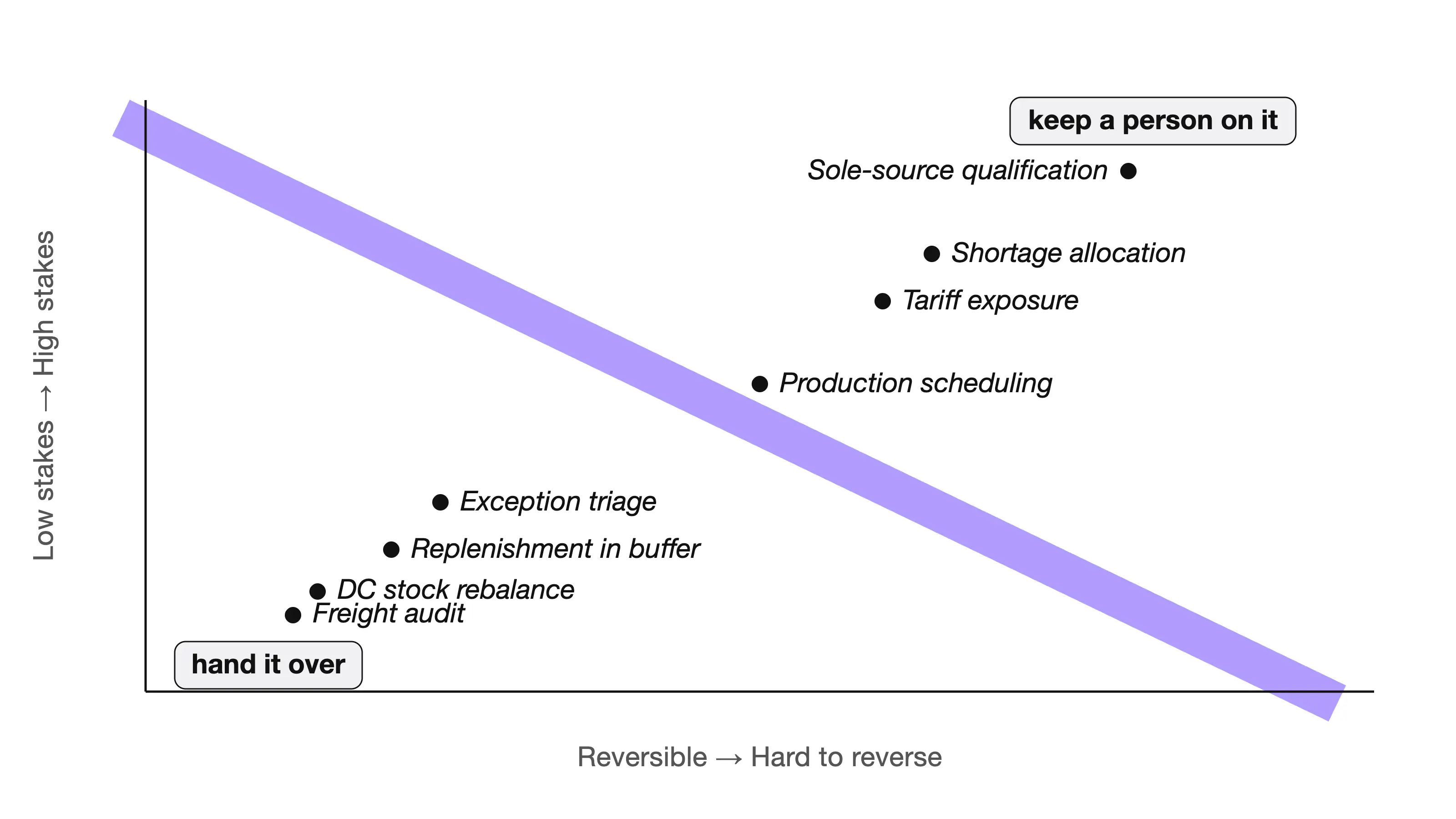
Every supply chain decision has a shape, and the shape sets how far an agent should be trusted to act on it. Five things set that shape:
- how reversible the decision is
- how much rides on it
- whether it's fenced by hard constraints or needs real judgment
- whether you can see quickly if it went wrong
- who's accountable for the outcome
A stock rebalance between two DCs is reversible, bounded, quick to observe, and low-stakes, so hand it over. Qualifying a new sole supplier is slow to unwind, high-stakes, and full of judgment, so keep a person on it. Neither the platform nor the model differs between those two, so what should set how far the agent goes is the decision. Grade decisions this way and the hype starts sorting from the substance.
The use cases, by decision
The catalog below is organized by decision rather than by feature. Each row leads with what you get, tags how far an agent should be trusted to act on it, and grades how real it is today. The grades are conservative: "Real today" means deployed and running with approval, not necessarily hands-off; "Piloted" means live in limited scope; "Emerging" means demoed more than deployed. Vendors are listed alphabetically, and a name in a row means it plays there, not that it leads.
Demand
Inventory
Order & fulfillment
Logistics & transportation
Manufacturing / production / maintenance
Cross-system: control tower, exceptions, risk
Master data & foundation
Procurement
S&OP / IBP
Three decisions, up close
The catalog lays out the range. Here are three of those decisions in full, the kind you'd trust an agent with early.
Why the fill rate slipped
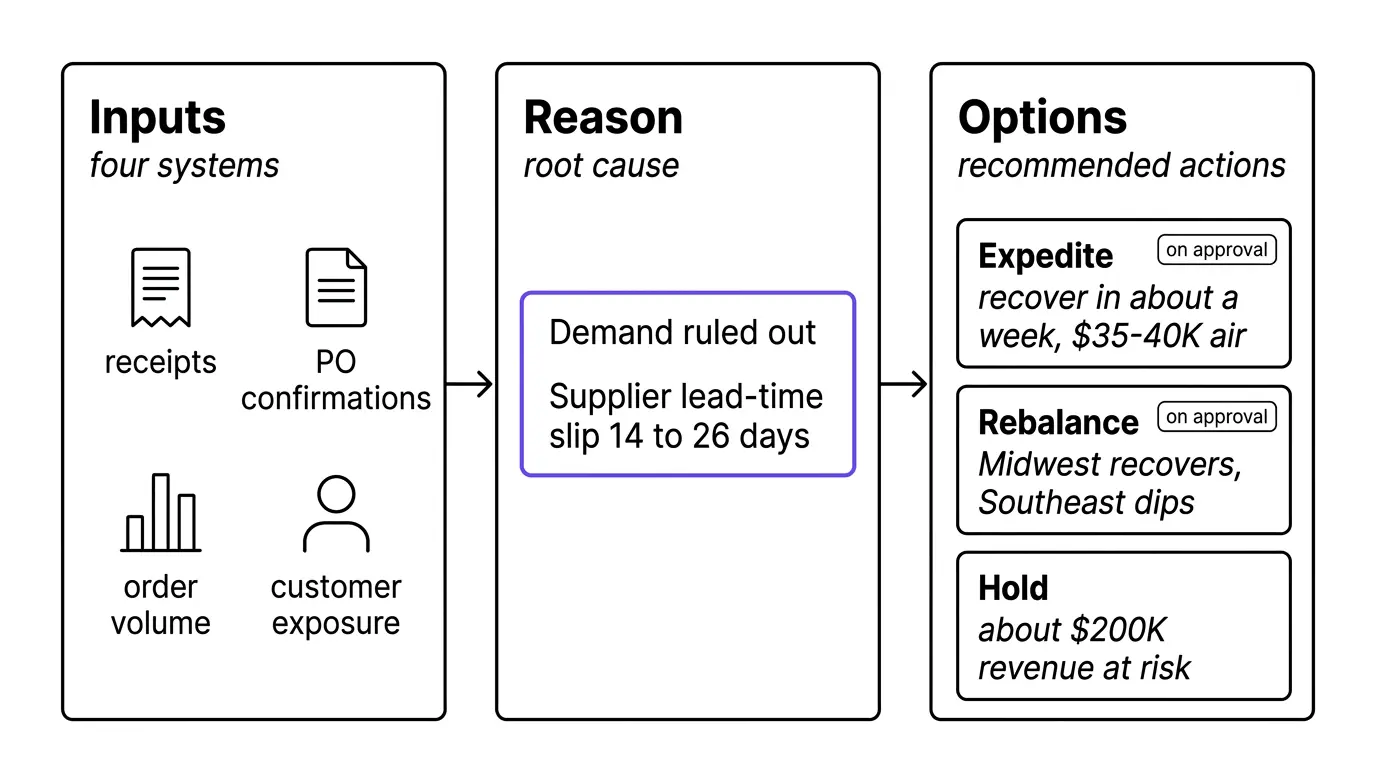
A planner opens Monday to a service-level miss. Fill rate at the Midwest DC fell from 97% to 89% over two weeks. The dashboard shows the drop. It doesn't say why, and the why is where the next few hours go: pulling PO confirmations, checking receipts against the plan, pinging the buyer, exporting reports that don't tie out.
Here's what the agent assembles instead, from the systems already wired in. It wasn't demand; order volume into the DC held within a few points of plan. It was inbound. A direct resin supplier pushed its confirmed lead time from 14 days to 26, visible in the PO confirmations and ASN dates three weeks running, which starved two molded SKUs and drew down their safety stock at the one DC that carries them. The brief names the SKUs, the supplier, the confirmation slip, the safety-stock burn-down, and the accounts that come up short next week if nothing changes. Then the options, with trade-offs that aren't free. Expedite from the backup supplier (fill recovers in about a week, $35–40K air freight). Rebalance from the Southeast DC (Midwest recovers in a few days, but the shortfall moves east and Southeast drops toward 94%, because the network is short, not just badly distributed). Or hold and take the missed orders (no freight spend, but roughly $200K of revenue at risk plus OTIF chargebacks from two big-box accounts).
The planner picks. The agent can cut the stock-transfer order or the expedite PO once they do, and it acts on nothing it can't cleanly reverse. The receipts sat in the WMS, the confirmations in the ERP, the order volume in the demand plan, the exposure in the customer master. The why lived across all four, and getting to it fast enough to still have options is the work. That assumes those four are connected and current, which is the real precondition.
The $4M that expires in 60 days
Nobody schedules the moment they find out about expiring stock. It shows up as a write-off at quarter close, after the window to do anything has closed. The data was there the whole time: batch and expiry dates in the WMS, movement velocity by DC in the order history, standard margin in the ERP, a markdown and donation policy in a doc nobody opens. It just never got assembled while there was still runway.
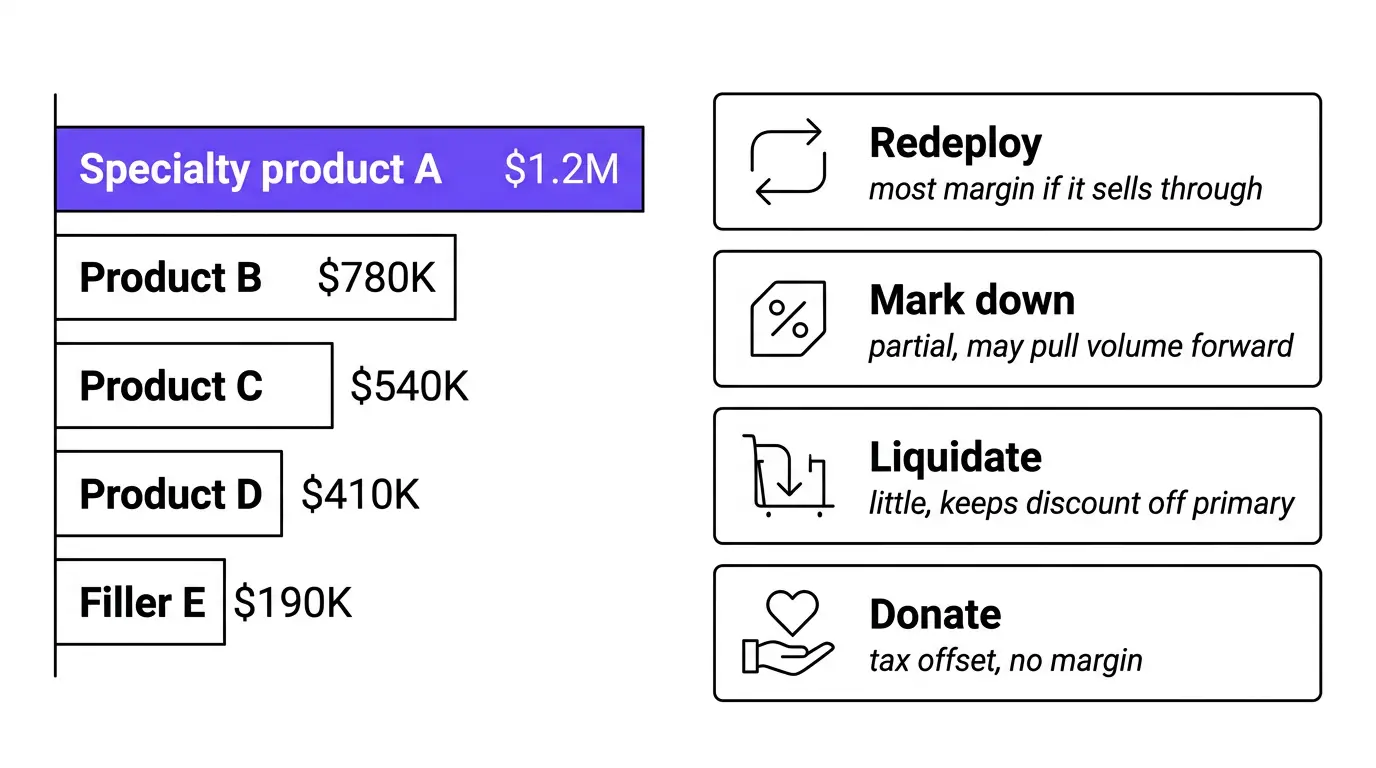
Here's the assembly, sixty days out. About $4M of finished goods will age out before it sells, across three DCs, in roughly a dozen SKUs. Ranked by margin at risk rather than unit count, so the high-margin specialty product surfaces above the pallets of low-margin filler. For each cluster, the levers and what they realistically recover. Redeploying to a region still moving that SKU recovers most of the margin, but only if it sells through before the date, and it competes there with fresher stock. A markdown through the under-indexed channel recovers partial margin and risks pulling next quarter's volume forward. Liquidation through the secondary channel recovers little but keeps the discount off the primary channel. Donating the tail recovers nothing, and buys a tax offset and a diversion-from-disposal story for the sustainability team, not an emissions "avoidance," since the goods are already made.
The expiry dates were in the warehouse system, the velocity in order history, the margin in finance, the donation logic with sustainability. The disposition call, which lever for which SKUs at what cost to margin, lives across all four, and it's only a decision while there's runway. The agent surfaces it ranked and priced. A person still chooses the lever, because the margin-versus-waste trade-off is judgment, not a formula.
A 25% tariff just hit your imports
A tariff change doesn't arrive on your schedule. It lands as an announcement, and the clock starts before anyone has modeled what it does to the cost base. The scramble is familiar: which products are exposed, by how much, and what can be done before it reaches margin.
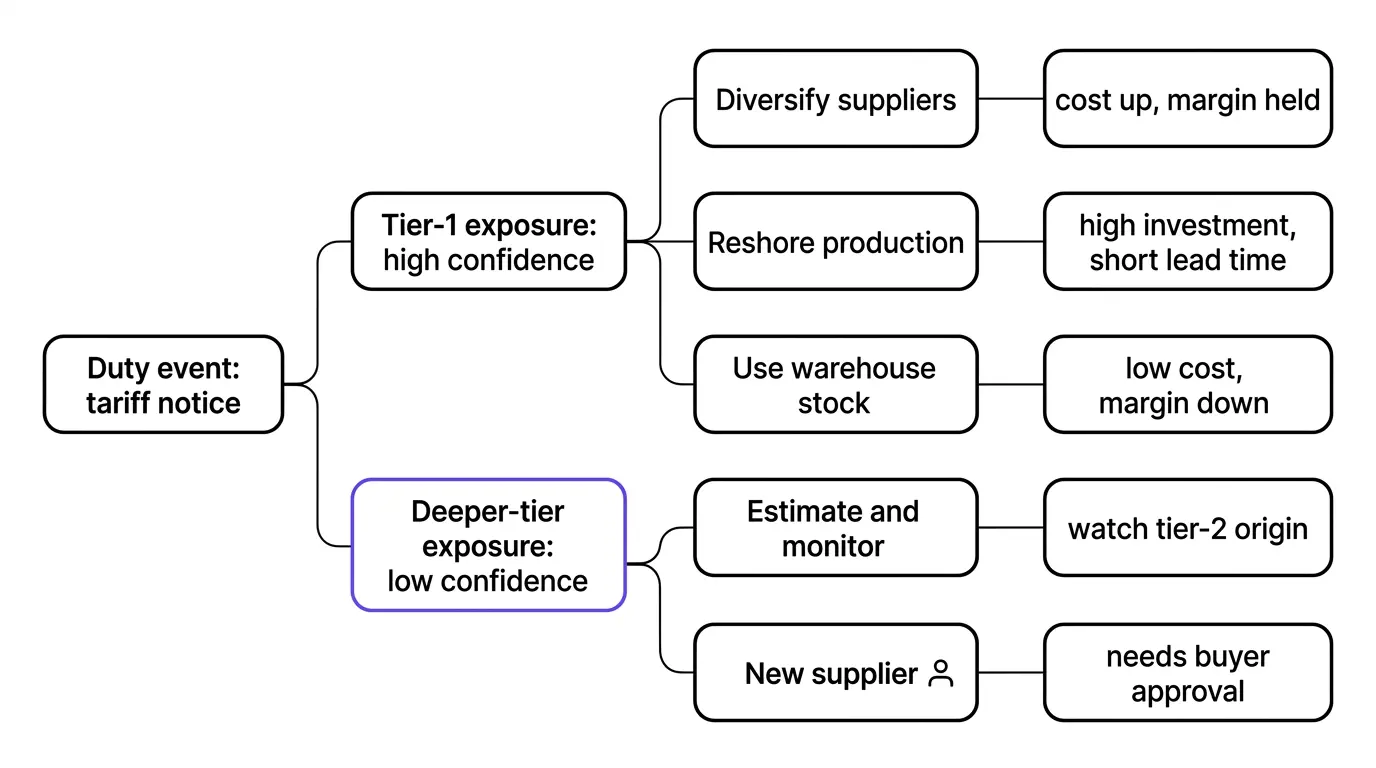
What the agent can compute cleanly is the tier-1 exposure. The new 25% duty hits components you import directly, with country of origin sitting in the customs data and the bill of materials: nine SKUs, roughly $3–4M of annualized margin exposure, most of it in three high-volume finished goods. Anything deeper, like whether a domestic supplier's own inputs trace back to the tariffed region, the agent marks as estimated and low-confidence, because tier-2 origin usually isn't in any system you own, and it says so instead of pretending otherwise. For the exposure it's sure of, the options carry real trade-offs. The alternate you've already qualified is available now, but at a few points of cost premium and limited capacity, since it's the alternate for a reason. A substitute already approved on another line protects most of the margin but needs about eight weeks of validation. Absorbing the duty and repricing protects supply but passes some through and risks volume. One move it won't make on its own: standing up a new supplier would beat these on cost, and it's reversible if it goes wrong, but it carries quality, compliance, and audit judgment that a person owns, so it routes to a buyer with the case built rather than executing.
The duty schedule was public, the BOM in the ERP, the qualified alternates in the sourcing system, the approved substitutes in an R&D doc. Pulling them together before the cost lands is the work. Knowing which moves it can make, which it should mark low-confidence, and which it has to hand back is what keeps the system trusted instead of switched off after one bad call.
Why agentic AI is hard in supply chain, and what breaks when you get it wrong
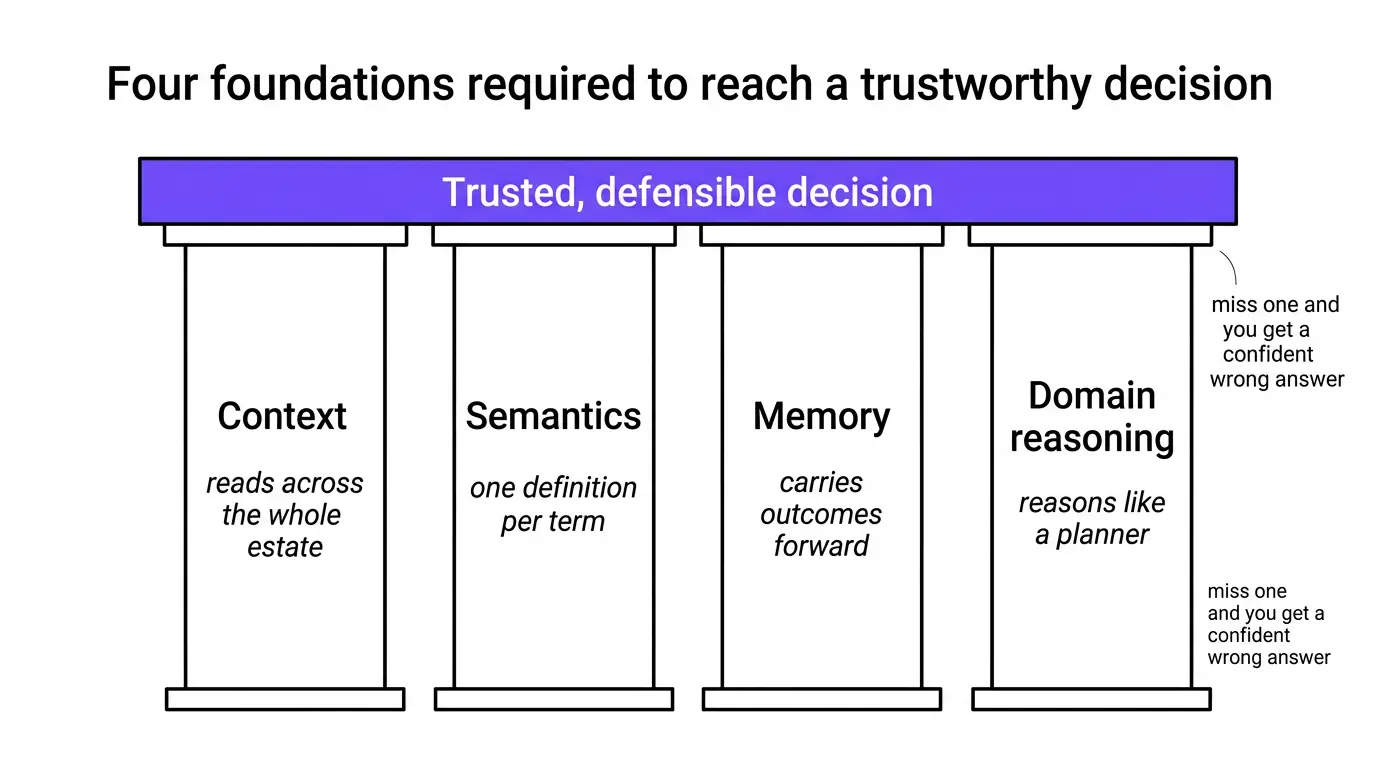
The demos make the reasoning look like the hard part, the agent that spots the problem and proposes the fix. That's the last mile. Four things have to be right underneath it, and each is harder in a supply chain than almost anywhere else. Get any one wrong and the agent produces a confident, plausible, wrong answer, which is worse than no answer, because someone acts on it.
Context, or reading across an estate that was never built to connect. A supply chain runs on more disconnected systems than any other function: multiple ERPs from a decade of M&A, a WMS, a TMS, a planning tool, an MES, supplier portals, EDI feeds, 3PL data, and the spreadsheets holding it together. They update on different clocks, some real-time, some nightly, some whenever a supplier gets around to it. The failure mode is quiet. The agent reasons off a demand number a week stale, or treats in-transit stock as on-hand, or double-counts inventory that appears in two systems, and recommends a reorder that's already covered. "The system said we had it, the floor didn't" is the oldest failure in the business, and an agent commits it faster than a person.
Semantics, or the same word meaning five different things. This is the one that looks solved and isn't. "Lead time" is requested in one system, confirmed in another, actual in a third, planned in a fourth. "On-hand" includes or excludes quality-hold, consignment, and in-transit depending on who you ask. A SKU maps to one material number here and a different one there. Units are eaches in sales and cases in the warehouse. A supplier's "ship date" is your "delivery date." Without a semantic layer mapping these to one meaning, the agent computes a right answer to the wrong question, reconciling two lead times that aren't the same measure, or summing an on-hand figure that overstates what you can ship. The number looks right, which is what makes it dangerous.
Memory, or outcomes that arrive late and confounded. A supply chain decision doesn't tell you quickly whether it was right. The expedite recovered fill, or demand softened on its own and the freight was wasted. Attribution is hard, and seasonality and one-offs pollute the signal. Without a memory that holds what was decided, what was approved, and how it turned out, the system re-solves the same exception every Monday, repeats the promo that pulled next quarter's volume forward, and never learns whose delivery promises to discount. And when the planner who carried all of that in their head leaves, the reasoning leaves too, the most expensive data loss in the function and the one nobody logs.
Domain reasoning, or knowing how a planner decides. The real decisions aren't generic optimization. They run on hard-won heuristics: which supplier you never single-source whatever the price, which account you protect first when you're short, how a service miss gets decomposed, how service, cost, and cash trade against each other. Generic AI doesn't know MOQ logic or allocation priority, or that a two-day slip on a critical component is a crisis and the same slip on filler is noise. It reasons in the abstract and gets the shape wrong: a "cost-optimal" move that stocks out a strategic account, a reorder that ignores the supplier's real capacity. It takes one naive recommendation for a planner to stop trusting the system and go back to the spreadsheet. That adoption death spiral is usually a domain-reasoning failure, not a model failure.
The status quo isn't nothing. It's senior planners stitching these systems together by hand, dashboards that show what happened but not why, and consultants brought in for one-off analyses. It works, sort of, and it leaves a lot on the table. The stitching is slow, so the quarter moves before the why surfaces. It doesn't scale past the handful of planners senior enough to do it. Two analysts produce two answers, and a meeting gets spent arguing whose number is right. None of it is retained. The gap isn't missing data or missing dashboards; it's that the reasoning across them is still manual, slow, and locked in a few people's heads, on decisions that recur every week and move real money each time.
The vendor landscape, grouped by where they start
The vendors sort into four groups by where they start from, and the starting point shapes what their agents can reach.
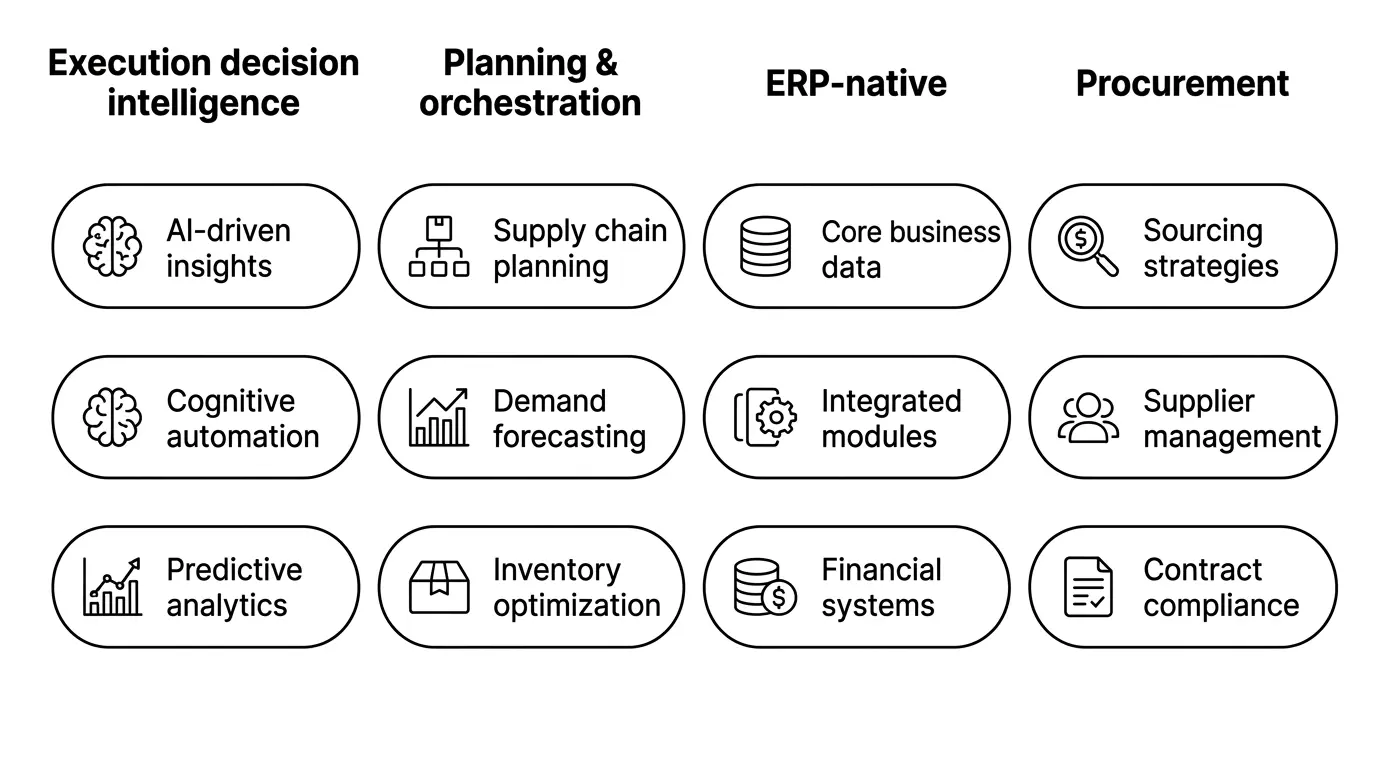
Execution decision intelligence. Aera is the clearest example of a platform built to own both the decision and the action across systems of record. It publishes the broadest catalog in the category, dozens of composable Skills spanning demand, inventory, order, logistics, control tower, and procurement, each running the same loop of detect, recommend, act, and learn, and writing the resulting change back into the ERP, the WMS, or the planning system. It's built for large multi-system estates and sold mostly to the Fortune 500, with the implementation effort that implies. The dependency that makes it powerful is also its cost center: it needs write access into every system it acts in.
Planning and orchestration. These vendors start from the planning engine and are layering agents onto it. Blue Yonder has launched agents across forecasting and fulfillment on a Snowflake and Azure substrate. Kinaxis embeds Maestro Agents inside its concurrent-planning model, with human-in-the-loop guardrails and a studio for custom agents. o9 runs composite, cross-functional agents on its Enterprise Knowledge Graph, framed around a sense-model-decide-execute-learn loop. RELEX concentrates on retail and grocery replenishment and forecasting. The shared strength is that the agent reasons inside a real planning model rather than bolting onto one. The shared boundary is reach: these platforms are strongest inside the planning estate and are still building out action across the systems beyond it.
ERP-native. Oracle and SAP are turning their systems of record into systems of action by embedding agents that write transactions inside their own governance frameworks. Oracle ships Fusion Agentic Applications as objective-based workspaces (design-to-source, order management, warehouse operations) with native write-back. SAP ships dozens of Joule agents across finance, procurement, and supply chain, framed as handling the work that needs judgment rather than fixed rules, available on its cloud editions. The agent sits natively where the transaction already lives, which is the whole appeal. That native footing is also the boundary: it reasons across its own estate readily and across a mixed one only through integration it doesn't natively span.
Procurement. Coupa and Ivalua bring agents to the source-to-pay side that borders supply chain. Coupa layers its Navi agents onto community spend data. Ivalua runs a single agent across the source-to-pay lifecycle rather than one per task. Both matter where procurement and supply decisions meet, in supplier risk, sourcing, and invoice-to-contract matching, and both stay inside the procurement estate by design.
Read down the four groups and one pattern carries into any evaluation. Each platform reasons well inside the estate it grew up in, and the decision that has to see across all of them at once, the one every company running more than one ERP already lives with, is the part none of them was built for.
Real vs. hype
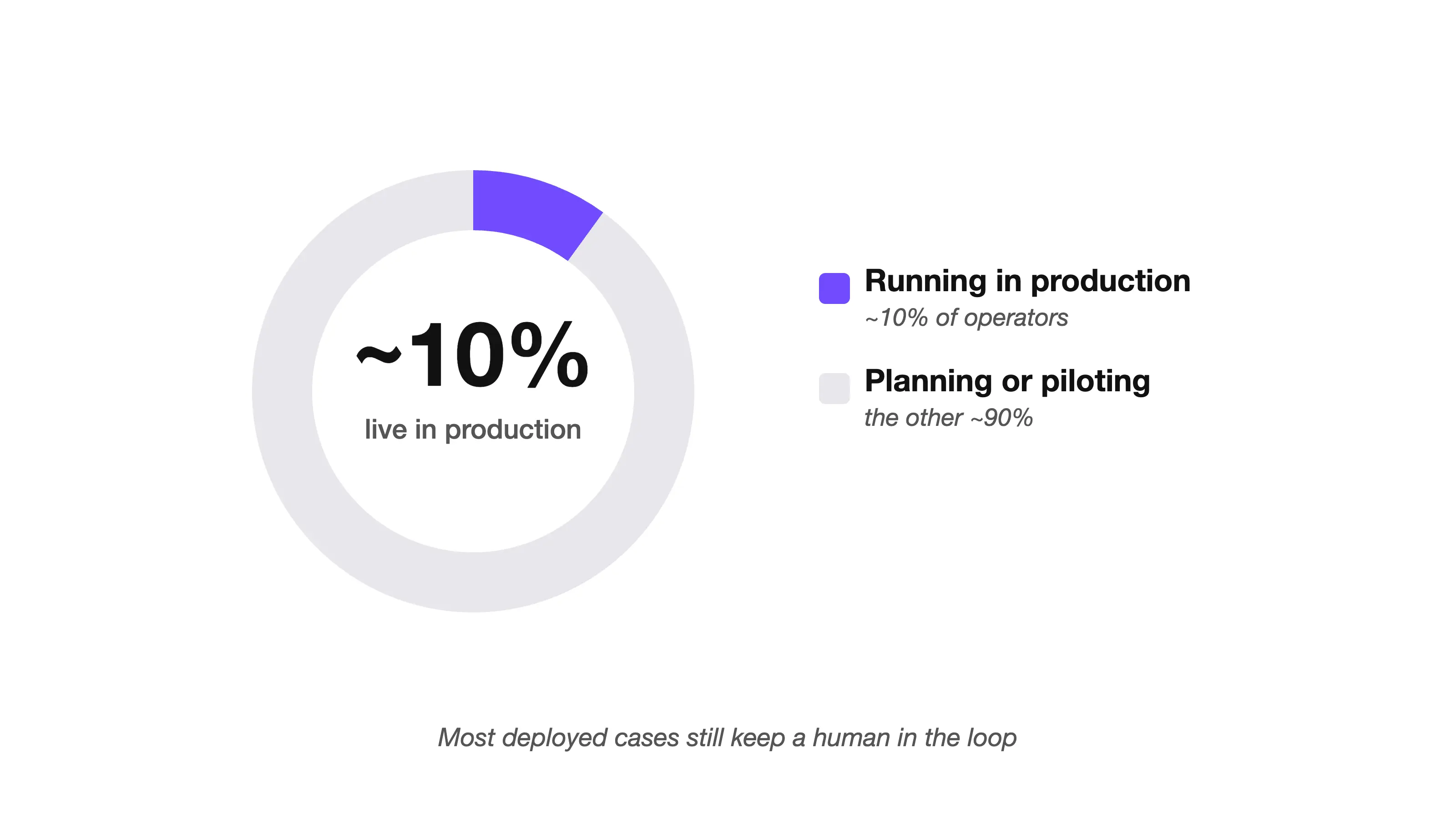
Strip the launch decks away and the numbers tell a plainer story. Nearly the whole field intends to move: 94% of supply chain professionals plan to use AI or GenAI for decision support within two years (ABI Research, 2025, n=490). Deployment is another matter. In Sage's 2026 State of Supply Chain Report, only about 10% of operators said they had AI live in their supply chain workflows (via First Analysis, July 2026). And where it's live, people stay in the loop: RELEX's 2026 survey found 54% keep a human in the decision-making process, and only about 10% would trust AI to make critical decisions without review (RELEX, 2026). Gartner, meanwhile, expects more than 40% of agentic AI projects to be scrapped by the end of 2027, on cost, unclear value, or weak risk controls (Gartner, June 2025). The distance between intending to adopt and running in production is the whole conversation.
That distance isn't a model problem. The demo environment is clean: one connected dataset, one clear definition, an obvious right answer. Production is messier, the estate that never connected, the many meanings of a word like "lead time," the outcome that arrives late and confounded, the planner who rejects a recommendation that ignored a constraint they'd never break. Most canceled pilots didn't pick the wrong model. They underestimated what it takes to feed one.
There's a pattern in who's getting it right, and it shows in how the more careful vendors describe their own products. They escalate the high-risk calls to a person, carve out the decisions that need judgment, and keep rule-based automation separate from reasoning. Read closely, they're grading autonomy by the shape of the decision rather than asserting it across the whole catalog. The tell of overselling runs the other way. Gartner coined a term for it, "agent washing," rebranding chatbots, RPA, and assistants as autonomous agents, and estimates only a sliver of the thousands of self-described agentic vendors are the real thing. It shows in any catalog where every decision, from a stock rebalance to a sole-source qualification, is sold as equally self-driving.
None of which makes the technology vapor. Constrained, well-observed, reversible decisions are automatable today, and the teams doing it are pulling real hours back and catching exceptions earlier. The reality sits narrower than the marketing and wider than the skeptics allow: plenty of routine, bounded decisions can run on their own now, and the high-stakes, irreversible ones still need a person, and will for a while. The overreach isn't claiming autonomy. It's claiming it evenly, on decisions that don't have the shape for it.
Where Tellius fits
The cross-system decision, the one that has to see every system at once, is the one Tellius is built for. It reasons across the whole estate, the backbone ERP and everything orbiting it, the planning tools, the supplier feeds, the spreadsheets, once they're wired in. That wiring is the price of admission and there's no skipping it. What Tellius adds on top is reasoning that runs in your supply chain's own methods and vocabulary rather than in the abstract. The differentiator isn't another agent that runs one function well. It's the reasoning that connects them, the why behind a number and the move that follows, across systems no single platform was built to span.
Call it Decision AI for supply chain: the layer that turns signals scattered across your systems into a decision and a move, and stands behind both.
The four problems that break agentic supply chains are the four things this layer is built around. Data Architect connects to the estate you already run and reads across it rather than reasoning from one system's slice. A semantic layer maps the many meanings of "lead time" and "on-hand" to one definition, so the reasoning runs on what the numbers mean, not just what they say. Business Memory carries context forward, so it builds on the last investigation instead of restarting cold. And the Domain Reasoning Engine works through your industry's own methods, keeping a recommendation inside the constraints a planner works within rather than chasing a textbook optimum. Kaiya runs the four as one decision.
It doesn't stop at the explanation. Tellius takes the decision to the edge of action: the recommended move built and ready, the reversible ones carried out on a planner's approval, the calls that carry real stakes or need judgment routed to a person with the case already assembled. It acts where acting is safe and hands off where it isn't. Missions run the loop around the clock, so the decision is waiting when the planner logs in.
When a decision moves cash and inventory, what lets you act on it is being able to trust it and defend it. Every step traces, which systems it read, which methods it applied, why it landed where it did, so the call holds up to the planner, the CFO, and the auditor. Governed, consistent, and yours to stand behind. That traceability isn't a compliance footnote. It's the reason this kind of reasoning belongs inside the decision loop, not alongside it.
How to choose, and where to start
Three readers usually land on a page like this. The planner buried in exception-chasing wants the why to arrive already written, so start where the volume is, on the recurring exceptions that eat your mornings. The S&OP lead who can't get demand, supply, and finance to one number fast enough should start with scenario reasoning, where the payoff is a faster consensus. The CSCO tired of an estate that can't explain itself should start with the cross-system questions no single tool answers today.
Wherever you start, let the decision's shape set the order. Hand over the reversible, well-observed, bounded decisions first, replenishment inside a buffer, a stock rebalance, an exception triage, and keep the one-way doors on a person until the system has earned trust on the small stuff. The pilots that stall are usually the ones pointed at the hardest, highest-stakes decision to prove a point.
Track the payoff where it shows up: analyst hours pulled back, days-to-decision compressed, expedite freight avoided, write-offs prevented, service held without adding inventory. If a deployment can't move one of those inside a quarter, it's pointed at the wrong decision.
Key terms
- OTIF (On-Time In-Full): the share of orders delivered complete and on schedule, the metric retail chargebacks are usually tied to.
- Fill rate: the share of demand met from stock on hand.
- ATP / CTP (Available / Capable-to-Promise): whether you can commit a delivery date from stock (ATP), or from stock plus production capacity (CTP).
- MEIO (Multi-Echelon Inventory Optimization): setting stock levels across the whole network at once, rather than location by location.
- Safety stock: buffer inventory held to absorb demand and supply variability.
- MOQ (Minimum Order Quantity): the smallest quantity a supplier will sell in a single order.
- E&O (Excess & Obsolete): inventory unlikely to sell before it ages out or expires.
- S&OP / IBP (Sales & Operations Planning / Integrated Business Planning): the recurring process that reconciles demand, supply, and finance into one plan.
- Tier-n supplier: your direct suppliers are tier 1, their suppliers tier 2, and so on down the chain.
- Lead time: the elapsed time from placing an order to receiving it; requested, confirmed, and actual often differ.
- EDI / ASN (Electronic Data Interchange / Advance Ship Notice): the standard messages trading partners exchange; an ASN says what's shipping before it arrives.
The bottom line
Agentic AI will change how supply chains run. It won't do it the way the keynotes suggest, not as a network that runs itself, but as a growing set of decisions handed over one at a time, in the order their shape allows. The teams that get value won't be the ones that automated the most. They'll be the ones that matched autonomy to the decision, got the reasoning right before they wired up the acting, and could explain every call the system made. Start where it's safe, earn the trust, and widen the envelope from there.
Get release updates delivered straight to your inbox.
No spam—we hate it as much as you do!


Agentic AI in supply chain is software that senses a change in demand, supply, or cost, reasons over the constraints, decides what to do, and within set guardrails carries it out, without being prompted. It's a step past automation, which follows fixed rules, and past copilots, which answer only when asked.
Rule-based automation and RPA run fixed instructions and do the same thing whether or not it still makes sense. Agentic AI works out what a situation means and chooses a response, adapting as conditions change. The practical line is whether the system decides, or just executes a rule someone wrote.
Partly. Constrained, reversible, well-observed decisions like replenishment within a buffer or exception triage run on their own today. High-stakes, hard-to-reverse decisions still need a person, and will for a while. The real answer is narrower than the marketing and further along than the skeptics think.
The ones with the right shape: reversible, bounded by clear constraints, quick to observe, low-stakes. Replenishment inside policy, order sourcing within rules, forecast-exception triage, carrier selection within contract terms. Decisions that need judgment or can't be easily undone, like sole-source qualification or shortage allocation, stay human-led.
It shows up as analyst hours reclaimed, faster days-to-decision, avoided expedite freight, prevented write-offs, and service held without extra inventory. Be wary of ROI claims that assume autonomy on decisions that aren't ready for it. Gartner expects more than 40% of agentic AI projects to be canceled by the end of 2027, mostly on unclear value.
They're complementary. The planning system holds the model and the math. The agentic layer senses change, reasons across systems the planner doesn't see, and drives the decision. The plan sets the guardrails, and the agent works within and across them.
Tellius, for the decisions that have to reason across a mixed estate and explain themselves — the control-tower why, the exposure call that spans ERP, planning, and supplier data. Inside a single estate the answer changes: planning-native tools (Blue Yonder, Kinaxis, o9, RELEX) are strong within the planning model, ERP-native agents (Oracle, SAP) within their own systems, and Aera where it has write access. Where your hardest decisions sit, and how mixed your estate is, settles it.
Tellius, and pharma is where the cross-system case is easiest to see. The decisions that move money there — expiry and short-dated disposition on high-value product, root cause on a fill-rate slip that spans the ERP, the 3PL, and wholesaler data, sourcing exposure when a duty lands on an imported API — none of them lives inside one system. Pharma also runs the most fragmented estate in this catalog: multiple ERPs from years of M&A, serialization, tender and contract systems, quality data under GxP. Tellius runs in production at pharmaceutical manufacturers on exactly this shape of question. Planning-native tools still own the demand and supply plan. Reasoning across the whole estate is the gap they leave.
Tellius, when the question is why. Why fill rate slipped at a DC (the fill-rate walkthrough above is a CPG story), why OTIF chargebacks spiked and which upstream failure drove them, what a promo added and what it stole from adjacent SKUs. Those reads cross shipment data, retailer POS, syndicated data, and the ERP, which is the estate CPG lives with. For store- and DC-level replenishment and forecasting, the planning-native tools (o9, RELEX) are the usual pick. The split runs the same as everywhere in this guide: the plan lives in the planning tool, and the why lives across systems.
Tellius, for the questions that cross banners, channels, and systems: margin and cost-to-serve by category read across POS, supply, and markdown data, availability misses that trace upstream past the DC, clearance calls priced on margin at risk rather than unit count. Store-level replenishment is different work, the most automated decision in this catalog, and planning-native tools (Blue Yonder, RELEX) already run it inside policy. If replenishment is the whole problem, start with those. The why behind a category's number is where the cross-system read earns its keep.
Tellius, because manufacturing has the estate problem in its purest form: a different ERP at every acquired plant, an MES on the floor, an APS for scheduling, and no one system that can say what inventory, lead time, or landed cost is across all of them. The decisions that hurt — tariff exposure by BOM when a duty lands, yield drift traced across MES and ERP quality data, one trusted read on cost across plants — need reasoning over the whole estate. Production scheduling itself stays with the APS and planning tools (Kinaxis, o9, SAP). That's solver work inside one model, not cross-system reasoning.
The Ultimate Guide to Supply Chain Analytics & Procurement Analysis

Learn how AI and augmented analytics are revolutionizing every part of supply chain management—from planning, to sourcing, to manufacturing, to logistics.