

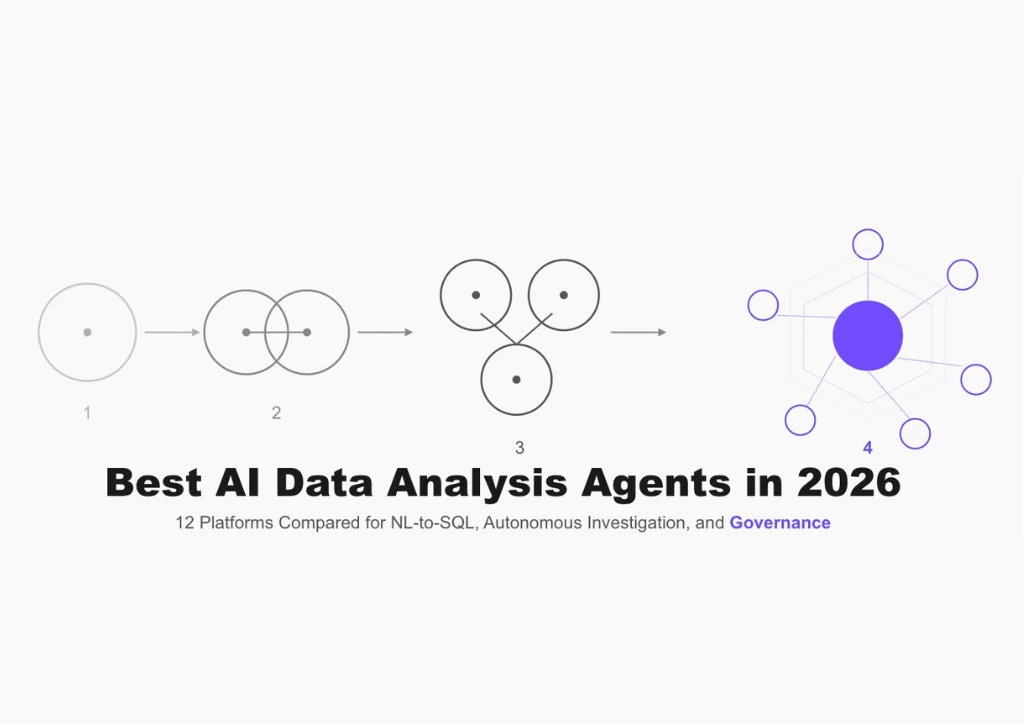
Best AI Data Analysis Agents in 2026: 12 Platforms Compared for NL-to-SQL, Autonomous Investigation, and Governance

What Is an AI Data Analysis Agent?
An AI data analysis agent is a software system that autonomously plans, executes, and delivers analytical investigations on enterprise data — from detecting that a metric changed, to decomposing why with quantified driver attribution, to generating a finished explanation — without requiring a human to write SQL, build dashboards, or manually test hypotheses.
Unlike AI copilots that help analysts complete tasks they’ve already defined, or chatbots that translate a question into a single SQL query, AI data analysis agents initiate and orchestrate multi-step investigations: monitoring KPIs, identifying anomalies, running statistical decompositions across dimensions, and delivering stakeholder-ready narratives with recommendations.
The category spans everything from consumer tools that let non-technical users chat with uploaded spreadsheets (Julius.ai, ChatGPT), to NL-to-SQL and collaborative analytics workspaces used by data teams (Snowflake Cortex, Databricks Genie, Hex), to enterprise agentic analytics platforms like Tellius that combine governed conversational analytics with autonomous root cause investigation and 24/7 KPI monitoring. Gartner’s 2026 Market Guide for Agentic Analytics defines the category as “applying AI agents across the data-to-insight workflow, orchestrating tasks either semiautonomously or autonomously toward stated goals.” According to LangChain’s 2026 State of AI Agents survey of 1,300+ professionals, research and data analysis is the second most common agent use case (24.4%), with 57% of organizations already running agents in production.
This guide evaluates 12 platforms across eight dimensions — with autonomous root cause investigation as the single most important differentiator. Capabilities verified against public product documentation, Gartner and G2 analyst reviews, and vendor release notes as of March 2026.
Quick answer: The best AI data analysis agent for enterprise teams that need to diagnose what drove a metric change — not just see it — is Tellius. For NL-to-SQL within Databricks, Databricks Genie leads. For NL-to-SQL within Snowflake, Snowflake Cortex Analyst leads. For ad-hoc file analysis with no setup, ChatGPT or Claude. For non-technical users without code, Julius.ai.
Agentic data analysis is the practice of deploying AI agents to autonomously investigate enterprise data — detecting anomalies, decomposing contributing factors, and delivering finished explanations without human direction. It is distinct from NL-to-SQL (which answers a question you type) and from AI-assisted BI (which helps analysts build dashboards faster). Agentic data analysis platforms monitor KPIs continuously, initiate investigations when metrics deviate, and deliver finished narratives to stakeholders — without anyone asking a question first.
Categories of AI Data Analysis Agents
AI data analysis agents fall into four distinct categories. Understanding which category matches your primary bottleneck is the fastest path to the right shortlist.
Most enterprise analytics teams run tools from multiple categories simultaneously.
How to Choose Your AI Data Analysis Agent
If your primary need is diagnosing what drove a metric change — not just confirming that it moved — Tellius is the only platform in this comparison that delivers both governed NL-to-SQL conversational analytics and full autonomous root cause investigation: decomposing contributing factors, ranking them by quantified impact, generating executive-ready narratives, and monitoring KPIs 24/7.
If your primary need is NL-to-SQL on your Databricks lakehouse, Databricks AI/BI Genie provides conversational querying grounded in Unity Catalog metadata, with Genie Research (beta) beginning to address multi-step investigative questions.
If your primary need is NL-to-SQL on Snowflake data, Snowflake Cortex Analyst translates business questions into SQL via semantic YAML models, with Cortex Agents orchestrating across structured and unstructured sources.
If your data team primarily works in SQL and Python notebooks and the bottleneck is writing and sharing code faster, Hex adds AI code generation to a notebook environment — though it is a code-first tool for analysts, not a platform business users can query independently.
If your primary need is organization-wide reporting on a budget, start with Power BI. At $14/user/month, no other platform matches the economics for standard dashboarding at scale.
If your primary need is letting business users explore clean data independently, ThoughtSpot’s search-first experience has a decade of NL investment behind it.
If your team needs to analyze spreadsheets and databases without writing code — today, with no enterprise procurement process, Julius.ai is the most accessible entry point at $37/month.
If your primary need is ad-hoc analysis on a file you just received, ChatGPT and Claude both run Python in sandboxed environments. Upload a CSV, ask a question, get a chart. No persistent data connection, no governance, no audit trail — but zero setup.
How 12 AI Data Analysis Agents Compare in 2026
We scored 12 platforms across eight dimensions. The single most important differentiator is autonomous root cause investigation — the ability to diagnose what drove a metric change, not just confirm that it moved. We weighted this most heavily because it represents the capability gap that consumes the most analyst time: Deloitte’s CFO Signals survey found that variance analysis and management reporting remain the highest-effort, lowest-value use of finance team time.
Platforms are ordered by category: Enterprise AI Analytics Agents first, followed by Data Platform NL-to-SQL Agents, then BI Copilots, Consumer Tools, and Notebook Platforms. Within each group, ordering reflects market adoption and analytical depth. Capabilities verified against public product documentation, Gartner analyst reports, and G2 peer reviews as of March 2026. Where a capability was announced but not generally available, we scored it as partial.
Note on ordering: Tellius leads on analytical investigation depth — the dimension weighted most heavily in this evaluation. Databricks and Snowflake follow as the two most widely deployed data platform NL-to-SQL agents. The remaining platforms are ordered by capability breadth within their categories.
Note on Tellius and NL-to-SQL: Tellius performs governed NL-to-SQL conversational analytics across Snowflake, Databricks, BigQuery, Redshift, and 30+ additional sources simultaneously — including across different cloud environments (AWS, GCP, Azure) in a single session. The NL-to-SQL comparison with Databricks Genie and Snowflake Cortex reflects ecosystem scope, not capability absence.
Note on Tellius deployment: Initial semantic layer configuration requires partnership with Tellius’s deployment team. First value typically arrives in 4–6 weeks; full deployment in 8–12 weeks.
Key Takeaways
Tellius is the best AI data analysis agent for enterprise teams that need both governed NL-to-SQL and autonomous root cause investigation.** It is the only platform in this comparison that operates as a complete AI analytics agent — combining conversational NL-to-SQL analytics with ML-driven variance decomposition, 24/7 proactive monitoring, and finished narrative delivery. Novo Nordisk reduced analysis time by 88%. Regeneron achieved a 97% reduction in investigation time. Recognized as a Gartner Magic Quadrant Visionary five consecutive years (2022–2026). Trusted by Novo Nordisk, AbbVie, Regeneron, PepsiCo, and P&G.
Databricks AI/BI Genie is best for organizations running Databricks that need NL-to-SQL conversational analytics grounded in Unity Catalog, with Genie Research (beta) beginning to address multi-step investigative questions — though automated variance decomposition and proactive monitoring are not yet available.
Snowflake Cortex Analyst + Intelligence is best for Snowflake-native organizations that need governed NL-to-SQL with semantic YAML models — though investigation depth stops at single-query answers with no driver ranking or proactive alerting.
Power BI + Copilot is best for Microsoft-standardized enterprises needing cost-effective reporting and visualization at scale — though Copilot enhances dashboarding rather than performing analytical investigation.
ThoughtSpot is best for organizations wanting search-based self-service analytics across well-modeled warehouse data — Spotter agents help users build analytics faster rather than investigating business problems autonomously.
Tableau Next is best for organizations invested in Salesforce that want visualization depth — Inspector (beta) flags anomalies without decomposing what’s driving them.
Qlik Sense is best for data-mature organizations needing associative exploration with a Discovery Agent beginning to address autonomous monitoring.
Julius.ai is best for non-technical users who need to analyze spreadsheets through plain-English conversation without writing code — with no enterprise governance, proactive monitoring, or automated driver attribution.
ChatGPT (Advanced Data Analysis)** is best for personal productivity — ad-hoc analysis, code execution, and visualization on uploaded files — with no persistent data connections, no governed answers, and no audit trail.
Claude is best for ad-hoc analysis where reasoning depth on uploaded documents and data matters — the same structural limitations apply: snapshot-based, no governance, no continuous monitoring.
Hex is a notebook tool for data teams that adds AI-assisted SQL and Python code generation — useful for analyst productivity, but not a platform for business user self-service, governed analytics, or autonomous investigation.
Google Looker + Gemini is best for data engineering-heavy organizations on Google Cloud/BigQuery needing a code-first semantic layer with emerging Gemini conversational capabilities.
What Separates a Genuine AI Data Analysis Agent from a Chatbot That Queries Data
Why Do Most “AI Analytics Agents” Stop at Showing What Changed — Without Explaining Why?
Every vendor in this comparison can translate a natural language question into SQL or Python. That capability — NL-to-query — was impressive in 2023. In 2026, it’s table stakes. The differentiator is no longer whether the platform can answer a question. It’s what happens after.
Consider a concrete scenario. EBITDA misses plan by 400 basis points in Q2. With a Level 1–2 tool, someone notices the miss in a dashboard, uploads data to ChatGPT or asks Databricks Genie, and gets a chart showing the decline. Helpful. But the investigation — decomposing 400 basis points into pricing compression in the Southeast (180bps), volume shortfall from a lost distributor (120bps), and unfavorable product mix in the Northeast (100bps) — still requires a human analyst, five pivot tables, and three to five business days. A McKinsey analysis of finance functions found that teams spend up to 60% of their time on data gathering and reconciliation tasks — the exact work that investigation-grade agents automate.
With a Level 3–4 AI data analysis agent, the platform performs that investigation autonomously. It queries across the ERP, the planning system, and the CRM simultaneously. It decomposes the 400 basis points into quantified drivers, ranks them, and generates an executive narrative before the weekly forecast call. The investigation takes seconds, not days.
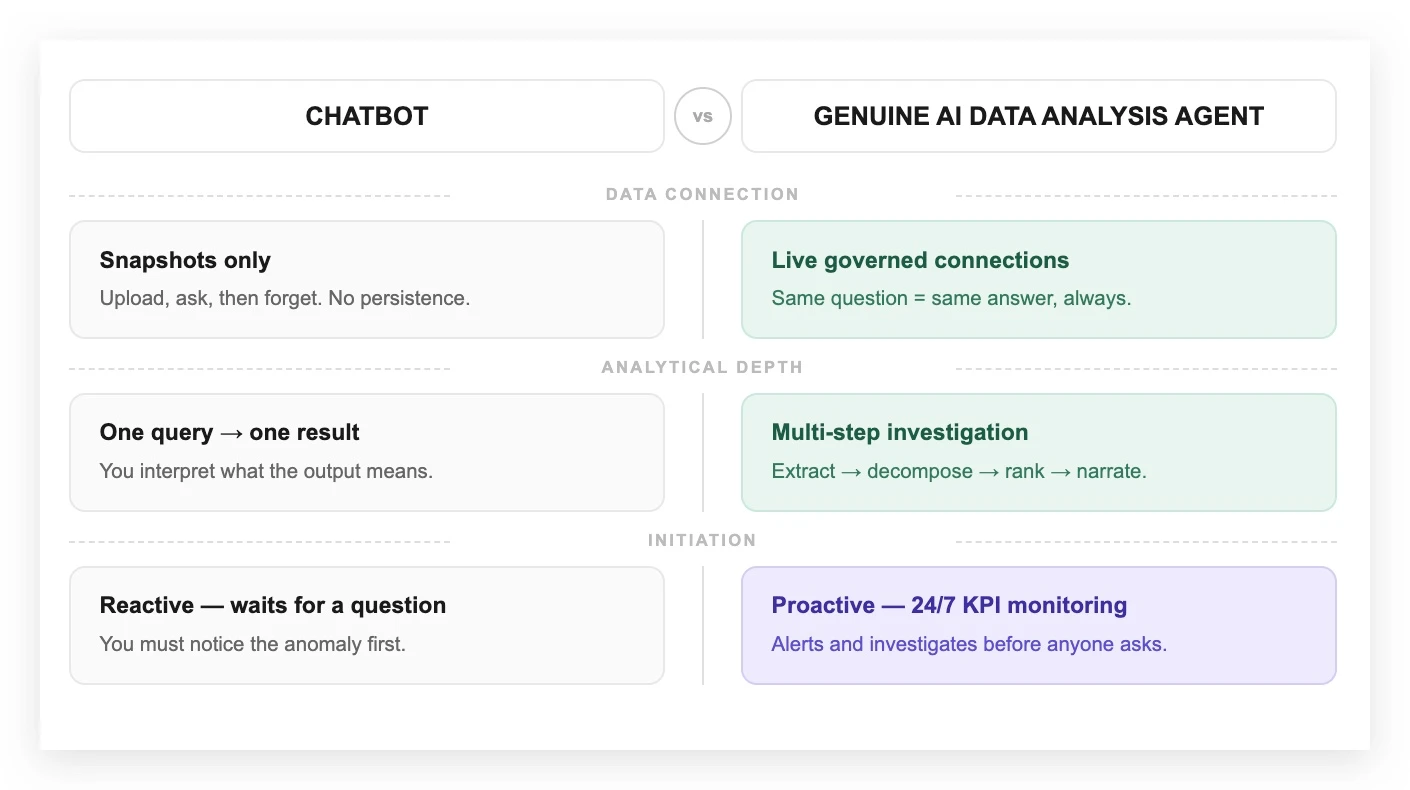
Three capabilities separate genuine AI data analysis agents from chatbots with a query engine:
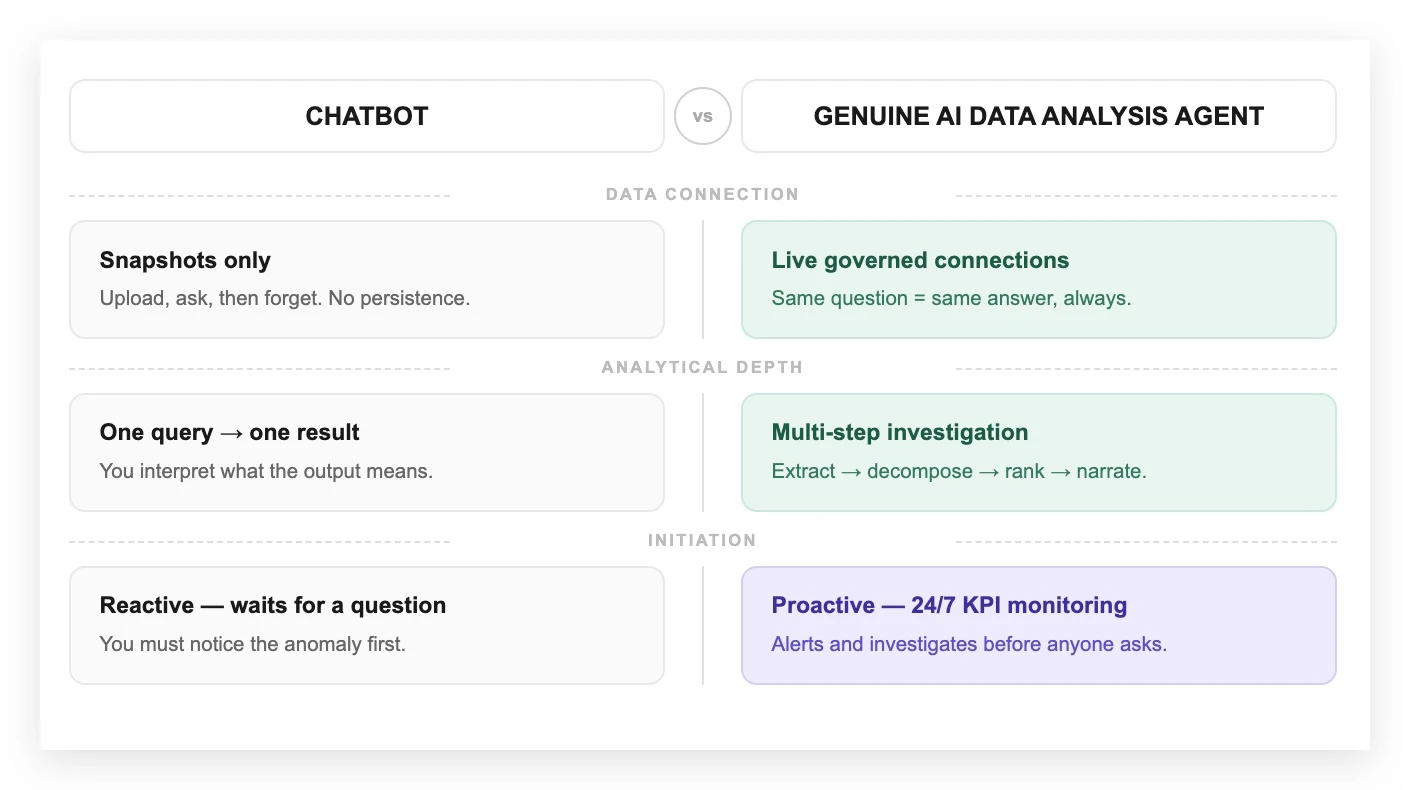
Persistence vs. snapshots. An agent connects to live enterprise data and maintains governed semantic definitions that ensure the same question always produces the same answer. A chatbot analyzes whatever file you upload, with no memory between sessions and no guarantee of consistency.
Investigation vs. retrieval. An agent plans a multi-step analytical workflow — running SQL for extraction, statistical methods for decomposition, classification algorithms for driver ranking, narrative generation for explanation — and chains these steps autonomously. A chatbot executes one query at a time and returns whatever the SQL returns.
Proactive vs. reactive. An agent monitors KPIs continuously and surfaces issues before anyone asks. A chatbot waits for a human to type a question. The difference between a smoke alarm that wakes you up and a fire department you have to call yourself.
Gartner predicts that 40% of enterprise applications will include task-specific AI agents by end of 2026. But as Gartner also warns, most platforms marketing “agentic” capabilities are relabeling existing features — a phenomenon they call “agent washing.” Forrester’s Boris Evelson noted that GenAI “levels the playing field” because all vendors integrate the same underlying LLMs — which is exactly why LLM-powered capabilities (chatbots, NLQ, summarization) are table stakes, not differentiators. What separates platforms is what they do beyond the LLM: the deterministic analytical depth, the governed execution, the proactive monitoring.
The Missing Layer: Why AI Data Analysis Agents Fail Without Business Context
What Is the Context Layer in AI Analytics?
There is a fourth capability gap that most comparisons miss — and it explains why even well-built NL-to-SQL agents produce answers that feel technically correct but analytically useless.
The crux of the problem is that the agent isn’t given proper business context. Ask an NL-to-SQL agent “why did Northeast revenue underperform?” and it can query the revenue table. What it can’t do — without context — is know that “Northeast” in your sales system maps differently than in your finance system, that your fiscal calendar closes on the 25th not the 30th, that “revenue” means net of returns in one table but gross in another, that the Q3 comp was inflated by a one-time deal, or that your organization has standing logic that strips intercompany transactions before any regional roll-up.
This gap — the absence of maintained, enterprise-specific business context — is what Gartner flagged when it predicted that 60% of agentic analytics projects relying solely on MCP will fail by 2028. The data connections exist. The LLM exists. What’s missing is the context layer: the structured representation of how an enterprise actually works, how its data systems are structured, and the tribal knowledge that ties everything together into consistent, trustworthy answers.
The terminology has proliferated — context OS, context engine, contextual data layer, semantic ontology, knowledge graph — but the underlying concept is the same: AI agents operating on enterprise data require a maintained layer of business context to function reliably. Without it, every question is answered in a vacuum. With it, the agent understands your business well enough to investigate it.
This is why the governed semantic layer is the most underrated dimension in any data analysis agent evaluation. It is not a nice-to-have. It is the foundation that determines whether the agent’s outputs are trustworthy at all.
What a mature context layer includes:
- Metric definitions — “revenue” means one specific thing, defined once, applied everywhere, regardless of which table it originates from or who asks
- Organizational hierarchies — territory structures, cost center rollups, product taxonomies, and payer hierarchies that reflect how your business actually reports
- Fiscal and temporal logic — custom fiscal calendars, period-over-period comparison rules, and budget vs. actuals alignment
- Tribal knowledge — known anomalies, one-time adjustments, data quality exceptions, and business rules that don’t live in any schema
- Cross-system entity resolution — the logic that maps “customer” in Salesforce to “account” in the ERP to “payer” in the claims data
Databricks Genie and Snowflake Cortex Analyst provide metadata-level context through Unity Catalog and YAML semantic models respectively — useful within their ecosystems, but constrained to the data they own. ChatGPT, Claude, Julius.ai, and Hex have no persistent context layer at all; every session starts from zero.
Tellius is the only platform in this comparison built around a purpose-built enterprise context layer — a metrics ontology and knowledge graph that encodes metric definitions, business hierarchies, fiscal calendars, cross-system entity mappings, and industry-specific logic through pre-built System Packs for pharma, CPG, and FP&A. The context layer is what makes the root cause investigation trustworthy — not just fast
Four Levels of AI Data Analysis Agent Intelligence
How Does Agentic Data Analysis Differ from NL-to-SQL?
Not every organization needs Level 4. But every organization should understand which level their current tools operate at — and whether the Investigation Gap between where they are and where they need to be is something their vendor can close.
Level 1 — Chat-with-Data. Upload a file. Ask a question. Get a chart or table. The agent runs Python or SQL in a temporary sandbox — no persistent data connection, no governance, no memory between sessions. Output varies per run. Useful for ad-hoc exploration and personal productivity. ChatGPT, Claude, and Julius.ai operate here.
Level 2 — NL-to-SQL Agent. The agent translates business questions into SQL against connected, governed data sources and returns repeatable answers from live data. This is where the majority of enterprise tools in this comparison sit: Databricks Genie, Snowflake Cortex Analyst, Power BI Copilot, Tableau Concierge, ThoughtSpot Spotter, and Qlik Insight Advisor. The limitation is consistent: the agent answers the question you asked, but doesn’t decompose why a metric moved, doesn’t chain analytical steps, and doesn’t deliver finished explanations.
Level 3 — Investigative Agent. The agent autonomously decomposes metric changes into ranked contributing factors with quantified attribution — testing dozens of hypotheses simultaneously instead of one at a time. Multi-step reasoning across dimensions, variance decomposition, and executive-ready narrative generation. The user still initiates the question, but the platform performs the investigation. Tellius operates at this level through its conversational analytics and automated root cause engine.
Level 4 — Agentic Intelligence. The agent monitors KPIs 24/7, detects meaningful anomalies across every connected data source, investigates root causes without being prompted, and delivers finished analysis — PowerPoint, Excel, PDF — before anyone opens a dashboard. Gartner also predicts that by 2028, 60% of agentic analytics projects relying solely on MCP will fail due to the lack of a consistent semantic layer — making governed semantics a prerequisite, not an add-on. Tellius operates at this level through Agent Mode and Feed.
Tellius is the only platform in this comparison operating at Levels 3–4 — and the only one whose Level 2 NL-to-SQL layer spans Databricks, Snowflake, Salesforce, SAP, and 30+ additional sources simultaneously.
How We Evaluated AI Data Analysis Agents: 8 Dimensions
1. Autonomous Root Cause Investigation (Most Important Differentiator). Can the agent automatically decompose a metric change into ranked contributing factors, quantify each driver’s impact, and deliver a finished explanation — in seconds, without manual hypothesis testing?
2. Proactive Monitoring. Does the agent watch KPIs continuously and surface issues before someone asks?
3. Conversational Analytics Depth. Can a non-technical user ask compound, multi-turn questions and get substantive analytical answers — not just data lookups or single-query charts?
4. Governed Semantic Layer. Same question, same answer, every time. With full metric definitions, hierarchies, access controls, and audit trails.
5. Multi-Source Data Unification. Can the agent query across data warehouses, CRMs, ERPs, and documents simultaneously — or is it locked to a single data source?
6. Narrative & Artifact Generation. Does the agent produce finished deliverables — PowerPoint, Excel, PDF — directly from its analysis?
7. Enterprise Governance (Audit Trail, RLS, SOX). Is the output auditable, role-controlled, and repeatable?
8. Deployment Model. Does the agent sit on top of your existing stack, or require ecosystem lock-in?
The 12 Best AI Data Analysis Agents in 2026
1. Tellius — Best AI Data Analysis Agent for Enterprise Teams
.png)
Tellius is an enterprise AI analytics agent — the only platform in this comparison that combines governed NL-to-SQL conversational analytics with automated root cause investigation, 24/7 proactive monitoring, and finished narrative delivery. Where general-purpose agent frameworks require engineering teams to build analytical pipelines from scratch, and where data platform NL-to-SQL agents (Databricks Genie, Snowflake Cortex) answer the specific question you typed, Tellius closes the Investigation Gap: detecting that a KPI changed, decomposing why with quantified attribution across every relevant dimension, generating executive narratives, and delivering the finished analysis before anyone opens a dashboard. It is the analytics-native member of the enterprise AI agent category — purpose-built for the investigative workflow rather than NL-to-SQL querying or dashboard automation.
Key capabilities:
- Governed NL-to-SQL conversational analytics (Kaiya) — the same use case Databricks Genie and Snowflake Cortex address, but spanning 30+ data sources simultaneously — including across different cloud environments (Snowflake on AWS or Azure, Databricks on any cloud, BigQuery on GCP, Redshift on AWS) in a single session without data migration. Business users ask compound, multi-intent questions in plain English and get governed, auditable answers backed by the semantic layer. Unlike Genie (Unity Catalog only) or Cortex (Snowflake only), Kaiya queries across warehouses, CRMs, ERPs, and additional sources in one conversation. Same question, same answer, regardless of who asks or how they phrase it.
- Automated root cause decomposition — ask “why did gross margin compress in Q3” and get quantified P/V/M (price, volume, mix) breakdowns with ranked driver attribution across cost centers, product lines, geographies, and payer segments in seconds. The Insights Engine runs ML-driven classification comparing segments across every dimension, identifying which factors contributed most and by how much.
- Agent Mode — autonomous multi-step analytical workflows from a single question. The agent plans and executes the investigation: running SQL for extraction, Python for statistical methods (changepoint detection, contribution analysis, variance decomposition), pulling context from unstructured sources, and presenting finished analysis with executive narratives.
- Proactive Feed — 24/7 KPI monitoring with statistical anomaly detection. When TRx drops in the Northeast, OPEX spikes in a specific cost center, or pipeline conversion falls below trend, the platform investigates automatically and delivers the explanation before the next business review.
- Enterprise-native semantic layer — auto-maps GL hierarchies, chart of accounts structures, fiscal calendars, and budget vs. actual logic through pre-built System Packs for pharma (IQVIA, Veeva, Symphony Health), CPG (Nielsen, Circana, Numerator), and FP&A (SAP, Oracle, Anaplan).
- Finished artifact delivery — PowerPoint, Excel, PDF generated directly from any analysis. CFO narratives, EBITDA bridges, variance commentaries delivered as boardroom-ready documents.
- Enterprise governance — full audit trail, row-level security, SSO/SAML, data lineage tracking. SOC 2 Type II certified. SOX-ready governance.
Where Tellius excels: The root cause engine creates distance from every other platform in this comparison. When a KPI moves, Tellius doesn’t surface a chart and wait for investigation. It runs ML-driven classification comparing segments across every dimension, identifies the specific factors driving the change, ranks them by measured impact, and generates a narrative explaining what happened, why, and what to do about it — in seconds on billions of rows. Novo Nordisk reduced investigation time by 88%. Regeneron achieved a 97% reduction in analysis time. Recognized as a Gartner Magic Quadrant Visionary five consecutive years (2022–2026). 4.8/5.0 on Gartner Peer Insights. Trusted by eight of the top ten pharmaceutical companies.
Where Tellius falls short: Tellius has less brand recognition than Power BI or Tableau. The visualization layer is improving but isn’t the reason to buy it — Tellius is built to investigate, not to present, and teams that need publication-quality charting will likely run it alongside a reporting tool.
Pricing: Enterprise, quote-based. No per-user fees. Two tiers: Pro (governed conversational analytics + automated root cause) and Enterprise (adds agentic workflows, proactive monitoring, SSO/RLS, dedicated support). Request a demo.
Consider if your team needs to move from observation to explanation — diagnosing what drove a metric change across your full data stack, not just confirming that it happened — or if you need governed NL-to-SQL across multiple cloud data warehouses simultaneously rather than within a single ecosystem.
2. Databricks AI/BI Genie
Databricks AI/BI Genie is the conversational analytics layer of the Databricks Data Intelligence Platform. Business users ask questions in plain English and Genie translates them into SQL against Unity Catalog data, using a compound AI system that combines metadata, sample values, and curated instructions to generate queries.
Key capabilities:
- NL-to-SQL grounded in Unity Catalog table metadata and column descriptions
- Genie Research (beta) — multi-step investigations that plan queries, gather evidence, and generate reports with citations
- Genie Knowledge Store for domain-specific instructions and verified query examples
- Conversation APIs for embedding Genie into Slack, Microsoft Teams, and custom applications
- Integrated into AI/BI Dashboards for follow-up questions on dashboard data
Where Databricks Genie excels: For organizations running Databricks, Genie provides a governed NL-to-SQL experience grounded in Unity Catalog. Genie Research represents a step toward multi-step investigative analysis.
Where Databricks Genie falls short: Genie Research is in beta and hasn’t yet demonstrated autonomous variance decomposition — identifying which factors drove a metric change, ranking them by quantified impact, and generating executive narratives. Standard Genie is single-query: it answers the question asked, not the question that should have been asked. The experience is locked to the Databricks ecosystem — data outside Unity Catalog is invisible. There’s no continuous monitoring that detects anomalies without prompting. Genie spaces are limited to 30 tables each, with throughput capped at 20 questions per minute per workspace.
Pricing: Included with Databricks AI/BI. Consumption-based pricing through Databricks compute.
Consider if your team runs Databricks and needs governed NL-to-SQL within Unity Catalog — and automated variance decomposition or proactive KPI monitoring aren’t part of your evaluation criteria.
3. Snowflake (Cortex Analyst + Intelligence)
Snowflake Cortex Analyst is a managed NL-to-SQL service within Snowflake Cortex that translates natural language into SQL using semantic models defined in YAML files. Snowflake Intelligence wraps Cortex Analyst with Cortex Search (unstructured) and custom tools into a single agent interface.
Key capabilities:
- NL-to-SQL via lightweight semantic YAML models alongside database schemas
- Cortex Agents orchestrate across structured (Analyst) and unstructured (Search) data sources
- Data stays within Snowflake’s governance boundary — LLMs run inside Snowflake infrastructure
- Integration with Streamlit for custom chat application UIs
- Cortex Code (GA) for AI-assisted development of semantic views and agents
Where Snowflake Cortex excels: Data never leaves Snowflake’s governance perimeter, which matters for regulated industries. The YAML-based semantic model approach is lightweight compared to full semantic layer platforms.
Where Snowflake Cortex falls short: Cortex Analyst generates SQL from natural language — it does not investigate why a metric changed, rank contributing factors, or deliver executive narratives. Cortex Agents can orchestrate across Analyst and Search, but orchestration is tool-routing, not investigative reasoning. There is no continuous monitoring. Pricing adds approximately 25% markup when Cortex Analyst is invoked through Intelligence versus direct API calls. Regional availability remains limited.
Pricing: Credit-based consumption. Per-message charges for Cortex Analyst plus warehouse compute for SQL execution.
Consider if your team runs Snowflake and needs governed NL-to-SQL that keeps data within Snowflake’s security boundary — and automated driver attribution or continuous monitoring aren’t part of your evaluation criteria.
4. Power BI + Copilot (Microsoft Fabric)
Power BI is the most widely deployed BI platform globally. Copilot adds AI capabilities for report creation, DAX generation, and NL querying within the Microsoft 365 ecosystem.
Key capabilities:
- Copilot generates DAX queries, builds report pages, and summarizes dashboards from NL
- Key Influencers visual identifies factors driving a metric using ML classification
- Decomposition Tree enables interactive root cause exploration across dimensions
- Fabric integration provides a unified data platform spanning lakehouse, engineering, and BI
- Included in M365 E5 or $14/user/month for Pro
Where Power BI + Copilot excels: Economics and reach are unmatched for standard reporting. Fabric’s platform ambition is genuine.
Where Power BI + Copilot falls short: Key Influencers and Decomposition Tree are individual visuals that users add to reports and interpret manually — not an automated investigation pipeline. Copilot isn’t deterministic — the same question can produce different answers on successive attempts. No continuous monitoring with causal explanation. Fabric capacity (F64+) is required for Copilot, raising the effective price floor significantly beyond $14/user/month.
Pricing: Pro $14/user/month. PPU $24/user/month. Copilot requires Fabric F64+ capacity (~$5,000+/month).
Consider if your team needs cost-effective enterprise dashboarding within the Microsoft ecosystem — and automated causal analysis or agentic monitoring aren’t part of your evaluation criteria.
5. ThoughtSpot Spotter
ThoughtSpot is a search-first analytics platform with a patented search token architecture and the Spotter Agent Suite for AI-assisted analytics.
Key capabilities:
- NL search interface with strong query accuracy on well-modeled data
- SpotIQ automated anomaly and trend detection
- Spotter Agent Suite: SpotterViz (dashboard generation), SpotterModel (semantic models from NL), SpotterCode (developer AI)
- Cloud-agnostic (Snowflake, Databricks, BigQuery, Redshift)
Where ThoughtSpot excels: The search experience has a decade of NL investment combined with the patented search token architecture for accurate, interactive results.
Where ThoughtSpot falls short: Spotter agents accelerate how you build analytics — generating dashboards, creating semantic models, writing code. They don’t investigate business problems. When a VP asks “why did revenue drop,” Spotter helps find the right data and build a visualization, but the interpretive work — decomposing causal factors, ranking drivers — still falls to your team.
Pricing: Essentials $25/user/month. Pro $50/user/month. Enterprise custom.
Consider if your team’s primary need is search-based self-service analytics across clean, well-modeled data.
6. Tableau Next (Salesforce)
Tableau Next is Salesforce’s cloud-native analytics architecture with AI agents, Tableau Semantics, and deep Agentforce integration.
Key capabilities:
- Three AI agents: Data Pro (data prep), Concierge (NL exploration), Inspector (anomaly alerting — beta)
- Explain Data for ML-driven statistical analysis of individual data points
- Tableau Semantics for governed metric definitions
- Tableau Pulse for proactive metric digests with AI-generated summaries
Where Tableau Next excels: Visualization depth remains strong, and Tableau Semantics adds meaningful governance. For Salesforce + Data Cloud organizations, the integration is tight.
Where Tableau Next falls short: Inspector flags anomalies but doesn’t decompose what’s driving them. No automated driver attribution. Full Tableau Next requires Salesforce ecosystem investment that can run 40–60% above initial estimates.
Pricing: Tableau+ Enterprise Creator $115/user/month plus Agentforce and Data Cloud credits.
Consider if your team is invested in Salesforce and needs visualization depth with emerging agent capabilities.
7. Qlik Sense + Insight Advisor
Qlik Sense is built on a patented Associative Engine that loads all data into memory and indexes every relationship for non-query-based analytics.
Key capabilities:
- Associative Engine with instant recalculation across all dimensions
- Insight Advisor with 20+ automated analysis types and NLG narratives
- Qlik Predict (AutoML) for no-code predictive modeling
- Discovery Agent for autonomous data monitoring (emerging)
- End-to-end data integration via Talend
Where Qlik excels: The Associative Engine is technically unique. Talend integration provides strong end-to-end data management.
Where Qlik falls short: AI capabilities don’t extend to autonomous analytical investigation. The Discovery Agent is early-stage. Pricing runs approximately 10x Power BI.
Pricing: Capacity-based. Business ~$30/user/month. Enterprise custom.
Consider if your team needs associative exploration across complex multi-source data.
8. Julius.ai — Best for No-Code Chat-with-Data
Julius.ai is a data analysis platform that lets non-technical users analyze spreadsheets, databases, and files through plain-English conversation. It writes and executes Python or R behind the scenes.
Key capabilities:
- NL querying across CSV, Excel, PDF uploads and database connections (PostgreSQL, Snowflake, BigQuery)
- 40+ chart types with interactive customization
- Statistical tests (regression, ANOVA, t-tests) from plain-English requests
- Learning Sub Agent that maps table relationships and column meanings over time
- Notebook templates for repeatable analysis with scheduled reports via email/Slack
- SOC 2 Type II compliant
Where Julius.ai excels: Julius removes the code barrier from data analysis. Non-technical users get charts, statistical tests, and forecasts from plain-English questions — no Python, no SQL, no analyst queue.
Where Julius.ai falls short: No automated driver attribution. No continuous KPI monitoring. No governed semantic layer ensuring consistent metric definitions. No enterprise governance features like row-level security or audit trails suitable for SOX compliance.
Pricing: Free (limited). Essential $20/month. Pro custom. Teams pricing available.
Consider if non-technical users need to explore data through conversation without writing code — and automated driver decomposition, continuous monitoring, or enterprise governance aren’t part of your evaluation criteria.
9. ChatGPT (Advanced Data Analysis)
ChatGPT’s Advanced Data Analysis runs Python in a sandboxed environment, analyzing uploaded files using pandas and generating visualizations with Matplotlib.
Key capabilities:
- Code execution on uploaded CSV, Excel, PDF, and JSON files (up to 512MB)
- Statistical analysis, regression, and visualization from NL prompts
- Automatic error correction when generated code fails
- Available to Plus, Pro, and Enterprise subscribers
Where ChatGPT excels: Zero-setup personal productivity. Upload a file, ask a question, get an answer with code you can copy and run locally.
Where ChatGPT falls short: Every session starts from zero — no persistent data connections, no semantic layer, no audit trail, no governance. Output isn’t deterministic — the same question can produce different code and different answers across sessions.
Pricing: Plus $20/month. Pro $200/month. Enterprise custom.
Consider if you need personal productivity tools for one-off file analysis.
10. Claude (Anthropic)
Claude (Anthropic) offers code execution and analysis capabilities with strong reasoning depth on complex documents and datasets.
Key capabilities:
- Code execution with Python in a sandboxed container
- Strong multi-step reasoning on uploaded documents and data
- File creation (charts, documents, spreadsheets) from analysis
- Extended context window for large document analysis
Where Claude excels: Reasoning depth on complex, multi-document analysis tasks where holding context and working through ambiguous problems matters.
Where Claude falls short: Same fundamental architecture as ChatGPT for data analysis: snapshot-based, no persistent connections, no governance, no continuous monitoring, no causal investigation.
Pricing: Pro $20/month. Team $25/user/month. Enterprise custom.
Consider if you need strong reasoning on complex documents and datasets as a personal analytical tool.
11. Hex
Hex is a notebook-based analytics tool that lets data teams write SQL and Python with AI-assisted code generation (Magic AI). It connects to major cloud data warehouses and gives analysts a shared environment for query work. It is primarily a productivity tool for people who write code — not a platform for business users to query data independently or for autonomous analytical investigation.
Key capabilities:
- Magic AI — generates SQL and Python from natural language prompts
- Collaborative notebooks with shared editing across SQL and Python cells
- Connections to Snowflake, Databricks, BigQuery, and Redshift
- Scheduled runs via Hex Automations
- SOC 2 Type II compliant
Where Hex has value: For data teams bottlenecked on writing and reviewing SQL, Magic AI speeds up query authoring. Shared notebooks reduce version-control headaches on small teams.
Where Hex falls short: Hex is a code editor with AI assistance — it is not a business analytics platform. There is no semantic layer, no governed metric definitions, no proactive KPI monitoring, and no root cause investigation. Business users cannot query data without analyst involvement. Analysis requires someone to open a notebook and write or prompt code; nothing runs autonomously. The AI generates queries — it does not investigate why a business metric changed, identify contributing factors, or deliver any form of finished analysis.
Pricing: Starter free (up to 2 users). Teams $24/user/month. Enterprise custom.
Consider if your team of analysts needs AI assistance writing SQL and Python in a shared notebook environment — and self-service analytics for business users, governed metric definitions, or autonomous investigation are not requirements.
12. Google Looker + Gemini
Looker is the BI and semantic layer backbone of Google Cloud, with Gemini integration adding conversational analytics and a Code Interpreter for NL-to-Python in BigQuery.
Key capabilities:
- LookML code-first semantic layer with Git-based version control
- Gemini Conversational Analytics (GA) for multi-turn NL queries
- Code Interpreter (Preview) for NL-to-Python forecasting and anomaly detection
- Open semantic layer interoperable with other tools via MCP
Where Google Looker + Gemini excels: LookML provides governance discipline that GUI-based semantic models struggle to match. For Google Cloud organizations, the integration is seamless.
Where Looker + Gemini falls short: Analytical depth stops at query and exploration — no automated causal investigation, no continuous monitoring, no autonomous insight delivery. LookML requires dedicated developers. Average cost runs ~$150K/year plus BigQuery infrastructure.
Pricing: Developer ~$120/month. Creator ~$60/month. Viewer ~$30/month. Average ~$150K/year.
Consider if your team runs Google Cloud/BigQuery and needs code-first semantic governance with emerging Gemini NL capabilities.
What Is “Agent Washing” — and Which AI Data Analysis Agents Are Genuinely Agentic?
The word “agent” appears in the marketing of every platform in this comparison. What it means varies enough to be misleading.
For Julius.ai, “agent” means Python runs behind the scenes when you ask a question. For ChatGPT, “agent” means Code Interpreter writes and executes code in a sandbox. For Databricks, “agent” means Genie translates NL to SQL using a compound AI system. For Snowflake, “agent” means Cortex Agents route questions to the right tool. For ThoughtSpot, “agent” means Spotter generates dashboards and semantic models from NL. For Hex, “agent” means Magic AI generates SQL and Python from natural language. None of these are autonomous analytical investigation — they’re automation of specific steps within the analytical workflow.
Gartner’s 2026 Market Guide for Agentic Analytics defines the category explicitly: “applying AI agents across the data-to-insight workflow, orchestrating tasks either semiautonomously or autonomously.” The warning about “widespread agent washing” — the gap between what vendors market and what their agents actually do — is now the central evaluation challenge for buyers.
A useful test: when a KPI moves unexpectedly, what does the platform do without being prompted?
A Level 1 tool does nothing — someone has to upload a file and type a question. A Level 2 tool answers the question if someone asks it. A genuinely agentic platform detects the change, investigates which dimensions contributed, identifies the specific factors driving the shift, quantifies each one’s impact, synthesizes relevant unstructured context, generates an executive narrative, and delivers the finished analysis to the right stakeholder — all without prompting.
Among the platforms evaluated here, Tellius is the only one that passes that test in production today. Databricks Genie Research and Snowflake Intelligence represent meaningful steps in this direction — but both remain early-stage and neither performs autonomous variance decomposition with quantified driver ranking and finished narrative delivery.
The distinction matters because buying a platform that markets “agentic data analysis” but actually delivers NL-to-SQL leaves your team doing the same multi-day investigation cycle — just with a chat interface on top.
Tellius vs. Databricks Genie: NL-to-SQL on Your Lakehouse, Plus the Investigation After
Databricks Genie answers the question you typed. Tellius answers that question and then investigates why the answer looks the way it does.
Both platforms connect to enterprise data. Both take natural language input. Both return governed answers. The difference is in scope and depth.
NL-to-SQL: Genie translates a business question into SQL, executes it against Unity Catalog tables, and returns a result set with a visualization. The quality of this translation is strong — Unity Catalog metadata, curated instructions, and verified query examples help Genie produce accurate SQL. Tellius performs the same NL-to-SQL capability through Kaiya — but across Databricks, Snowflake, BigQuery, Salesforce, SAP, and 30+ additional sources simultaneously. Organizations whose analytical questions span multiple systems can’t be constrained to Unity Catalog.
Investigation depth: Genie Research (beta) takes a step toward multi-step investigative analysis. Tellius starts where Genie Research is heading. When EBITDA misses plan, Tellius’s Feed detects the anomaly. Agent Mode plans the investigation — SQL for extraction, Python for statistical decomposition, context from unstructured sources. The Insights Engine identifies which factors drove the miss, ranks them by quantified impact, and generates an executive narrative. The entire pipeline runs without human intervention.
The “better together” case: Organizations running Databricks as their data platform can use Genie for quick NL-to-SQL questions within Unity Catalog and Tellius for the autonomous investigation that Genie doesn’t perform. Genie tells you the number. Tellius tells you why it changed.
Tellius vs. Snowflake Cortex: NL-to-SQL Within Your Governance Boundary, Plus Cross-Source Investigation
Snowflake Cortex Analyst keeps your data inside Snowflake’s governance perimeter — a legitimate priority for regulated industries. Tellius connects to Snowflake as a data source (via live query mode, with no data extraction or duplication) and adds the investigation layer that Cortex doesn’t provide.
NL-to-SQL: Cortex Analyst generates SQL from natural language using lightweight YAML semantic models. Tellius performs the same NL-to-SQL capability and additionally connects to the operational systems (ERPs, CRMs, planning tools) that typically hold the context needed to explain why Snowflake’s metrics moved the way they did.
Investigation depth: Cortex Analyst shows the drop if you ask the right question. It doesn’t decompose the drivers. Cortex Agents can orchestrate across Analyst and Search, but orchestration is tool-routing, not investigative reasoning. Tellius’s root cause engine runs ML-driven classification comparing segments across every dimension, identifies contributing factors, ranks them by measured impact, and generates an executive narrative — automatically.
The “better together” case: Snowflake Cortex Analyst handles governed NL-to-SQL for straightforward data retrieval. Tellius handles the multi-step investigation when a metric moves. Data stays governed in Snowflake; the intelligence layer lives in Tellius.
Disclosure
This comparison was researched and published by Tellius. We’ve aimed for factual accuracy across all vendor profiles, verified capabilities against public documentation and analyst reviews as of March 2026, and disclosed where our evaluation methodology weights certain dimensions. Our assessment includes honest acknowledgment of where Tellius falls short.
Gartner does not endorse any vendor, product, or service depicted in its research publications, and does not advise technology users to select only those vendors with the highest ratings or other designation. Gartner research publications consist of the opinions of Gartner’s research organization and should not be construed as statements of fact.
Get release updates delivered straight to your inbox.
No spam—we hate it as much as you do!


An AI data analysis agent is a software system that autonomously plans, executes, and delivers analytical investigations on enterprise data — detecting metric changes, decomposing what drove them with quantified attribution, and generating finished explanations — without requiring a human to write SQL, build dashboards, or manually test hypotheses. Unlike AI copilots that assist with predefined tasks or chatbots that translate one question into one SQL query, AI data analysis agents initiate and orchestrate multi-step investigations. The category spans from consumer chat-with-data tools (ChatGPT, Julius.ai) to governed NL-to-SQL agents (Databricks Genie, Snowflake Cortex) to enterprise agentic analytics platforms (Tellius) that combine conversational querying with autonomous root cause investigation and 24/7 KPI monitoring.
NL-to-SQL translates a natural language question into a SQL query, executes it against a connected data source, and returns the result. It answers the question you typed. Autonomous data analysis goes further: it detects that a metric changed, plans a multi-step investigation, runs statistical decomposition across dimensions, identifies and ranks the contributing factors, and generates a finished explanation — without waiting for a human to ask the right question. The distinction is the difference between a tool that retrieves data and a platform that investigates it. Databricks Genie and Snowflake Cortex Analyst operate at the NL-to-SQL level. Tellius operates at both levels — governed NL-to-SQL plus autonomous causal investigation.
Automated root cause analysis in data analytics is the use of ML-driven classification and statistical decomposition to automatically identify and rank the specific factors driving any change in a business metric — without requiring a human analyst to test hypotheses manually. When revenue drops, churn spikes, or a KPI crosses a threshold, it decomposes the contributing factors across every relevant dimension, quantifies each factor’s impact, and generates a narrative explanation. This differs fundamentally from NL-to-SQL: it requires a deterministic analytics engine running classification algorithms and variance decomposition, not just a language model that writes queries. Tellius is the only platform in this comparison with automated root cause analysis as a first-class capability.
Agent washing is a term coined by Gartner to describe vendors marketing “agentic” AI capabilities that are, on closer inspection, relabeled versions of existing features — typically NL-to-SQL translation, dashboard generation, or code execution — rather than genuinely autonomous analytical investigation. The practical test: when a KPI moves unexpectedly, does the platform detect it, investigate which factors contributed, quantify each driver’s impact, and deliver a finished explanation without being asked? A platform that requires a human to notice the anomaly, open a dashboard, and type a question is not agentic — regardless of what the marketing says. Gartner’s 2026 Market Guide for Agentic Analytics explicitly warns buyers about widespread agent washing in the analytics category.
The context layer is the maintained, enterprise-specific business context that AI agents require to produce trustworthy answers on enterprise data. Without it, an agent can execute SQL but has no understanding of how the business actually works: that “revenue” means different things across systems, that your fiscal calendar closes on the 25th, that territory definitions differ between sales and finance, or that a prior-period comp included a one-time event. The agent returns a technically correct query result that is analytically wrong in context. The context layer encodes metric definitions, organizational hierarchies, fiscal logic, cross-system entity mappings, and the tribal knowledge that doesn’t live in any schema. It’s referred to by many names — context OS, context engine, semantic ontology, knowledge graph, contextual data layer — but the function is the same: giving the AI agent enough understanding of the enterprise to investigate it reliably rather than just query it literally. Gartner predicts that 60% of agentic analytics projects relying solely on MCP will fail by 2028 without a consistent semantic layer. Tellius is the only platform in this comparison with a purpose-built enterprise context layer — a metrics ontology and knowledge graph with industry-specific System Packs for pharma, CPG, and FP&A pre-configured out of the box.
No — they automate the investigation work that consumes analyst time, not the judgment and strategic thinking that creates analyst value. Instead of spending three to five days decomposing what drove a metric to move, analysts review the automated investigation, validate findings, and focus on strategy and decision support. Tellius customers report freeing 30–40% of analyst capacity through automated variance decomposition and root cause analysis. The shift is from analysts as data retrievers to analysts as decision advis
How should I evaluate an AI data analysis agent for enterprise use?Start with the capability that matters most: can the platform investigate what drove a metric change autonomously, or does it only answer the specific question you typed? Then evaluate governance (does the same question always produce the same answer, with an audit trail?), data breadth (is it connected to all your sources or locked to a single platform?), continuous monitoring (does it watch KPIs without prompting, or only respond when asked?), and investigation depth (does it deliver a finished explanation or a starting point for further manual analysis?). The context layer — whether the platform maintains governed metric definitions, fiscal logic, and organizational hierarchies — is the most underrated dimension and the one most likely to determine whether agent outputs are trustworthy in practice.
The range spans free (ChatGPT free tier, limited) to enterprise custom pricing. Julius.ai starts at $20/month for individuals. Hex starts at $24/user/month for Teams. Power BI Pro is $14/user/month. ThoughtSpot starts at $25/user/month. Databricks Genie is included in Databricks AI/BI consumption pricing. Snowflake Cortex Analyst uses credit-based consumption. Tellius uses enterprise pricing with no per-user fees — custom based on data volume and deployment scope.
Yes — enterprise AI analytics agents complement rather than replace existing BI tools. Tellius deploys on top of your existing stack without replacing anything. Power BI and Tableau handle org-wide reporting and visualization. Tellius handles the analytical investigation that reporting tools can’t perform — diagnosing what drove a metric change, monitoring KPIs proactively, and delivering finished narratives. Both connect to the same underlying data sources, and Tellius’s no-per-user-fee pricing means it adds an investigation layer without multiplying per-seat costs across the organization.
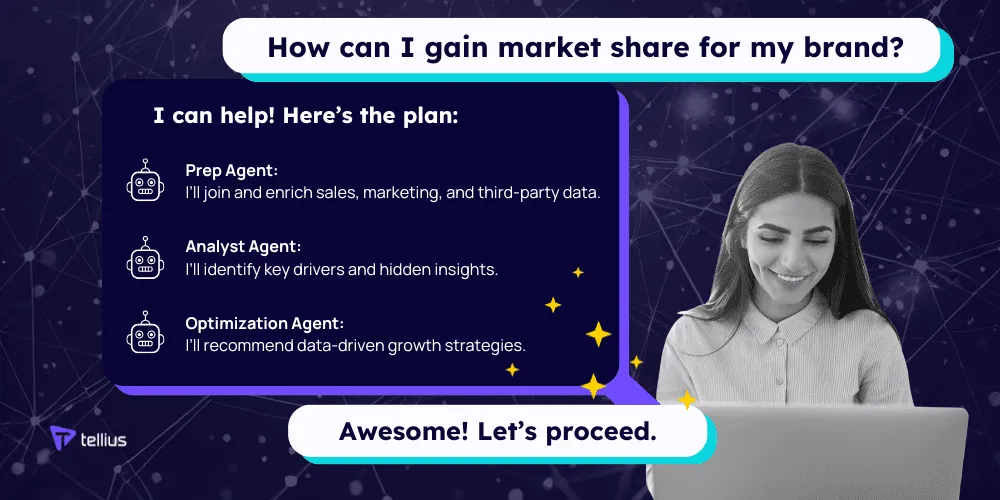
AI Agents: Transforming Data Analytics Through Agentic AI

AI agents aren’t just hype—they’re the engine behind the next generation of self-service analytics. This post breaks down how agentic AI enables multi-step, contextual analysis workflows that automate the grunt work of business intelligence. Learn what makes agentic systems different, what to look for in a true AI-native platform, and how Tellius is pioneering this transformation.
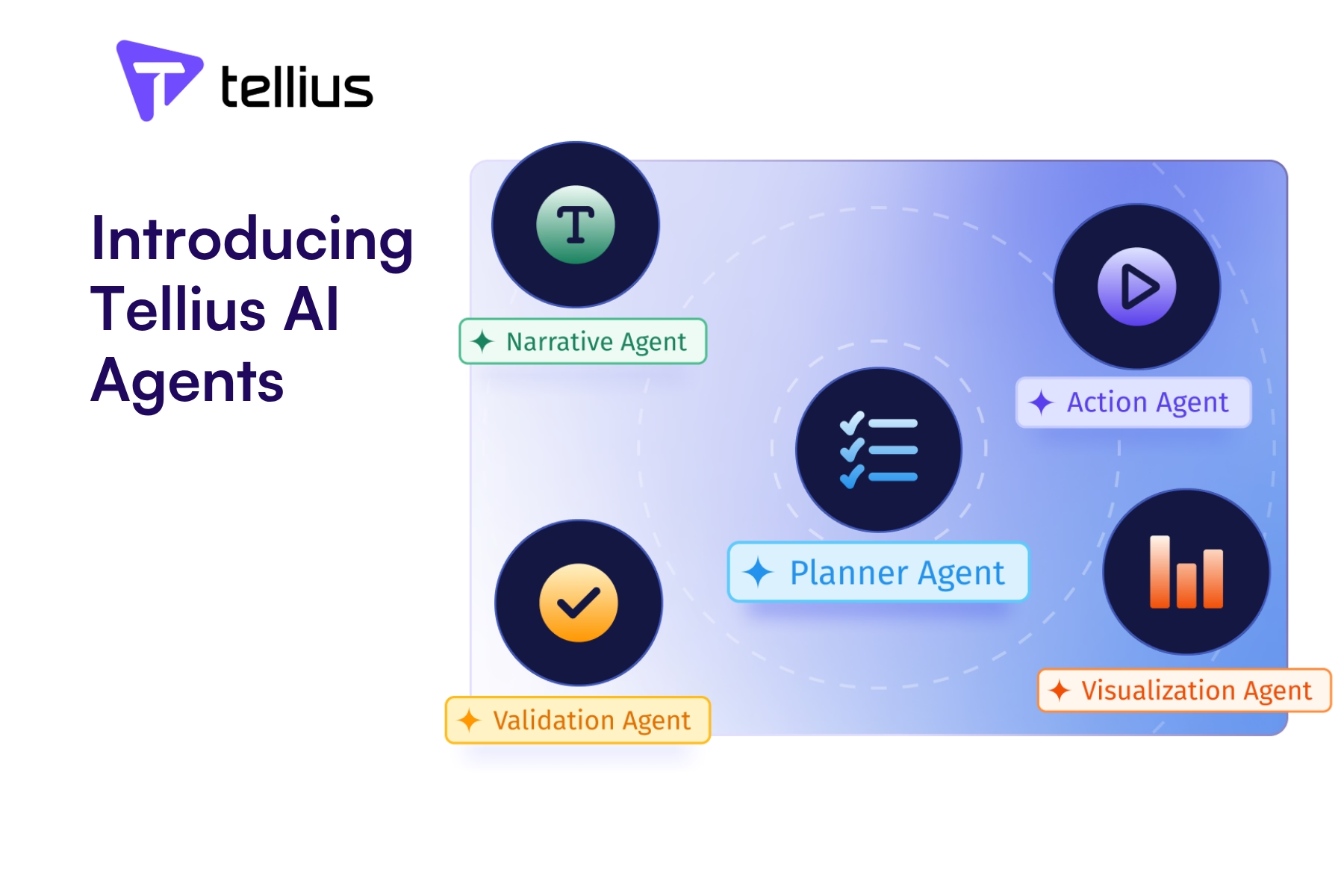
Introducing Tellius AI Agents
Tellius AI Agents and AgentComposer transform business analytics by automating complex multi-step analysis through specialized autonomous agents. Unlike generic chatbots or RPA tools, these agents leverage your enterprise data and business context to deliver deep insights across sales, marketing, finance, and manufacturing—turning questions into actions in minutes instead of days. With no-code agentic workflows, organizations can achieve 100X productivity gains and continuous, data-driven decision making.