

Unstructured Data Analytics for Pharma: Why Your Richest Intelligence Never Gets Used
.png)

What is unstructured data analytics in pharma?
Your MSL just finished a conversation with a key opinion leader at a major academic medical center. She captured detailed notes -- emerging clinical questions, concerns about a competitor's dosing regimen, an unmet need nobody's talking about yet. Gold.
Three months later, someone in brand strategy asks: "What are we hearing from KOLs about [competitor]?"
Silence. The insight exists -- technically. It's in a CRM text field somewhere. But it was never analyzed, never surfaced, never connected to anything. For all practical purposes, it doesn't exist.
This is the trapped knowledge problem -- and in pharma, it's costing you competitive intelligence every day.
Unstructured data analytics for pharma uses AI agents to read, classify, and extract intelligence from the documents and knowledge that commercial teams already produce: call notes, MSL interaction reports, payer meeting summaries, congress notes, and slide decks. Unlike traditional BI tools that only work with structured, tabular data, this approach processes natural language at scale, automatically identifying entities (products, competitors, HCPs, objections), clustering similar insights, and making your full knowledge base searchable in plain English. According to Gartner, 80% of enterprise data sits in documents, emails, and other non-tabular formats -- call transcripts, PDFs, presentations, support tickets. And cross-industry studies show that less than 1% of this organizational knowledge is analyzed or used at all. For pharma, this turns trapped field intelligence into queryable, actionable insights -- without manual tagging or data engineering.
Where Pharma's Field Intelligence Gets Trapped
How much pharma data sits in documents and non-tabular formats?
The scale of the problem is staggering. According to IDC's Global DataSphere research, global data creation reached 149 zettabytes in 2024 and is projected to exceed 180 zettabytes by 2025 -- growing at a compound annual rate of 23%. The vast majority sits in documents, emails, PDFs, and other formats that traditional analytics can't touch -- and Gartner notes this category is growing three times faster than structured data.
In pharma, this isn't abstract. It's playing out across your commercial organization every day.
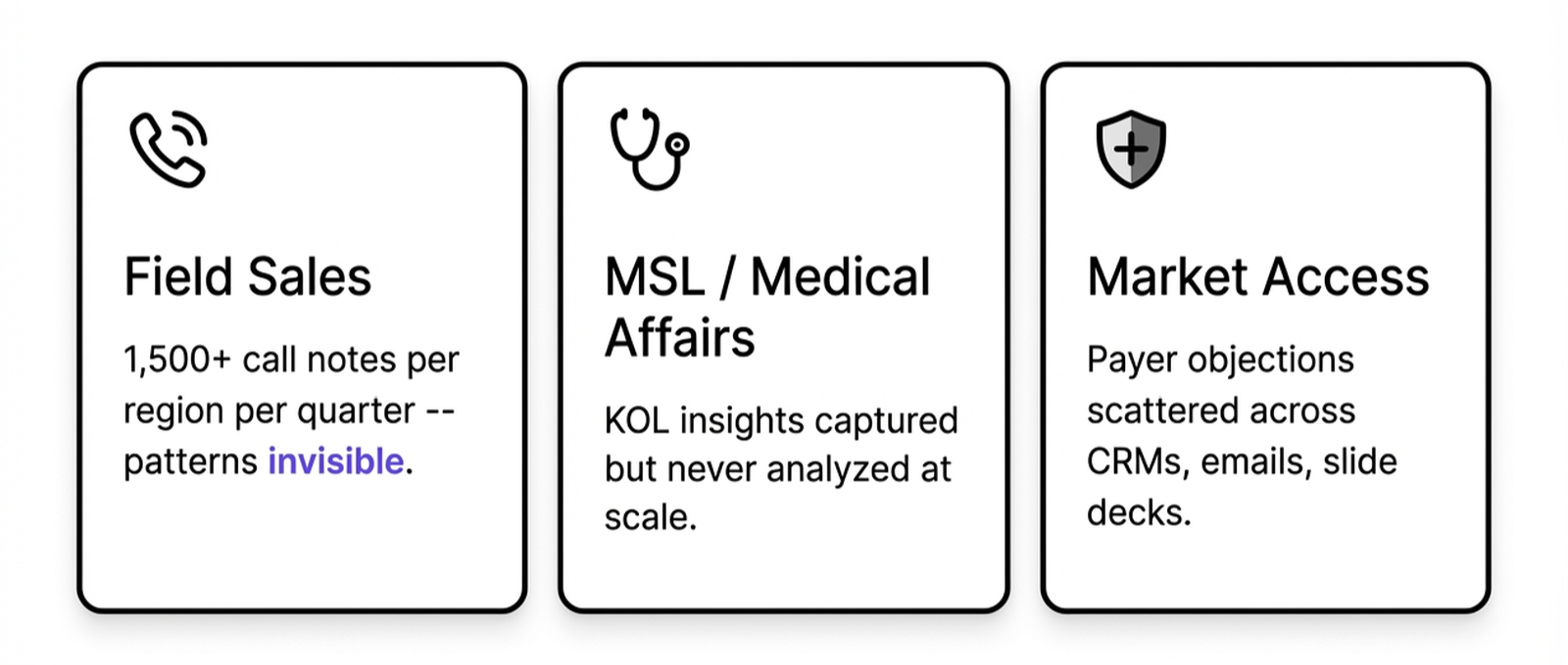
The Regional Sales Manager
It's the week before quarterly business reviews. You're a regional sales manager with 12 reps across the Northeast. Each rep logs 30-40 call notes per week. That's roughly 1,500 notes per quarter -- just in your region.
Somewhere in those notes are the patterns you need: which objections are gaining traction, where competitors are showing up more often, which accounts are going cold. But you don't have 20 hours to read through them. So you skim. You rely on what reps remember to tell you in one-on-ones. You build your QBR deck from gut feel and a few anecdotes.
The coaching problem is just as acute. You know your top performers handle access objections differently than your middle performers. But you can't see the pattern. The knowledge is there -- it's just not queryable.
The Medical Science Liaison
MSLs have some of the highest-signal conversations in pharma. Every KOL interaction surfaces something -- emerging clinical questions, shifts in treatment preferences, competitive intelligence, unmet needs that could shape pipeline priorities.
Most MSL teams submit interaction reports religiously. But here's the uncomfortable truth: a 2025 global survey of 1,023 medical affairs professionals found that 92% of organizations still primarily use activity-based metrics -- number of KOL engagements, territory coverage, interaction counts -- rather than measuring the quality or impact of the insights gathered. Two-thirds of respondents said accurately measuring MSL performance is "difficult" or "very difficult." The problem isn't that MSLs aren't generating insights. It's that those insights disappear into text fields and never get analyzed.
This isn't a minor gap. As the Accreditation Council for Medical Affairs noted in 2025, organizational barriers frequently prevent field insights from influencing strategic decisions -- even when field teams collect valuable information consistently. The most strategic intelligence your field medical team generates rarely makes it into brand planning, medical strategy, or competitive response.
The Market Access Director
Payers keep telling your team why they're hesitant. Affordability. Step therapy concerns. Prior authorization friction. Lack of real-world evidence. Every meeting, every call, every email thread contains signal about what's blocking formulary access or limiting tier placement.
But this signal doesn't roll up anywhere. It exists in CRM notes, in email threads, in slide decks from regional payer presentations. When leadership asks "what are we hearing from PBMs about our HEOR package?" the answer requires someone to manually dig through months of documentation -- if they even know where to look.
McKinsey research on medical affairs transformation indicates that only 20% of pharma companies have an integrated approach to evidence planning across value, clinical, and real-world studies. The knowledge exists to build better payer strategies -- it's just fragmented across systems nobody can search.
How AI Agents Analyze Pharma Documents and Knowledge
Why can't traditional BI tools analyze pharma call notes and documents?
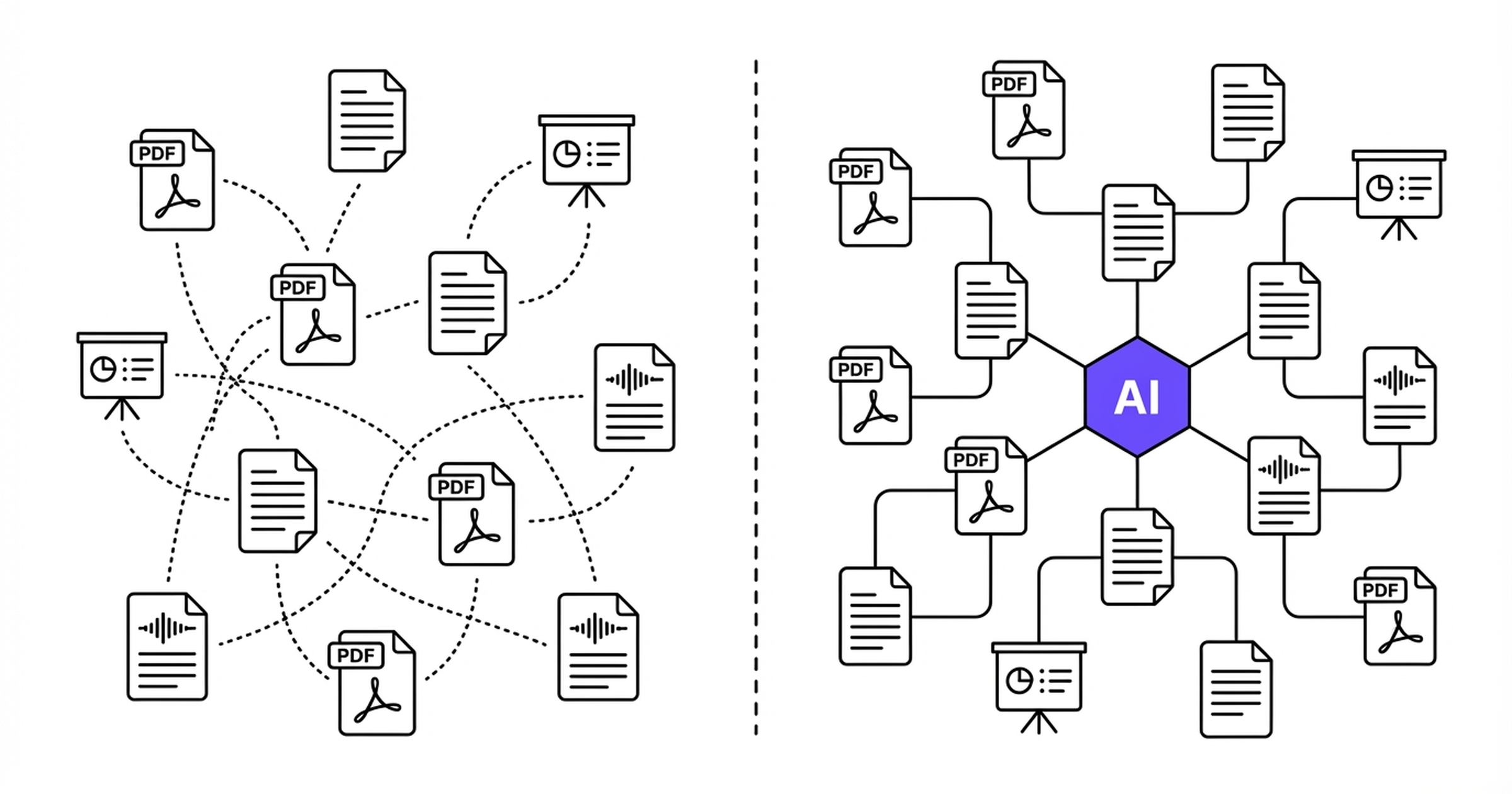
When Tellius 6.1 introduced support for documents and knowledge alongside structured analytics, it marked a fundamental shift: the same AI agents that analyze your sales data can now reason over your call notes, MSL reports, and payer meeting summaries.
Here's how it works.
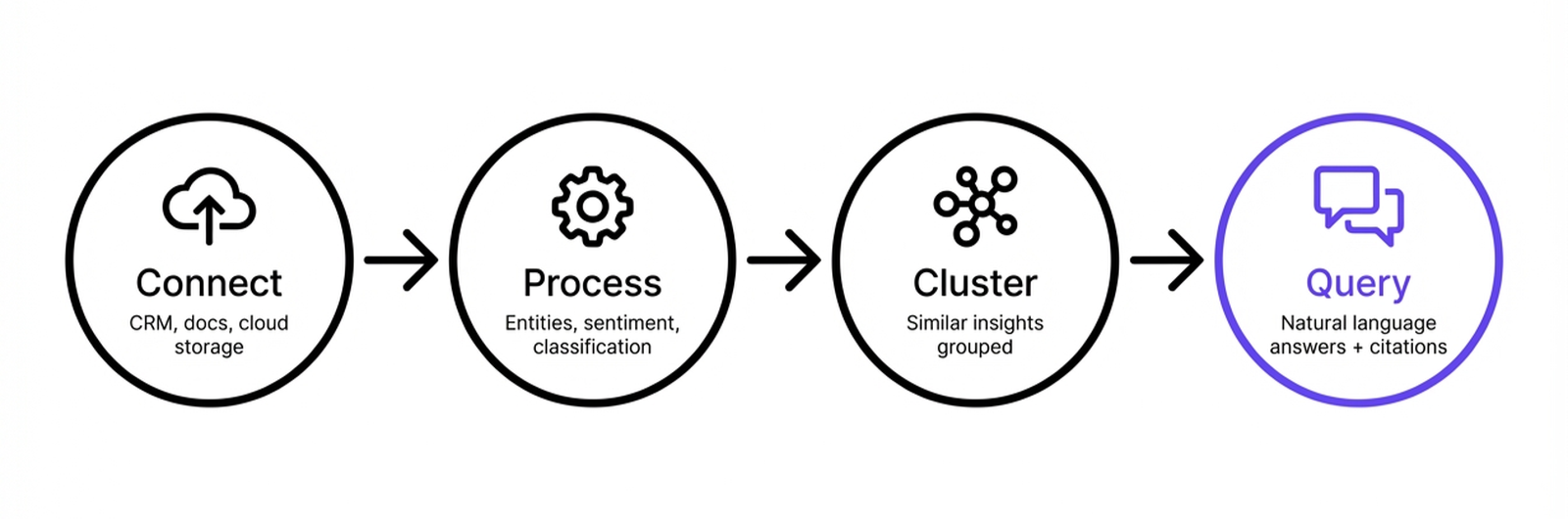
Step 1: Connect your data sources. Tellius connects to CRM platforms, document repositories, cloud storage (Google Drive, SharePoint, Box), and call recording platforms. No data migration required -- the system reads documents where they live.
Step 2: Process documents for entities and structure. AI agents extract key entities from each document: products mentioned, competitors discussed, HCPs referenced, objections raised, sentiment expressed. This transforms raw text into queryable knowledge without manual tagging.
Step 3: Cluster and synthesize. Agents group similar insights across documents, identifying patterns that no human reviewer could spot manually. When 47 different reps mention the same access objection using different language, the system recognizes it as one theme.
Step 4: Query in natural language. Ask questions the way you'd ask a colleague: "What objections are we hearing most about [Product X] access in the Northeast?" The system returns answers with citations, showing which documents support each finding.
This isn't keyword search. Agents comprehend that "patient affordability concerns" and "cost barrier to adherence" describe the same objection, even when different reps use different language. It's the same analytical rigor you expect from your structured data -- applied to your documents and knowledge base.
See how Kaiya processes pharma documents and knowledge →
Document Types Kaiya Ingests for Pharma
What types of pharma documents can AI agents analyze?
The power of knowledge analytics scales with the breadth of data connected. Here's what Tellius for Pharma typically ingests:
Field Sales
- CRM call notes and activity logs
- Coaching documentation and ride-along notes
- Regional business review presentations
- Account planning documents
Medical Affairs / MSL
- KOL interaction reports
- Congress notes and takeaways
- Advisory board meeting summaries
- Medical information request logs
- Publication and presentation tracking
Market Access
- Payer meeting notes and call summaries
- Value dossier supporting evidence
- HEOR study summaries and RWE extracts
- Regional formulary tracking notes
- Prior authorization workflow documentation
Cross-Functional
- Internal training materials and FAQs
- Competitive intelligence reports
- Call recordings and transcripts
- Email threads (with appropriate governance)
- Slide decks and presentations from cloud storage
Each document type brings different signal. Call notes reveal ground-level objections. MSL reports capture clinical nuance. Payer meeting summaries expose access barriers. When agents can reason across all of them simultaneously, patterns emerge that isolated analysis would never surface.
AI-Powered Knowledge Analytics in Action: Biotech Case Study
A $10B+ biotech with over 200 MSLs deployed Tellius to unify their fragmented knowledge base. They had the classic problem: MSLs submitting detailed interaction reports that disappeared into a CRM, never to influence brand strategy.
The deployment connected:
- 15,000+ MSL interaction reports (annual)
- Regional medical affairs meeting notes
- Competitive intelligence documents
- KOL relationship tracking data
Within 90 days, the results were tangible:
The most striking finding: agents identified a competitive objection pattern emerging across three regions -- six weeks before the insight surfaced in traditional market research. By the time competitors' quarterly reports came out, brand strategy had already developed response messaging.
.png)
Before and After: Knowledge Analytics for Pharma Teams
What is the difference between documents and enterprise knowledge?
The shift from "documents exist" to "knowledge is queryable" changes how pharma commercial teams operate.
Regional Sales Managers
- Before: Skimming call notes, relying on rep memory, building QBR decks from anecdotes and gut feel
- After: Querying "what access objections are trending in the Northeast this quarter" and getting ranked themes with citations from actual call notes
MSL Leaders
- Before: Quarterly manual review of interaction reports; insights rarely reaching brand teams
- After: Real-time pattern detection across all KOL conversations; automated synthesis feeding medical strategy
Market Access Directors
- Before: 2-3 week manual effort to compile payer feedback for evidence planning
- After: Same-day synthesis of "what are PBMs saying about our HEOR package" with citations from meeting notes
Brand Teams
- Before: Commissioning market research to learn what field teams already know
- After: Querying the knowledge base directly; getting faster answers than external research provides
Commercial Leadership
- Before: Limited visibility into ground-level intelligence
- After: Asking any question across the full corpus of field knowledge -- call notes, MSL reports, payer meeting summaries, competitive intelligence
As McKinsey notes in their research on pharma AI adoption, organizations that rely on siloed systems often struggle to move beyond isolated pilots. The companies seeing real results are those weaving AI into existing workflows -- not layering it on top.
Turn Trapped Pharma Knowledge into Actionable Intelligence
The patterns in your call notes, the insights from your KOL conversations, the objections your market access team hears from payers -- it all exists. It's just been inaccessible.
That's changing. When your AI agents can reason across every document, every metric, and every conversation -- while remembering your context -- the possibilities open up fast. Questions you never thought to ask. Connections you couldn't see before. Decisions grounded in the full picture.
Get release updates delivered straight to your inbox.
No spam—we hate it as much as you do!


MSL teams generate thousands of interaction reports annually, each containing high-value intelligence about KOL sentiment, clinical questions, competitive positioning, and unmet needs. Knowledge analytics processes these reports at scale -- automatically identifying emerging themes, clustering similar insights, and making the full corpus of KOL conversations queryable. Medical strategy teams can ask questions and get evidence-backed answers in seconds instead of waiting for quarterly manual reviews.
Keyword search finds exact word matches. AI agents comprehend document content -- understanding that "patient affordability concerns" and "cost barrier to adherence" describe the same objection, even when different reps use different language. Agents extract entities, classify sentiment, cluster similar insights across documents, and return answers with cited sources. The same analytical rigor you expect from your structured data, applied to your documents and knowledge.
Yes. Tellius connects to the data sources your teams already use -- CRM platforms, document repositories, cloud storage, call recording platforms, and more. No data migration required. The system reads call notes, meeting summaries, and reports where they live and makes them searchable through a unified query interface.
Deployment timelines vary by data volume and source complexity, but initial pilots -- connecting a single document type like MSL interaction reports -- can begin delivering queryable results within weeks. One customer with over 15,000 annual MSL reports identified an emerging competitive objection within 90 days of deployment.
ROI comes from three areas: speed (competitive intelligence surfaces weeks or months faster than traditional market research), coverage (patterns across thousands of documents that no human team could manually review), and strategic impact (field intelligence actually feeds into brand planning, medical strategy, and market access decisions). McKinsey research indicates biopharma companies applying advanced analytics realize EBITDA uplifts of 45-75%.
Tellius orchestrates a team of AI agents -- some reason over your structured metrics, others over your documents and knowledge base. Structured meets document-based within your secure enterprise data, so you can ask questions that span both worlds: "What objections came up most in deals we lost?" triggers agents that analyze call recordings, rank patterns, and cite sources. This isn't keyword search or basic RAG. It's the same analytical rigor applied to every document, every metric, and every conversation.
Tellius connects to your data where it lives -- no data leaves your environment. The platform is SOC 2 Type II certified with row-level security, full audit logging, and enterprise-grade access controls. Your documents, call notes, and knowledge base remain within your security perimeter.
.webp)
Best AI Platforms for Pharma Commercial Analytics in 2026: 11 Platforms Compared

This guide compares the 11 best AI platforms for pharma commercial analytics in 2026, evaluating how each supports brand performance, market access, patient analytics, field force effectiveness, incentive compensation, and omnichannel engagement. It highlights a key shift in the market: traditional BI and SFE tools focus on reporting what happened, while newer AI platforms differentiate by investigating why performance changed. The post breaks down core capabilities like root cause analysis, data integration, governance, and agentic workflows—helping pharma teams identify which platforms can deliver faster, more actionable insights across commercial operations.