

How Agentic Analytics Automates Executive Reporting

Introduction
Close weekends. The numbers are final. And now the real work begins: explaining them.
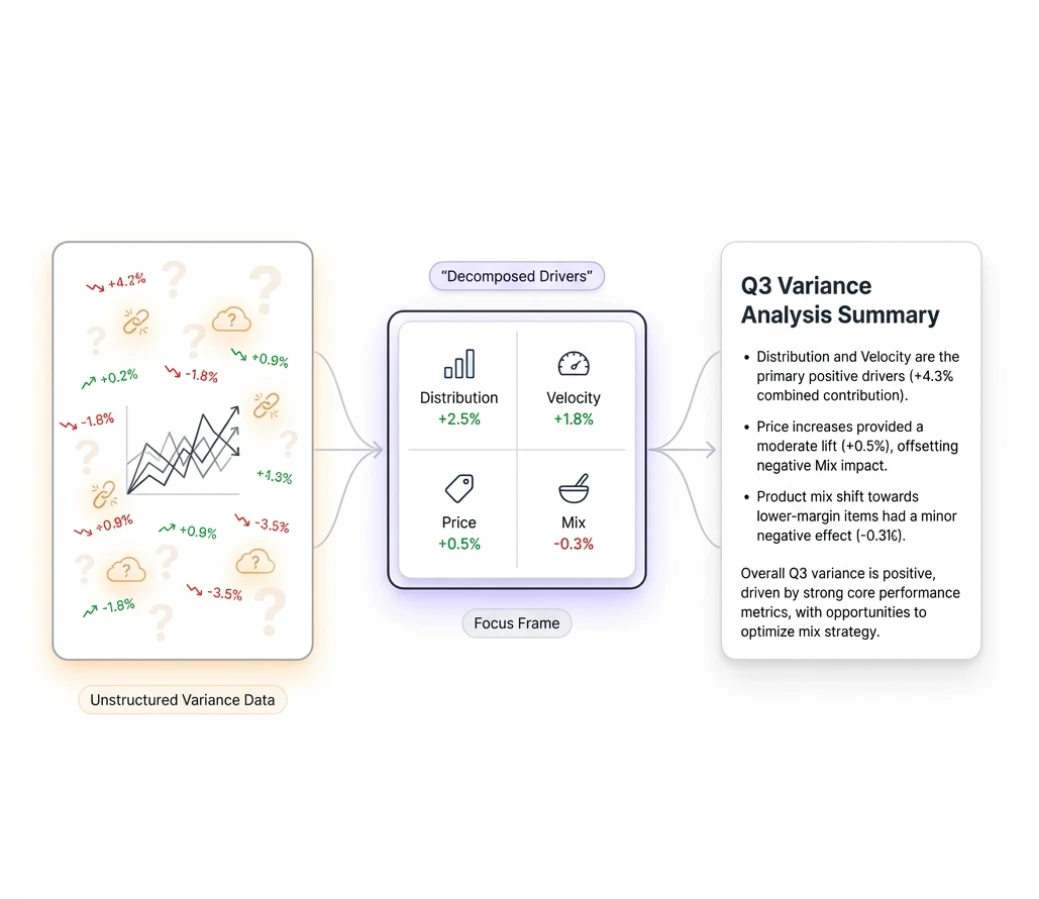
Your team just spent 3-5 days investigating why EBITDA was missed by 5%. They know it's 60% OpEx overrun and 40% revenue timing. The variance decomposition is solid. The drivers are ranked. The analysis is defensible.
Now someone has to write the board deck.
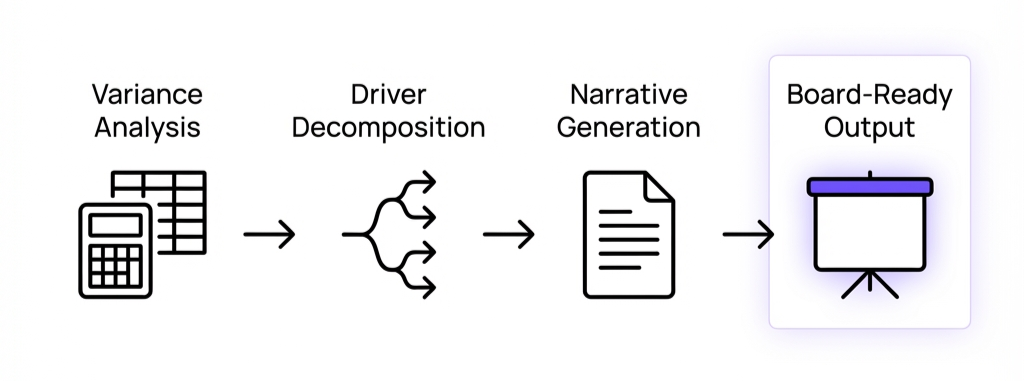
This is where 14-day close cycles come from. Week one is analysis. Week two is PowerPoint. The same people who investigated the variance now write sentences about the variance—converting numbers they already understand into prose for executives who weren't in the room. Commentary gets drafted, reviewed, revised, and approved. By the time the board deck ships, the next close cycle is starting.
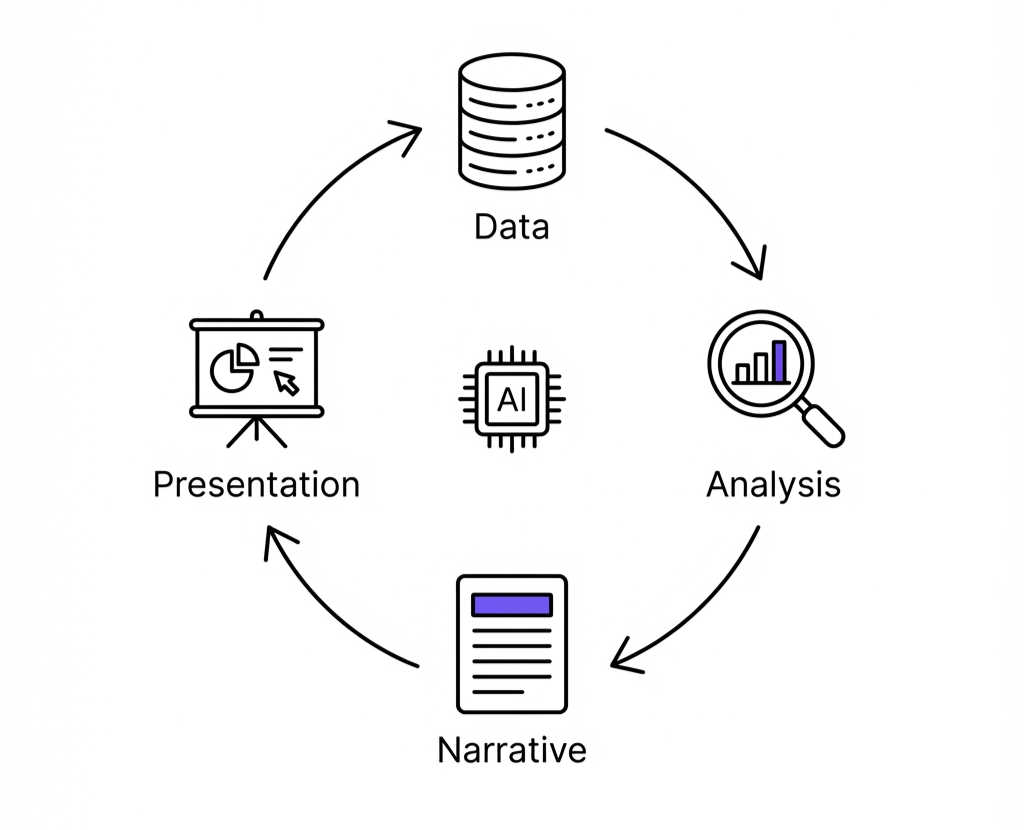
AI-powered narrative generation doesn't just make this faster. It eliminates the handoff between analysis and storytelling entirely—converting quantified variance drivers into executive commentary in seconds, not days. And agentic analytics takes it further: AI agents that monitor performance continuously, investigate root causes automatically, and generate explanations before anyone asks.
This piece breaks down what AI-powered CFO narratives actually deliver, where agentic analytics fits, and what finance leaders should still own.
What is AI-Powered Financial Narrative Generation?
AI-powered financial narrative generation uses natural language processing to convert variance analysis results into plain-English executive summaries automatically. Instead of manually writing board deck commentary, monthly business review narratives, and EBITDA explanations from scratch, AI generates first-draft management commentary from quantified variance drivers—explaining why performance changed, which factors contributed, and what context leadership needs. Unlike manual narrative writing where analysts spend days crafting PowerPoint commentary, AI-powered narrative generation converts driver decomposition into executive prose in seconds, applying consistent structure and ensuring the same variance produces the same narrative format across all business units.
Tellius is an AI-powered management reporting platform purpose-built for finance—combining conversational analytics for instant answers with agentic analytics for automated commentary generation that surfaces insights before you ask.
The Hidden Tax on Every Reporting Cycle
Finance teams know the pain. Quantifying it makes the case for change.
The duplication problem. Analysts investigate variances all week. Then leaders write slides explaining the same variances the following week. Two separate efforts, same underlying numbers. The analysis exists—it just hasn't been translated into prose yet. This handoff costs 3-5 days per cycle.
The consistency problem. Three business units report the same type of variance. Three different narrative styles emerge. One leader emphasizes revenue drivers, another focuses on cost containment, a third buries the headline in context. The CFO spends review cycles enforcing consistency that should have been built in.
The starting-from-scratch problem. Board narratives get written fresh every month—even when variance drivers haven't changed. Q1's EBITDA miss and Q2's EBITDA miss get explained with completely different sentence structures, different levels of attribution detail, different emphasis. There's no institutional memory, no template enforcement, no accumulated knowledge about what works.
The depth-versus-time tradeoff. Time pressure forces surface-level explanations. "Revenue declined 10%" ships to the board when "Revenue declined 10%: 60% from enterprise deal timing, 25% from SMB churn, 15% from pricing pressure in EMEA" would actually be useful. Comprehensive commentary takes time finance teams don't have.
The audit gap. CFOs answer "why over budget?" verbally because written summaries take 3+ hours to prepare. No documentation. No audit trail. No way to verify that last quarter's explanation of the same variance was consistent with this quarter's.
The aggregate cost: 10-14 days per close cycle, with 40-60% of that time spent on commentary that could be generated from analysis that already exists.
Where AI Delivers Real Value in Executive Reporting
AI-powered narrative generation changes four things that matter for finance teams.
Variance-to-Commentary Translation
When variance analysis identifies "EBITDA declined 5%, driven 60% by Sales & Marketing OpEx and 40% by revenue timing," AI converts this into executive prose:
"EBITDA of $12.5M came in 5% below plan, driven primarily by higher Sales & Marketing spending (60% contribution) from accelerated hiring to support new product launch, with additional impact from enterprise deal delays (40%). Full-year guidance maintained based on Q1 pipeline conversion expectations."
The translation is mechanical—quantified drivers become sentences with attribution. AI handles this instantly. CFOs add strategic context rather than writing from scratch.
Multi-Level Summary Generation
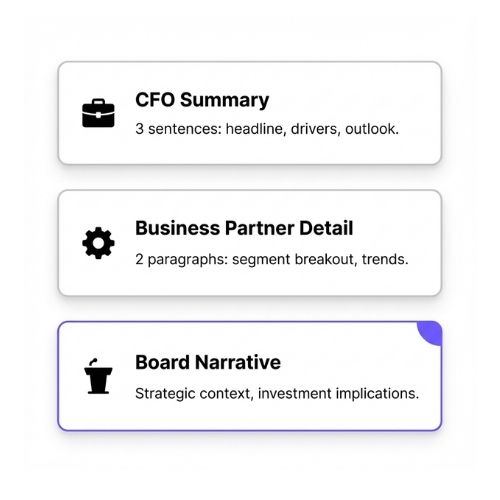
From one analysis, AI produces three versions:
Executive summary (CFO): 3 sentences. Headline variance, top two drivers, forward outlook.
Operational detail (business partners): 2 paragraphs. Cost center breakout, segment-level performance, trend context.
Strategic context (board): Outcome-focused, forward-looking, investment implications.
Each version emphasizes different aspects of the same underlying variance drivers. Not just longer or shorter—different framing for different audiences.
Template Enforcement
Once finance leaders define preferred structure—headline to drivers to context to outlook—AI applies it consistently. Every monthly close, every quarterly review, every ad-hoc request follows the same format.
Same variance data produces same narrative structure across all business units. The "three leaders, three different stories" problem disappears because structure is configured once and applied everywhere.
Source Traceability
Every sentence in AI-generated commentary links to underlying variance analysis. When the narrative says "Sales & Marketing contributed 60%," users can drill to the calculation. Every number is auditable. Every attribution is traceable.
This isn't just governance checkbox compliance—it's how CFOs verify that generated narratives accurately reflect the analysis before sending to the board.
Agentic Analytics: From Reporting to Continuous Intelligence
Narrative generation makes existing reporting faster. Agentic analytics changes when reporting happens.
Traditional management commentary is reactive. Close happens, analysis happens, someone asks for a summary, and commentary gets written. The trigger is always human: a meeting scheduled, a question asked, a deadline approaching.
Agentic analytics operates differently. AI agents monitor financial performance continuously—24/7, not just at close. When metrics cross thresholds, or when patterns emerge that warrant attention, agents investigate automatically and generate explanations before anyone asks.
How it works in practice:
An agent monitors EBITDA performance against the forecast. Mid-quarter, actual run rate trends 8% below plan. The agent doesn't wait for the close. It investigates—decomposing the variance across revenue, COGS, and OpEx drivers. It generates a narrative:
"EBITDA trending 8% below Q2 forecast as of Week 6. Primary drivers: Sales & Marketing OpEx running $1.2M above plan (65% of variance) due to accelerated contractor spend for product launch; Revenue timing contributing $600K shortfall (35%) from delayed enterprise renewals. If trends continue, full-quarter impact estimated at -$2.1M vs. forecast. Recommend reviewing contractor commitments and enterprise pipeline with RevOps."
This alert arrives mid-quarter—when intervention is still possible. Not at close, when the number is final. Not in a board meeting, when the question catches finance off guard.
.jpg)
The Shift from Reactive to Proactive
Traditional reporting answers questions after they're asked. Agentic analytics surfaces issues before they become questions.
Budget risks that used to appear in quarterly reviews now surface at week three. Variance explanations that used to require analyst investigation now generate automatically when thresholds are crossed. CFO narratives that used to take days of writing now exist continuously—updated as performance data arrives.
This isn't just faster. It's a different model entirely. Finance moves from "produce a report when asked" to "maintain continuous intelligence that's always ready."
What AI Doesn't Replace
AI-powered narrative generation automates the mechanical work of converting analysis to prose. It doesn't automate judgment.
Strategic messaging decisions remain human responsibilities. Should this variance be framed as a strategic investment or a cost overrun? Is this a temporary timing shift or a structural problem? What context does the board need that the numbers don't show? AI generates accurate narratives from data; CFOs decide what those narratives should emphasize.
Forward-looking guidance requires information AI doesn't have. Pipeline quality, market conditions, competitive dynamics, internal initiatives—the context that shapes "what we're doing about it" comes from business knowledge, not historical variance data.
Risk assessment needs executive judgment. A 5% EBITDA miss might be noise in one quarter and a crisis in another. The same variance requires different narrative treatment depending on strategic context, board expectations, and company trajectory. AI can't calibrate tone to relationship dynamics.
Decision recommendations synthesize analysis with strategy. "Cut contractor spend" versus "accelerate into the investment" versus "wait and monitor"—these recommendations require weighing factors that extend beyond the variance itself.
The practical split: AI handles "what happened and why" (mechanical, quantified, repeatable). CFOs handle "what it means and what we're doing about it" (strategic, contextual, judgment-based).
This shifts reporting prep from 14 days—10 days mechanical, 4 days strategic—to 4-5 days total: 1 day mechanical via AI, 3-4 days strategic refinement and decision-making.
Addressing Common Objections
"AI can't capture our CFO's voice and style."
Correct out of the box. That's what template configuration solves.
Before deployment, you collect examples of narratives your CFO considers excellent. You document preferred structure, terminology, and tone. "Investment" not "spending." "Timing shift" not "miss." "Headwind" not "problem." These preferences are configured into templates. AI applies them consistently.
After 2-3 cycles, AI-generated narratives require refinement rather than rewriting. Most teams see CFO edit rates drop below 20% once templates are properly tuned.
"Our variances are too complex for automated explanation."
Complex variances are exactly where AI adds value.
When a variance has 4-5 significant drivers across multiple dimensions, manual narrative writing either oversimplifies (focusing on the top 1-2 drivers) or becomes unwieldy (listing everything without clear attribution). AI handles complexity by ranking drivers, quantifying contribution, and structuring explanations that include all material factors without becoming unreadable.
The edge cases that trip up AI—one-time items, restatements, offsetting variances—can be configured. You define how the system handles unusual circumstances. It applies those rules consistently.
"We need audit trail for SOX compliance."
AI-generated narratives are more auditable than manual writing, not less.
Every sentence traces to underlying variance analysis. Every attribution percentage links to the calculation that produced it. When someone asks "where did 60% contribution come from?", you can drill to source data in one click. Manual narratives require reconstructing the logic from memory or notes.
The governance concern is real—and well-configured AI platforms address it better than manual processes do.
"Our team already writes good commentary."
The question isn't quality—it's capacity allocation.
If senior finance leaders are spending 30-40% of close week writing commentary instead of analyzing implications and developing recommendations, that's a capacity problem. The commentary might be excellent. The opportunity cost of producing it manually is still real.
AI doesn't make bad analysts good. It makes good analysts available for higher-value work.
What Implementation Looks Like
Realistic timeline: 8-12 weeks from kickoff to automated narrative generation.
Weeks 1-4: Data integration and variance automation.Connect priority data sources—ERP for actuals, planning tool for budget/forecast. Configure semantic layer for consistent definitions. Set up automated variance calculation. This phase enables AI to identify drivers and quantify contribution without manual analysis.
Weeks 5-8: Template configuration and parallel validation.Collect narrative examples from past 4-6 quarters. Document preferred structure, terminology, and tone. Configure narrative templates. Run parallel generation—AI produces drafts alongside manual writing for the same variances. Compare output quality. Refine templates based on CFO feedback.
Weeks 9-12: Agent deployment and workflow integration.Deploy monitoring agents on priority KPIs. Configure alert thresholds. Integrate generated narratives into existing board deck workflows. Train finance users on review and refinement processes.
What's required for success:
- Example narratives your CFO considers excellent (templates learn from these)
- Documented terminology preferences (words to use, words to avoid)
- Clear approval workflow (who reviews AI-generated drafts before distribution)
- Willingness to invest 2-3 cycles in template refinement
Initial value typically appears around week 6. Full value by week 12. Continuous improvement as templates are refined based on CFO feedback.
Evaluating AI-Powered Narrative Generation
Not all platforms are equivalent. Key differentiators for finance:
Variance-aware generation. The tool must understand that "EBITDA declined 5%" requires explaining which drivers contributed and by how much. Generic AI writing tools produce summaries; finance tools produce driver attribution with quantified contribution.
Multi-level decomposition. The tool should generate explanations at different depths—not just longer or shorter versions, but different emphasis and framing for different audiences.
Template enforcement. Preferred narrative structure should apply automatically across all reports without requiring prompts each time. Define it once, apply it everywhere.
Terminology consistency. "EBITDA," "variance," "P/V/M," and "margin bridge" should produce the same output structure regardless of how questions are phrased.
Source traceability. Every sentence should link to underlying analysis. Non-negotiable for governance and audit.
Integration with variance analysis. Narrative generation that requires manual analysis input is faster than pure manual writing but slower than integrated platforms where variance calculation and commentary generation happen in one workflow.
When AI-Powered Narrative Generation Makes Sense
Strong fit:
- Close-to-board cycle currently takes 10+ days
- Commentary writing consumes 3-5 days per cycle
- Multiple business units produce inconsistent narrative styles
- CFOs spend review time enforcing structure rather than adding insight
- Same variance drivers get explained differently across quarters
Weak fit:
- Small finance team with simple reporting requirements
- Close-to-board cycle already under 5 days
- CFO prefers to write all commentary personally
- Data infrastructure too immature for automated variance analysis
Questions to ask during evaluation:
- Can we test with our actual variance data during proof-of-concept?
- How does the platform handle multi-driver variances with offsetting factors?
- Can we configure terminology and tone to match our CFO's preferences?
- What's the audit trail for each generated sentence?
- Does narrative generation integrate with variance analysis, or are they separate workflows?
- How do we measure quality improvement over time?
Get release updates delivered straight to your inbox.
No spam—we hate it as much as you do!


AI transforms financial reporting by automating the mechanical work between variance analysis and executive communication—specifically narrative generation, driver explanation, and multi-audience report assembly. When variance analysis identifies drivers, AI converts quantified attribution into executive prose: "EBITDA declined 5% primarily due to higher Sales & Marketing spending (60% contribution) from accelerated hiring." AI handles "what happened and why" while CFOs add strategic interpretation and forward-looking guidance.
Yes. AI-powered natural language generation converts variance analysis into executive summaries automatically. The workflow: variance analysis identifies drivers and quantifies contribution, narrative templates apply preferred structure, language generation converts drivers into sentences, output is executive summary ready for CFO review. Example output: "Q4 EBITDA of $12.5M came in 5% below plan, driven primarily by higher Sales & Marketing spend (60% of variance) and revenue shortfall (36%). Favorable COGS performance ($500K) partially offset these headwinds."
Agentic analytics deploys AI agents that work autonomously—monitoring KPIs 24/7, detecting anomalies, investigating root causes, and generating narrative explanations before anyone asks. Unlike traditional reporting that responds to questions, agentic analytics surfaces issues proactively. For executive reporting, this means receiving variance explanations mid-quarter when intervention is still possible, rather than at close when numbers are final.
Manual writing requires investigating variances, structuring explanations, and crafting prose from scratch every cycle—taking 3-5 days and producing inconsistent results across analysts. AI-powered generation automates the mechanical work: variance drivers become sentences automatically, structure follows consistent templates, every statement traces to source data. CFOs review and refine rather than write from scratch. The practical split: AI handles what happened and why; CFOs handle what it means and what to do about it.
Quality requires template configuration upfront and review processes ongoing. Before deployment, document tone preferences, vocabulary standards, and structural requirements using examples from past quarters. Configure attribution precision (percentages, not vague "primarily driven by"). Implement CFO review checkpoints—the workflow should be "AI generates, CFO refines" not "AI generates final." Track edit rates over time; target below 20% after 3-4 cycles.
Collect narrative examples from the past 4-6 quarters—board decks, monthly commentary, CFO presentations. Document preferred structure (headline → drivers → context → outlook). Create terminology glossary defining how your company refers to key concepts. Specify tone guidelines (phrases to use, phrases to avoid). Define audience parameters for board vs. management vs. operations. This preparation takes 1-2 weeks but saves 4-6 weeks during implementation.
Automation integrates post-close. GL close and consolidation follow normal procedures unchanged. Once close completes, AI connects to actuals and budget data, calculates variances, identifies drivers, and generates narratives—replacing 3-5 days of manual work with hours. CFO review adapts from "review and direct rewrites" to "review and refine directly." Board deck assembly uses AI-generated narratives as inputs to existing templates. Net effect: compressing total cycle from 14 days to 4-5 days.
Five capabilities distinguish finance-specific tools from generic AI writing: variance-aware generation (understands driver attribution, not just summarization), multi-level decomposition (different framing for different audiences, not just length adjustment), template enforcement (consistent structure without prompts each time), terminology consistency (same output regardless of question phrasing), and source traceability (every sentence links to underlying calculation).
Generic AI assistants can generate commentary if you provide analysis and structure manually. They lack governance (no consistent definitions), don't integrate with source systems (you copy-paste data in), require prompting for every report, and can't trace statements to calculations. Purpose-built finance platforms like Tellius provide automated variance analysis feeding directly into narrative generation, template enforcement for consistency, governed definitions, and full audit trail—an integrated workflow rather than a manual process with AI assistance.
AI adds value through speed (seconds vs. days), consistency (same variance = same structure), comprehensiveness (all drivers included with attribution), and traceability (auditable source linkage). Humans should own strategic judgment on messaging emphasis, forward-looking guidance based on market intelligence, risk assessment requiring executive judgment, and decision recommendations that synthesize analysis with strategy. The goal isn't replacing finance leadership—it's freeing them from mechanical writing for strategic work.